
Business priorities can change in weeks, but many companies still manage goals through quarterly planning cycles. That gap between changing strategy and active execution, what we call OKR Lag, makes it harder for teams to stay aligned.
Generative AI is emerging as one of the biggest changes in goal management since Peter Drucker introduced Management by Objectives in 1954 and Andy Grove later popularized OKRs at Intel in the 1970s.
This guide covers what AI OKR software does, how generative AI is being applied across the goal-setting lifecycle, and what organizations should look for when evaluating platforms built on this capability.
| TL;DR – 30 Seconds Quick Summary AI OKR software transforms the entire goal management process by generating, aligning, monitoring, and adapting OKRs with minimal manual effort. Traditional goal-setting methods can’t keep pace with changing business priorities, creating a gap between strategy and execution that AI helps close. The benefits of AI-powered OKRs include faster planning, stronger alignment, higher accountability, earlier risk detection, and greater organizational agility. The key features to evaluate when choosing AI OKR software include context-aware goal generation, strategy alignment, predictive risk detection, seamless integrations, and scalability. |
| Table of Contents 1. What is AI OKR software 2. How AI goal setting is transforming objectives and key results 3. Why traditional strategic goal setting has become a business liability 4. Key benefits of AI OKR software for intelligent goal management 5. How to choose the right AI OKR software for your organization 6. Final takeaway 7. Frequently asked questions |
What is AI OKR software
AI OKR software is a goal-management platform that uses artificial intelligence to help organizations create, align, track, and adjust objectives and key results (OKRs). Traditional OKR tools relied on structured spreadsheets or manual tracking systems. Managers wrote goals, manually checked progress, and relied on quarterly reviews to catch misalignment.
AI OKR software replaces those manual steps with an intelligent layer: goal generation from text prompts, automatic alignment mapping, real-time progress analysis, and predictive nudges when a team is at risk of missing a key result.
The AI OKR execution cycle
Unlike traditional OKR tools that focus primarily on documenting goals, AI OKR software supports the entire execution cycle. AI OKR software supports goal management through five stages:
- Generate: Create structured OKRs from natural language prompts.
- Align: Connect goals across teams and business priorities.
- Monitor: Track progress continuously using work data from integrated systems.
- Adapt: Recommend updates when business priorities or execution risks change.
- Learn: Detect execution patterns and insights that improve future planning.
This continuous cycle helps organizations reduce OKR Lag, keeping goals aligned with changing business priorities throughout execution rather than only during quarterly planning.
Suggested Reading: An Ultimate Guide to OKR Tracking
How AI goal setting is transforming objectives and key results
Generative AI makes the OKR process faster and more responsive. It helps teams create better goals, keep them aligned with business priorities, and spot problems early through continuous monitoring instead of periodic reviews.
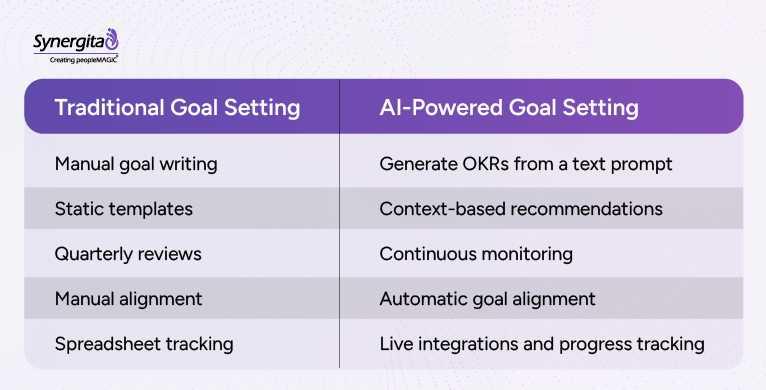
1. AI-generated OKRs
AI goal setting tools remove the biggest barrier to OKR adoption: writing high-quality goals from scratch. Managers can generate structured, measurable OKRs using a simple text prompt without templates or dedicated OKR coaching.
Entering “improve onboarding for enterprise accounts” instantly produces a complete objective with clearly defined key results, including start values, target values, and units of measurement. This improves consistency, reduces effort, and accelerates planning cycles.
Suggested Reading: 7 Best Goal-Setting Tools for Teams in 2026
2. Context-aware OKR templates
Context-aware AI recommendations produce goals calibrated to each team’s actual situation, not just structurally correct OKRs. Generative AI uses organizational context, including team responsibilities, existing OKRs, historical performance, and business priorities, to generate recommendations that fit each team’s role.
For example, a sales team at 120% of quota receives different OKR recommendations than one at 70%, a distinction no standard template can capture.
3. Strategy alignment
Misaligned goals are a primary reason OKR programs fail at execution. AI catches misalignment during goal creation by mapping each new objective to the broader organizational hierarchy, identifying overlaps and gaps where no team owns a critical company-level priority.
Once goals are active, generative AI continuously checks whether OKRs remain aligned with changing business priorities, flagging objectives that drift from the company’s strategy.
Suggested Reading: How to Overcome Misalignment of OKR Goals
4. Proactive goal monitoring
Modern AI OKR platforms integrate with tools such as Jira, Slack, Microsoft Teams, and HR systems to continuously track progress against key results. Instead of waiting for scheduled reviews, leaders receive early warnings when a key result begins to fall behind, giving them time to intervene before delivery is affected.
5. Automated goal management
AI automates routine OKR administration, including goal drafting, progress tracking, check-in reminders, and status updates. According to Asana’s 2023 Anatomy of Work Index, knowledge workers spend 60% of their time on “work about work,” including meetings, status updates, and coordination, rather than skilled work. Automating routine OKR administration reduces this administrative overhead, giving managers more time for coaching and strategic decision-making.
Instead of spending time on repetitive coordination tasks, managers can focus on coaching, removing roadblocks, and helping teams achieve their goals. This keeps OKR programs running consistently while reducing the effort required to maintain them.
6. AI-Powered OKR insights
AI OKR platforms help companies identify which teams consistently achieve their key results, which objectives are falling behind, and where teams are focusing their efforts. These insights help leaders identify execution patterns, compare team performance, and make better planning decisions.
For example, companies using AI in HR management can use these insights to improve workforce planning, strengthen performance management, and make more informed organizational decisions.
Why traditional strategic goal setting has become a business liability
The issue is not with the OKR framework itself. The challenge is that many organizations still manage goals using manual processes that cannot keep up with changing business priorities. As teams grow and business conditions evolve, traditional goal-setting methods often struggle to maintain alignment, visibility, and agility.
According to PMI’s latest global research, only half of projects successfully deliver their intended business value. This shows that many organizations face an execution gap between strategic planning and measurable outcomes. This gap widens when goals remain static but business priorities change.
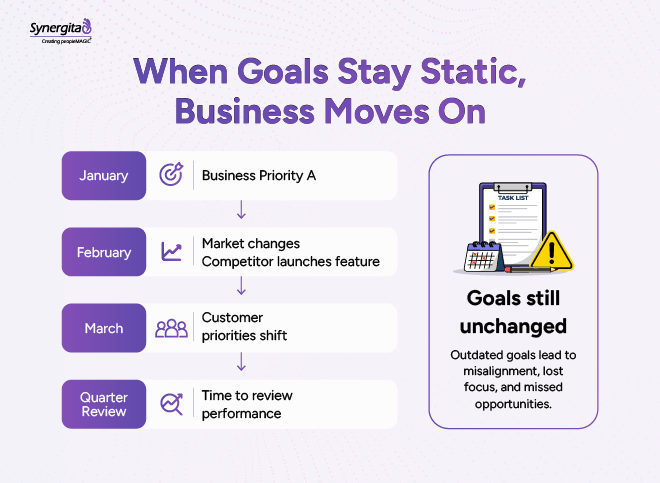
Business priorities change faster
Business priorities can change before the next planning cycle. Market conditions, competitive pressures, and internal priorities can change without waiting for quarterly or annual OKR reviews. When goals are not updated to reflect those changes, teams keep working toward outdated objectives, creating a growing gap between strategy and execution.
Low engagement and disconnected goals
Disconnected goals impact execution quality. When employees cannot see how their work contributes to business priorities, teams lose alignment and decision-making becomes fragmented. AI OKR software maintains that connection by linking individual and team goals to organizational strategy.
Research from Quantum Workplace shows that employees are 3.2 times more likely to be engaged when their performance goals are aligned with the organization’s goals, making goal alignment a direct engagement lever, not just a planning exercise.
When goals become disconnected from business realities, motivation and accountability decline together.
Misalignment slows execution
Without a connected goal hierarchy, teams can optimize for local success while working against broader business objectives. Individual departments hit their targets but the company misses its strategic priorities. This failure remains invisible until a quarterly review reveals the damage.
Key benefits of AI OKR software for intelligent goal management
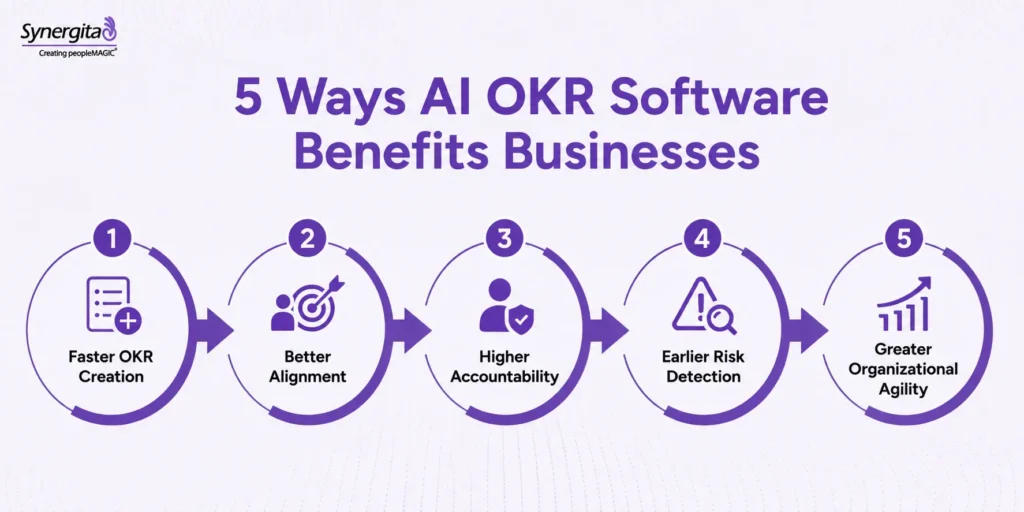
AI OKR software helps companies plan faster, align teams more effectively, identify execution risks earlier, and adapt goals as business priorities change. These outcomes improve strategic execution and reduce the administrative effort required to manage OKRs.
1. Faster OKR creation
Creating and refining OKRs often involves multiple review cycles and manual revisions. AI shortens that process by generating structured goals and simplifying updates, allowing teams to spend less time planning and more time executing. This helps organizations:
- Launch planning cycles more quickly
- Reduce administrative effort
- Adapt goals without restarting the planning process
2. Better alignment
Strategic execution improves when every team understands how its goals contribute to broader business priorities. This ensures AI business strategy is reflected in everyday execution, not treated as a standalone technology initiative. AI-powered OKR management software also helps companies reduce conflicting priorities by making alignment visible across the organization.
3. Higher accountability
Clear ownership improves execution. When every objective has a defined owner and progress is visible throughout the organization, teams take faster action, managers spend less time chasing updates, and performance discussions become more objective.
Organizations benefit through:
- Stronger ownership of business goals
- Better cross-functional transparency
- More informed performance conversations
4. Earlier risk detection
Small execution issues become major problems when they remain hidden until the end of the review cycle. AI OKR software helps organizations identify risks early enough to take corrective action before they affect business outcomes.
It allows managers to:
- Reallocate resources to high-priority goals
- Resolve blockers before they delay execution
- Adjust timelines based on current progress
- Update goals as business priorities change
5. Greater organizational agility
Organizations that can quickly adjust priorities are better positioned to respond to changing customer needs, market conditions, and business opportunities. AI OKR software makes goal updates part of everyday execution instead of waiting for the next planning cycle, helping teams stay focused on the work that delivers the greatest business impact.
How to choose the right AI OKR software for your organization
Not all AI OKR tools are built with the same depth or intent. The checklist below covers what actually differentiates platforms that deliver performance outcomes from those that simply add a “generate with AI” button to a static goal tracker.
Essential features to look for
- ☐ Structured OKR creation with correct objective/key result hierarchy, not just goal templates.
- ☐ Visual alignment hierarchy showing how individual OKRs map to company-level objectives in real time.
- ☐ Progress tracking connected to actual work tools (Jira, Slack, Teams), not just self-reported updates.
- ☐ Automated check-in nudges that drive adoption without creating manager overhead.
- ☐ Reporting and analytics that surface OKR completion rates, alignment scores, and at-risk goals.
AI capabilities
Generic AI features may look impressive in demos, but they offer little value in day-to-day goal management. So, you should look specifically for:
- Context-aware OKR generation: AI that uses role, team function, and organizational priorities to produce relevant goals, not just structurally correct ones.
- Predictive progress analysis: AI that flags risks before a goal is missed, not afterward.
- Alignment intelligence: AI that evaluates whether a team’s OKRs genuinely serve the company strategy, not just whether they are formatted correctly.
- Natural language input: The ability to describe a goal in plain text and receive a complete, measurable OKR from it.
Scalability and integration considerations
An OKR platform that works for a 50-person team needs to continue working for a 500-person team. Key questions to ask:
- Does the system maintain performance and visibility as the organization grows across departments, geographies, and business units?
- Does it integrate with the HRMS, project management, and communication tools your teams already use, so OKR data flows automatically rather than manually?
- Does the pricing model reward adoption without penalizing growth?
Questions to ask before investing
- ☐ Does the AI generate OKRs from context, or does it just auto-complete templates?
- ☐ Can the platform support both strict cascading and flexible alignment for individual contributors?
- ☐ How does the system alert managers when a goal is at risk, and how specific are those alerts?
- ☐ Is AI included in all plans, or is it a premium add-on that limits adoption?
- ☐ How quickly can the platform be deployed and adopted; days or months?
Learn more about OKR Pilot | View Synergita OKR Pricing
Final takeaway
AI is changing how organizations create, manage, and adapt their goals. Instead of relying on manual planning cycles and periodic reviews, teams can generate structured OKRs, keep them aligned with changing priorities, and monitor progress continuously.
As you evaluate AI OKR software, look for a platform that provides intelligent goal creation, continuous goal alignment, and real-time progress tracking into a single solution. Synergita OKR offers this with OKR Pilot for AI-driven goal creation, the Hierarchy Tree View for visual goal alignment, and integrations with Jira, Slack, Microsoft Teams, and HRIS tools that automatically keep OKRs up to date.
Start free with Synergita OKR today
Frequently Asked Questions
For most teams, yes, at the goal creation and structure level. AI generates well-formed, measurable OKRs without an internal OKR expert. However, human facilitators still play an important role in defining strategic priorities, aligning stakeholders, and improving organizational adoption.
AI OKR platforms monitor alignment between current OKRs and updated company priorities. When a strategic shift occurs, the system identifies which team OKRs are now misaligned and shows targeted adjustment recommendations. This allows teams to update goals within days rather than waiting for the next planning cycle.
Cascading OKRs use a strict top-down model: a company-level key result becomes a locked objective at the next level, ensuring complete strategic control. Aligned OKRs allow employees or teams to self-link their goals to higher-level objectives with more flexibility.
AI-generated OKRs provide structurally sound, measurable goals as a starting point. Most platforms allow users to edit, refine, and customize before finalizing. The quality is consistently higher than the average manually written OKR, but human judgment is important for calibrating ambition and strategic relevance.
Integrations sync task or project status in connected tools directly to key result progress in the OKR platform. When a Jira sprint closes or a Slack update is logged, the corresponding key result updates automatically, eliminating manual progress entry and making tracking continuous rather than periodic.
Adoption simplicity and cost structure. An AI OKR tool that requires a six-week implementation or reserves AI features for enterprise tiers will not drive adoption in lean teams. Prioritize platforms where AI is included at every tier, onboarding is measured in days, and the interface requires no prior OKR expertise.
Standard dashboards show where a goal stands today. Predictive analytics project where a goal will be met based on current progress velocity and identify which key results are at risk with enough lead time to intervene. This shifts performance management from reactive reporting to proactive decision support.