
Gallup’s State of the Global Workplace report records only 23% of employees strongly agree they know what’s expected of them at work. When goals are not clear, teams can’t prioritize work, measure progress, and stay aligned with business objectives.
The right goal setting software helps orgnizations create clear objectives, track progress, and improve visibility across teams. It gives employees a better understanding of how their work contributes to the company’s goals.
In this guide, we cover the 7 best goal setting software options for teams in 2026, with honest comparisons on pros, cons, pricing, and the types of organizations each platform is best suited for.
TL;DR – 30 Seconds Summary
- Selecting the right goal setting software is critical for keeping teams aligned, tracking progress, and improving accountability.
- The leading options in 2026 include Synergita, Lattice, Betterworks, WorkBoard, Weekdone, Leapsome, and 15Five, each suited to different team sizes and business needs.
- When evaluating goal setting software, look for platforms that offer OKR tracking, continuous feedback, real-time visibility, and integrations with your existing tools.
- Synergita offers AI-powered goal management, performance reviews, and transparent pricing, with plans starting at $3/user/month.
| Table of Contents 1. Top 7 Goal-Setting Software for Teams in 2026 2. How to Choose the Right Goal Tracking Software for Business 3. Final Takeaway 4. Frequently Asked Questions |
Top 7 Goal-Setting Software for Teams in 2026
According to MIT Sloan Management Review, companies with well-defined goal alignment practices see significantly higher employee engagement and performance outcomes. That’s why selecting the right tool is essential. Here’s a quick overview before we explore the features, pros, cons, and pricing of each tool:
| SL no | Software | Best For | Starting Price |
| 1 | Synergita | Affordable AI-powered goal tracking | $3/user/mo |
| 2 | Lattice | HR-driven teams needing OKRs + performance | $11/user/mo |
| 3 | Betterworks | Large enterprises (500+ employees) | Custom |
| 4 | WorkBoard | Strategy execution at enterprise scale | Custom |
| 5 | Weekdone | Small teams using OKR methodology | $10.80/user/mo |
| 6 | Leapsome | Tech companies and scale-ups | $3–$7/module/mo |
| 7 | 15Five | Mid-market teams focused on engagement | $4/user/mo |
1. Synergita
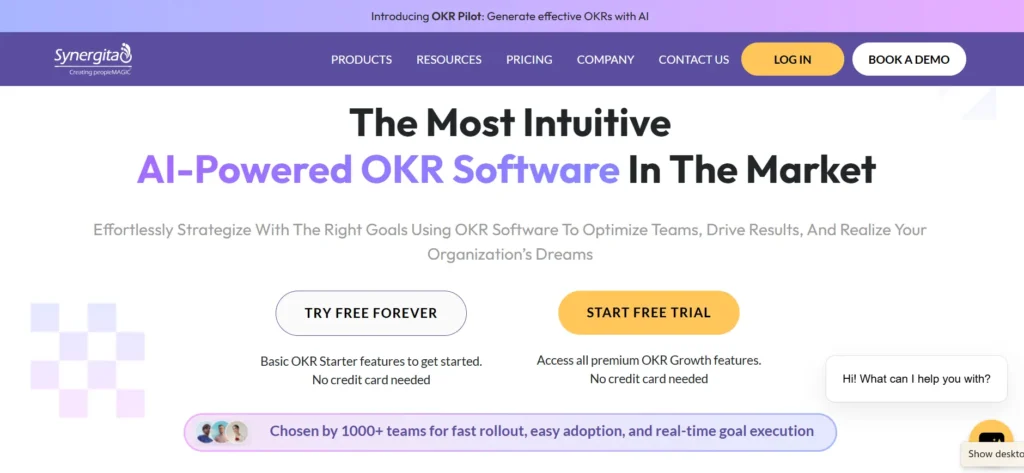
Synergita is one of the best goal-setting software platforms for organizations that want structured goal management, OKR alignment, and real-time visibility into progress. Its AI-powered goal creation, continuous feedback capabilities, and goal alignment features help teams stay aligned and accountable.
The tool also offers transparent per-user pricing, making it an ideal choice for startups and growing businesses.
Pros:
- Reduces the time spent on creating and managing OKRs through AI-assisted goal setting and automated workflows.
- Gives managers real-time visibility into progress, helping teams stay accountable and address risks before deadlines slip.
- Encourages consistent goal tracking by integrating with the tools employees already use every day.
- Supports enterprise security and compliance requirements, making it suitable for organizations with strict governance standards.
Cons:
- The mobile app experience could be more polished
- Report generation can slow down a bit when pulling very large datasets
Pricing
Synergita offers three pricing plans and a 14-day free trial with no hidden fees. Bulk discounts are available on request.
- OKR Starter: Free Forever (Up to 3 users)
- OKR Lite: $3/user/month (billed annually)
- OKR Growth: $6/user/month (billed annually)
- Custom pricing for enterprises
Best for: US teams looking for a cost-effective goal-setting platform with quick deployment.
2. Lattice
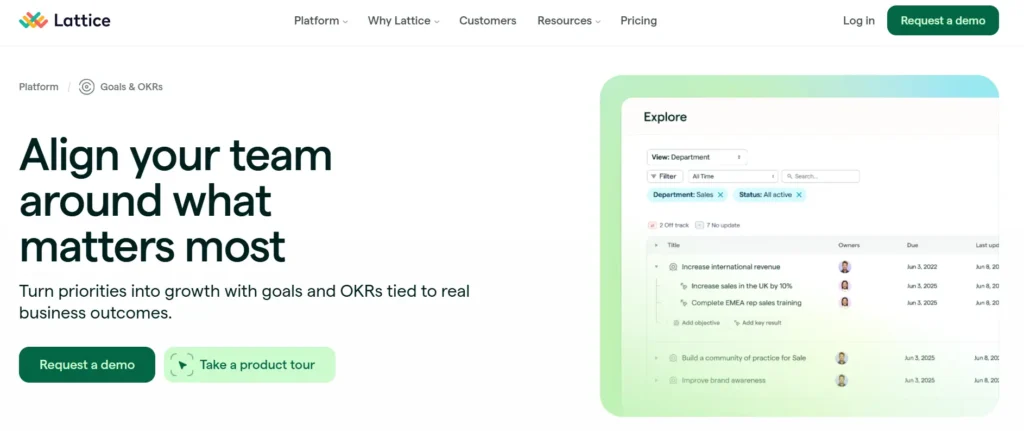
Lattice is employee goal-management software used by HR-driven organizations that want structured OKRs, employee performance and career development in a single platform. It’s built for teams that already have dedicated HR operations and want a more formal performance infrastructure.
Pros:
- Goal and OKR workflows are connected directly to performance reviews
- Slack and Teams integrations make recognition and check-ins part of daily work
- Strong career growth pathways and development planning tools
Cons:
- Managing complex OKR structures can become difficult for larger teams
- Reporting and analytics may feel limited for advanced HR analysis needs
- Initial setup and configuration can take additional time without dedicated HR support
Pricing:
- Talent Management and Foundations plans start at $11/seat/month
- Performance or Goals & OKRs available individually at $8/seat/month
- Engagement, Grow, and Compensation are available as add-ons at $4–$6/seat/month
- No free trial; demo available on request
3. Betterworks
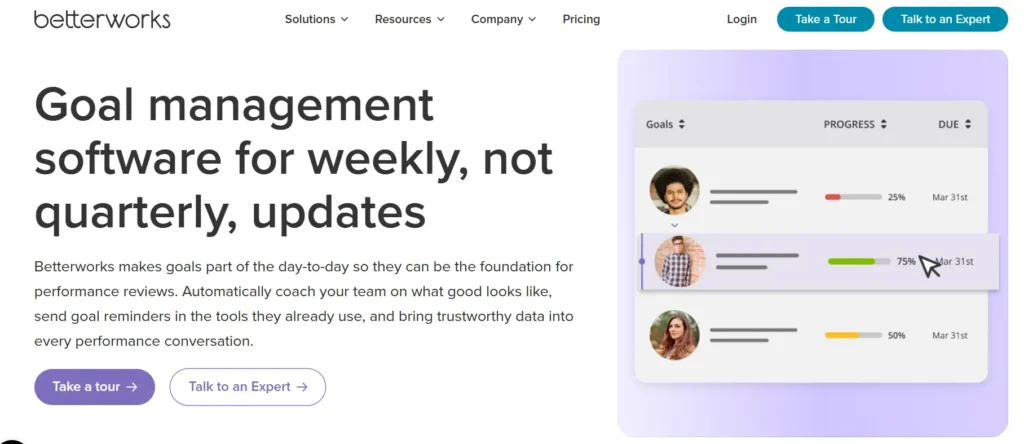
Betterworks is built for large enterprises that need goal alignment at scale. It makes goals part of day-to-day work, allowing them to serve as the foundation for performance reviews.
Pros:
- Purpose-built for enterprise-scale, continuous performance and goal management
- Strong OKR alignment across large teams and multiple business units
- Most HRIS integrations complete within two to four weeks
Cons:
- Minimum of 500 users required, not suited for SMBs or growing teams
- Implementation may take several weeks, even with support
Pricing:
- Custom pricing only; contact sales for a quote
4. WorkBoard
WorkBoard is an enterprise OKR and strategy execution platform used by large organizations that need to connect top-level strategy to day-to-day team goals. It focuses heavily on business results, leadership alignment, and measurable outcomes across complex organizational structures.
Pros:
- AI-powered goal suggestions help teams create measurable OKRs faster
- Cascading OKR alignment improves visibility across teams and business units
- Slack integration sends automatic reminders to keep goals on track
Cons:
- Minimum user requirements make it less suitable for smaller or growing teams
- Some users report inconsistencies in navigation across different sections
- Implementation and onboarding may take several weeks for larger deployments
Pricing:
- Custom pricing; contact sales for a free quote
5. Weekdone
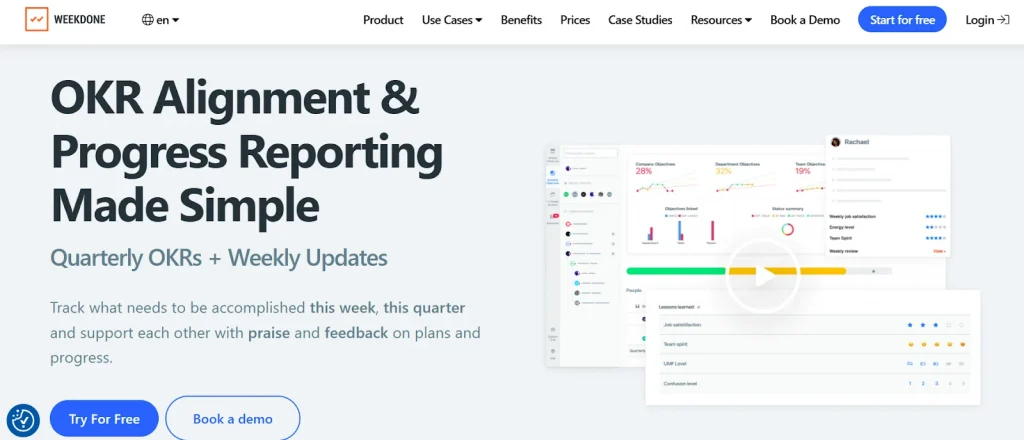
Weekdone is a goal-tracking tool built for small and mid-sized companies that want a user-friendly tool to set, manage, and monitor goals. Its simple interface and structured workflows make it a practical option for teams getting started with the OKR framework.
Pros:
- Visual OKR hierarchy helps teams connect individual and company goals clearly
- Weekly check-ins and automated reports keep goal progress consistently updated
- Free plan for up to 3 users makes it easy for small teams to get started with OKRs
Cons:
- New users may need some time to get comfortable with the platform
- The mobile app may feel slower at times
- Initial setup and onboarding can take longer for first-time users
Pricing:
- Paid plans start at approximately $10.80/user/month (billed annually)
6. Leapsome
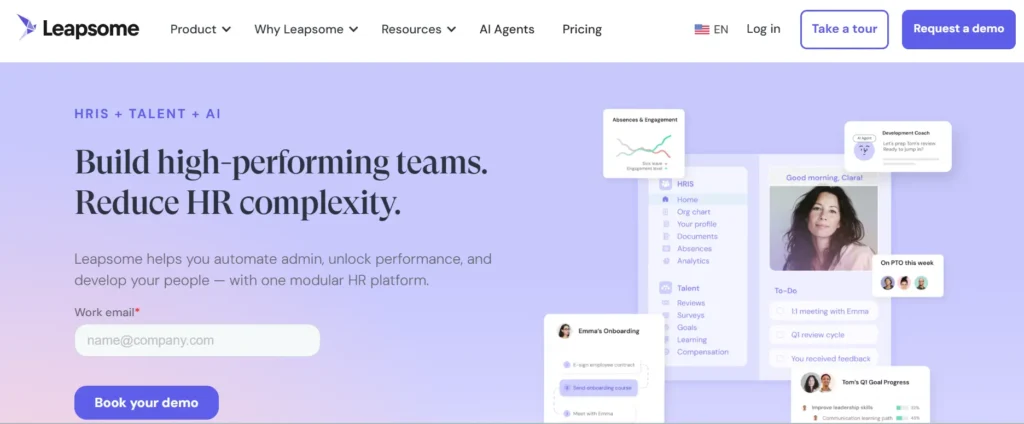
Leapsome is a cloud-based goal-setting and performance management platform suitable for growing tech companies and scale-ups. It combines goal tracking, performance reviews, learning management, and engagement surveys in one platform, helping HR teams manage employee development more efficiently.
Pros:
- Goal setting, OKRs, 360-degree reviews, and engagement surveys in one platform
- Intuitive UX praised consistently by users across team sizes
- Useful for managing 1:1s, development plans, and team goals in one place
Cons:
- Goal review cycles can feel complex for first-time users
- Focuses on individual development rather than enterprise strategy
Pricing:
- Pricing not publicly available; contact the team for a custom quote
7. 15Five
15Five is a goal tracking and employee engagement platform used by mid-market US teams. It focuses on connecting goals to weekly check-ins, performance reviews, and manager-employee conversations, making it another suitable option for teams that want an OKR and employee performance management tool.
Pros:
- Tracks OKRs and employee performance in one place
- AI-powered insights help identify risks early
- Manager effectiveness scoring helps track quality check-ins and goal progress
Cons:
- SSO access is available only in higher-tier plans
- Reporting and cross-team analytics may feel limited for advanced HR reporting needs
- Managing goal visibility across teams of very different sizes requires additional setup and customization.
Pricing:
- Engage plan starts at $4/user/month
- Perform plan starts at $8/user/month (includes OKRs, reviews, and goal tracking)
- Free trial available; enterprise pricing on request
How to Choose the Right Goal Tracking Software for Business
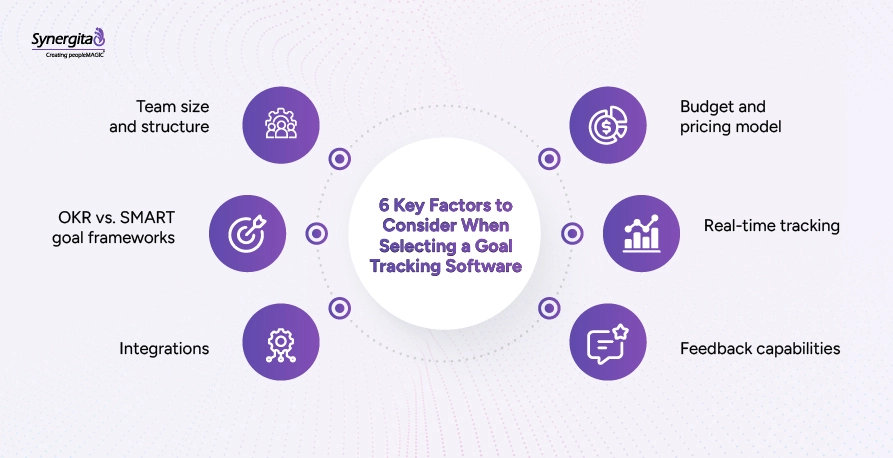
When choosing a goal setting software platform, consider the following factors.
- Team size and structure: SMBs need simple, fast setup; enterprises need hierarchy and rollup views.
- OKR vs. SMART goal frameworks: Make sure the tool supports your preferred methodology.
- Integrations: Check if the tool connects to your HRIS, Slack, or project management tools.
- Budget and pricing model: Per-user pricing is more predictable than seat minimums or custom contracts.
- Real-time tracking: Look for dashboards and check-ins, not just end-of-cycle reporting.
- Feedback capabilities: The best goal tracking tools link goals to continuous feedback and 1:1s.
Evaluating these factors will help you choose a platform that fits your team’s goals, workflows, and growth plans.

Final Takeaway
Without the right goal setting software, it becomes difficult to track the project progress and maintain accountability. Managers have to rely on spreadsheets, manual updates, or fragmented data, making it difficult to identify risks.
The tools we’ve shared above are ideal for organizations looking to improve goal visibility, and create a more structured approach to goal execution.
Synergita is an ideal choice for companies looking to improve goal alignment and accountability across teams. Its AI-powered goal management, and quick deployment make it well suited for startups and growing businesses. Start your 14-day free trial today.
Frequently Asked Questions
Goal setting software is a digital platform that helps teams create, track, and align goals across the organization. It replaces spreadsheets with real-time visibility into individual and team goal progress.
software helps businesses set objectives, monitor employee progress, and track team performance in one centralized platform. Many modern tools also include OKRs, feedback systems, and reporting dashboards.
Synergita is a top choice for US teams as it offers AI-powered goal creation, tracking, and risk analysis. It offers a starting price at $3/user/month, making it a complete and most affordable option for growing businesses.
It allows managers and employees to set measurable goals, assign ownership, check in regularly on progress, and link outcomes to performance reviews, all in one platform with real-time dashboards.
The cost of goal-setting software varies based on features, team size, and deployment requirements. The starting price for most platforms is between $3 and $11 per user per month, while enterprise solutions often offer custom pricing based on business needs.
Yes. Most modern goal tracking tools, including Synergita, Lattice, Leapsome, and 15Five, offer native or API-based integrations with major HRIS platforms, Slack, Microsoft Teams, and project management tools.