



Most customer success teams track everything: NPS scores, churn rates, support tickets, and product adoption. But tracking isn’t the same as improving. Without clear objectives tied to measurable outcomes, your customer success team only reacts to problems instead of preventing them. That’s where customer success objectives and key results (OKRs) transform how teams operate.
By setting quarterly objectives for retention, satisfaction, and growth, OKRs help customer success teams move from reactive support to a more structured approach. They bring clarity to priorities and ensure efforts generate measurable business outcomes. In this guide, we will explore 12 customer success OKRs you can use to set clear and measurable goals.
| Table of Contents 1. Why Do Customer Success Teams Need OKRs? 2. Top 12 Customer Success OKR Examples 3. How to Track Customer Success OKRs Effectively 4. Common Mistakes When Setting Customer Success OKRs 5. Final Takeaway 6. Frequently Asked Questions |
Why Do Customer Success Teams Need OKRs?
Customer success OKRs that focus on retention and satisfaction deliver measurable business impact. Here are the key reasons why the customer success team needs OKRs.
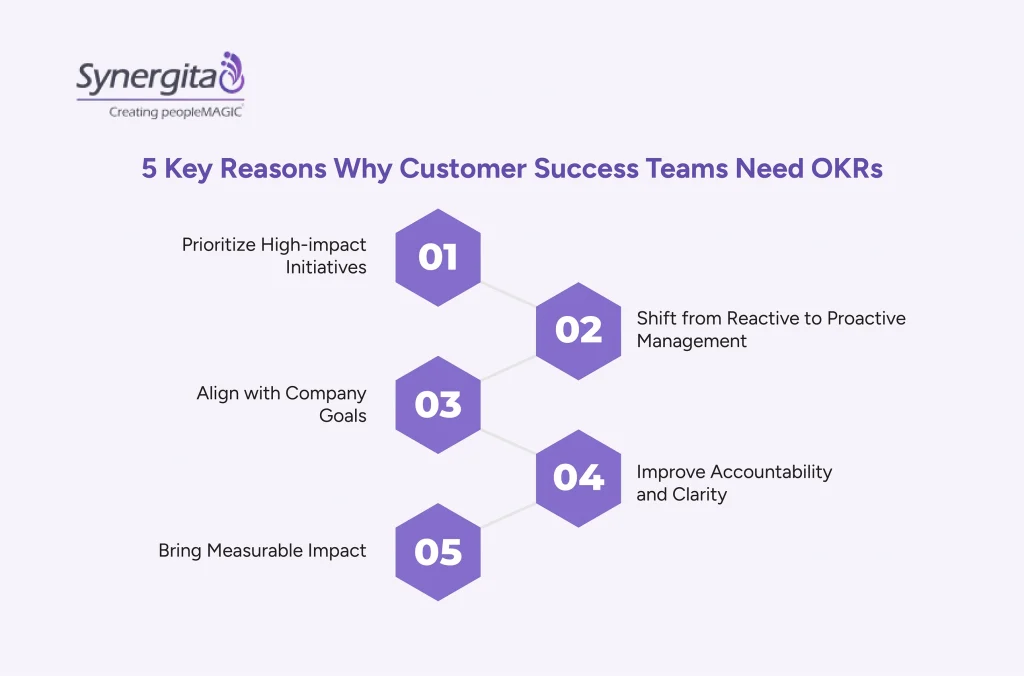
1. Prioritize High-impact Initiatives
OKRs help customer success teams focus on the activities that directly influence retention, adoption, and customer growth instead of managing scattered tasks.
2. Shift from Reactive to Proactive Management
By tracking leading indicators such as customer engagement and onboarding progress, teams can address risks before they become churn.
3. Align with Company Goals
OKRs help businesses connect customer success objectives with broader business outcomes like revenue expansion, retention, and customer lifetime value.
Suggested Reading: How to Align Workforce with Business Strategy
4. Improve Accountability and Clarity
Clearly defined objectives and measurable key results enable teams to track progress and understand how success is measured.
5. Bring Measurable Impact
OKRs ensure customer success efforts are connected to concrete outcomes such as reduced churn, higher NPS, improved product adoption, and increased expansion revenue.
Top 12 Customer Success OKR Examples
The best customer success teams know which metrics to track. These 12 OKR examples give you a proven framework for onboarding, adoption, retention, expansion, and team performance.
1. Accelerate Customer Onboarding Success
Why it is important: First impressions shape the entire customer relationship. Research shows that 88% of users are unlikely to return to a website after a poor user experience. Fast, effective onboarding is essential for retaining customers over the long term.
- Key Result 1: Reduce average onboarding time from 14 days to 7 days
- Key Result 2: Increase onboarding completion rate from 68% to 85%
- Key Result 3: Achieve post-onboarding CSAT score of 4.5/5 or higher
- Key Result 4: Reduce time-to-first-value from 21 days to 10 days
2. Maximize Product Adoption Across Customer Base
Why it is important: Customers who actively use your product are less likely to churn. This customer success OKR focuses on driving engagement beyond initial implementation.
- Key Result 1: Increase monthly active users (MAU) from 62% to 80%
- Key Result 2: Grow feature adoption rate from 45% to 70%
- Key Result 3: Ensure 90% of accounts use at least 3 core features
- Key Result 4: Increase average session time from 8 minutes to 15 minutes
3. Reduce Customer Churn Through Proactive Engagement
Why it is important: According to Zendesk, 50% of customers switch to a competitor after one bad experience. Proactive intervention prevents churn before it happens.
- Key Result 1: Decrease quarterly churn rate from 8% to 4%
- Key Result 2: Identify and re-engage 100% of at-risk accounts (health score <30)
- Key Result 3: Conduct quarterly business reviews with 95% of enterprise customers
- Key Result 4: Reduce customer escalations from 25 to under 10 per quarter
4. Deliver World-Class Customer Support Experiences
Why it is important: Support quality directly impacts retention. These customer support OKRs measure response quality and speed.
- Key Result 1: Maintain CSAT score of 90% or higher for all support interactions
- Key Result 2: Resolve 85% of tier-1 tickets within 4 hours
- Key Result 3: Reduce average first response time from 2 hours to 30 minutes
- Key Result 4: Achieve 95% first-contact resolution rate for common issues
5. Drive Revenue Expansion Through Upsells
Why it is important: Existing customers are your best growth opportunity. Expansion revenue indicates strong product-market fit and customer satisfaction.
- Key Result 1: Increase net revenue retention (NRR) from 105% to 120%
- Key Result 2: Generate $500,000 in expansion revenue this quarter
- Key Result 3: Grow average revenue per account (ARPA) from $8,000 to $12,000
- Key Result 4: Increase the percentage of customers using multiple products from 35% to 60%
6. Improve Customer Health Score Across Portfolio
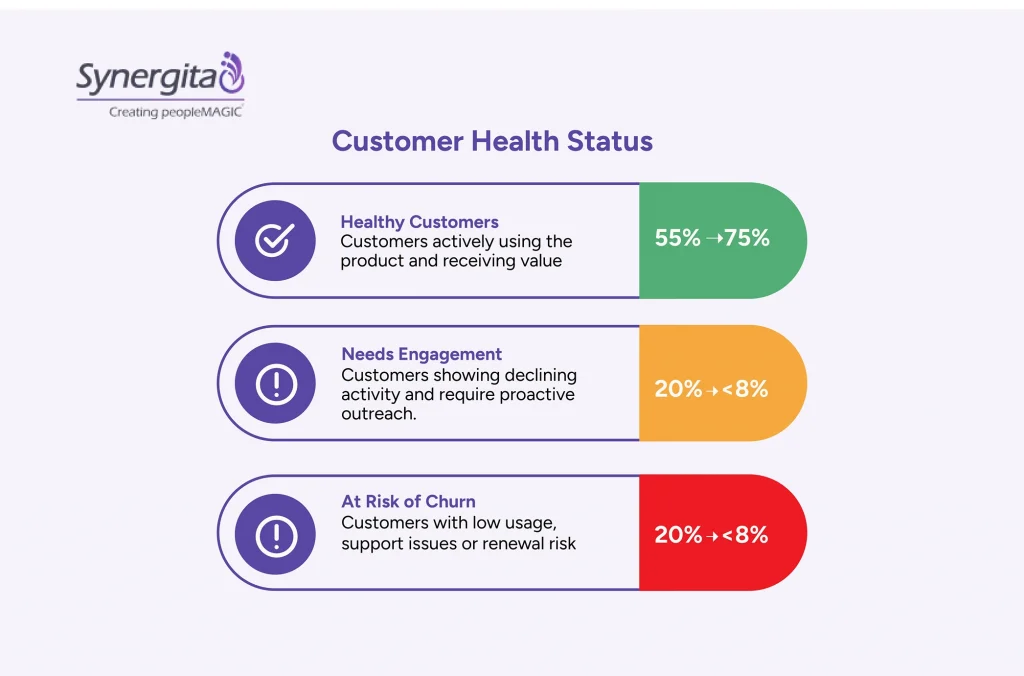
Why it is important: Health scores predict churn risk and expansion opportunities. This objective focuses on moving customers from red/yellow to green status.
- Key Result 1: Increase percentage of “green” health accounts from 55% to 75%
- Key Result 2: Reduce “red” health accounts from 20% to less than 8%
- Key Result 3: Conduct success planning sessions with 100% of yellow/red accounts
- Key Result 4: Improve average customer health score from 62 to 80
7. Build Customer Advocacy and References
Why it is important: Happy customers become your best salespeople. Customer advocacy OKRs track how well you’re turning satisfaction into marketing assets.
- Key Result 1: Generate 10 new customer case studies this quarter
- Key Result 2: Increase Net Promoter Score (NPS) from 45 to 65
- Key Result 3: Secure 15 customer references willing to speak with prospects
- Key Result 4: Grow customer review count on G2/Capterra by 50 reviews
8. Enhance Customer Education and Enablement
Why it is important: Educated customers extract more value from your product and require less support.
- Key Result 1: Achieve 70% completion rate for product certification program
- Key Result 2: Launch 8 new training webinars covering advanced features
- Key Result 3: Increase knowledge base article views from 5,000 to 12,000 monthly
- Key Result 4: Improve customer product proficiency scores from 6.2 to 8.5
9. Optimize Customer Success Operations
Why it is important: Internal efficiency allows CS teams to support more customers without sacrificing quality.
- Key Result 1: Reduce average time spent per account from 12 hours to 8 hours monthly
- Key Result 2: Automate 50% of recurring customer touchpoints
- Key Result 3: Implement a customer success platform to track engagement across 100% of accounts
- Key Result 4: Increase CS team productivity score from 72 to 88
10. Strengthen Customer Renewal Rates
Why it is important: Renewals are the foundation of recurring revenue. This OKR for customer success targets the moments that matter most.
- Key Result 1: Achieve 95% gross renewal rate this quarter
- Key Result 2: Conduct renewal conversations 90 days before contract end for all accounts
- Key Result 3: Reduce contract downgrades from 15% to under 5%
- Key Result 4: Increase multi-year contract renewals from 25% to 45%
11. Scale Customer Success Team Performance
Why it is important: Team development ensures sustainable customer success operations as you grow.
- Key Result 1: Hire and onboard 5 new CSMs to maintain 1:30 CSM-to-customer ratio
- Key Result 2: Achieve 85% employee satisfaction score within the CS team
- Key Result 3: Certify 100% of CSMs on advanced customer success methodology
- Key Result 4: Promote 2 CSMs to senior positions based on performance
12. Increase Customer Engagement Through Community
Why it is important: Peer-to-peer support reduces support burden while creating brand advocates.
- Key Result 1: Grow customer community from 500 to 1,200 active members
- Key Result 2: Generate 100 customer-created community posts per month
- Key Result 3: Host 4 customer-led webinars showcasing product use cases
- Key Result 4: Increase community engagement rate from 18% to 40%
How to Track Customer Success OKRs Effectively
Setting customer success OKRs is the first step, but to ensure they drive measurable outcomes, teams need to understand how to track OKRs efficiently to keep progress visible and actionable.
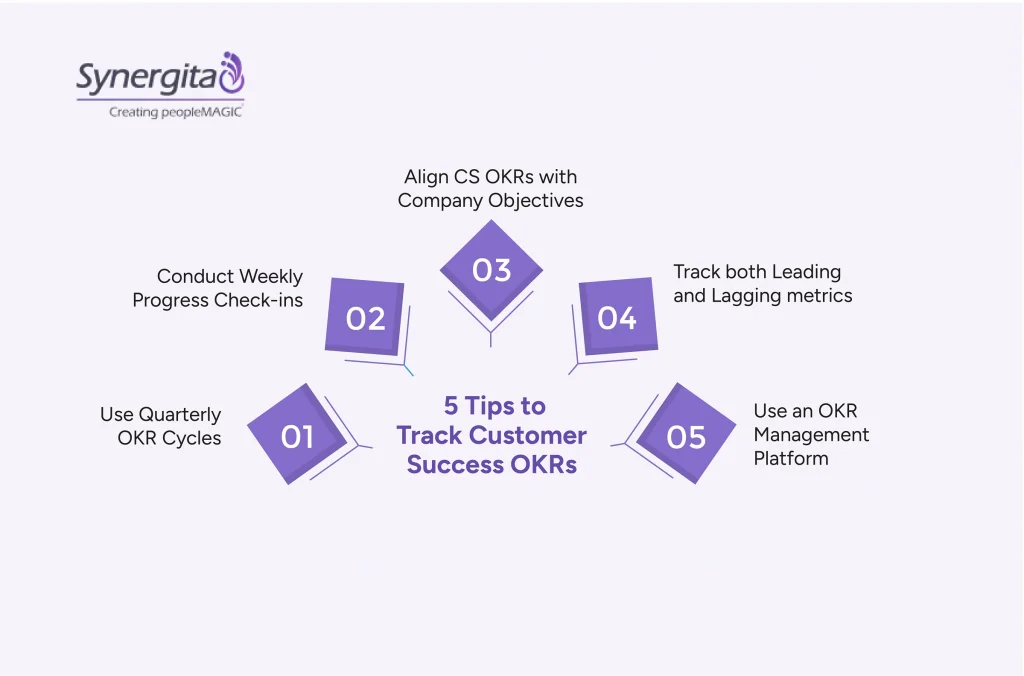
1. Use Quarterly OKR Cycles
Customer success initiatives often evolve with changing customer needs. A 90-day OKR cycle allows teams to review progress frequently, test new strategies, and refine objectives without losing focus.
2. Conduct Weekly Progress Check-ins
Regular check-ins help teams identify blockers early and adjust execution strategies. These discussions keep key results on track and ensure accountability across the team.
3. Align CS OKRs with Company Objectives
Customer success goals should connect directly with broader business outcomes such as revenue growth, retention, and expansion. Alignment ensures CS efforts contribute to company-wide priorities.
4. Use an OKR Management Platform
Tracking customer success OKRs using spreadsheets can be a complex process. Instead, you can use an OKR management software that provides real-time visibility and helps you track OKR progress. This ensures that customer success initiatives stay aligned with broader company objectives while keeping everyone accountable.
Common Mistakes When Setting Customer Success OKRs
While setting customer success OKRs, you need to avoid the common mistakes.
- Too many objectives: Limit each CS team member to 3-5 OKRs per quarter. More than that dilutes focus.
- Vague key results: “Improve customer satisfaction,” isn’t specific. “Increase CSAT from 7.5 to 8.5” is a specific and measurable goal.
- Setting easy targets: OKRs should stretch your team. Aim for 70% achievement of ambitious goals rather than 100% of safe ones.
- Forgetting alignment: Every customer success OKR should ladder up to company objectives around revenue, retention, or market expansion.
- Not reviewing regularly: Set it and forget it doesn’t work. Review progress weekly and adjust tactics as needed.
Final Takeaway
Customer success improves when teams move beyond reactive support and focus on clear, measurable goals. For example, if churn is rising, concentrate on retention-focused OKRs.
If product adoption is low, you need to build objectives around onboarding, activation, and engagement, and use these 12 customer success OKR examples as a practical starting point.
Platforms like Synergita OKR tool help teams set aligned objectives, monitor key results in real time, and maintain accountability throughout the quarter. Try Synergita OKR software free for 14 days and see how it streamlines OKR management.
Frequently Asked Questions
OKRs for customer success are objectives with measurable key results that help CS teams focus on customer retention, adoption, satisfaction, and revenue growth instead of just reacting to problems when they arise.
A CS team member should have 3–5 OKRs per quarter because too many OKRs may impact focus and make it difficult to work on each goal.
You should follow a 90-day cycle for OKR review with weekly check-ins. Regular reviews help teams identify blockers early, adjust tactics, and ensure they can keep key results remain on track.
Customer success OKRs improve retention by setting specific, measurable targets related to onboarding, engagement, and health scores, CS teams can identify at-risk accounts early and intervene proactively.
Every CS OKR should be connected to business objectives like revenue growth, customer lifetime value, or market expansion.