
Marketing leaders often face the frustration of reporting “record-high” social engagement or website traffic while sales numbers remain stagnant. You likely see your team working long hours on creative campaigns that generate buzz but fail to move the financial needle.
This gap exists because traditional marketing metrics often prioritize volume over value, leaving the C-suite skeptical of your department’s true impact. Relying on vanity metrics creates a false sense of progress while obscuring the actual bottlenecks in your revenue funnel.
Without a unified framework, your content, demand gen, and product marketing teams often work at cross-purposes, diluting your budget and slowing down growth. You need a disciplined system that connects every campaign to high-stakes business outcomes like customer acquisition cost and lifetime value.
In this guide, we provide an authoritative playbook for implementing marketing OKRS that drive commercial excellence and organizational alignment. We will explore 20 specific examples across every marketing function to help you move from tracking clicks to achieving strategic wins.
Key Takeaways
- Shift from tracking total leads to measuring “Sales Qualified Leads” to ensure better alignment with revenue targets.
- Focus on conversion rates between funnel stages to identify and fix specific leaks in your customer journey.
- Every marketing objective should link directly to financial outcomes like Customer Acquisition Cost (CAC) or Pipeline Value.
- Use quarterly OKR cycles to pivot marketing tactics quickly as market conditions or platform algorithms change.
- Ensure marketing goals support Sales and Product objectives to create a unified front for business growth.
- Move beyond “gut feelings” by using measurable key results that provide distraction-free insights into performance.
Importance of OKRs for Marketing
Marketing departments operate in a high-speed environment where capital can easily be wasted on unoptimized channels. A structured goal-setting framework provides the focus needed to ensure your budget is allocated to the most impactful initiatives.
This discipline ensures that your best talent is focused on solving systemic growth issues rather than chasing temporary trends.
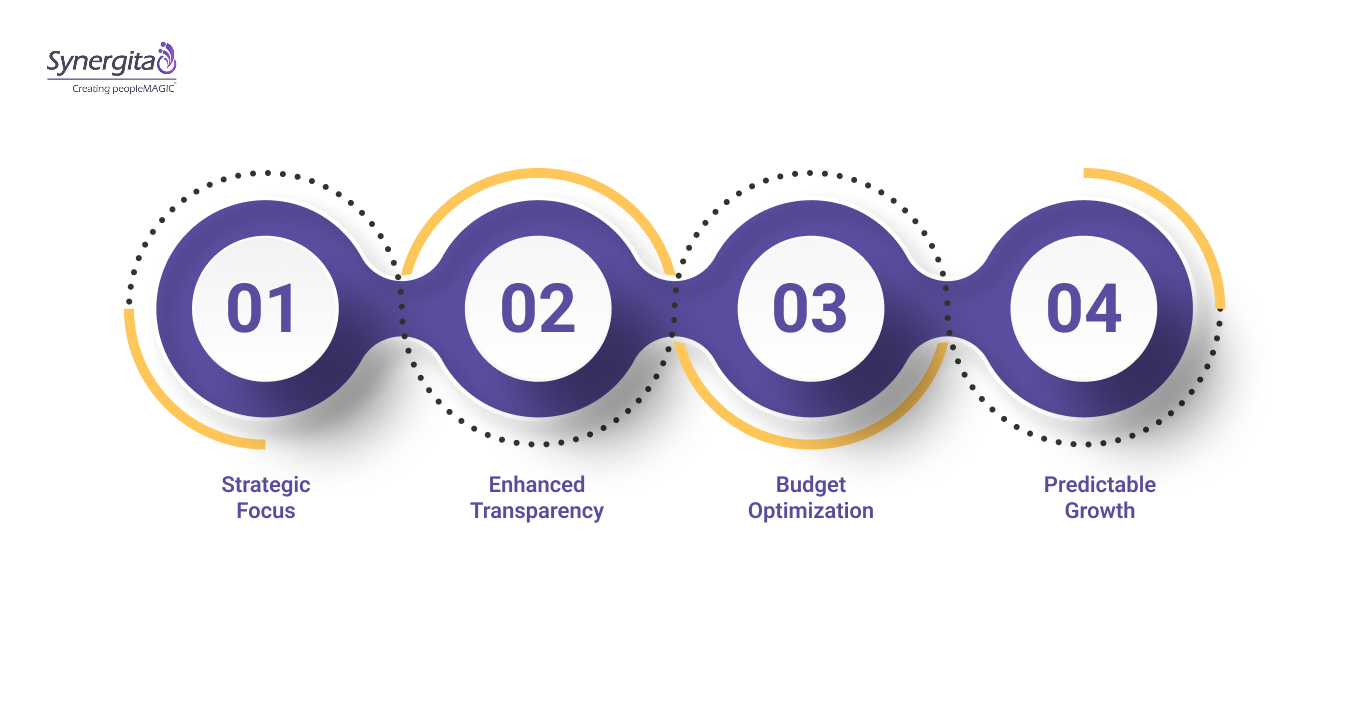
Implementing a formal system provides several critical advantages for competitive marketing leadership:
- Strategic Focus: Limits the number of active projects to ensure teams finish what they start rather than multitasking across twenty channels.
- Enhanced Transparency: Clearly defined key results eliminate confusion about which team owns specific outcomes like “brand sentiment” or “inbound pipeline.”
- Budget Optimization: Forcing teams to prioritize high-impact results prevents the waste of capital on underperforming “vanity” campaigns.
- Predictable Growth: Using measurable data for goal setting provides a more accurate view of future revenue and customer acquisition trends.
High-level benefits must translate into daily execution through a framework that mirrors the actual customer experience.
Also read: 10 Essential Tips for Effective Employee Performance Reviews
How to Write Effective Marketing OKRs
Effective goal-setting requires a deep understanding of the difference between an activity and a strategic result. Your objectives should describe a qualitative state of success, while your key results provide the numerical proof of that victory.
Follow these steps to ensure your team remains focused on the outcomes that drive a competitive advantage:
1. Start with Business Outcomes
- Identify the primary corporate bottleneck, such as low renewal rates or slow new logo acquisition.
- Draft an objective that describes a qualitative solution to that problem in simple language.
- Ensure the objective is ambitious enough to require a change in current team behavior.
- Avoid using technical jargon that stakeholders in Finance or Sales might find confusing.
2. Select Measurable Key Results
- For every objective, choose three to five specific metrics that track progress toward the goal.
- Include a mix of leading indicators like “form completions” and lagging indicators like “closed-won revenue.”
- Ensure every key result is time-bound and carries a specific numerical target for the quarter.
- Use percentages or dollar values to make the success or failure of the goal undeniable.
3. Coordinate with Sales and Product
- Validate your proposed marketing targets with the Sales Director to ensure they can handle the projected lead volume.
- Align your product marketing goals with the engineering roadmap to support upcoming feature launches effectively.
- Check that your brand objectives do not conflict with the current customer success or retention initiatives.
- Share your draft OKRs with the executive team to ensure total alignment with the 2026 fiscal plan.
Aligning your creative efforts with hard business data is the first step toward a high-performance marketing culture. Explore Synergita’s lightweight OKR module to see how we help you manage these objectives with real-time visualization tools. Book a demo to learn more.
Establishing this disciplined approach allows you to implement specific examples that turn projects into commercial wins.
Top 20 Examples of Marketing OKRs You Should Not Miss
Translating strategy into action requires concrete examples that your various sub-teams can adopt and customize. The following tables provide a comprehensive playbook for setting goals that cover the entire digital marketing lifecycle.
Use these as a starting point to build your strategic roadmap for sustainable growth and efficiency.
1. For Demand Generation & Growth
| Objective 1 | Key Results |
| Accelerate the inbound revenue pipeline for the mid-market segment | 1. Increase Sales Qualified Leads (SQLs) from 150 to 250 per month. |
| 2. Grow the total value of marketing-sourced pipeline from $1M to $1.8M. | |
| 3. Achieve a 20% conversion rate from MQL to SQL. |
| Objective 2 | Key Results |
| Optimize paid acquisition spend to improve profitability | 1. Reduce blended Customer Acquisition Cost (CAC) from $250 to $180. |
| 2. Increase average Return on Ad Spend (ROAS) across all channels to 4.5x. | |
| 3. Achieve 10% lower CPC on Google Ads through improved quality scores. |
Also read: OKR 101: Beginner’s Guide to Objectives and Key Results
| Objective 3 | Key Results |
| Improve the efficiency of the lead nurturing process | 1. Increase click-through rate on automated email flows by 15%. |
| 2. Reduce the average time from “Lead Created” to “SQL” by 4 days. | |
| 3. Reach a 30% webinar-to-demo conversion rate for new prospects. |
| Objective 4 | Key Results |
| Expand our footprint in the enterprise sector via ABM | 1. Secure 15 new discovery meetings with target Tier-1 accounts. |
| 2. Achieve a 40% engagement rate with personalized landing pages for ABM accounts. | |
| 3. Generate $500k in new pipeline from 50 high-priority accounts. |
| Objective 5 | Key Results |
| Scale our partnership channel as a revenue driver | 1. Source 30% of new monthly revenue through verified partner referrals. |
| 2. Onboard 10 new high-impact agency partners this quarter. | |
| 3. Achieve 50% participation in the new partner certification program. |
2.For Content & Organic Growth
| Objective 6 | Key Results |
| Establish our brand as the leading authority in Talent Management | 1. Rank in the top 3 on Google for 15 high-intent industry keywords. |
| 2. Increase organic website traffic by 40% year-over-year. | |
| 3. Secure 5 high-authority backlinks from major HR news publications. |
| Objective 7 | Key Results |
| Enhance the conversion value of the company blog | 1. Generate 100 net-new MQLs directly from blog CTAs per month. |
| 2. Increase the average time-on-page for high-value guides by 20%. | |
| 3. Reduce the blog bounce rate from 75% to 60%. |
| Objective 8 | Key Results |
| Launch a high-performing video content strategy | 1. Achieve 10,000 views on our new “Product Insight” YouTube series. |
| 2. Generate 50 qualified leads from video-specific landing page links. | |
| 3. Increase LinkedIn video engagement rate from 2% to 5%. |
Also read: Essential OKR Dashboard Examples for Goal Tracking
| Objective 9 | Key Results |
| Optimize existing content for better lead capture | 1. Update 20 legacy blog posts with new data and lead magnets. |
| 2. Improve the conversion rate of top 5 high-traffic pages by 10%. | |
| 3. Increase total newsletter sign-ups by 1,000 through pop-up optimization. |
3. For Brand & Communications
| Objective 10 | Key Results |
| Elevate brand sentiment across primary social channels | 1. Increase positive social media sentiment score from 65% to 80%. |
| 2. Secure 10 new unprompted customer testimonials on G2 or Capterra. | |
| 3. Maintain a response time of under 2 hours for all social inquiries. |
| Objective 11 | Key Results |
| Maximize the impact of the 2026 Annual Conference | 1. Secure 500 early-bird registrations for the flagship event. |
| 2. Sign 10 premium corporate sponsors for the conference. | |
| 3. Generate 50 post-event demo requests from qualified attendees. |
| Objective 12 | Key Results |
| Strengthen internal brand alignment and employee advocacy | 1. Achieve a 40% employee participation rate in the social sharing program. |
| 2. Conduct brand voice training for 100% of the sales and support staff. | |
| 3. Publish 3 “Employee Spotlight” stories to improve recruitment branding. |
4. For Product Marketing & Retention
| Objective 13 | Key Results |
| Ensure a successful market launch for the AI Analytics module | 1. Secure 50 beta test participants within the first 30 days. |
| 2. Achieve a 15% adoption rate for the module among existing customers. | |
| 3. Conduct 5 successful internal training sessions for the sales team. |
| Objective 14 | Key Results |
| Improve customer retention through marketing education | 1. Reduce the churn rate of “at-risk” customers by 5% via email flows. |
| 2. Increase the login frequency of low-activity users by 20%. | |
| 3. Achieve 1,000 completions of the new user certification course. |
| Objective 15 | Key Results |
| Maximize expansion revenue from the existing customer base | 1. Generate $200k in upsell pipeline through in-app marketing prompts. |
| 2. Secure 20 case study interviews with high-value Enterprise clients. | |
| 3. Achieve a 25% click-through rate on new feature announcement emails. |
5. For Marketing Operations & Tech
| Objective 16 | Key Results |
| Cleanse the CRM database for better reporting accuracy | 1. Reduce duplicate lead records by 40% through automated cleansing. |
| 2. Achieve 100% data completion for “Job Title” and “Industry” fields. | |
| 3. Update 1,000 stale lead records older than 12 months. |
| Objective 17 | Key Results |
| Optimize the marketing tech stack to reduce waste | 1. Consolidate or cancel 3 redundant software subscriptions. |
| 2. Reduce the total monthly martech spend by 10% without losing functionality. | |
| 3. Ensure 100% of the marketing team completes advanced platform training. |
| Objective 18 | Key Results |
| Implement a full-funnel attribution model | 1. Track 100% of inbound leads back to their primary marketing source. |
| 2. Deliver the first “Multi-Touch Attribution” report to the C-suite. | |
| 3. Achieve a 95% data match rate between Marketing and Sales systems. |
| Objective 19 | Key Results |
| Improve website performance for a better user experience | 1. Reduce mobile page load time by 1.5 seconds. |
| 2. Achieve a Lighthouse performance score of 90+ on all core pages. | |
| 3. Fix 100% of identified 404 errors and broken internal links. |
| Objective 20 | Key Results |
| Scale international marketing presence in the DACH region | 1. Launch a fully localized version of the website in German. |
| 2. Secure 5 new Enterprise MQLs from the target region. | |
| 3. Conduct 2 localized webinars with German-speaking industry experts. |
Managing your marketing strategy is more effective when your organization utilizes a centralized platform for alignment. See how Synergita simplifies your 2026 planning with our easy-to-use administration module. Book a demo to learn more.
Transitioning from these examples to a successful rollout involves avoiding the subtle traps that often derail marketing teams.
Common OKR Mistakes Marketing Department Makes (And How to Avoid Them)
Marketing teams often face unique challenges when adopting a goal-setting framework designed for agile growth. Without careful planning, your OKRs can unintentionally encourage vanity-seeking behavior or obscure the actual progress of complex campaigns.
Recognizing these common pitfalls early allows you to build a more resilient and transparent organizational culture.
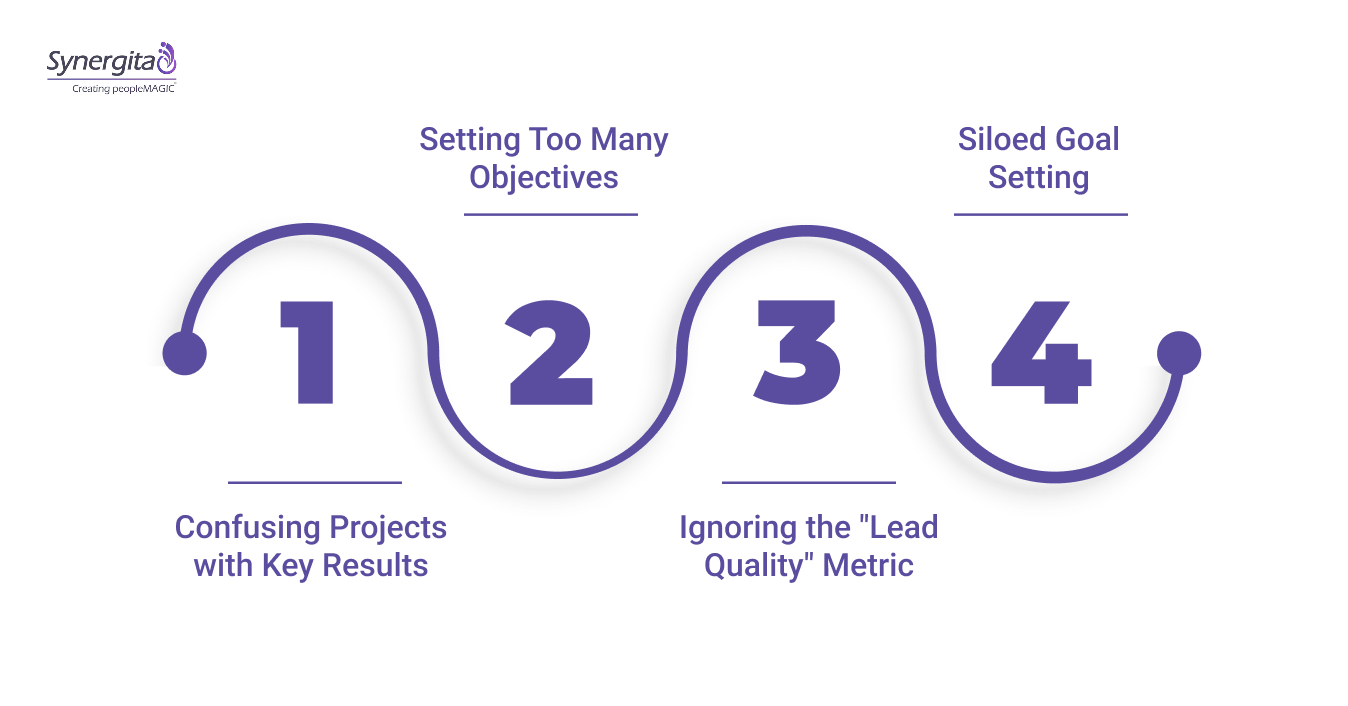
1. Confusing Projects with Key Results
A key result that says “Write 10 blog posts” is a task, not a strategic outcome. This mistake fails to measure whether those posts actually improved the business or generated any specific revenue.
Solution: Focus your Key Results on the impact of those tasks, such as “Increase organic traffic by 20%” or “Generate 50 MQLs.”
2. Setting Too Many Objectives
Attempting to track fifteen different marketing objectives simultaneously dilutes your team’s focus and capital. You end up with a dozen half-finished initiatives that fail to move the needle on your primary growth targets.
Solution: Follow the “3×3 Rule” and limit your department to three high-level objectives per quarter to ensure deep impact.
3. Ignoring the “Lead Quality” Metric
A marketing team might hit its total lead volume goals while the Sales team struggles with poor-quality prospects. If you only measure quantity, you incentivize your team to skip the targeting that protects your sales conversion rates.
Solution: Always pair a volume Key Result with a quality benchmark like “Lead-to-SQL Conversion Rate” to ensure a balanced approach.
4. Siloed Goal Setting
Marketing teams often set goals in a vacuum without consulting the Sales or Product departments they support. This leads to Marketing hitting their own targets while inadvertently failing to support the company’s broader revenue mission.
Solution: Co-create at least one OKR with each major stakeholder department to ensure departmental synergy and shared success.
Establishing this level of discipline is easier when you follow proven implementation strategies for your department.
Also read: The Ultimate 360 Debrief Guide: Definition, Steps And Best Practices
Best Practices for Effective Marketing OKRs Implementation
Sustaining a high-performance culture in marketing requires more than just a good list of targets; it requires transparency. Your goal-setting process must be visible to everyone, from the junior content writer to the Chief Marketing Officer.
This openness creates a sense of shared ownership that is vital for surviving the high-pressure environment.
1. Adopt a Full-Funnel View
Ensure your marketing OKRs cover a mix of top-of-funnel awareness, middle-funnel consideration, and bottom-funnel conversion. This provides a holistic view of the department’s health and prevents over-rotation on any single technical metric.
Impact:
- Ensures long-term sustainability by balancing immediate revenue needs with brand building.
- Provides a more compelling narrative for the department’s value during board meetings.
- Reduces the risk of “funnel droughts” by maintaining a consistent flow of leads.
2. Prioritize Real-Time Data Dashboards
Avoid the trap of manual spreadsheets by connecting your goal-tracking platform directly to your marketing automation tools. This ensures that your progress measurements are objective and updated without requiring manual administrative labor.
Impact:
- Provides a single source of truth for all technical and business stakeholders.
- Allows for immediate course correction when a key result starts to lag mid-quarter.
- Reduces the time spent in status update meetings by 50% or more.
3. Reward Strategic Impact, Not Just Effort
Ensure that your performance appraisal process recognizes marketers who solve business problems, not just those who are busy. Use your performance platform to track how individual contributions align with the company’s highest-value marketing objectives.
Impact:
- Motivates the team to focus on work that truly drives the bottom line.
- Improves talent retention by providing clear career progression for high-performers.
- Reduces the amount of “busy work” that does not contribute to strategic goals.
Maintaining this level of focus requires a technical infrastructure that can support your organizational ambitions.
Synergita: Connecting Marketing Strategy to Daily Execution
Marketing leaders often struggle with fragmented data and a lack of real-time visibility into their team’s strategic impact. You might find yourself spending hours manually aggregating report data for the board instead of proactively managing growth.
This lack of a unified source of truth makes it nearly impossible to align your creative talent with the company’s mission. Synergita provides a modular, cloud-based solution that specifically addresses the needs of high-stakes marketing and HR leadership.
Our platform consolidates your goal tracking, continuous feedback, and performance analytics into a single interface that facilitates strategic alignment.
- Lightweight OKR Module: Deploy your strategic framework across the marketing department in days with intuitive visualization tools.
- Continuous Check-ins: Facilitate meaningful 1:1 conversations that keep your marketers focused on high-value outcomes.
- AI-Powered Analytics: Access distraction-free insights into team performance and sentiment through configurable dashboards.
- Perform Plus Module: Automate complex promotion cycles and aspiration tracking for your top-performing marketing talent.
By unifying your talent and goal management, you can ensure that every marketing initiative contributes to the firm’s overall success.
Also read: 5 Proven Ways To Align Employees With Company Goals
Conclusion
Implementing a disciplined marketing OKRs strategy is the most effective way to drive measurable growth in 2026. By moving from vanity metrics to funnel-based outcomes, you build the transparency necessary to optimize your budget and outpace competitors.
Avoiding common pitfalls like siloed goal setting and project-based tracking will ensure your marketing team remains an indispensable partner to the business. Synergita offers the modular flexibility your organization needs to scale its performance culture without the complexity of traditional enterprise software.
Our platform helps you align your team, engage your top talent, and prove your results through data-backed performance management tools. You can move beyond outdated annual reviews and build an agile marketing culture that thrives in a competitive environment.
See how Synergita can structure and track your marketing team’s goals. Book a demo to discuss your specific growth challenges.
FAQs
Q. What is the difference between a marketing KPI and a marketing OKR?
KPIs are ongoing health metrics for your marketing engine (e.g., website traffic, email open rate). OKRs are ambitious, quarterly goals that change what you do to drive a specific business outcome (e.g., enter a new market, launch a product). OKRs often use KPIs as key results.
Q. How do we align marketing OKRs with sales goals?
Co-create objectives that focus on the shared funnel. Hold a joint planning session to agree on targets for qualified leads, pipeline generation, and conversion rates. Assign joint ownership for key results that span both departments.
Q. Who should own marketing OKRs?
The CMO or VP of Marketing owns the department’s top-level OKRs. Channel owners (e.g., Demand Gen, Content, Product Marketing) can own specific objectives. Each key result must have one named individual accountable.
Q. How many OKRs should a marketing team have?
A marketing department should have 3-5 top-level Objectives per quarter. Each objective should have 2-4 Key Results. This maintains strategic focus without creating an unmanageable number of metrics.
Q. Can OKRs work for brand awareness and top-funnel goals?
Yes. Frame brand objectives around measurable business outcomes. Instead of “increase awareness,” use “Increase marketing-qualified leads from branded search by 40%” or “Grow share of voice in target publications by 25%.”
Q. What if a key result becomes impossible to hit mid-quarter?
The OKR framework accommodates this. You can adjust the key result target if circumstances change, but the objective should remain. The quarterly retrospective should analyze why the original target was missed to improve future planning.