



You and your team work hard every quarter only to find that budgets still miss the mark when compared with actual results.
Finance leaders often feel pressure from executive teams to deliver accurate forecasts while managing limited resources and rising expectations.
In this blog, we’ll explore why traditional budgeting and forecasting fall short, how finance teams can use OKRs for stronger financial planning, and specific steps you can take in the next ninety days to improve outcomes.
Key Takeaways:
- Finance OKRs work only when they influence budget decisions, forecast reviews, and trade-off discussions across planning cycles.
- Linking OKRs to budgeting helps finance explain spending choices with shared outcomes rather than isolated line items.
- Forecast accuracy improves when teams review assumptions regularly against agreed OKRs, not static annual targets.
- Shared OKRs help finance, HR, and managers make hiring and cost decisions using the same reference points.
- Fewer outcome-based OKRs support clearer ownership and better follow-through during budget and forecast reviews.
How Finance OKRs Show Up in Actual Budget and Forecast Work
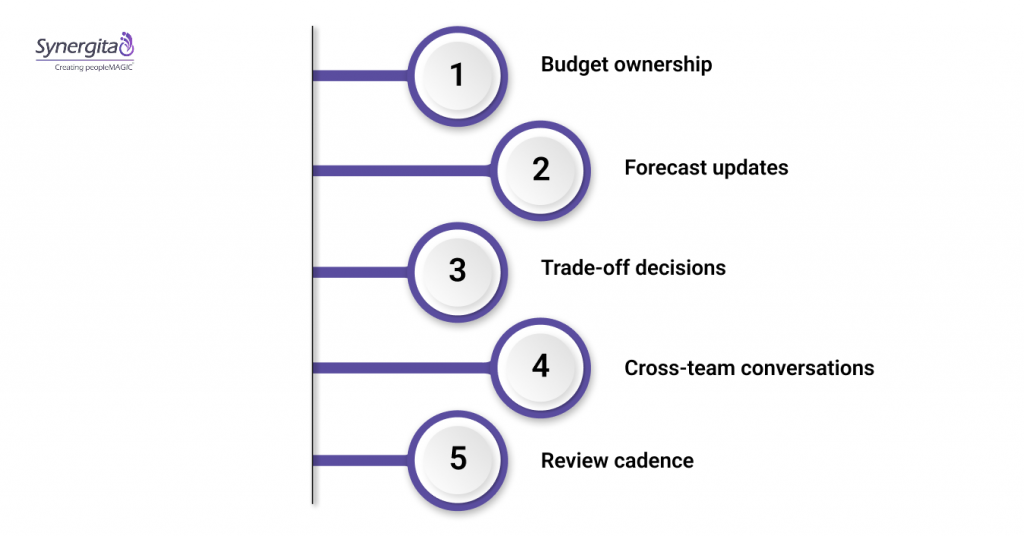
Finance OKRs only matter when they change how work happens across planning cycles, reviews, and decision points inside your finance function. They shift focus from static targets toward shared outcomes that guide daily choices during budgeting, forecasting, and spend discussions.
Here are the ways finance OKRs show up inside everyday workflows, without adding extra process or slowing decision-making.
- Budget ownership: OKRs clarify which spending supports priority outcomes, helping finance teams approve, pause, or reject requests with shared context.
- Forecast updates: Teams use OKRs as reference points during monthly reviews, checking whether assumptions still support agreed financial results.
- Trade-off decisions: When resources feel tight, OKRs help finance leaders explain why one initiative moves forward while another waits.
- Cross-team conversations: Shared OKRs give HR and team managers a common frame when discussing hiring plans, capacity, and cost implications.
- Review cadence: Finance replaces reactive fire drills with scheduled check-ins that focus on progress against outcomes rather than line-item variances.
With this context in place, you can now look at specific OKRs that guide budgeting and forecasting decisions more consistently.
Also Read: OKR 101: Beginner’s Guide to Objectives and Key Results
Practical Finance OKRs That Improve Budgeting and Forecasting
Finance OKR examples work best when they mirror how your team already handles budgets, forecasts, controls, and financial reviews. They should reflect measurable outcomes that guide planning conversations, forecast updates, and spending decisions across departments.
Here are practical finance OKR examples tied directly to budgeting and forecasting workflows, grouped by common finance responsibilities.

1. Audit Readiness and Cost Predictability
Objective: Successfully pass external audits without delays or rework.
Key Result 1: Reduce audit findings to fewer than 5 across all financial control areas.
Key Result 2: File 100% of customer and vendor contracts in approved shared repositories before audit kickoff.
Key Result 3: Reduce total audit duration from 6 weeks to 4 weeks through early preparation.
2. ERP Transition and Forecast Continuity
Objective: Prepare accounting records for an ERP transition without disrupting forecast cycles.
Key Result 1: Identify and resolve core reporting gaps affecting budget tracking in the new system.
Key Result 2: Build 5 equivalent financial reports in the new system used for forecast reviews.
Key Result 3: Review 10 expense categories to identify cost reduction opportunities before migration.
3. Accounts Payable and Receivable Accuracy
Objective: Improve visibility into payables and receivables to support short-term cash forecasting.
Key Result 1: Categorize more than 85% of invoices using standardized expense classifications.
Key Result 2: Reduce late document submissions from 40% to 15%.
Key Result 3: Cut payment processing time from 12 hours to 6 hours.
4. Annual Budgeting Cycle Reliability
Objective: Improve the annual budgeting process for better participation and forecast credibility.
Key Result 1: Train 5 department heads on the updated budgeting process.
Key Result 2: Review 100% of department budget proposals before mid-Q3.
Key Result 3: Secure final budget approval from all leaders before year-end deadlines.
5. Financial Reporting Close Timelines
Objective: Improve reporting timelines to support timely forecast updates.
Key Result 1: Hire 5 additional finance team members.
Key Result 2: Move 50% of financial records to cloud accounting software.
Key Result 3: Close 100% of quarterly financials within 2 weeks of period close.
6. Quarterly Analysis Discipline
Objective: Improve quarterly financial analysis quality.
Key Result 1: Define 3 reporting improvements based on executive feedback.
Key Result 2: Host 3 internal workshops with attendance above 90%.
Key Result 3: Build 5 standardized reporting templates.
7. Invoicing and Credit Workload Balance
Objective: Balance invoicing workloads to improve service levels.
Key Result 1: Increase processed transactions per team member by 20%.
Key Result 2: Reduce pending transaction time from 24 hours to 18 hours.
Key Result 3: Conduct 4 internal coaching sessions.
8. Inventory Record Reliability
Objective: Improve inventory record accuracy.
Key Result 1: Reduce inventory check duration from 14 hours to 6 hours.
Key Result 2: Automate 5 inventory-related accounting processes.
Key Result 3: Reduce inventory bookkeeping discrepancies to 3%.
9. Payroll Accuracy and Predictability
Objective: Eliminate payroll errors.
Key Result 1: Reduce unresolved payroll errors to 0.
Key Result 2: Reduce payroll error rate to below 0.25%.
Key Result 3: Reduce manual payroll data entry by 25%.
10. Expense Management Visibility
Objective: Improve expense tracking.
Key Result 1: Identify the top 5 expense categories driving monthly variance.
Key Result 2: Classify 200 payments with consistent expense tags.
Key Result 3: Reduce monthly operating expenses by 25%.
11. Revenue and Cost Structure Planning
Objective: Adjust cost structures to support revenue targets.
Key Result 1: Reduce office maintenance costs from $15,000 to $7,500.
Key Result 2: Reduce employee travel spend from $12,000 to $3,000.
Key Result 3: Secure a lease generating more than $7,500 in monthly income.
12. Cash Flow Forecast Reliability
Objective: Improve short-term cash forecasting accuracy.
Key Result 1: Reduce forecast variance to below 5%.
Key Result 2: Review cash assumptions monthly with department leaders.
Key Result 3: Publish forecasts within 5 business days of the month-end.
13. Department Budget Accountability
Objective: Increase accountability for budget adherence.
Key Result 1: Review the budget versus actuals monthly with all departments.
Key Result 2: Resolve unplanned spend requests within 5 working days.
Key Result 3: Reduce unapproved overruns to fewer than 3 per quarter.
14. Hiring Cost Planning
Objective: Improve hiring cost forecasts.
Key Result 1: Review hiring plans quarterly against budgets.
Key Result 2: Track cost per hire variance monthly.
Key Result 3: Update hiring forecasts within 10 days of changes.
15. Forecast Review Cadence
Objective: Build consistent forecast review habits.
Key Result 1: Schedule monthly reviews with full attendance from department heads.
Key Result 2: Document agreed forecast changes after each review.
Key Result 3: Reduce last-minute forecast revisions by 30%.
With these examples in mind, the next step is understanding how you can structure OKRs for your finance function.
Also Read: Logistics OKR Examples: 15 Best Objectives And Key Results
How to Set Up OKRs for Finance Teams
Setting up OKRs for finance works best when goals connect directly to budgeting cycles, forecast reviews, and spending decisions. The focus should stay on outcomes that improve planning quality, not on tracking routine tasks or report completion.
To keep OKRs practical and relevant, follow a simple setup approach that mirrors how your finance team already operates.
Here’s a step-by-step process to set up finance OKRs effectively:
- Review current planning challenges: Identify where budgets miss targets, forecasts drift, or approvals get delayed during planning cycles.
- Define one clear quarterly objective: Choose a single outcome that would most improve budgeting or forecasting accuracy this quarter.
- Select measurable key results: Set 3 to 4 results tied to forecast variance, approval timelines, cost control, or reporting speed.
- Assign clear ownership: Name one accountable owner for each key result to avoid delays during reviews.
- Link OKRs to existing meetings: Track progress during forecast reviews or budget check-ins instead of adding new sessions.
- Review assumptions regularly: Use OKRs to test whether spending plans still support agreed financial outcomes.
- Adjust when conditions change: Update key results if hiring plans, revenue targets, or cost pressures shift mid-quarter.
Once your setup process is clear, it helps to understand common practices that either strengthen or weaken results.
What Finance Teams Get Right and Wrong With OKRs
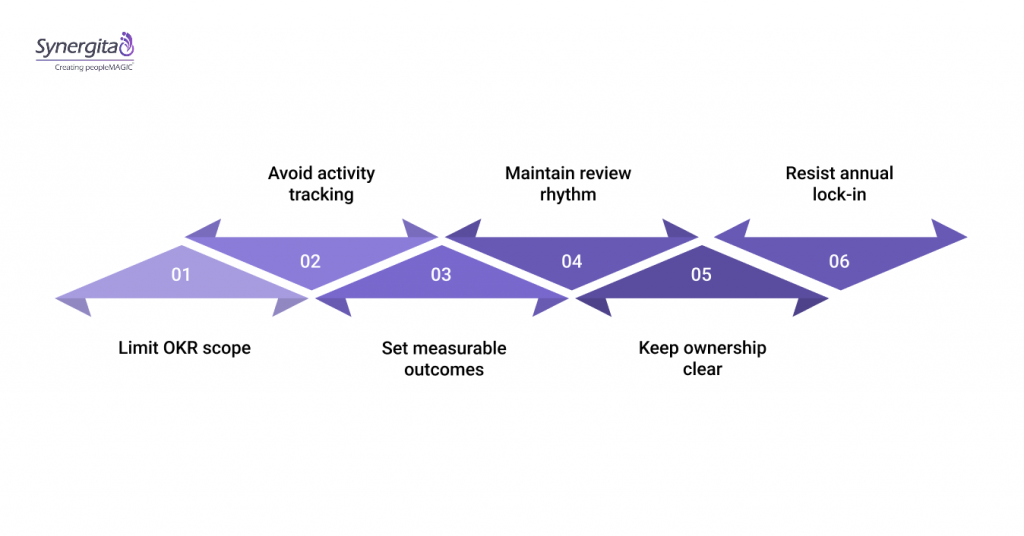
Finance teams see mixed results with OKRs when habits from traditional planning quietly carry forward into new goal-setting routines. Clear practices help OKRs support budgeting and forecasting instead of adding confusion during reviews and planning cycles.
Here are proven practices to follow, along with common mistakes that often weaken financial planning outcomes.
- Limit OKR scope: Finance teams perform better when each quarter focuses on fewer outcomes tied directly to budgeting and forecasting decisions.
- Avoid activity tracking: Treating tasks like closing reports as key results weakens focus on forecast quality and budget reliability.
- Set measurable outcomes: Each key result should reflect a clear financial change, such as forecast variance reduction or improved spend predictability.
- Maintain review rhythm: Skipping regular check-ins causes OKRs to fade, leaving budgets disconnected from current business conditions.
- Keep ownership clear: Shared goals without named owners create delays during budget reviews and weaken accountability for forecast adjustments.
- Resist annual lock-in: Treating OKRs as fixed yearly commitments reduces their value during reforecast cycles and changing cost pressures.
Teams using structured OKR tools like Synergita often find it easier to maintain visibility, ownership, and consistency across finance reviews.
Avoiding these mistakes becomes easier when goals are shared across teams involved in hiring, spending, and capacity decisions.
Also Read: Tips and Best Practices for OKR Reporting

How Shared OKRs Improve Cross-Team Financial Decisions
Finance teams struggle when hiring plans, capacity decisions, and spend requests arrive without shared context or agreed financial outcomes. Shared OKRs give finance, HR, and team managers a common reference for decisions that affect budgets and forecasts.
Here are practical ways shared OKRs improve coordination across finance, HR, and operational teams.
- Hiring plans: Shared OKRs connect headcount requests to expected outcomes, helping finance assess timing, affordability, and forecast impact.
- Capacity planning: HR and managers use OKRs to explain workforce needs while finance evaluates cost implications against agreed financial priorities.
- Budget accountability: Team managers understand how spending choices affect shared outcomes, reducing last-minute budget escalations during review cycles.
- Forecast discussions: Finance, HR, and managers reference the same OKRs during updates, keeping assumptions consistent across functions.
- Performance conversations: Shared OKRs shift reviews away from blame toward progress against outcomes that everyone agreed to support.
With shared OKRs in place, finance leaders can bring budgets, forecasts, and decisions into a more consistent rhythm.
Conclusion
Finance leaders see better budgeting and forecasting when goals, people decisions, and financial plans stay connected through shared outcomes. OKRs give finance, HR, and managers a common structure for decisions, reducing friction during reviews, reforecasts, and prioritization discussions.
Discover how Synergita aligns strategy and execution with clear, trackable OKRs.
FAQs
1. How long does it take for finance OKRs to show results in budgeting?
Most finance teams notice clearer decision-making within one quarter, while measurable forecast improvements usually appear after two consistent planning cycles.
2. Can finance OKRs work if the company still uses annual budgets?
Yes, finance OKRs work alongside annual budgets by guiding monthly reviews and helping teams adjust assumptions without reopening the full budget each time.
3. Who should own finance OKRs in smaller or mid-sized companies?
Ownership usually sits with the finance leader, while specific key results belong to managers responsible for spending, hiring, or revenue assumptions.
4. How many finance OKRs should a team run at one time?
Most teams perform better with one to three finance objectives per quarter, keeping focus on outcomes that affect budgets and forecasts directly.
5. What should finance teams avoid measuring in OKRs?
Finance teams should avoid measuring routine tasks or report completion, since those signals rarely improve budget accuracy or forecast reliability.