



OKRs and SMART goals are often used interchangeably, but they are used to address different problems. Understanding the differences helps teams plan more effectively and execute plans with clarity.
Quick Takeaway
- SMART goals are specific, realistic, and expect 100% completion. OKRs are ambitious, outcome-driven, and 70% success is considered remarkable.
- SMART goals are the best for individuals and projects; OKRs drive company-wide alignment. You should use SMART goals for tactical clarity and accountability and use OKRs for strategic direction and cross-functional coordination.
- You don’t have to choose; you can use both. Many organizations apply OKRs for strategy and SMART goals for execution to balance ambition with operational control.
- Implementation is more important than the framework. OKRs require discipline, transparency, and consistent tracking. Dedicated OKR software automates workflow, check-ins, provides real-time dashboards, and ensures alignment.
Many organizations face a dilemma during quarterly planning: half of the team supports OKRs while the other half wants SMART goals. Which one should you choose for your organization?
Both frameworks are great for goal-setting, but they solve different problems. Choosing the wrong framework for your business can affect your chances for success.
So let’s address the confusion. In this guide, you will discover the real differences between OKR vs SMART goals, when to use each framework, and whether you can (spoiler: you can!) use both together. By the end, you will know exactly which approach fits your team’s needs.
| Table of Contents 1. OKR vs SMART Goals: A Quick Comparison 2. What Are SMART Goals? 3. What Are OKRs? 4. OKR vs SMART Goals: The Key Differences 5. When to Use SMART Goals vs OKRs 6. Implementing OKRs? Here is How to Do It Correctly 7. The Bottom Line 8. Frequently Asked Questions |
OKR vs SMART Goals: A Quick Comparison
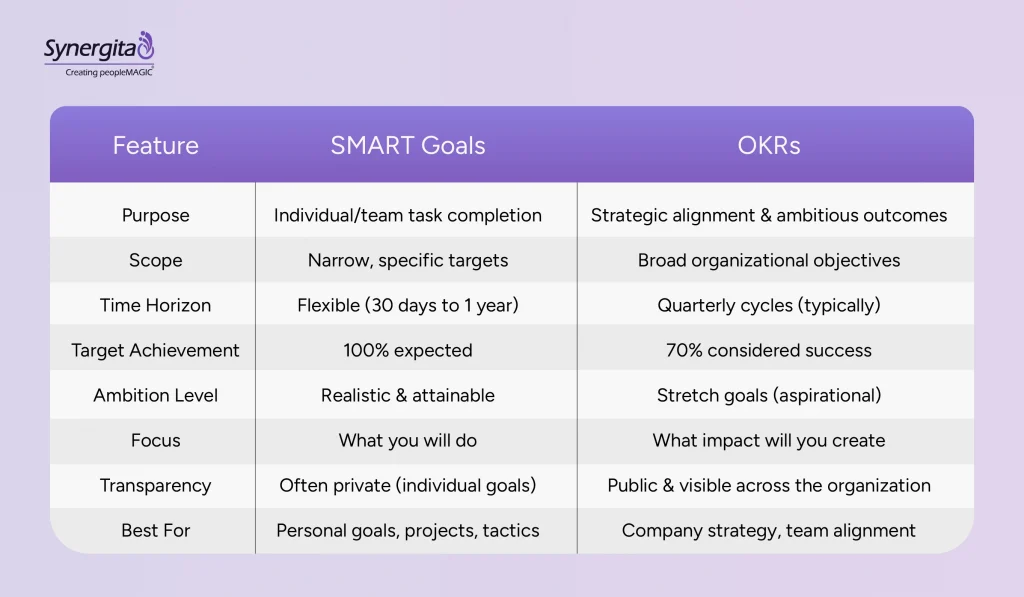
Before we dive deep and compare OKRs vs SMART goals in detail, here is a quick overview of the differences.
What Are SMART Goals?
SMART goals have been around since 1981, when George T. Doran introduced them as a framework for setting clear, actionable objectives. The acronym stands for:
- Specific: Exactly what will you accomplish?
- Measurable: How will you track progress?
- Achievable: Is this realistic given your resources?
- Relevant: Does it align with broader objectives?
- Time-bound: When will you complete this?
Here is an example of a SMART goal:
“Increase our email newsletter subscriber base from 5,000 to 7,500 subscribers by December 31 through a combination of lead magnets, social media promotion, and website optimization.”
Notice how specific it is? You know exactly what success looks like, how you’ll achieve it, and when it needs to be done. There’s zero ambiguity.
SMART goals are suitable for:
- Individual performance targets
- Project management
- Professional development
- Tactical execution
- Situations where you need 100% certainty
The limitation? SMART goals can encourage safe, incremental thinking. When “achievable” is built into the framework, you’re less likely to shoot for the moon.
What Are OKRs?
Objectives and Key Results (OKRs) were developed by Andy Grove at Intel in the 1970s and later popularized by John Doerr at Google. They’ve since become the go-to framework for ambitious tech companies like LinkedIn, Twitter, and Uber.
Here’s how the framework works:
Objectives are qualitative and inspirational. They answer: “Where do we want to go?”
Example: “Become the most trusted brand in cybersecurity”
Key Results are quantitative and measurable. They answer: “How will we know we’re getting there?”
Example Key Results:
- Increase Net Promoter Score from 45 to 65
- Achieve 4.5+ rating across all review platforms with 500+ reviews
- Reduce customer-reported security incidents by 75%
Notice the difference? The Objective paints a compelling vision. The Key Results tell you if you’re actually making progress toward that vision.
Here’s what makes OKRs special: you’re expected to achieve about 70% of your targets. If you’re consistently hitting 100%, you’re not being ambitious enough. This built-in stretch factor drives innovation and breakthrough thinking.
OKRs excel at:
- Strategic company goals
- Cross-functional initiatives
- Driving organizational alignment
- Encouraging ambitious thinking
- Quarterly planning cycles
The catch? OKRs require organizational maturity, consistent review processes, and cultural buy-in. They’re overkill for small teams or simple projects.
OKR vs SMART Goals: The Key Differences
OKRs and SMART goals may look similar at first glance. But when you break them down, you find they are different. Here are the four key differences.
1. Philosophy and Mindset
This is the biggest distinction, and it changes everything.
SMART goals operate on a “set it and achieve it” mentality. You aim for 100% completion. Anything less than full achievement feels like failure. This encourages conservative target-setting; after all, you want to make sure you can actually hit that goal.
OKRs operate on a “stretch and learn” mentality. You aim for 70% achievement. Missing your target isn’t failure; it’s learning. This encourages aggressive, aspirational thinking.
Example time:
- SMART goal: “Increase website conversion rate from 2% to 2.5%” (realistic 25% improvement)
- OKR: “Increase website conversion rate from 2% to 4%” (ambitious 100% improvement)
See the difference in ambition? The SMART goal is something you’re confident you can hit. The OKR makes you uncomfortable, which is exactly the point.
2. Scope and Alignment
SMART goals are typically individual- or small-team-focused. You set them for yourself or your immediate team. They’re self-contained and independent.
OKRs are organization-wide alignment tools. They cascade from the company level down to teams (and sometimes individuals). Everyone can see how their work connects to company objectives.
Think of it this way: SMART goals are individual puzzle pieces. OKRs show you what the complete puzzle looks like.
3. Time Horizons and Review Cadence
SMART goals are flexible. They might span 30 days, six months, or a full year. Reviews happen periodically, maybe monthly or at major milestones.
OKRs run on standardized quarterly cycles. You set them every quarter, review progress monthly (or even weekly for critical initiatives), and score results at quarter-end. This creates urgency and forces regular reflection.
4. Language and Focus
Here’s where the rubber meets the road.
SMART goals use action-oriented, output-focused language:
- Complete training program
- Hire 5 engineers
- Launch new feature
OKRs use outcome-oriented, impact-focused language:
- Objective: Build world-class engineering capability
- Key Result: Reduce time-to-hire from 90 to 45 days
The test is simple: Does your goal measure what you will do (output) or what you’ll achieve (outcome)?
When to Use SMART Goals vs OKRs
Here’s your decision framework:
Use SMART Goals When:
- You’re working on individual professional development (learning new skills, getting certified)
- You have specific project deliverables with a clear scope
- You’re managing a small team (under 10 people)
- Certainty is critical (compliance, contracts, non-negotiable deadlines)
- Success is one-dimensional and obvious
Use OKRs When:
- You’re setting strategic company priorities
- You need cross-functional alignment (multiple departments must coordinate)
- You want breakthrough results, not incremental improvement
- You need to inspire and rally teams around a mission
- You’re navigating ambiguity (new markets, innovation initiatives)
Quick rule: If you’re an individual contributor or small team executing tactical work, lean toward SMART goals. If you’re a leadership team driving strategic change across an organization, lean toward OKRs.
Can You Use Both Together?
Here’s the secret many companies don’t tell you: you don’t have to choose. Many successful organizations use both frameworks in a two-tier system.
The Two-Tier Approach:
Tier 1 – Strategic Layer (OKRs): Company and department-level objectives that are ambitious, public, and reviewed quarterly.
Tier 2 – Execution Layer (SMART Goals): Individual and project-level goals that are realistic, sometimes private, and track tactical work.
Here’s how it works in practice:
Company OKR (Strategic):
- Objective: Become the #1 customer-rated CRM in our category
- KR1: Achieve 4.7+ G2 rating with 500+ reviews
- KR2: Increase NPS from 40 to 70
- KR3: Reduce support tickets by 40%
Supporting SMART Goals (Tactical):
- Product Team: Launch in-app tutorial feature covering 5 core workflows by July 15
- Support Team: Reduce first response time from 4 hours to 1 hour by June 30
- Marketing Team: Generate 200 G2 reviews through customer outreach by Q2 end
See the relationship? The OKR sets the ambitious destination. The SMART goals define specific paths to get there. Teams collectively own OKRs; individuals personally own SMART goals.
This hybrid approach gives you the best of both worlds: strategic alignment from OKRs plus tactical clarity from SMART goals.
Implementing OKRs? Here Is How to Do It Correctly
If you’ve decided that OKRs are right for your organization, implementing them correctly is critical. The framework sounds simple, but executing it well requires discipline, transparency, and the right tools.
This is where many teams face issues. They set OKRs in a spreadsheet, check them once mid-quarter, and forget about them until it’s time to scramble at quarter-end.
Start With SMART Individual OKRs
At the individual level, the most effective OKRs are built using SMART goals: Specific, Measurable, Achievable, Relevant, and Time-bound. For example, instead of writing “improve customer engagement,” a well-structured individual OKR would read: “Increase monthly active users from 62% to 80% by end of Q3”
Successful OKR implementation requires:
- Consistent weekly or monthly check-ins
- Clear progress tracking that is visible to the whole team
- Regular updates that keep OKRs top of mind
- Easy scoring and reflection at quarter-end
That’s why many growing companies invest in dedicated OKR software to keep everyone aligned. The OKR management tool helps teams set, track, and achieve their objectives with features like automated check-ins, real-time progress dashboards, and seamless cascading from company goals to team and individual OKRs.
The Bottom Line
So, OKR vs SMART goals, which is better?
The answer is not straightforward and depends on what suits your organization the best.
Choose SMART goals when you need tactical clarity, individual accountability, and realistic targets, but select OKRs when you need strategic alignment, ambitious goals, and organizational coordination. OKRs are ideal for company strategy, cross-functional initiatives, and breakthrough goals.
However, you can choose both using the two-tier approach: OKRs for strategic direction, SMART goals for tactical execution. Synergita’s OKRs tool helps you manage OKRs effortlessly. Try it free for 14 days and experience how much easier OKR management becomes with the right platform.

Frequently Asked Questions
SMART goals are specific, realistic targets designed for individual execution with 100% completion expected. OKRs are aspirational, organization-wide objectives where about 70% achievement is considered success.
Yes, at the individual level, the two complement each other well. You can use SMART criteria to write individual OKRs, making them more specific, measurable while the broader OKR framework keeps teams and company goals aligned.
It depends on the specific requirements. SMART goals are better for individual accountability and project management, while OKRs are ideal for strategic alignment, cross-functional initiatives, and driving ambitious organizational change. You should choose based on your team size and goals.
OKRs are usually set on a quarterly cycle. So, it’s better to review them weekly or twice a month. Regular reviews maintain visibility, encourage accountability, and prevent last-minute chaos at the end of the quarter.
No, OKRs are designed as a learning and alignment framework, not a compensation tool. Tying them directly to performance reviews can discourage ambitious goal-setting and reduce innovation.