



Legal departments often function as a “black box” where high-stakes work happens without clear visibility into strategic impact. You might see your team buried under contract reviews and compliance fire drills while stakeholders view Legal as a bottleneck.
This disconnect makes it difficult to justify headcount or demonstrate how legal initiatives actually protect the bottom line and enable growth. Traditional management often relies on billable hours or subjective feedback, which fails to capture the complexity of modern corporate law.
Without a structured goal-setting system, your highly skilled attorneys end up reacting to crises instead of proactively mitigating organizational risk. You need a way to translate legal excellence into the language of business results that executive leadership understands.
This guide provides 15 actionable OKR examples for legal department teams. Use them to shift from a cost center to a quantified strategic partner.
Quick Look
- Legal OKRs must measure outcomes like risk reduction, not just completed reviews.
- Effective legal OKRs balance quantitative metrics with qualitative compliance checks.
- Define specific owners for each key result to maintain clear accountability.
- Avoid vanity metrics; focus on data that influences business decisions.
- Integrate OKR check-ins into existing legal ops meetings for consistency.
- Use a dedicated platform to align legal goals with company-wide objectives.
Importance of OKRs for the Legal Department
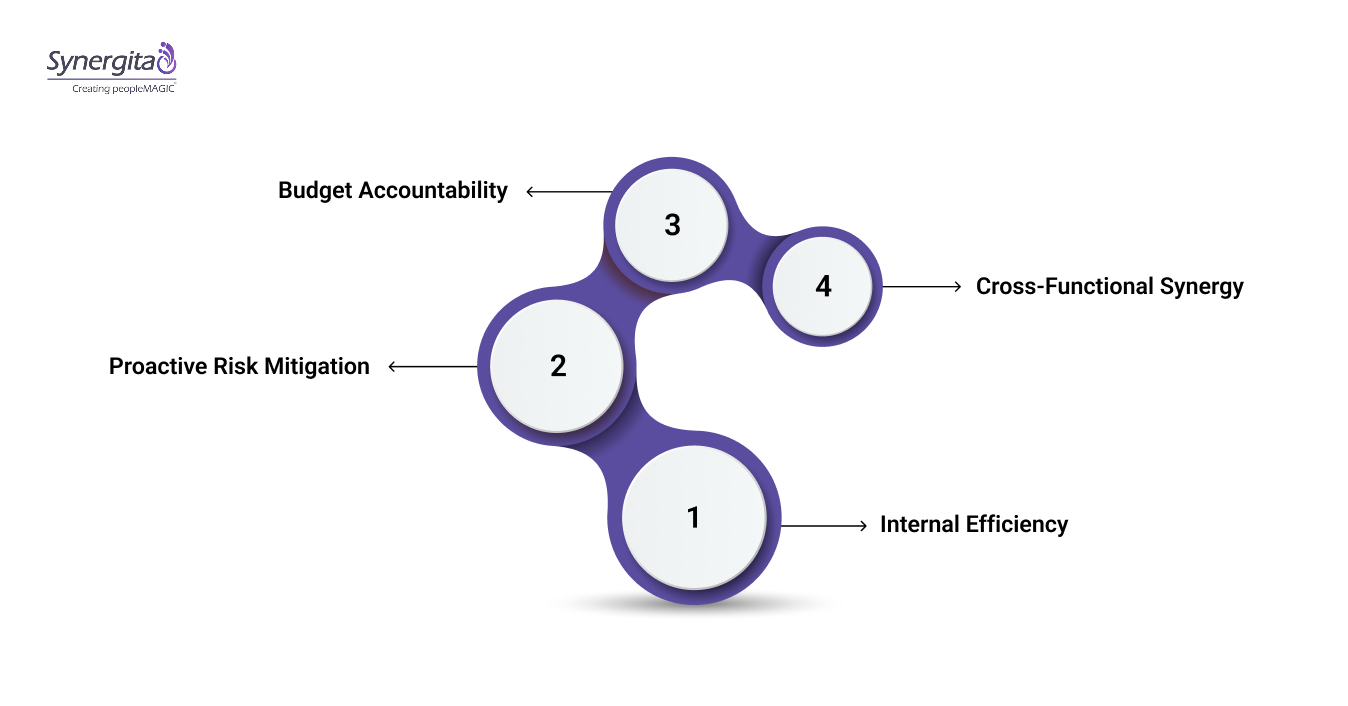
Corporate legal teams are under more pressure than ever to do more with fewer resources while navigating complex global regulations. A structured goal-setting framework provides the focus needed to ensure high-cost talent works on the most critical business priorities.
This discipline moves the department from a purely defensive posture to one that actively facilitates revenue and innovation.
Standardizing your performance measurement through this framework offers several strategic advantages for legal leadership:
- Internal Efficiency: Helps identify bottlenecks in the contract lifecycle and administrative workflows that slow down other business units.
- Proactive Risk Mitigation: Shifts the focus toward preventative measures and compliance training rather than just responding to litigation.
- Budget Accountability: Provides a clear narrative for outside counsel spend and the impact of internalizing specific legal functions.
- Cross-Functional Synergy: Aligns legal timelines with product launches and sales targets, reducing friction during high-pressure deal closures.
Establishing this foundational clarity allows your team to move from being perceived as the “department of no” to a business accelerator.
How to Write Effective OKRs for the Legal Department
Writing effective goals for a technical department like Legal requires a deep understanding of the distinction between an activity and a result. You must ensure that your team is not just completing tasks, but actually moving the needle on organizational health.
Follow these disciplined steps to create a culture of high performance within your legal operations.
1. Focus on Strategic Outcomes
Legal objectives should describe a qualitative state of success that directly supports the company’s broader mission for the year. Avoid using internal legal jargon that non-legal stakeholders might find confusing or irrelevant to their own departmental goals.
- Connect the objective to a business driver like “Revenue Growth” or “Risk Reduction.”
- Use inspiring language like “Become the benchmark for compliance excellence.”
- Ensure the objective is ambitious enough to require a change in current behavior.
2. Define Measurable Key Results
Every Key Result must be a quantitative yardstick that proves you have achieved the objective without any room for subjective debate. If a result is just a task on a to-do list, it is not a true Key Result.
- Use percentages, dollar amounts, or time-based metrics for every result.
- Include a mix of efficiency metrics and quality benchmarks.
- Ensure the data for these results is verifiable through your existing legal tech stack.
3. Ensure Cross-Functional Buy-In
Legal work rarely happens in isolation, so your OKRs should reflect the collaborative nature of corporate law and business operations. Consult with Sales, HR, and Product heads to ensure your legal goals align with their upcoming quarterly needs.
- Validate that your “contract speed” goals match the Sales team’s quarterly targets.
- Coordinate compliance objectives with HR’s internal training and culture initiatives.
- Align intellectual property goals with the Product team’s roadmap for innovation.
Transitioning from a reactive mindset to a strategic one is easier with concrete examples to guide your team’s planning.
Aligning these technical milestones with business outcomes is the first step toward a high-performance legal culture. Explore Synergita’s OKR module to see how we help legal teams manage these objectives without adding administrative overhead. Book a demo to learn more.
Also read: 15 Customer Support OKR Examples: The Complete Guide to Scaling Support Quality
15 Ultimate OKR Examples for Legal Department
Translating legal strategy into execution requires a library of specific, data-backed examples that your team can adapt for their specific needs. The following tables provide a comprehensive playbook for setting goals that cover contract management, compliance, and corporate governance.
These examples move beyond surface-level tasks to focus on the formulas that drive significant organizational value.
1. For Contract Efficiency & Sales Support
| Objective 1 | Key Results |
| Streamline the sales contract lifecycle to accelerate revenue | 1. Reduce average contract turnaround time from 10 days to 5 days. |
| 2. Implement a self-service contract portal for 100% of standard NDAs. | |
| 3. Achieve a 90% satisfaction rating from the Sales team on legal support. |
| Objective 2 | Key Results |
| Optimize the procurement legal process for cost savings | 1. Complete review of 100% of vendor contracts within 72 hours of receipt. |
| 2. Identify and renegotiate 5 key vendor contracts to save $100k annually. | |
| 3. Standardize 3 new templates for common procurement service agreements. |
| Objective 3 | Key Results |
| Strengthen intellectual property protection for core products | 1. File 10 new patent applications for the R&D department. |
| 2. Conduct IP awareness training for 100% of the engineering staff. | |
| 3. Execute a comprehensive audit of all current trademark filings. |
2. For Compliance, Risk & Governance
| Objective 4 | Key Results |
| Establish a gold-standard global data privacy framework | 1. Achieve 100% compliance with new regional data protection laws. |
| 2. Conduct privacy impact assessments for 5 new product features. | |
| 3. Reduce data subject access request (DSAR) response time by 40%. |
| Objective 5 | Key Results |
| Minimize corporate risk through proactive legal audits | 1. Complete internal legal audits for all 4 regional branch offices. |
| 2. Remediate 100% of high-risk findings within 30 days of the report. | |
| 3. Update the corporate risk register for the Board of Directors. |
| Objective 6 | Key Results |
| Elevate the corporate ethics and compliance culture | 1. Achieve a 100% completion rate for annual anti-bribery training. |
| 2. Reduce the time to investigate whistleblower reports by 25%. | |
| 3. Launch an internal “Ethics Hotline” awareness campaign to all staff. |
3. For Litigation & Financial Management
| Objective 7 | Key Results |
| Optimize outside counsel spend without sacrificing quality | 1. Reduce total legal spend on external firms by 15% this quarter. |
| 2. Negotiate alternative fee arrangements (AFAs) for 50% of new matters. | |
| 3. Internalize 3 recurring legal workflows previously sent to outside firms. |
| Objective 8 | Key Results |
| Resolve outstanding litigation matters favorably and efficiently | 1. Close 3 pending litigation cases within the budgeted legal reserves. |
| 2. Reduce the average lifecycle of small-claims disputes by 20%. | |
| 3. Implement a new e-discovery tool to save $50k in processing costs. |
Also read: Logistics OKR Examples: 15 Best Objectives And Key Results
| Objective 9 | Key Results |
| Strengthen employment legal support for HR initiatives | 1. Update 100% of employee handbooks to reflect 2026 labor laws. |
| 2. Reduce the frequency of employment-related claims by 15% YoY. | |
| 3. Review and approve 100% of executive severance agreements in 48 hours. |
4. For Operational Excellence & Legal Tech
| Objective 10 | Key Results |
| Modernize the legal tech stack for improved productivity | 1. Successfully deploy a new Contract Lifecycle Management (CLM) tool. |
| 2. Train 100% of the legal staff on the new matter management system. | |
| 3. Achieve 80% adoption of the digital signature platform by stakeholders. |
| Objective 11 | Key Results |
| Enhance board-level governance and reporting transparency | 1. Deliver 100% of board materials 5 days prior to scheduled meetings. |
| 2. Implement a digital portal for secure board voting and document storage. | |
| 3. Standardize the legal reporting format for the Audit Committee. |
| Objective 12 | Key Results |
| Build a high-performing and engaged legal team | 1. Achieve an 85% employee engagement score in the legal department. |
| 2. Ensure 100% of attorneys complete 15 hours of specialized CLE. | |
| 3. Implement a formal mentorship program for junior legal associates. |
| Objective 13 | Key Results |
| Streamline the M&A legal due diligence process | 1. Create a standardized due diligence checklist for all acquisitions. |
| 2. Reduce the time to populate virtual data rooms by 30%. | |
| 3. Complete legal review of 2 potential targets within the deal window. |
| Objective 14 | Key Results |
| Improve internal legal knowledge management | 1. Migrate 100% of legal templates to a centralized, version-controlled library. |
| 2. Create 10 “Playbooks” for common legal negotiations. | |
| 3. Reduce the volume of routine legal inquiries by 20% via a new FAQ. |
Also read: IT OKR Examples: Top 15 Objectives And Key Results
| Objective 15 | Key Results |
| Strengthen environmental and social governance (ESG) legal oversight | 1. Publish the annual legal compliance report on ESG disclosures. |
| 2. Review 100% of supply chain contracts for sustainability clauses. | |
| 3. Secure a 95% pass rate on the external environmental compliance audit. |
Executing these goals requires a unified platform that provides visibility into team progress. Schedule a demo with Synergita to discover how our solution helps you prove the strategic value of your legal operations.

Moving from these specific examples to a successful rollout involves avoiding common strategic errors.
Common OKR Mistakes Legal Department Makes (And How to Avoid Them)
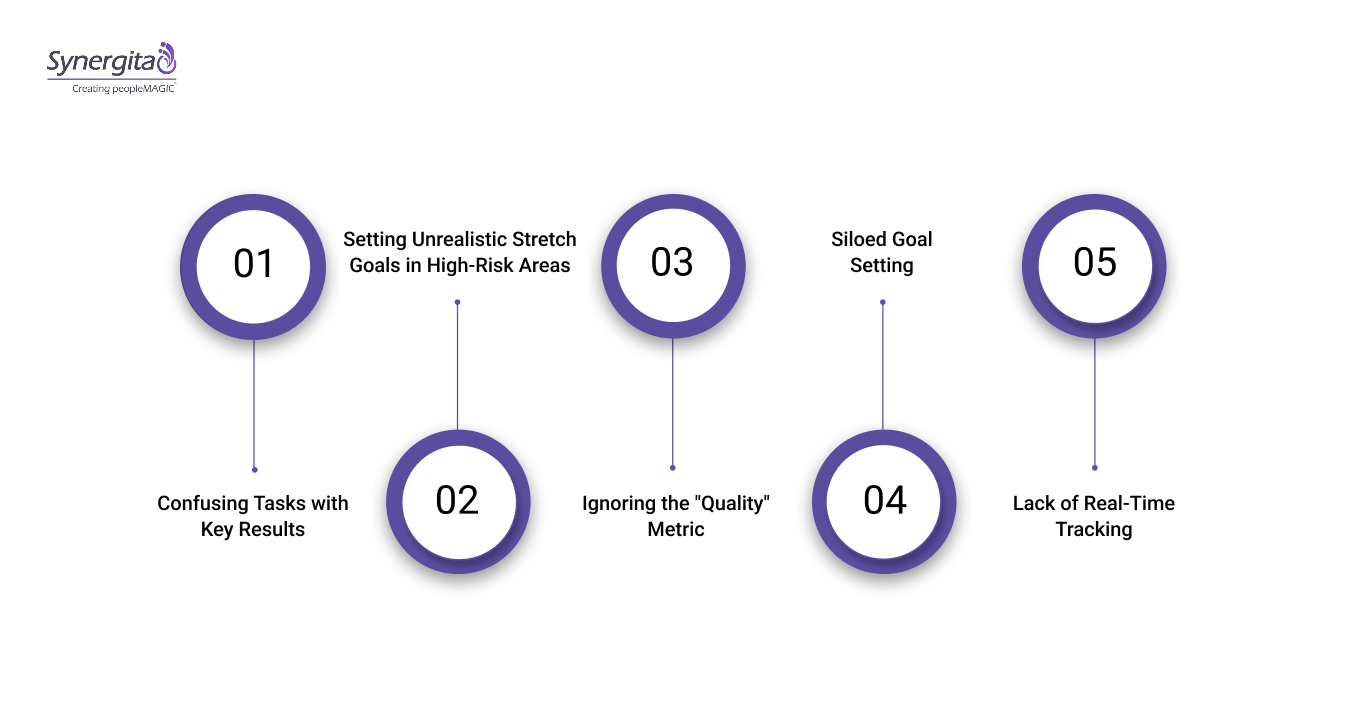
Legal teams often face unique challenges when adopting a goal-setting framework designed for agile business units. Without careful planning, your OKRs can unintentionally encourage risk-averse behavior or obscure the actual progress of complex legal work.
Recognizing these traps early allows you to build a more resilient and transparent organizational culture.
1. Confusing Tasks with Key Results
Attorneys are used to checking off tasks, but an OKR that says “Review 50 contracts” is just an activity. This mistake fails to measure if those reviews actually improved the business or reduced any specific risks.
Solution: Focus your Key Results on the impact of those tasks, such as “Reduce contract turnaround time” or “Decrease error rate.”
2. Setting Unrealistic Stretch Goals in High-Risk Areas
While OKRs encourage ambitious “stretch” targets, applying this to compliance or safety can be dangerous for a legal team. Attempting to “innovate” on a zero-tolerance compliance requirement can lead to catastrophic regulatory failures.
Solution: Use “Committed OKRs” for regulatory and compliance goals where the target must be 100% every single time.
3. Ignoring the “Quality” Metric
A legal team might hit its speed goals for contract review but sacrifice accuracy, leading to expensive litigation later. If you only measure speed, you incentivize your team to skip the deep analysis that protects the company.
Solution: Always pair an efficiency Key Result with a quality-control metric to ensure a balanced approach to legal excellence.
4. Siloed Goal Setting
Legal teams often set goals in a vacuum without consulting the departments they support, like Sales or HR. This leads to Legal hitting their own targets while inadvertently blocking the progress of other critical business units.
Solution: Co-create at least one OKR with each major stakeholder department to ensure departmental synergy and shared success.
5. Lack of Real-Time Tracking
Many legal departments treat OKRs as a static document that they only look at during the end-of-quarter review. This “set and forget” mentality prevents you from course-correcting when legal priorities inevitably shift during a crisis.
Solution: Use a dynamic platform like Synergita to track progress weekly and discuss roadblocks in regular team huddles.
Transitioning toward a data-driven legal culture is significantly easier when you follow proven implementation strategies.
Also read: Top Objectives of Employee Engagement
Best Practices for Effective OKR Implementation
Sustaining a high-performance legal culture requires more than just a good template; it requires a commitment to radical transparency. Your goal-setting process must be visible to everyone, from the junior paralegals to the General Counsel and executive board.
This openness creates a sense of shared ownership that is vital for surviving the high-pressure environment of corporate law.
1. Adopt a Balanced Scorecard Approach
Ensure your legal OKRs cover a mix of financial, customer (internal stakeholder), process, and growth-oriented goals for the quarter. This provides a holistic view of the department’s health and prevents over-rotation on any single technical metric.
Impact:
- Ensures long-term sustainability by balancing immediate needs with future growth.
- Provides a more compelling narrative for the department’s value during board meetings.
- Reduces the risk of burnout by acknowledging different types of legal contributions.
2. Implement a Continuous Feedback Loop
Move away from the annual performance review and integrate goal discussions into your regular 1:1 meetings with your legal staff. This allows for immediate coaching and ensures that individual efforts stay aligned with the department’s evolving strategic priorities.
Impact:
- Increases legal staff engagement by providing real-time recognition for achievements.
- Allows for faster pivoting when new regulations or litigations suddenly emerge.
- Improves the accuracy of performance evaluations by using continuous data points.
3. Leverage Legal Tech for Automated Tracking
Avoid the trap of manual spreadsheets by integrating your OKR platform with your existing matter management and CLM tools. Automated data feeds reduce the administrative burden on your attorneys and provide a “single source of truth” for leadership.
Impact:
- Eliminates human error in reporting and provides more credible data to stakeholders.
- Frees up attorneys to focus on high-value legal work rather than data entry.
- Enables real-time visualization of goal trajectories and potential bottlenecks.
Correcting these strategic errors sets the stage for adopting the advanced techniques used by high-performing legal organizations.
Also read: How to Give Constructive Feedback to Employees
Synergita: Moving Legal Operations from Cost Center to Strategic Asset
Corporate legal leaders often struggle with fragmented data and a lack of real-time visibility into their team’s strategic impact. You might find yourself spending hours manually aggregating report data for the board instead of proactively managing organizational risk.
This lack of a unified source of truth makes it nearly impossible to align your highly skilled legal talent with the company’s growth mission. Synergita provides a modular, cloud-based solution that specifically addresses the needs of high-stakes legal and HR leadership.
Our platform consolidates your goal tracking, continuous feedback, and performance analytics into a single, user-friendly interface that facilitates strategic alignment.
- Lightweight OKR Module: Deploy your strategic framework across the legal department in days with intuitive visualization tools.
- Continuous Check-ins: Facilitate meaningful 1:1 conversations that keep your attorneys focused on high-value outcomes.
- AI-Powered Analytics: Access distraction-free insights into team performance and sentiment through configurable dashboards.
- Perform Plus Module: Automate complex promotion cycles and aspiration tracking for your top-performing legal talent.
By unifying your talent and goal management, you can ensure that every legal initiative contributes to the firm’s overall success.
Conclusion
OKRs provide the structure legal departments need to quantify their strategic value. Moving from activity reports to outcome-based metrics demonstrates a concrete contribution to business health. The examples and practices here offer a clear path to that shift.
Synergita is designed to support this strategic transition for legal teams. It provides the necessary alignment and visibility tools.
See how Synergita can structure and track your legal department’s goals. Book a demo to discuss your specific legal ops challenges.

FAQs
Q. How many OKRs should a legal department have?
Most successful legal departments focus on 3 to 5 high-level objectives per quarter. Each objective should have no more than 3 to 4 Key Results to ensure the team remains focused and avoids being overwhelmed.
Q. Can OKRs be used to measure individual attorney performance?
While OKRs are primarily a team alignment tool, they can inform individual development plans. However, they should not be the sole metric for compensation, as this can discourage the setting of ambitious stretch goals.
Q. How do we measure “Risk Reduction” in an OKR?
Risk reduction can be measured through proxy metrics like “Audit pass rates,” “Percentage of staff trained on compliance,” “Number of identified vulnerabilities remediated,” or “Decrease in litigation costs YoY.”
Q. What if a legal matter changes mid-quarter?
OKRs are meant to be agile. If a major litigation or regulatory shift occurs, legal leaders should feel empowered to “pause” or “pivot” specific OKRs to reflect the new reality of the department’s priorities.
Q. How do we track OKRs without adding more work for busy attorneys?
Use a dedicated platform like Synergita that integrates with your existing workflows. Focus on a few high-impact metrics that can be easily pulled from your CLM or matter management systems.
Q. Should legal OKRs be shared with the entire company?
While high-level objectives can be shared to show alignment, specific Key Results involving sensitive litigation or confidential compliance data should remain restricted to the relevant leadership teams.