



Despite widespread adoption of OKRs and performance metrics in product and engineering organizations, research & development (R&D) functions still struggle to connect goal‑setting frameworks.
This is not surprising, as about 35% of them don’t use specific ROI metrics at all, and another 23% only monitor one solitary figure. This gap isn’t merely semantic.
In practice, R&D leaders routinely report that legacy metrics lead to misaligned priorities: Teams chase output volume rather than outcome impact and miss early‑stage pipeline performance.
In contrast, well-designed Objective and Key Result (OKR) systems for R&D metrics deliver outcomes. This article goes beyond introductory framing to address the reported failures of old R&D measurement approaches and explain how modern OKR systems deliver strategic clarity.
Quick Key Takeaways
- Properly structured OKRs are essential for R&D teams to align their efforts with broader business goals.
- Traditional Key Performance Indicators (KPIs) often fail to measure the true impact of R&D; outcome-based OKRs provide a more effective approach.
- Real-time tracking and adaptable OKRs help R&D teams stay aligned and make necessary adjustments throughout the project lifecycle.
- Efficient resource allocation is key to maximizing R&D outcomes and ensuring alignment with strategic goals.
- By focusing on outcome-based OKRs, R&D teams can improve their innovation, efficiency, and overall ROI.
Why Does Your R&D Team Need OKRs Most?
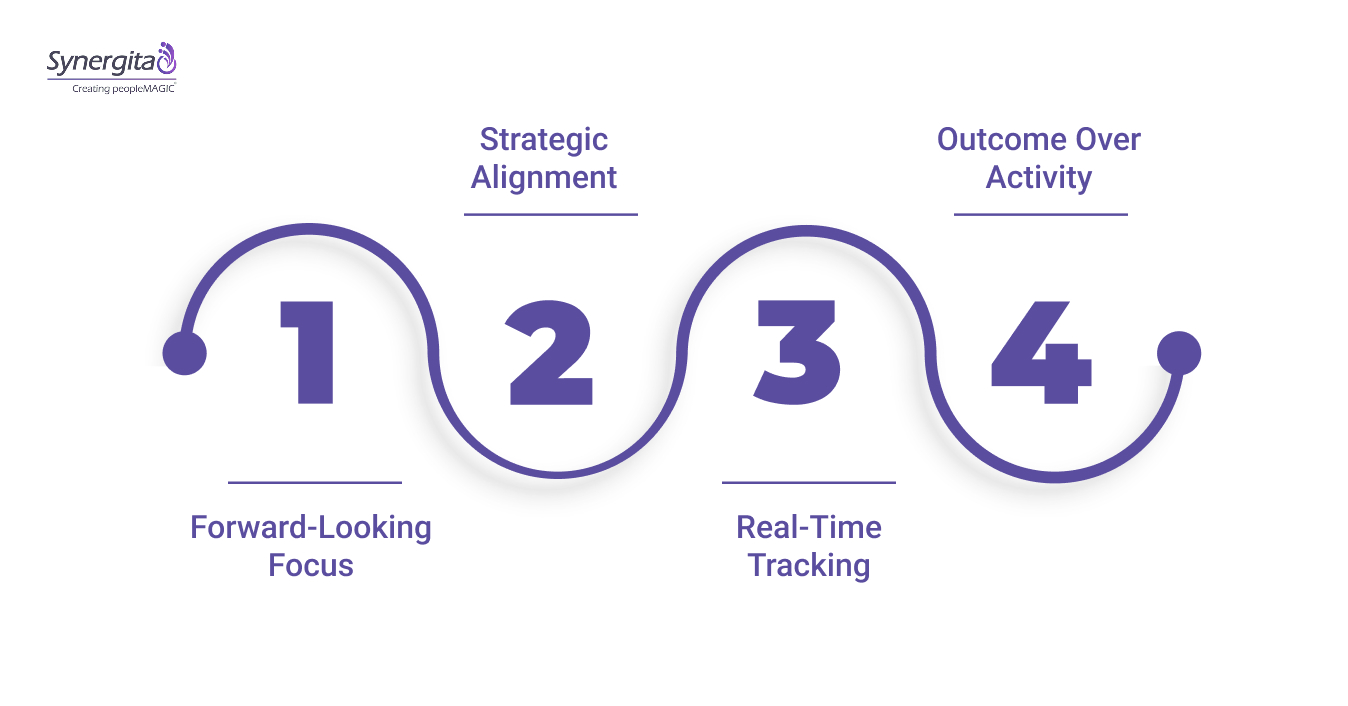
OKRs (Objectives and Key Results) provide a modern, results-driven framework for R&D teams, offering a clearer path than traditional KPIs.
Why OKRs Matter for R&D:
- Forward-Looking Focus: OKRs help R&D teams set ambitious, measurable goals that drive innovation and efficiency.
- Strategic Alignment: Ensures R&D efforts are directly connected to company objectives, preventing siloed teams.
- Real-Time Tracking: Offers continuous feedback and progress tracking, helping teams stay adaptable.
- Outcome Over Activity: Focus on delivering value, such as faster time-to-market and customer-driven innovation, rather than just research output.
By integrating OKRs into R&D strategies, teams achieve better alignment, more impactful outcomes, and ultimately drive growth and innovation.
While OKRs provide clear, measurable goals for R&D teams, the challenge lies in crafting them effectively. To ensure these objectives drive meaningful results, your R&D teams need to follow a structured approach.
Also Read: Logistics OKR Examples: 15 Best Objectives And Key Results
A Four-Step Guide to Craft an OKR System for R&D Metrics
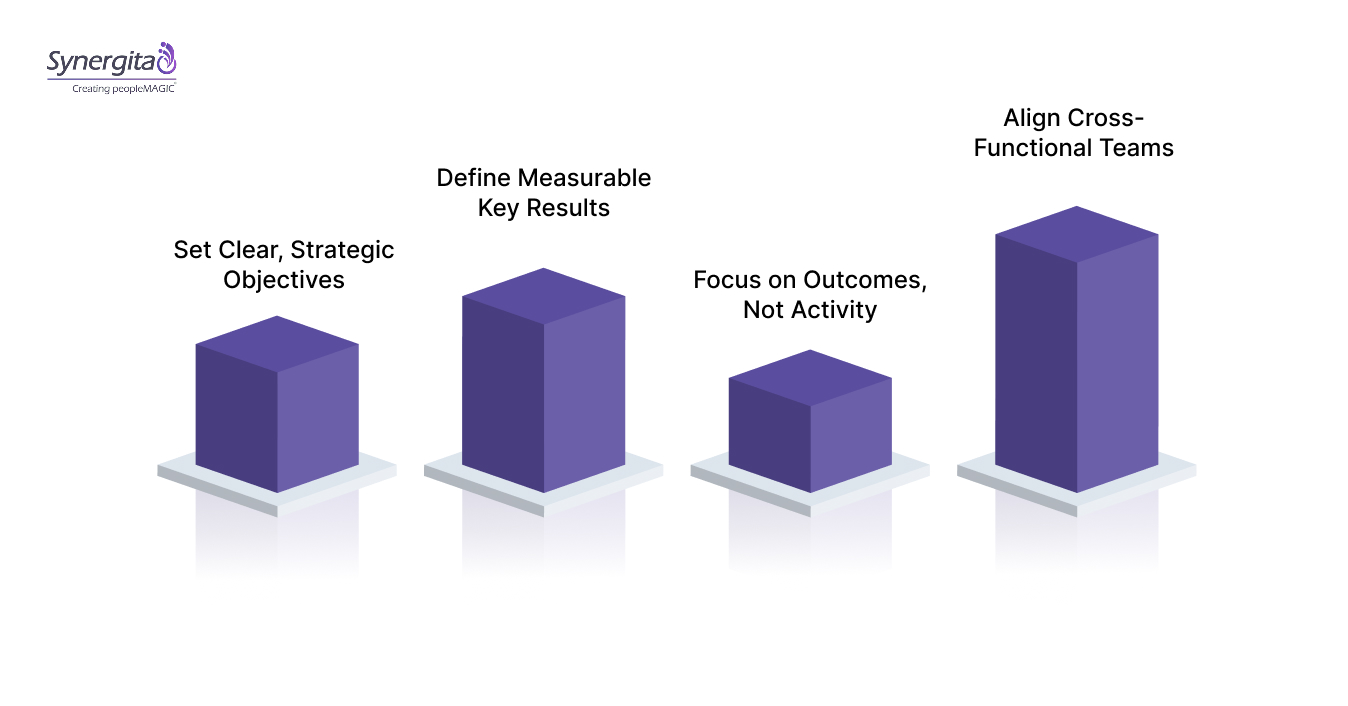
When setting OKRs for R&D teams, it’s essential to ensure they are both actionable and measurable. Here’s a structured approach to crafting OKRs that will drive performance and alignment across research teams:
1. Set Clear, Strategic Objectives
- Focus on improving innovation or speeding up development cycles.
- Ensure the objective directly supports business priorities.
- Align objectives with long-term R&D vision and company strategy.
2. Define Measurable Key Results
- Break down each objective into 3–5 specific, quantifiable key results.
- Key results should track real outcomes, like increasing research efficiency by 20% or reducing development time by 15%.
- Ensure the key results are time-bound and trackable to measure progress accurately.
3. Focus on Outcomes, Not Activity
- Prioritize results that show tangible impact, such as time-to-market improvements, not just internal processes or activities.
- Ensure key results reflect outcomes that are business-relevant, like enhanced customer satisfaction or market validation.
- Avoid vanity metrics (e.g., number of reports written) that don’t move the needle.
4. Align Cross-Functional Teams
- Ensure OKRs reflect collaboration across various functions, such as R&D, product, and marketing.
- Align team OKRs with the overall business strategy to break down silos and enhance coordination.
- Regularly review progress with stakeholders to maintain alignment and adjust as necessary.
So, you know the mechanics of crafting an OKR. But how do you make this framework stick in the dynamic world of R&D? This is why moving from theory to implementation requires looking at real-world examples.
Also read: OKR vs KPI: Key Differences and How to Use Both

15 OKR Examples for R&D Teams
For R&D leaders, the challenge is creating OKRs that genuinely turn principle into practice. Explore these 15 targeted OKRs to address a core goal with three concrete key results.
OKR 1: Build On Team Performance and Collaboration
- KR1: Improve cross-functional communication by 30%.
- KR2: Increase team satisfaction score to 85% or above.
- KR3: Achieve 90% completion rate of collaborative projects.
OKR 2: Establish Lead and Supporting Themes
- KR1: Align 80% of projects with core company themes.
- KR2: Define and communicate 3 lead research themes for the year.
- KR3: Ensure 70% of the teams adopt these themes in their projects.
Without a clear strategic direction, R&D teams may work on projects that are not aligned with business priorities. Synergita’s goal alignment features help ensure your projects stay focused on core company themes, promoting strategic unity.
OKR 3: Refine Product Prototyping and Testing Efficiency
- KR1: Increase the number of successful prototype iterations by 25%.
- KR2: Reduce the average testing time per prototype by 15%.
- KR3: Achieve 95% on-time completion of testing milestones.
OKR 4: Boost Innovation and Development
- KR1: File at least 10 new patents by the end of the quarter.
- KR2: Increase research paper submissions to top journals by 20%.
- KR3: Establish 3 new strategic partnerships for co-development.
OKR 5: Improve Collaboration with External Research Partners
- KR1: Increase joint projects with external partners by 30%.
- KR2: Achieve 85% satisfaction score in external partner feedback surveys.
- KR3: Accelerate the development of 2 new co-funded projects.
OKR 6: Optimize Resource Allocation
- KR1: Reduce R&D budget overruns by 15%.
- KR2: Allocate 60% of resources to high-priority projects.
- KR3: Decrease project delays due to resource shortages by 20%.
OKR 7: Enhance Data-Driven Decision-Making
- KR1: Implement data analytics tools for all major R&D projects.
- KR2: Increase data-driven project decisions by 40%.
- KR3: Improve project outcomes by using predictive analytics on 3 major R&D initiatives.
OKR 8: Accelerate and Enhance Pharmaceutical Processes
- KR1: Reduce R&D cycle time by 20%.
- KR2: Increase successful product formulations by 15%.
- KR3: Implement automation in at least 3 major R&D processes.
Pharmaceutical R&D processes are often slow and resource-intensive, delaying product launch timelines. Synergita’s platform allows teams to track progress. This development automates time-consuming tasks, speeding up overall processes.
OKR 9: Improve Knowledge Sharing and Documentation
- KR1: Increase knowledge sharing frequency by 30% within the team.
- KR2: Ensure 100% of research projects are documented on the central platform.
- KR3: Improve access to research data by centralizing all project documentation.
OKR 10: Upgrade Agility and Time-to-Market
- KR1: Decrease time-to-market for key products by 20%.
- KR2: Implement agile project management across all R&D teams.
- KR3: Increase the number of iterations per product by 15%.
OKR 11: Enhance Talent Development and Retention
- KR1: Increase employee retention rate by 10%.
- KR2: Ensure 100% of staff complete at least one professional development course.
- KR3: Promote 3 key leaders within the year.
OKR 12: Improve Sustainability
- KR1: Reduce energy consumption in facilities by 10%.
- KR2: Decrease waste produced during activities by 20%.
- KR3: Increase sustainability in projects by integrating green technologies in 50% of projects.
OKR 13: Strengthen Intellectual Property (IP) Portfolio
- KR1: Secure 5 new patents in critical areas of research.
- KR2: Increase IP licensing revenue by 15%.
- KR3: Implement IP training for 100% of R&D teams.
OKR 14: Organize Supply Chain Processes
- KR1: Reduce lead time for materials by 15%.
- KR2: Decrease procurement costs by 10%.
- KR3: Improve supplier reliability score by 20%.
OKR 15: Enhance Customer-Centric Research Initiatives
- KR1: Increase customer feedback integration by 30%.
- KR2: Improve customer satisfaction score for products by 10%.
- KR3: Launch 3 customer-driven projects by year-end.
Translating examples into effective practice requires mastering the principles of OKR design. To bridge this gap, you should know the key best practices for setting objectives that are both inspiring and grounded.
Use the accompanying “Do’s and Don’ts” guide as a quick reference to refine your approach in R&D operations.
Also Read: 15 Key HR Metrics Every Organization Should Track

R&D Team OKR Best Practices You Must Know
To maximize the effectiveness of OKRs in R&D, it’s important to follow some key best practices that ensure alignment, focus, and measurable results. That leads you to the ultimate question: Which parts of actions are doable and which aren’t?
| Do’s | Don’ts |
|---|---|
| Set clear, outcome-focused goals | Avoid setting vague, activity-based objectives |
| Ensure key results are measurable and realistic | Don’t overload OKRs with too many metrics |
| Align objectives with broader business goals | Don’t create disconnected OKRs with no strategic tie |
| Keep OKRs dynamic and adaptable | Avoid rigid OKRs that can’t be adjusted |
By following these best practices, R&D teams ensure their efforts are aligned with larger organizational goals. Many R&D teams struggle with maintaining alignment, managing competing priorities, and ensuring that their efforts translate into impactful results.
Fortunately, Synergita’s OKR system addresses these challenges, offering a comprehensive solution.
Synergita’s Solution to R&D OKR Challenges
Common issues like lack of alignment, inefficient resource allocation, and insufficient tracking of innovation often lead to slower progress.
Challenge 1: Lack of Alignment with Business Goals
Many R&D teams struggle with ensuring their projects are directly aligned with organizational goals. Research initiatives, even when successful in their own right, often fail to connect with key business outcomes such as customer satisfaction, market relevance, and revenue growth.
How Synergita Solves It
Synergita’s OKR system is designed to align R&D OKRs with overall business goals, ensuring that every project and objective contributes to the company’s strategic vision.
With real-time tracking, cascading OKRs, and integrations with tools like Jira and Microsoft Teams, Synergita ensures that R&D teams remain focused on high-impact outcomes that drive growth.
Challenge 2: Ineffective Resource Allocation
R&D teams often struggle to allocate resources effectively across multiple projects, leading to delays and wasted effort. This issue becomes especially significant when multiple, competing research initiatives require attention and investment.
How Synergita Solves It
The AI-powered OKR assistant (OKR Buddy) keeps projects on track and allows adjustments when necessary.
Additionally, this platform’s project status updates allow managers to spot challenges early and reassign resources to where they are most needed.
Problem 3: Lack of Measurable Progress and Tracking
Tracking the progress of R&D projects can be difficult, especially when traditional KPIs are used. Metrics like the number of patents filed or hours worked fail to account for more nuanced aspects like innovation quality or research impact.
How Synergita Solves It
With Synergita’s continuous feedback loops, R&D teams can adjust their efforts based on real-time insights.
If you’re interested in learning how to better align your R&D team’s OKRs with your company’s strategic goals, explore Synergita for effective implementation.
Also Read: Top 10 OKR Software Features You Need for a Competitive Advantage
Focusing on Return On Investment (ROI) with OKRs
The ability of R&D teams to align their work with business objectives is crucial for driving innovation and achieving high ROI. Unfortunately, many R&D teams struggle with effectively setting OKRs that deliver real value and clearly demonstrate their impact on the organization.
Without proper alignment, measurable tracking, and efficient use of resources, even the best research initiatives can fall short of their potential.
Synergita ensures that your R&D teams can track their progress in real time. In this way, teams can efficiently allocate resources, adjust priorities as needed, and ultimately see higher returns on their research investments.
Consider adopting Synergita’s structured OKRs that help drive measurable progress across all projects.

FAQs
1. How can R&D teams track OKRs more effectively?
R&D teams can track OKRs more effectively by ensuring that their objectives are measurable and outcomes-focused. Regularly reviewing progress and making adjustments based on real-time insights is essential for staying on track.
2. How can R&D teams improve cross-functional collaboration?
By aligning OKRs across departments and ensuring open communication, R&D teams can build better collaboration with product, engineering, and marketing teams. Integration of tools and shared objectives makes coordination easier and more effective.
3. Can OKRs handle complex R&D projects?
Yes, OKRs can be customized to suit the specific needs of complex R&D projects. By setting clear objectives and measurable key results, R&D teams can break down intricate projects into manageable tasks.
4. How can R&D OKRs remain aligned with business goals?
Ensuring that R&D OKRs are directly tied to overarching business objectives helps teams stay focused on what matters most. Regular OKR reviews and adjustments based on shifting priorities ensure continued alignment with the company’s strategy.