


Most performance reviews fail before the meeting begins. When goals are vague, feedback arrives late, and managers rely on memory, employees receive ratings they cannot understand or act on.
McKinsey found that 46 percent of respondents at companies that link goals to business priorities consider performance management effective, compared with 16 percent at companies that do not. The characteristics of performance appraisal determine whether a performance review gives direction or simply adds a form to HR records.
An effective performance management system simplifies the job, helping HR personnel and managers set roles‑specific expectations, records evidence, and analyze performance, and applies ratings based on data.
This article discusses the 12 characteristics of effective performance appraisal systems and how they help organizations build a consistent, evidence-based appraisal process.
| TL;DR: An effective appraisal uses role-specific goals, job-related criteria, evidence from the full review period, and regular feedback. Shared rating standards help managers make fair decisions, while employee input adds context. The review earns its place only when it ends with clear actions, owners, deadlines, and follow-up dates. |
Table of Contents
- 12 key characteristics of an effective performance appraisal system
- Which warning signs show that the appraisal system is not working
- How HR can measure performance appraisal effectiveness
- How a performance appraisal system supports effective reviews
- Final takeaway
- Frequently asked questions
12 key characteristics of an effective performance appraisal system
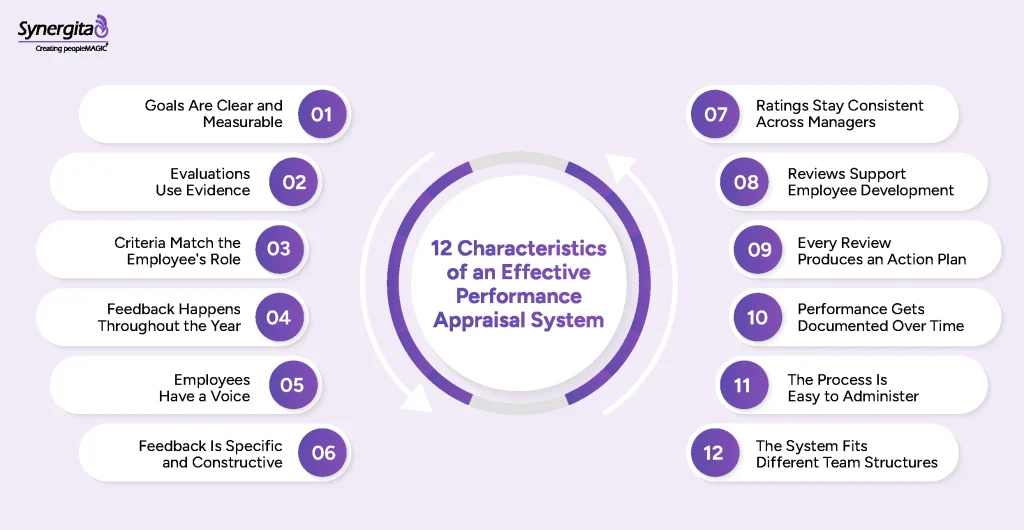
The following characteristics of performance appraisal separate a useful management process from an administrative task.
1. Appraisal goals are clear and measurable
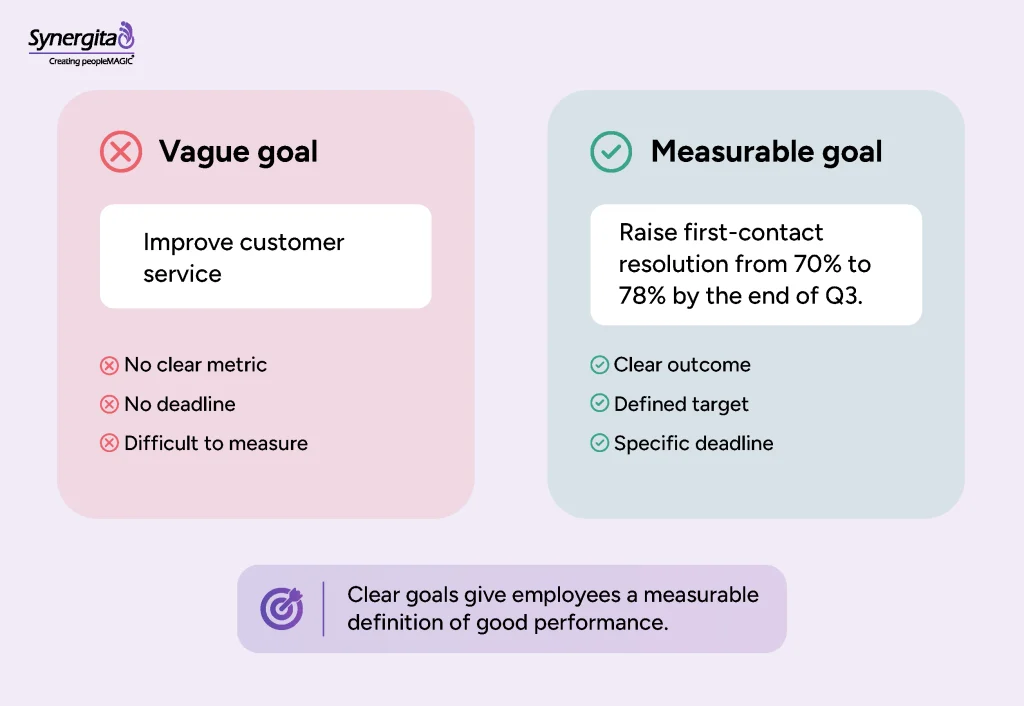
Appraisal objectives should be specific and measurable. An effective performance review system should define clear performance expectations that match the employee’s job responsibilities.
Employees need to know what good performance management looks like before the review period starts. Managers should define metrics, deadlines, and priorities that connect an employee’s work with team and company goals.
A target such as “improve customer service” gives little direction. “Raise first-contact resolution from 70% to 78% by the end of Q3” gives the employee a result they can track.
2. Evaluations use evidence
A fair review relies on completed goals, project results, work quality, customer feedback, agreed records, and check-in notes from the full review period.
Evidence does not remove human judgement. It gives that judgement a sound basis.
The criteria for performance appraisal should tell managers what supports each rating. “Missed three agreed client-update deadlines” carries more value than “needs to communicate better.”
3. Criteria match the employee’s role
Using relevant employee appraisal criteria helps managers assess people against the responsibilities and outcomes expected in their roles.
The criteria of performance appraisal should reflect the employee’s actual responsibilities, expected outcomes, and relevant competencies. An effective performance appraisal system uses well-defined performance criteria and standards, along with appropriate appraisal forms, rules, and procedures.
For instance, you cannot rate a graphic designer based on a skill that is not part of their job description.
| Role | Relevant criteria | Weak or irrelevant criteria |
| Sales representative | Revenue, pipeline quality, retention | Time spent at a desk |
| Customer support agent | Resolution quality, CSAT, response time | Sales revenue |
| Graphic designer | Design quality, brand adherence, timely delivery | Unrelated technical skills |
| People manager | Team results, coaching, retention | Individual output alone |
4. Feedback should be given throughout the year
Employees should not hear about a concern for the first time during an annual review. By then, the work is old, and the person has lost time they could have used to correct it.
Short check-ins help managers recognize good work, address problems, and adjust goals while the details remain clear. Gallup reports that employees who receive weekly rather than annual feedback are 5.2 times more likely to strongly agree that they receive meaningful feedback.
Keep this simple. A clear ten-minute conversation at the right time is more effective than a long form completed six months later.
5. Employees have a voice
An appraisal should work as a discussion, not a verdict delivered by a manager. Employees need space to explain results, name obstacles, correct missing context, and discuss the support they need.
A self-assessment helps the employee prepare, but HR should treat it as one source because people may underrate their work or focus on effort when the review measures outcomes.
A post-appraisal talk should be arranged between employees and their immediate superior to exchange feedback. This helps the organization to learn about the problems and difficulties the employees are facing and discover suitable training plans.
6. Feedback is specific and constructive
Useful feedback identifies the behaviour or result, explains its effect, and states what should continue or change.
- Weak: “You need to take more ownership.”
- Useful: “The client update went out two days after the agreed date. For the next phase, send it by Friday noon and flag any risk on Thursday.”
Specific feedback removes confusion. Recognition needs the same care. “Good job” feels pleasant, but it teaches little. Explain what the employee did and why it mattered.
Suggested Reading: Modern Performance Appraisal Methods for Today’s Workforce
7. Ratings stay consistent across managers
Two managers can read the same scale and apply it in different ways. One treats “meets expectations” as a strong result. Another reserves approval for “exceeds expectations.”
Shared definitions, manager training, and calibration reduce that gap. An effective performance management system should allow leaders to compare proposed ratings with evidence while checking for recency, halo, horns, similarity, leniency, and severity bias.
8. Reviews support employee development
One of the key strengths of performance appraisal is it connects performance discussions with employee development. An effective performance appraisal should show employees where they stand and what they can build next. That may involve a skill, a larger responsibility, coaching, mentoring, or training.
Managers should connect each action to a real need. “Lead the next project review, receive coaching, and collect feedback afterwards” gives the employee a task and a measure.
This is one of the main strengths of performance management characteristics when the company follows through.
9. Every review produces an action plan
A review without follow-up becomes a record of the past. A useful review creates commitments for the future.
Each action should state:
• What needs to happen
• Who owns it
• When it is due
• What support is required
• How progress will be assessed
• When will the next discussion occur
Keep the list short. Three completed actions have more value than ten forgotten promises.
10. Performance gets documented over time
Managers cannot recall a full year of work with equal accuracy. Recent events, visible projects, and difficult incidents often receive more weight.
Ongoing documentation corrects that imbalance. Record goals, outcomes, feedback, achievements, and agreed changes as observable facts. Good records also help HR review rating patterns and answer employee questions.
An effective performance appraisal system provides consistent, reliable, and valid data to help management make strategic decisions. It furnishes data according to the goal that serves the purpose of performance appraisal and succession planning.
11. The process is easy to administer
A performance appraisal should demand thought, not paperwork. Long forms, repeated questions, manual reminders, and unclear approval paths pull managers away from the discussion.
A workable process uses focused forms, defined stages, deadlines, reminders, central records, and visible completion status. Efficiency means removing work that does not improve the decision.
12. The system fits different team structures
Companies may need annual, quarterly, probationary, project-based, or promotion reviews.
Matrix teams need more care because the primary manager may not see work completed for another department. Input from a project leader can add context when each reviewer follows the same criteria. The system should support role-specific questions and workflows while preserving common standards.
How does the appraisal framework work: An example
Consider Steve, a customer support team lead. At the start of Q1, her manager set two role-specific goals: raise first-contact resolution from 70% to 78% and coach three new agents through certification.
During the quarter, check-in notes record that resolution reached 76%, two agents completed certification, and one program was delayed by a product release. Customer feedback and coaching records provide evidence beyond the final result.
At review time, Steve completes a self-assessment and explains the delayed certification. His manager rates each goal against the agreed scale, and HR calibration confirms that comparable team leads received comparable treatment. The final plan assigns Steve one coaching course, ownership of the next agent cohort, and a 60-day follow-up date.
This example shows the full chain: clear expectations define what should be measured, evidence supports the rating, and the rating leads to action.
Which warning signs show that the appraisal system is not working?
Failed appraisals usually reveal themselves through review disputes, rating gaps, late submissions, and unfinished actions. HR should treat each warning sign as a process problem that needs a specific correction.
| Warning sign | Likely cause | Corrective action |
| Employees receive surprise ratings | Feedback was delayed or undocumented | Require regular check-ins and dated feedback records |
| Comparable teams show large rating gaps | Managers interpret scales differently | Define rating anchors and run calibration sessions |
| Employees challenge basic facts | Reviews rely on memory | Require evidence for material ratings and comments |
| Managers submit reviews late | Forms or approval paths create excess work | Remove repeated questions and automate reminders |
| Development plans remain unfinished | Actions lack ownership | Assign an owner, due date, and follow-up meeting |
| Employees question fairness | Criteria changed or do not match the role | Publish role-specific criteria before the cycle |
A sound form cannot rescue a manager who avoids hard conversations. Manager training remains a process requirement, not an optional extra.
How HR can measure performance appraisal effectiveness
HR can measure performance appraisal effectiveness by evaluating goal clarity, evidence quality, rating consistency, employee voice, development actions, and follow-up after the review. A 100% completion rate proves that people submitted forms but does not prove that the process improved performance.
| Evaluation area | Test question | Evidence | Warning sign |
| Goal clarity | Were expectations agreed before the period began? | Approved goals | Goals added near review time |
| Evidence quality | Does each material rating cite observable evidence? | Results, feedback, check-in records | Ratings rely on memory |
| Rating consistency | Do managers apply the same definitions? | Calibration records and rating patterns | Comparable work receives different ratings |
| Employee voice | Could the employee add context and respond? | Self-assessment and meeting record | Review operates as a one-way decision |
| Development | Did the review identify a specific growth action? | Development plan | Generic training recommendation |
| Follow-up | Does every action have an owner and date? | Action tracker | Actions end at form submission |
HR can also track supporting indicators such as on-time completion, check-in frequency, perceived fairness, development-plan completion, appeal volume, and progress against post-review goals.
The CIPD recommends treating performance reviews as part of an ongoing performance-management cycle rather than as an isolated annual event.
Ask employees three questions after the review:
- Did you understand the rating?
- Could you respond?
- Did you leave with clear next steps?
Those answers expose problems that a completion dashboard cannot show.
How a performance appraisal system supports effective reviews
Managing employee appraisal becomes difficult when teams use spreadsheets, generic review forms, and manual follow-ups. Performance management software brings goals, feedback, reviews, and employee engagement and development into a system, giving HR teams a view of performance across each review period.
These tools supports the appraisal process across several areas, including:
- Configurable workflows and forms for different roles and job levels
- Custom rating scales aligned with each review question
- Self-assessments and structured manager feedback
- Reviews from matrix managers linked to assigned goals
- 360-degree feedback from peers, managers, direct reports, and clients
- One-on-one review conversations focused on performance and growth
- Automated reminders that help teams complete reviews on time
- Documented ratings and recommendations following review discussions
AI-powered performance management systems like Synergita can help HR teams generate insights from performance data, summarize feedback, highlight development areas, and support more informed appraisal decisions.
The Repos Energy case study shows how Synergita helps HR teams scale role-based appraisals while maintaining consistency across the review process.

Final takeaway
An appraisal system succeeds when HR can explain every rating, employees understand the evidence, and managers complete the agreed follow-up. If the organization cannot defend a rating or show what happens next, the process has produced paperwork rather than a performance decision.
Synergita’s performance management tool gives HR teams one platform for making data-based performance decisions, collecting employee and manager input, maintaining performance records, and recommending development actions. It supports continuous and 360 degree feedback and one-on-one meetings for effective performance appraisal.
Book a demo to see how configurable reviews, multi-source feedback, rating scales, AI-powered reviews and automated workflows can support your appraisal process.

Frequently asked questions
Neither suits every purpose. A manager review provides accountability, while 360-degree feedback adds views from people who observed the work. Defined criteria still matter. Read Synergita’s guide to 360-degree feedback evaluation.
Yes. Employees need a clear route to challenge factual errors, missing evidence, inconsistent standards, or suspected bias. HR should review the record and explain its decision. A separate performance appraisal appeals process helps companies handle these cases consistently.
Review its purpose, completion time, employee feedback, rating consistency, disputes, manager capability, and follow-up rate. New software will not correct unclear standards or weak manager training.
The right choice depends on the decision. Goal reviews, narrative assessments, competency reviews, project retrospectives, and check-ins provide different evidence. Many companies combine methods. Compare their use cases in this guide to modern performance appraisal methods.
Many teams reserve 45 to 60 minutes. The meeting should cover results, employee input, feedback, and next steps without repeating the written assessment. Difficult issues may need another conversation.

Would appreciate a demo of your product.
Thank you,
Barb