
Every OKR software demo ends with the same promise: better alignment, greater visibility, and faster execution. Yet many organizations still struggle with low adoption, disconnected goals, and manual tracking after implementation.
The problem often isn’t the software itself, but how it’s evaluated.
Instead of asking “Which OKR software is best?”, the more useful question is “Which OKR software is best for how our organization actually works?”
An OKR software evaluation checklist gives decision-makers a structured way to look beyond feature comparisons and assess whether a platform truly fits their organization’s workflows, growth plans, and execution needs. Before you buy an OKR tool, evaluate how well it fits your team’s workflows and growth plans.
| TL;DR Choose an OKR platform that fits your team’s workflows instead of one with the longest feature list. Understand which capabilities have the biggest impact on adoption and execution. Compare vendors objectively to choose a solution that supports your organization’s growth and helps you avoid costly software decisions. |
| Table of Contents 1. The 6-Point checklist for evaluation before you buy an OKR tool 2. How to compare vendors using OKR software buying checklist 3. Final takeaway 4. Frequently asked questions |
The 6-Point checklist for evaluation before you buy an OKR tool
Before you buy an OKR tool, evaluate user adoption, goal management, integrations, execution visibility, and scalability. Use this evaluation checklist to compare vendors before making your final decision.
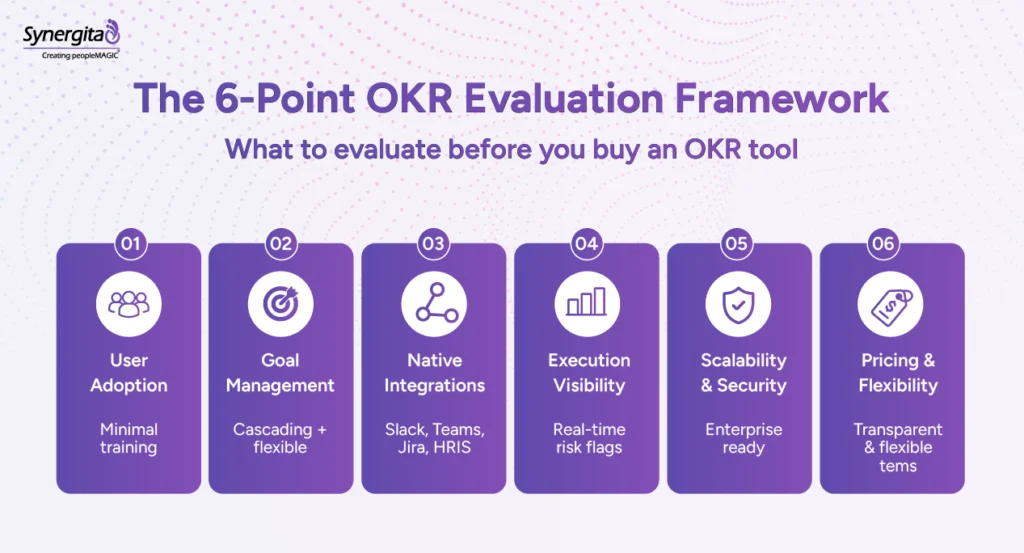
1. User adoption
A good OKR platform should be simple enough for employees and managers to start using without spending hours in training sessions. It should have:
- An intuitive interface that employees can use with minimal training
- Fast onboarding to launch your first OKR cycle in days, not weeks
- Mobile access for remote, hybrid, and field-based teams
Questions to ask vendors:
- How quickly can a new manager create their first OKR without assistance?
- What onboarding, training, and implementation support are included?
2. Goal management
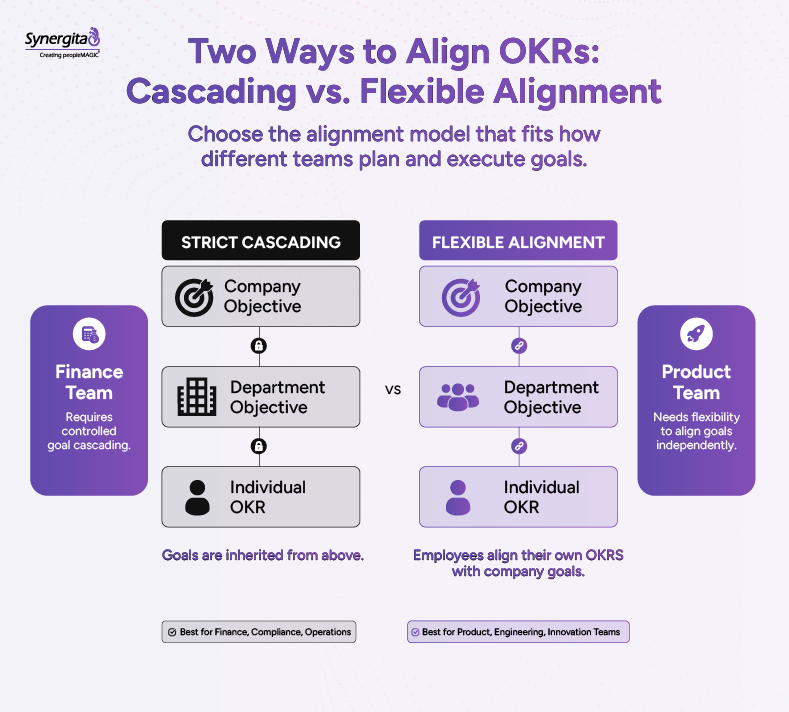
An effective OKR platform should connect company, department, team, and individual goals in one place. It should make it easy to align objectives, track progress, and keep everyone focused on shared priorities. Look for features including:
- Company goals cascading to department and team goals
- Support for both strict cascading and flexible, employee-linked alignment
- Personal OKRs linked to clear company goals
- Regular check-ins with structured progress updates
For example, Synergita OKR software supports both hierarchical goal cascading and flexible employee-linked alignment, allowing organizations to adopt the goal-setting approach that best fits their culture.
3. Native integrations
If people have to leave their everyday tools to update an OKR, they eventually stop updating it.
Slack’s State of Work research found that 68% of knowledge workers spend at least 30 minutes a day toggling between workplace apps, and 56% say that switching between tools makes it difficult to get essential work done. So, choose an OKR platform that integrates smoothly with Microsoft Teams, Slack, Jira, and HRIS tools.
4. Execution visibility
A progress percentage only shows where an OKR stands today. It does not reveal risks, blockers, or declining momentum before they affect outcomes. That’s why you should select a platform that helps managers identify issues early and take corrective action before the quarter ends. Ensure the OKR tool offers features including:
- Live dashboards with real-time progress, not weekly exports
- Confidence indicators on each Key Result, not just a completion bar
- AI insights that flag at-risk OKRs before the review cycle
- Reporting built for both managers and executive leadership views
5. Scalability and security
An OKR platform should support your organization from your current team size to future growth without forcing a costly migration later. A tool that works well for a 40-person company should also support hundreds or even thousands of employees without requiring you to switch platforms.
Evaluate whether the solution can handle increasing users, complex team structures, and enterprise requirements as your organization expands.
6. Pricing and total cost of ownership
Most software purchases cost more than the price shown on the pricing page. Implementation, integrations, premium support, training, and additional users can increase the total investment over time. The pricing factors you should consider include:
- Clear base subscription breakdown
- Transparent per-user pricing
- No hidden threshold jumps
- Upfront implementation costs
- No hidden integration fees
How to compare vendors using OKR software buying checklist
The easiest way to compare OKR software is to evaluate every vendor against the same criteria. A structured checklist helps you identify the platform that best fits your team’s workflows, budget, and long-term goals. This OKR checklist helps you evaluate platforms based on adoption, alignment, integrations, and scalability.
1. Create a simple evaluation scorecard
List the six evaluation criteria covered in this guide and assign each a weight based on your organization’s priorities. For example, a growing startup may prioritize ease of adoption and pricing, while an enterprise may place greater emphasis on integrations, security, and scalability.
Score every vendor using the same criteria to make comparisons objective.
2. Ask relevant questions during every demo
Use the same questions for every vendor instead of relying on a generic product demonstration. This makes it easier to compare responses and identify key differences.
Questions you can ask include:
- How long does implementation usually take?
- How do you measure user adoption after deployment?
- Which collaboration and business tools integrate natively?
- How does AI support goal creation and progress reviews?
- What reporting is available for managers and executives?
- What implementation and customer success support are included?
3. Compare more than features
Two platforms may offer similar capabilities but deliver very different user experiences. You should consider how easily employees can update OKRs, how managers review progress, and how leaders monitor execution.
Before making your decision, consider:
- Ease of use
- Adoption across teams
- Goal alignment capabilities
- Reporting and visibility
- Long-term scalability
- Total cost of ownership
4. Validate before making a decision
Whenever possible, request a free trial before purchasing. Involve managers and employees from different departments and gather feedback on usability, reporting, and day-to-day goal management.
A short pilot can reveal usability issues and adoption challenges that are difficult to identify during a product demonstration.
Use these frameworks before you buy OKR software to compare vendors objectively.
Final takeaway
The right OKR software makes goal execution easier. The wrong one creates extra work and poor adoption. Evaluating vendors without a structured framework increases the likelihood of low adoption, disconnected goals, and expensive software replacements.
Synergita helps organizations align company, team, and individual goals while giving teams the flexibility to manage OKRs based on their own workflows. With goal alignment, built-in check-ins, governance, and integrations with Jira, Slack, Microsoft Teams, and HRIS systems it keeps goals, progress, and reporting in one connected platform.
Start a free trial today.

Frequently Asked Questions
An OKR software evaluation checklist is a structured framework for comparing OKR software on usability, integrations, reporting, scalability, implementation support, and adoption, rather than only feature lists.
Include ease of use, goal alignment capabilities, AI features, integrations, reporting, security, implementation support, scalability, pricing, and customer success track record across similar-sized companies.
Build a weighted scorecard with consistent criteria, involve key stakeholders in every demo, and assess how each platform supports your planning, execution, and review workflow end to end.
Select software that offers regular check-ins, aligns goals across teams through both cascading and flexible linking, provides real-time visibility, integrates with existing tools, and stays easy to adopt.
Evaluate whether the OKR platform matches your team’s size, workflows, goal-setting approach, and existing tools. Look for flexible goal alignment, simple user adoption, strong reporting, and the ability to scale as your organization grows.
Avoid selecting a platform based only on feature lists or pricing. Common mistakes include ignoring user adoption, ignoring integration needs, failing to test the tool with real users, and not considering long-term scalability.