



Strategic goals fail when execution lacks structure. Teams chase too many priorities, measure the wrong metrics, or lose sight of what actually drives business outcomes. OKR templates solve this problem by providing a repeatable framework that connects strategic intent to measurable results.
An OKR template standardizes how your organization defines objectives and tracks key results. This consistency ensures every team member understands what success looks like and how their work contributes to broader company goals.
This guide covers proven OKR template examples for company-wide strategy, department goals, transformation initiatives, cross-functional projects, and individual performance, plus best practices for writing effective OKRs that drive real results.
Key Takeaways
- Five template types cover all goal-setting needs. Company-wide strategic, department functional, transformation initiatives, cross-functional projects, and individual performance OKRs each serve distinct purposes.
- Effective OKR templates require specific core elements, including qualitative objectives, 3-5 measurable key results, time frames, owner assignments, and consistent scoring mechanisms.
- Set ambitious targets at 60-70% confidence levels rather than safe goals to encourage stretch thinking while maintaining motivation through achievable progress milestones.
- Write objectives as inspiring outcomes, not activities, while making key results measurable with clear baseline numbers, target values, and deadlines to eliminate ambiguity.
- Synergita provides template infrastructure with cascading alignment, real-time dashboards, OKR Buddy AI assistance, and integrations that turn goal frameworks into executable strategy.
What Are OKRs, And Why They Matter For Strategy Building
OKRs (Objectives and Key Results) are a goal-setting framework that helps organizations translate strategy into execution. An objective describes what you want to achieve. Key results define how you will measure progress toward that objective.
Why OKRs matter for strategic execution:
- Strategic clarity: Teams understand which goals actually matter versus busywork
- Measurable progress: Quantitative key results eliminate ambiguity about success
- Organizational alignment: Public OKRs show how individual work connects to company priorities
- Focus through constraint: Limiting objectives forces difficult prioritization decisions
- Ambitious thinking: The framework encourages stretch goals beyond comfortable targets
Research from the American Psychological Association shows that setting challenging and specific goals enhances employee engagement compared to vague aspirations. OKRs force this specificity while maintaining flexibility for teams to determine their approach.
Strategic execution requires more than good intentions. OKR templates provide the structure that turns strategic thinking into coordinated action across your organization.
Also, know how to build a successful OKR culture for teams.
Anatomy Of A High-Impact OKR Template
An effective OKR template structures goals to drive execution while maintaining strategic flexibility. Understanding core components helps you choose or build templates that improve performance.
Core components every template needs:
- Objective statement: Qualitative, ambitious description of what you want to accomplish in 3-7 words
- Key results: 3-5 quantitative metrics with baseline and target values per objective
- Time frame: Clear start and end dates, typically quarterly or annual
- Owner assignment: Named individuals responsible for tracking each key result
- Scoring mechanism: Consistent grading scale with defined success thresholds
Additional elements that enhance effectiveness:
- Parent-child relationships: Visual indicators showing how OKRs connect across levels
- Confidence tracking: Periodic assessments marked as on track, at risk, or off track
- Initiative links: Connections between key results and specific projects driving them
- Historical performance: Past scores and trends informing future goal-setting
- Commentary fields: Space for context, blockers, wins, and learnings
The best templates balance standardization with customization. Standard fields ensure consistency while optional fields allow team-specific context. Templates should drive accountability but remain simple enough that teams actually use them.
However, your template structure directly impacts whether teams embrace OKRs or view them as administrative overhead.
5 OKR Template Examples for Strategic Goal-Setting in 2026
Different organizational contexts require different OKR structures. These templates provide starting frameworks you can adapt based on your strategy, team size, and industry. Each template balances ambition with practical measurement while maintaining flexibility for specific needs.
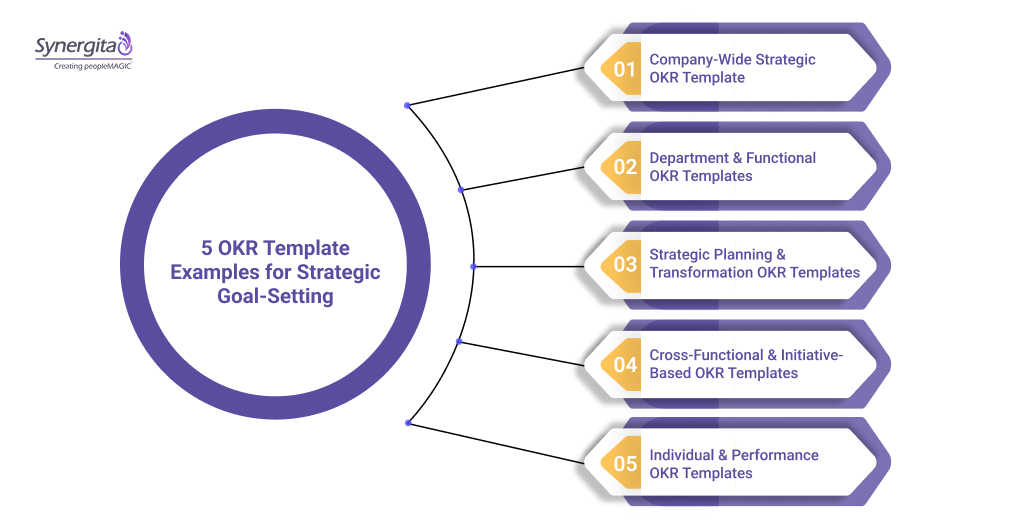
1. Company-Wide Strategic OKR Template
Company-level OKRs define strategic direction for the entire organization. These high-level objectives typically span 12 months and guide quarterly planning across all departments. Leadership uses this template to align board expectations with operational reality.
Objective: Build market leadership in enterprise AI solutions
- Key Result 1: Increase enterprise annual recurring revenue from $12M to $25M
- Key Result 2: Achieve net revenue retention of 120% or higher
- Key Result 3: Secure 15 enterprise logos with contracts exceeding $500K annually
Objective: Establish product excellence as a competitive differentiator
- Key Result 1: Launch three major capabilities validated by 50+ enterprise customers
- Key Result 2: Improve product NPS from 42 to 60
- Key Result 3: Reduce time-to-value from 45 days to 21 days
Objective: Build a world-class team positioned for scale
- Key Result 1: Grow headcount from 85 to 140 employees, maintaining quality bar
- Key Result 2: Increase employee engagement score from 7.8 to 8.5
- Key Result 3: Achieve 90% retention rate for top performers
Use this template during annual planning sessions where executives define a multi-year strategy. Company OKRs cascade down to inform department objectives. Review progress monthly at executive meetings and adjust quarterly as market conditions shift.
2. Department & Functional OKR Templates
Department OKRs translate the company strategy into functional execution plans. These templates help department leaders align teams to company priorities while maintaining autonomy over how they achieve results.
Sales team template:
Objective: Accelerate pipeline velocity and conversion efficiency
- Key Result 1: Generate $8.5M qualified pipeline with 35% conversion to close
- Key Result 2: Reduce average sales cycle from 87 days to 62 days
- Key Result 3: Increase average contract value from $85K to $125K
Marketing team template:
Objective: Drive qualified demand that converts to revenue
- Key Result 1: Generate 2,400 marketing qualified leads with 25% sales acceptance
- Key Result 2: Increase organic traffic from 45K to 75K monthly visitors
- Key Result 3: Improve marketing-sourced revenue from 28% to 40% of bookings
HR team template:
Objective: Build talent infrastructure for sustainable growth
- Key Result 1: Fill 38 open positions with a 90% offer acceptance rate
- Key Result 2: Reduce time-to-hire from 52 days to 35 days for priority roles
- Key Result 3: Achieve 85% positive ratings on quarterly pulse surveys
Department leaders draft these OKRs in consultation with teams, then validate alignment with company objectives before finalizing. Each department should have 2-3 objectives to maintain focus.
3. Strategic Planning & Transformation OKR Templates
Transformation OKRs guide major organizational changes like digital transformation, market expansion, or business model shifts. These templates span longer time horizons with quarterly milestones.
Objective: Complete digital transformation of customer experience
- Key Result 1: Migrate 100% of customer interactions to the new CRM platform by Q2
- Key Result 2: Launch self-service portal handling 60% of tier-1 support tickets
- Key Result 3: Reduce customer onboarding time from 6 weeks to 10 days
Objective: Expand into three new geographic markets successfully
- Key Result 1: Establish legal entities and operational presence in APAC, EMEA, and LATAM by Q3
- Key Result 2: Close first 10 customers in each region with $ a $250K combined ARR minimum
- Key Result 3: Hire regional leadership teams (3 roles per region) by Q2
Objective: Transition from services to a product-led growth model
- Key Result 1: Launch product-led trial experience with 500 self-serve signups monthly
- Key Result 2: Reduce services revenue from 65% to 35% of total, maintaining margin
- Key Result 3: Increase product ARR from $3M to $12M through self-serve motions
Use transformation templates when major strategic shifts require sustained focus beyond normal quarterly cycles. Assign executive sponsors to each objective and create dedicated working groups for key results.
4. Cross-Functional & Initiative-Based OKR Templates
Cross-functional OKRs coordinate work requiring collaboration across multiple teams or departments. These templates clarify shared ownership and prevent duplicated effort.
Objective: Launch enterprise-grade security and compliance capabilities
- Key Result 1: Achieve SOC 2 Type II certification by end of Q3 (Owner: Security/Compliance)
- Key Result 2: Ship SSO, SCIM, and audit logs to 100% of enterprise customers (Owner: Engineering)
- Key Result 3: Close eight deals worth $2M+ previously blocked on security (Owner: Sales)
Objective: Deliver a seamless mobile experience for the remote workforce
- Key Result 1: Launch iOS and Android apps with feature parity by Q2 (Owner: Product/Engineering)
- Key Result 2: Achieve 35% mobile adoption among active users within 60 days (Owner: Product Marketing)
- Key Result 3: Drive $1.5M in new bookings attributed to mobile capabilities (Owner: Sales)
Objective: Build a strategic partnership ecosystem for market acceleration
- Key Result 1: Sign five technology integration partnerships with co-marketing agreements (Owner: Partnerships)
- Key Result 2: Launch partner portal and certification program with 20 trained partners (Owner: Partner Ops)
- Key Result 3: Generate 150 partner-sourced leads converting at 18% to opportunities (Owner: Marketing)
Use cross-functional templates for product launches, major initiatives, or customer experience improvements requiring sustained collaboration. Assign a single initiative owner responsible for coordination, while individual key results have functional owners.
5. Individual & Performance OKR Templates
Individual OKRs connect personal goals to team and company objectives while supporting professional development. These templates help managers conduct meaningful performance conversations focused on impact rather than activity.
Objective: Drive product marketing success for Q1 enterprise launch
- Key Result 1: Create eight pieces of sales enablement content with 90% sales team usage
- Key Result 2: Launch a competitive positioning framework adopted by 100% of customer-facing teams
- Key Result 3: Generate 45 enterprise marketing qualified leads through thought leadership
Objective: Expand technical leadership and architectural impact
- Key Result 1: Complete system design for new authentication service reviewed by three senior engineers
- Key Result 2: Mentor 2 junior engineers to ship features independently with minimal reviews
- Key Result 3: Reduce API latency for core endpoints from 280ms to 150ms
Objective: Build a high-performing sales development team
- Key Result 1: Increase team qualified pipeline from $1.2M to $2.8M per quarter
- Key Result 2: Improve SDR-to-AE handoff acceptance rate from 62% to 85%
- Key Result 3: Hire 4 SDRs with 100% retention after first 90 days
Individual contributors draft personal OKRs supporting 1-2 team objectives while including development goals aligned with career aspirations. Score OKRs mid-quarter to identify support needs and adjust targets if circumstances have changed significantly.
These template examples provide proven structures for different organizational contexts. But to be successful, they need to deliver results.
5 Best Practices For Writing OKRs Into Any Template
Effective OKR templates work only when teams write strong objectives and key results. These best practices keep OKRs focused on real progress—not busy work or metrics theater.
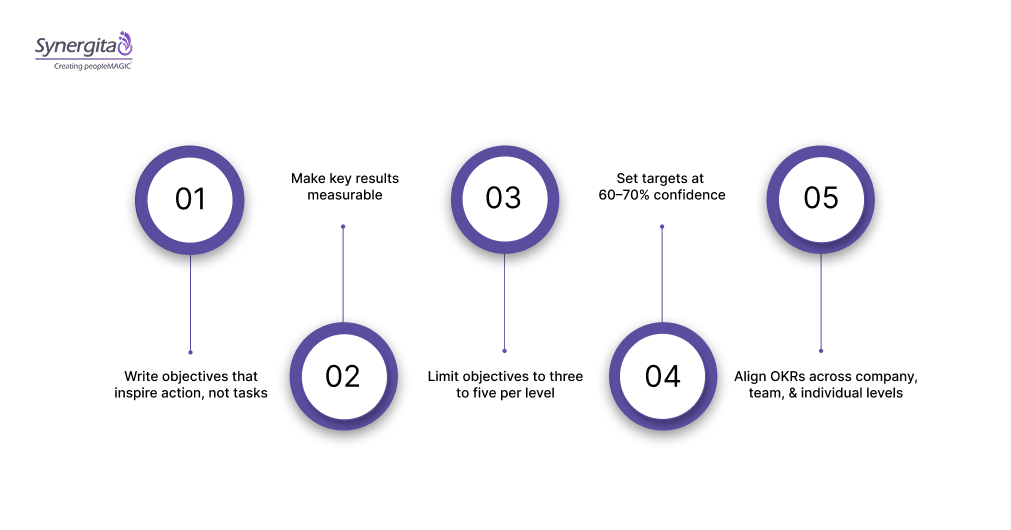
- Write objectives that inspire action, not tasks: Objectives should describe the outcome you want to achieve, not the work you plan to do. “Launch a mobile app” lists an activity. “Become the mobile-first solution for remote teams” defines an aspirational end state that clarifies intent and motivates action. Google advises framing objectives around outcomes and states, not activities.
- Make key results measurable with clear start and end points: Vague key results like “improve customer satisfaction” invite subjective success. Instead, use metrics such as “increase NPS from 42 to 58” or “reduce monthly churn from 8% to 4.5%.” Always include a baseline, a target, and a deadline to remove ambiguity.
- Limit objectives to three to five per level: Trying to do everything weakens focus. Google’s OKR research shows that three to five objectives per level prevent overextension and force teams to prioritize what matters most. Too many objectives dilute effort and stall progress.
- Set targets at 60–70% confidence: If teams consistently hit 100% of their OKRs, the goals are too safe. Ambitious OKRs should stretch the team. Google treats 60–70% achievement as success, with 100% being exceptional. This mindset encourages bold thinking and learning.
- Align OKRs across company, team, and individual levels: Every team objective should support a company goal, and every individual objective should support team priorities. Make these links explicit in your template so contribution and misalignment are immediately visible.
These practices turn OKR templates from administrative checklists into strategic tools. Structure matters, but the quality of what you write determines whether OKRs actually improve performance.
Also Read: A Guide To Weekly OKR Check-Ins
How Synergita Supports Your Strategic OKR Framework
Your OKR templates need software that makes goal-setting, tracking, and alignment effortless rather than an administrative burden. Synergita provides the platform infrastructure to turn your OKR frameworks into operational reality.
The platform helps you deploy OKR templates at the company, department, and individual levels with full visibility into how objectives cascade and connect across the organization. Teams can start with the free OKR Starter plan for up to 3 users, then scale with paid plans that include advanced features as your OKR practice matures.
Key features for strategic OKR execution:
- Template-based OKR creation with customizable fields matching your organizational structure
- Visual alignment and cascading showing parent-child relationships between objectives
- Real-time dashboards and reporting provide leadership visibility without micromanaging
- OKR Buddy AI assistant helping teams write better objectives while maintaining best practices
- Integration with Jira, Slack, and Microsoft Teams, ensuring updates flow within existing workflows
- Automated progress tracking and reminders prompt teams to update scores without overhead
Start your free trial and discover how Synergita turns OKR templates into a competitive advantage through better alignment and execution.

Frequently Asked Questions
1. How many key results should each objective have in an OKR template?
Each objective should have 3-5 key results. Fewer than three key results may not fully capture whether you achieved the objective. More than five key results typically indicates you are tracking activities rather than outcomes or that your objective is too broad and should be split into multiple objectives.
2. What is the difference between OKRs and KPIs in goal-setting templates?
OKRs are aspirational goals set quarterly or annually that push teams toward new achievements. KPIs are operational metrics you monitor continuously to maintain performance standards. Use KPIs to track business-as-usual health while OKRs drive improvement and strategic initiatives beyond current performance levels.
3. Should OKR templates include both quarterly and annual objectives?
Yes. Annual objectives define strategic direction and major outcomes you want to achieve over 12 months. Quarterly objectives provide tactical focus and create momentum through shorter feedback loops. Annual OKRs inform quarterly goal-setting, while quarterly results prove or disprove whether annual targets remain realistic.
4. How do you score OKRs when using a template with multiple key results?
Score each key result individually on a 0.0 to 1.0 scale based on actual achievement versus target. Calculate the objective score by averaging the individual key result scores. Some organizations weight certain key results more heavily based on strategic importance, but a simple average works well for most teams.
5. Can the same OKR template work for both startups and large enterprises?
The core structure (objective plus 3-5 measurable key results) remains consistent across company sizes. However, startups typically need simpler templates with fewer administrative fields while enterprises require additional elements like approval workflows, compliance tracking, and multi-level cascading. Start simple and add complexity only as organizational needs require it.