
Every performance review is expected to answer a simple question: Is this employee performing well?
Yet two managers can evaluate the same employee very differently. When ratings vary from one manager to another, employees question the outcome, and leaders struggle to make confident decisions. The issue in performance appraisal is the way the evaluation is done..
Performance appraisal errors fall into two categories: process failures (the system itself is built wrong) and rater bias (a manager’s judgment is skewed, often without them noticing). Fixing the first is a design problem. Fixing the second requires documentation and structure that removes reliance on memory and impression.
In this guide, we will explore the most common performance appraisal errors, the reason behind that, and how to prevent them.
| TL;DR Most performance appraisal errors occur when managers rely on memory instead of documented performance throughout the review period. Fair evaluations require structure, including continuous documentation, measurable rating criteria, and regular calibration to reduce bias. The 18 common performance appraisal errors fall into two categories: process design failures and rater bias. Use the diagnostic checklist at the end to identify which performance appraisal errors may already be affecting your review process. |
| Table of contents 1. What are the common errors in performance appraisal 2. How performance evaluation errors impact employees and business outcomes 3. Performance review mistakes: Is your review process making these errors 4. How structured performance management reduces common performance appraisal errors 5. Final takeaway 6. Frequently asked questions |
What are the common errors in performance appraisal
The 18 performance appraisal errors below are grouped into two categories so you can identify whether the problem comes from your review process or from individual manager judgment.
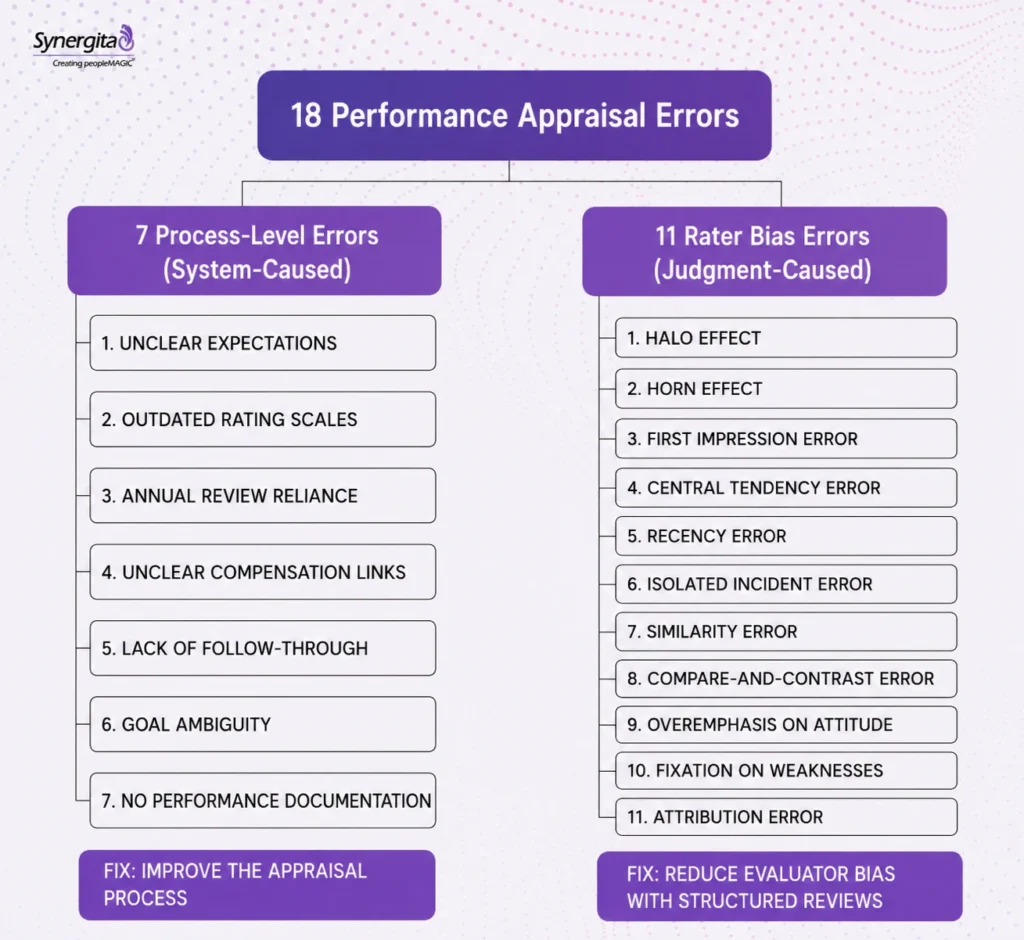
7 Process-level errors
These errors come from how the appraisal system is designed, not from any individual manager’s judgment.
- Unclear expectations: Employees can’t succeed if they don’t know what’s expected of them. Evaluate performance against clearly defined goals, responsibilities, and job expectations, not against other employees.
- Outdated rating Scales: Ratings like “meets expectations” can mean different things to different managers. Without clear definitions for each rating, employees with similar performance may receive different scores.
- Annual review reliance: A single annual review can’t accurately capture twelve months of performance. Managers usually remember recent events more than earlier contributions.
- Unclear compensation links: Employees should understand how their performance ratings affect pay, promotions, and bonuses. Without that clarity, they may lose confidence in the appraisal process.
- Lack of follow-through: A review that ends with a score and no subsequent check-ins turns performance management into a paperwork exercise instead of employee development.
- Goal ambiguity: Closing a review without specific, measurable goals for the next cycle means the employee has no clear target to achieve and to be measured against next time.
- No performance documentation: When performance isn’t documented throughout the review period, managers may forget important achievements and challenges, which can lead to inaccurate ratings.
11 rater bias errors
These come from individual judgment, not from how the system is designed. Each is defined once here; the process-level errors above aren’t repeated in this list.
- Halo effect: A strong performance in one area influences the entire evaluation, causing managers to overlook weaknesses or other aspects of an employee’s performance.
- Horn effect: One mistake or weakness shapes the entire appraisal, preventing managers from recognizing consistent achievements in other areas.
- First impression error: Early interactions sometimes influence the final rating, even when an employee’s performance has improved or changed significantly during the review period.
- Central tendency error: Rating most employees as average to avoid difficult performance conversations prevents managers from recognizing high performers and identifying employees who need additional support.
- Recency error: Giving too much weight to recent events instead of considering performance over the entire appraisal period leads to incorrect evaluation.
- Isolated Incident error: Giving too much importance to isolated incidents and overlooking the employee’s overall performance throughout the review period.
- Similarity error: Giving higher ratings to employees because they have a similar work style, personality, or background as the manager, rather than because they performed better.
- Compare-and-contrast error: Compare-and-Contrast Error: Rating employees against one another rather than measuring their performance against the same standards.
- Overemphasis on attitude: Focusing more on an employee’s enthusiasm or positivity than on the quality of their work and results.
- Fixation on weaknesses: Giving too much attention to mistakes overlooking the employee’s strengths, achievements, and overall performance.
- Attribution error: Judging employees’ performance based on assumptions about an employee’s intentions or circumstances instead of documented evidence and observed behavior.
The scope of individual bias is massive; research reveals that up to 60% of a manager’s performance rating is driven by the manager’s own idiosyncratic bias rather than the employee’s actual performance.
How performance evaluation errors impact employees and business outcomes
Performance appraisal errors lead to unfair evaluations, lower employee trust, poor talent decisions, and weaker business performance. According to an SHRM report, 90% of HR leaders believe their performance review process does not accurately measure employee performance. These errors affect companies in several ways including:
Unfair pay and promotion decisions
Inaccurate ratings can reward the wrong employees while overlooking top performers. This reduced confidence in the appraisal process.
Lower employee engagement
Employees are less motivated when they feel reviews are inconsistent, biased, or don’t reflect their actual contributions.
Poor performance development
Without accurate evaluations and continuous feedback, employees don’t clear direction on how to improve, and managers miss opportunities to train them.
Weaker talent decisions
Inconsistent appraisals make it difficult to identify high performers with potential to move to the next level and provide additional support where it is needed.
Higher employee turnover
Employees who repeatedly experience unfair or inaccurate evaluations lose trust in the company and look for opportunities in other organizations. This is one of the major impacts of performance appraisal errors.
Performance review mistakes: Is your review process making these errors
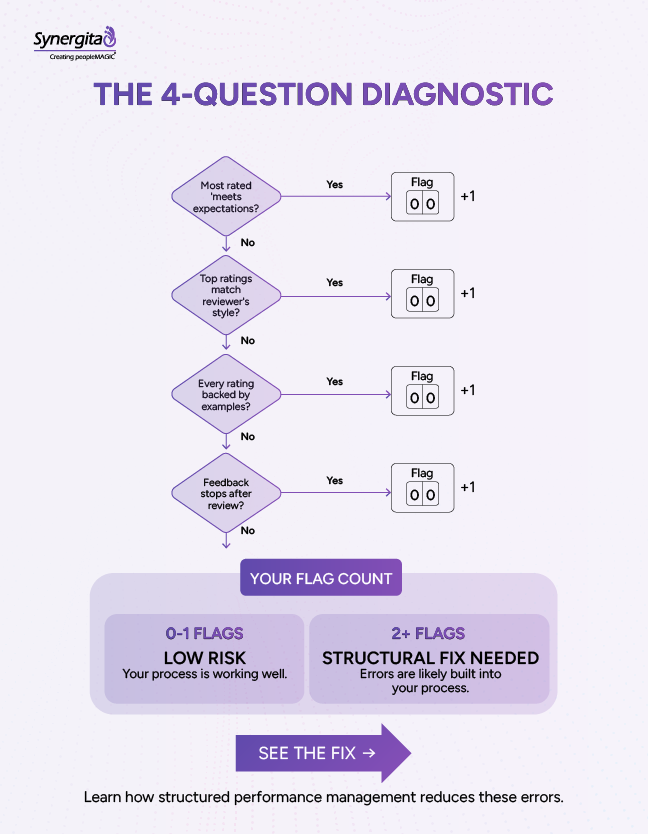
A quick review of your appraisal process can reveal common performance appraisal errors, problems in performance appraisal, and hidden manager bias before they affect employee trust.
Ask these questions before your next cycle:
- Are most employees rated as “meets expectations”?
This may indicate central tendency error, where managers avoid deep evaluation and distinguishing different levels of performance.
- Do top ratings consistently go to employees who share the reviewer’s work style or personality?
This could point to similarity bias, one of the most common performance appraisal errors.
- Can every rating be backed by specific examples from throughout the review period?
If not, recency error may be influencing the evaluation.
- Does feedback end once the appraisal is complete?
Without regular follow-ups, performance reviews become one-time events instead of ongoing development conversations.
If you have noticed any of these issues in performance appraisal cycle, it’s time to improve the process instead of repeating it next year.
How structured performance management reduces common performance appraisal errors
A structured AI-powered performance management system reduces appraisal errors by replacing memory with documented evidence, standardized criteria, in-depth analysis and removing inconsistencies.
Continuous performance documentation
Managers can record achievements, feedback, and performance issues throughout the review period, making evaluations based on data instead of memory.
Standardized evaluation criteria
A common rating framework helps managers assess employees using the same standards, improving consistency across teams.
Regular check-ins and 360-degree feedback
Frequent one-on-one meetings, regular and 360-degree feedback reduce the chances of recent events and manager bias impacting the final appraisal.
AI-based performance insights
AI summarizes performance data, identifies recurring achievements and improvement areas, and highlights potential rating issues, helping managers make more objective decisions.
Calibration across managers
Calibration tools allow HR and leadership teams to compare ratings across departments, identify scoring differences, and ensure employees with similar performance receive similar ratings.
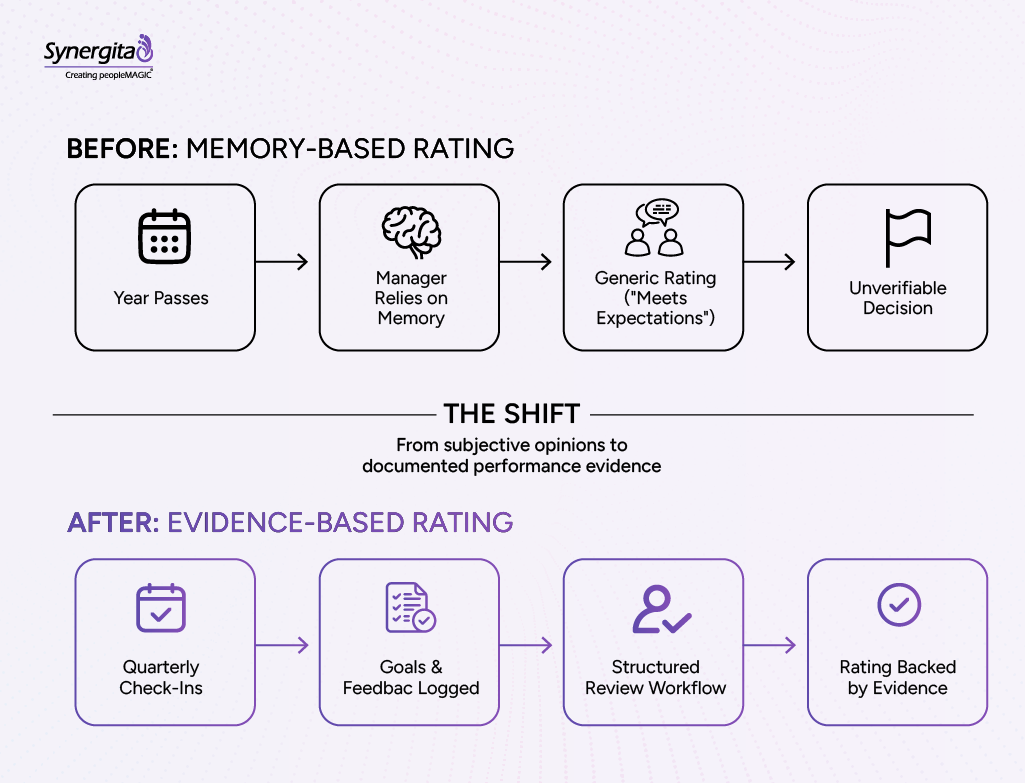
That shift, from memory-based to evidence-based rating, is what continuous documentation, structured check-ins, and 360-degree feedback are built to support.
Final takeaway
Performance appraisal errors keep growing as companies grow in size. Inconsistent evaluation criteria, manager bias, and delayed feedback become difficult to identify and correct.
Although every review process has some limitations of performance appraisal, organizations can minimize those limitations through continuous feedback, standardized evaluation criteria, and data-based performance management instead of relying on memory and for that you need a dedicated performance management tool.
Synergita performance management system strengthens your existing process with continuous check-ins and AI insights, helping managers make consistent, data-driven appraisal decisions. Start a free trial today and see how it simplifies performance management.
Frequently asked questions
The most common performance appraisal errors include halo effect, recency bias, central tendency, similarity bias, contrast error, and unclear evaluation criteria. These performance appraisal mistakes reduce rating accuracy and lead to poor employee evaluations.
Performance appraisals fail when managers rely on memory instead of documented evidence, goals are unclear, feedback is infrequent, and rating standards vary across departments.
The biggest problems with performance appraisals include subjective ratings, inconsistent manager evaluations, unclear expectations, poor documentation, and limited follow-up. These performance appraisals issues reduce employee trust, increase turnover, and make incorrect promotion decisions.
Organizations can reduce performance evaluation errors by setting measurable goals, documenting employee performance throughout the year, calibrating manager ratings, and using performance management software that identifies evaluation errors before reviews are finalized.
An appraisal gap refers to the difference between an employee’s actual performance and the manager’s evaluation or between employee self-ratings and manager ratings. Regular feedback and documented performance evidence help close these gaps before formal reviews.
Organizations should hold monthly or quarterly performance check-ins throughout the year. Frequent conversations reduce performance review mistakes, improve documentation, and help managers make more accurate final evaluations.