



Your top-performing sales representative is sitting in your office. They just hit their quarterly quota, but their screen is filled with job alerts from your competitors.
The disconnect you both felt after their last review felt like a minor misstep. Your sales team sees a wrong review as a fear of missing out on better leadership, clearer growth paths, and fairer recognition.
Worse,57% of employees think human decision-makers are more prone to bias when determining compensation. So, when an unclear, manual review process feeds these doubts, you lose.
In this blog, you’ll get an actionable framework for building a sales employee performance review template that works for 2026.
Quick Glance
- Outdated, annual reviews fuel disengagement and turnover.
- A strategic review process is a critical tool for boosting productivity, fairness, and retention.
- Effective reviews must blend quantitative metrics (the “what”) with qualitative feedback on skills and behaviors (the “how”).
- Using role-specific templates ensures fair, comprehensive, and efficient evaluations.
- A successful review follows three phases: Preparation, Conversation, and Follow-Up to ensure goals are met.
What is a Sales Performance Review?
Your top rep just hit their quarterly number. However, their forecast for next quarter is a guess.
This is the exact moment a modern sales performance review can change everything. What exactly is this tool? A sales performance review is a structured, one-on-one conversation.
It measures a rep’s results against their goals. However, it digs much deeper than a quota scorecard. This conversation blends hard numbers with the skills and behaviors behind them.
For the manager, it’s a chance to connect with the front-line reality of selling. For the rep, it’s a voice in their own career path. When done right, both sides leave aligned on a clear plan for growth.
Also Read: The Best Performance Management Software in 2025
So, you want to know the concrete, measurable payoffs of getting these conversations right. You can find that in the next section.
The 5 Tangible Benefits of Getting Sales Performance Reviews Right
What is the single most expensive mistake in your sales department right now? It’s the slow, silent leak of disengaged talent. With only 21% of employees globally feeling engaged at work, most of your team is just going through the motions.
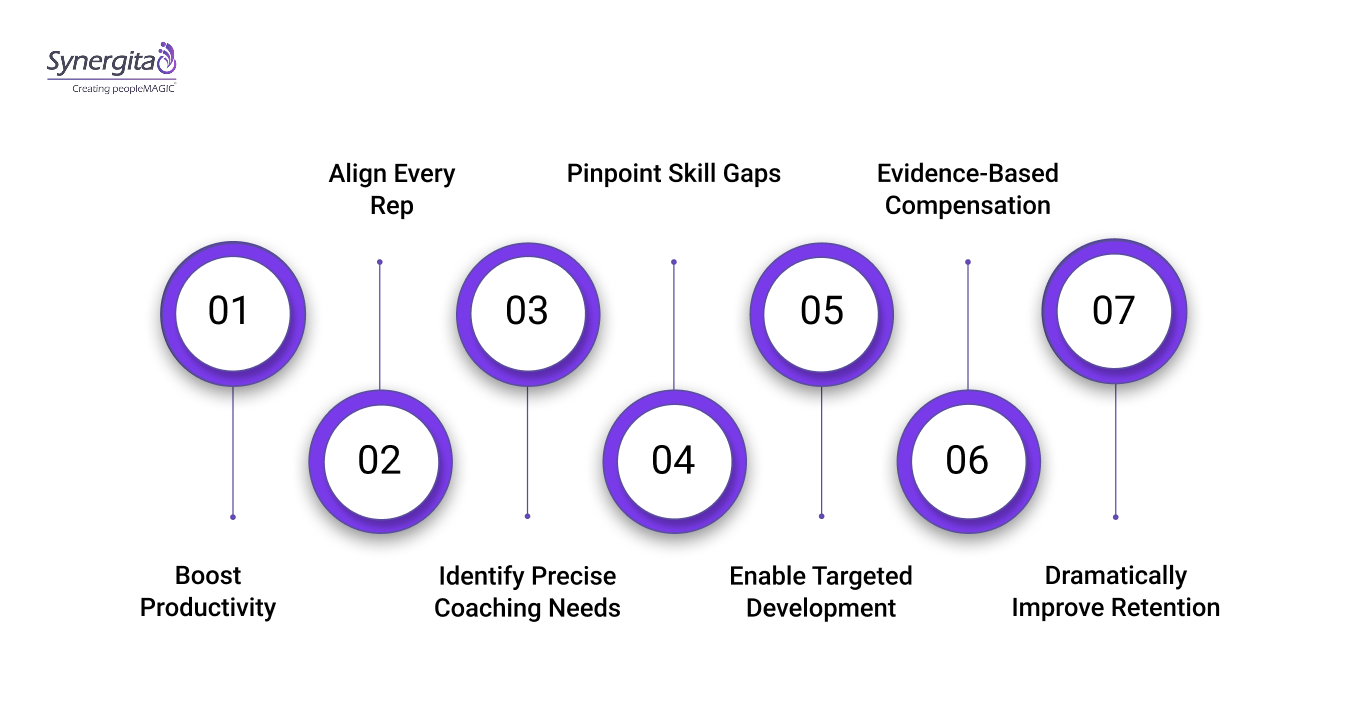
Here’s how performance reviews deliver concrete, data-backed returns :
- Boost Productivity, Morale, and Well-being: Regular, meaningful reviews directly combat the global engagement crisis.
- Align Every Rep with Company Goals: Effective reviews create a direct line of sight from individual activities to organizational strategy.
- Identify Precise Coaching Needs: A data-driven review reveals the exact skills each rep needs to develop.
- Pinpoint Skill Gaps: Reviews move from vague feedback (“get better at selling”) to specific insights (“improve discovery questions to boost lead-to-opportunity conversion by 5%”).
- Enable Targeted Development: This precision allows you to assign relevant training, shadowing, or projects.
- Guide Fair, Evidence-Based Compensation and Promotions: A documented review process builds a fair, transparent system.
- Dramatically Improve Retention and Protect Revenue: This is the ultimate payoff. Retention is a direct result of the previous four benefits.
Most importantly, a modern sales employee performance review template is a strategic framework that builds engagement. Now that you’re convinced of the advantages, it’s time to go through a few performance review templates for quarterly analysis.
Also Read: How to Provide Effective Feedback in the Workplace
5 Essential Sales Employee Performance Review Templates
A great template does more than track numbers. It structures a forward-looking conversation on growth. The following templates provide this structure for every key role and scenario:
1. Quarterly Sales Rep Performance Review
A comprehensive template for measuring a closer’s core output against quota and ensuring forecast reliability for business planning.
| Review Area | Description | Evaluation Summary | Development Recommendation | Rating (1–5) | Next Steps |
|---|---|---|---|---|---|
| Quota Attainment | Achievement against the quarterly revenue target. | Achieved 110% of quota through two large deals closed in the final week. | |||
| Average Deal Size | Monetary value of closed-won opportunities. | Average size is 15% below team average, favoring high-volume, low-value deals. | |||
| Sales Cycle Length | Average days from opportunity creation to close. | Cycle length exceeds team average by 10 days, often stalled at the proposal stage. |
Quota attainment lives in spreadsheets. Skill assessments are in a different HR form. You can’t see the complete picture of an employee’s performance and potential.
WithSynergita, your complete view lives in one place. The Digital Cockpit automatically syncs quota data, skill assessments, and 360-degree feedback into a single, role-based dashboard.
2. Sales Development Representatives (SDR)/ Business Development Representatives (BDR) Activity & Outreach Tracker
| Review Area | Description | Evaluation Summary | Development Recommendation | Rating (1–5) | Next Steps |
|---|---|---|---|---|---|
| Outreach Volume | Number of daily calls, emails, and social touches. | Consistently exceeds daily email targets, but calls are 20% below goal. | |||
| Connection Rate | Percentage of outreaches that lead to a live conversation. | Connection rate is strong for emails (12%) but low for calls (8%). | |||
| Meeting Booking Ratio | Number of qualified meetings booked per week. | Books an average of 5 meetings/week, meeting the target. |
3. Account Executive (AE) Strategic Closer Review
Designed to assess a closer’s strategic impact, this template evaluates win rates, deal size, and the accuracy of their sales forecasts to gauge efficiency and predictability.
| Review Area | Description | Evaluation Summary | Development Recommendation | Rating (1–5) | Next Steps |
|---|---|---|---|---|---|
| Win Rate | Percentage of proposals/opportunities that close as won. | Win rate of 32% is above the team average of 28%. | |||
| Average Deal Size | Monetary value of closed-won opportunities. | Deals are 25% larger than the team average, showing skill with complex sales. | |||
| Forecast Accuracy | How closely do predicted deal closures match reality? | Predict accuracy is 70%, below the 90% goal, causing planning issues. |
4. Account Manager (AM) Retention & Growth Review
Centers on customer-centric outcomes, measuring success in renewing contracts, expanding account revenue, and maintaining high levels of client satisfaction.
| Review Area | Description | Evaluation Summary | Development Recommendation | Rating (1–5) | Next Steps |
|---|---|---|---|---|---|
| Renewal Rate | Percentage of customers who renew their contracts. | Maintained a 95% renewal rate, well above the 85% target. | |||
| Upsell/Cross-Sell Revenue | Additional revenue generated from existing accounts. | Generated $50K in upsell revenue, meeting the quarterly goal. | |||
| Customer Satisfaction (CSAT/NPS) | Score from post-interaction surveys or relationship health. | Average Customer Satisfaction (CSAT) score is 8.5/10. Scores dip after support-heavy periods. |
5. Self-Evaluation Template
A preparatory questionnaire that helps the salesperson to reflect on their own achievements, challenges, and goals before the review meeting, fostering a two-way dialogue.
| Review Area | Description | Evaluation Summary | Development Recommendation | Rating (1–5) | Next Steps |
|---|---|---|---|---|---|
| Biggest Achievement | The accomplishment you are most proud of this period. | Closing the enterprise deal with Acme Corp involved navigating a complex procurement process. | |||
| Key Challenge | The most significant obstacle faced and how it was handled. | Struggled with a new Customer Relationship Management (CRM) update, slowing down data entry temporarily. | |||
| Skill to Develop | A professional skill you want to improve next. | I want to improve my ability to handle pricing objections confidently. | . |
With the right tools, the daunting task of building a review process becomes a straightforward, strategic exercise. Once you want to translate the theory into action, you need a step-by-step guide on how to construct a powerful review framework.
3 Step Guide on an Effective Sales Performance Review Template
What if every performance review felt less like an evaluation and more like a launchpad? Building an effective template is the first step, turning sporadic feedback into a clear blueprint for growth. This guide has three pivotal phases: Preparation, Conversation, and Follow-Up.
Discover how to apply each to create reviews:
1. Preparation & Foundation
Preparation prevents biased, incomplete reviews. It shifts the conversation from opinions to evidence-based coaching. Start by deciding what to measure.
- Quantitative Metrics (The “What”): Select 5-7 Key Performance Indicators (KPIs) customized to the role.RoleRecommended KPIsSDR/BDRMeetings Booked, Lead → SQL Conversion %, Outreach Activity, Lead Response TimeAccount Executive (AE)Quota Attainment %, Win Rate, Average Deal Size, Sales Cycle Length, Pipeline AccuracyAccount Manager (AM)Renewal Rate %, Upsell/Cross-Sell Revenue, Customer Health Score, CSAT/NPS
2. The Review Meeting Structure
A structured conversation keeps reviews focused and productive.
- Start with specific, data-backed praise. Example: “You exceeded Q3 quota by 15%. The client specifically praised your onboarding in their CSAT survey.”
- Provide feedback on competencies, always linking to an example. “Your discovery is strong. In the Acme deal, your questions uncovered the budget timeline early.
3. Post-Review Follow-Up & Tools
A review’s value is determined by what happens after the meeting.
- Share the finalized summary and development plan. Use a central platform to track goal progress, not a forgotten email.
- Modern tools are essential. Artificial Intelligence (AI) can analyze deal patterns and reduce bias in feedback. Automation ensures nothing slips through the cracks.
Open collaboration fuels innovation. Consistent recognition boosts morale. However, your team can cultivate a culture of collaboration and recognition to elevate productivity with Synergita’s continuous feedback and coaching tools.
Also Read:Continuous Performance Management: A Complete Guide
Synergita‘s Profound Advantage: The Continuous Performance Cycle
Most templates create a snapshot, a single report that gets filed away until next quarter. The real challenge begins after the conversation: Turning feedback into consistent growth and goals into daily actions.
Without a system to close this loop, even the best-intentioned reviews lose impact within weeks, and development plans stall. This is where a Synergita changes everything.
Here’s how:
- Zero Disruption: Implement the structured template without overhauling your process. Use configurable templates that fit your workflow.
- Insta Go: Launch new review cycles or OKR sets in days, adapting to business needs.
- Digital Cockpit: This living dashboard keeps goals, feedback, and progress always visible, driving accountability.
- Close the Loop: The Perform and Engage modules connect review outcomes to ongoing actions. A development plan can trigger a training assignment. A goal can link to a continuous feedback request from a peer in 90 days.
This integrated cycle ensures performance management is never a standalone event, but the core rhythm of your high-performing sales team.
Transform Reviews into Your Strategic Growth Engine
Now, you have access to five specialized templates for every role. However, without the right system, even the best template becomes another form to complete. A disconnected process fails, and this gap between planning and results is where revenue and talent are lost.
Synergita closes this gap. The 1:1 Performance Reviews turn goals into trackable objectives. This unified approach ensures that it builds the agile, motivated, and high-performing sales team you need to win in 2026.
Book a Call with Synergita to build a culture of continuous growth and predictable revenue.
FAQs
1. Can review templates be customized for different sales roles like SDRs and AEs?
Yes, a system should allow full customization. You can create distinct templates with unique KPIs and skill sets for each role, ensuring reviews are relevant and fair.
2. How can a platform help reduce unconscious bias in performance reviews?
It promotes objectivity by auto-populating reviews with data from CRM and 360-degree feedback. This shifts the conversation from subjective opinions to measurable results and team-based insights.
3. Can individual performance goals be linked directly to company OKRs?
In an integrated system, yes. Goals from a review can be formalized as aligned Objectives and Key Results, connecting personal achievements directly to broader business strategy.
4. What ensures that development plans are acted on after the review meeting?
The right platform turns plans into trackable tasks with deadlines. Progress is monitored in a central dashboard, and the system can trigger reminders or link to training resources to ensure follow-through.