



Quick Summary
- Companies like Google, Samsung, and Amazon use Objective and Key Results (OKRs) to drive alignment and ensure every team is working toward measurable business outcomes.
- OKR software replaces manual goal tracking by providing real-time dashboards, automated updates, and structured alignment between company, team, and individual objectives.
- The top 10 features to evaluate include user-friendly design, real-time progress tracking, continuous feedback, integrations, customizable templates, and AI-powered analytics. These feature solves OKR execution challenges
- Synergita AI OKR software offers a cost-effective solution that combines ease of use with AI-driven insights, helping organizations adopt OKRs faster and achieve measurable business outcomes.
The first step toward achieving your goals is to prepare a plan. Executing that plan requires discipline, alignment, collaboration, and transparency. Objectives and Key Results (OKRs) turn that plan into measurable, trackable progress that drives organizational outcomes.
According to Forbes, leading companies such as Google, Samsung, and Amazon use OKRs to sharpen focus and streamline effort. However, adopting this system requires careful consideration.
Using an intuitive, goal-focused, AI-powered OKR software can make a significant difference in how companies achieve their targets. In this guide, we will explore the key OKR software features you should evaluate before making your selection.
| Table of Contents 1. What is OKR software? 2. What Are the Top OKR Software Features You Should Look for? 3. What Is the Main Purpose of OKR Software? 4. Final Takeaway 5. Frequently Asked Questions |
What is OKR software?
OKR software is a digital platform that helps organizations set, track, and manage Objectives and Key Results using built-in OKR features designed to bring alignment and transparency. It replaces spreadsheets and manual tracking with real-time dashboards, automated updates, and better alignment.
What Are the Top OKR Software Features You Should Look for?
The best OKR software features include, but are not limited to, real-time progress tracking, continuous feedback, seamless integration, customizable OKR templates, and AI-powered analytics.
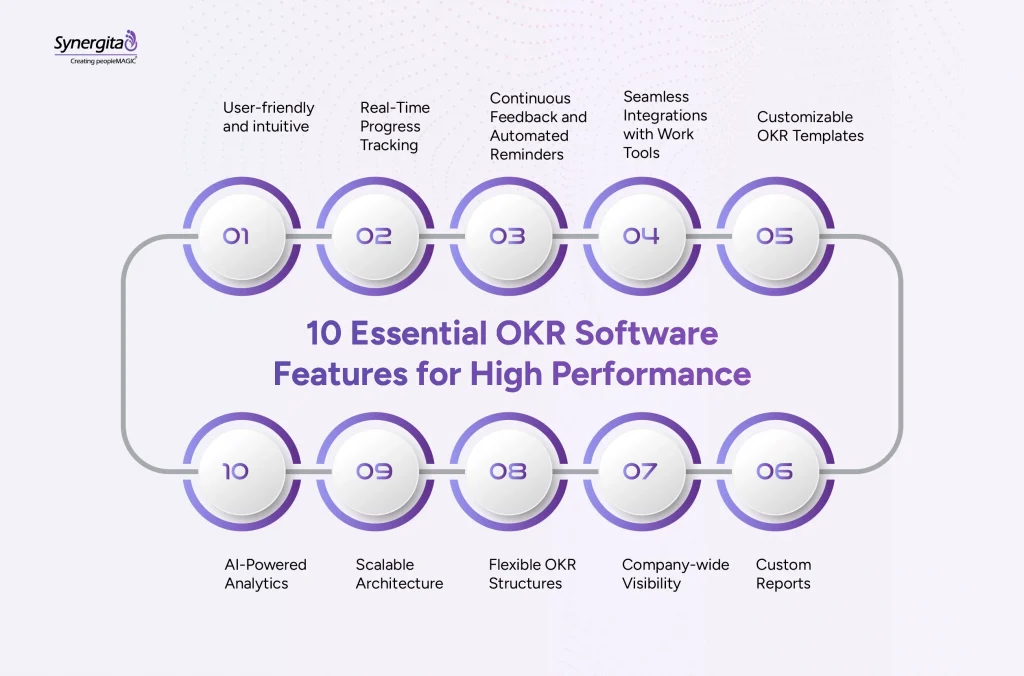
1. User-Friendly and Intuitive
A clean, clutter-free interface in OKR software helps leaders and employees use the tools without technical knowledge. They can focus on their goals rather than spending time on understanding the tool itself. When the system is easy to navigate, it becomes easier to adopt across the organization.
How it solves real problems:
- Reduces the learning curve, enabling teams to start tracking goals immediately.
- Improves adoption rates by eliminating complexity and confusion.
2. Real-Time Progress Tracking
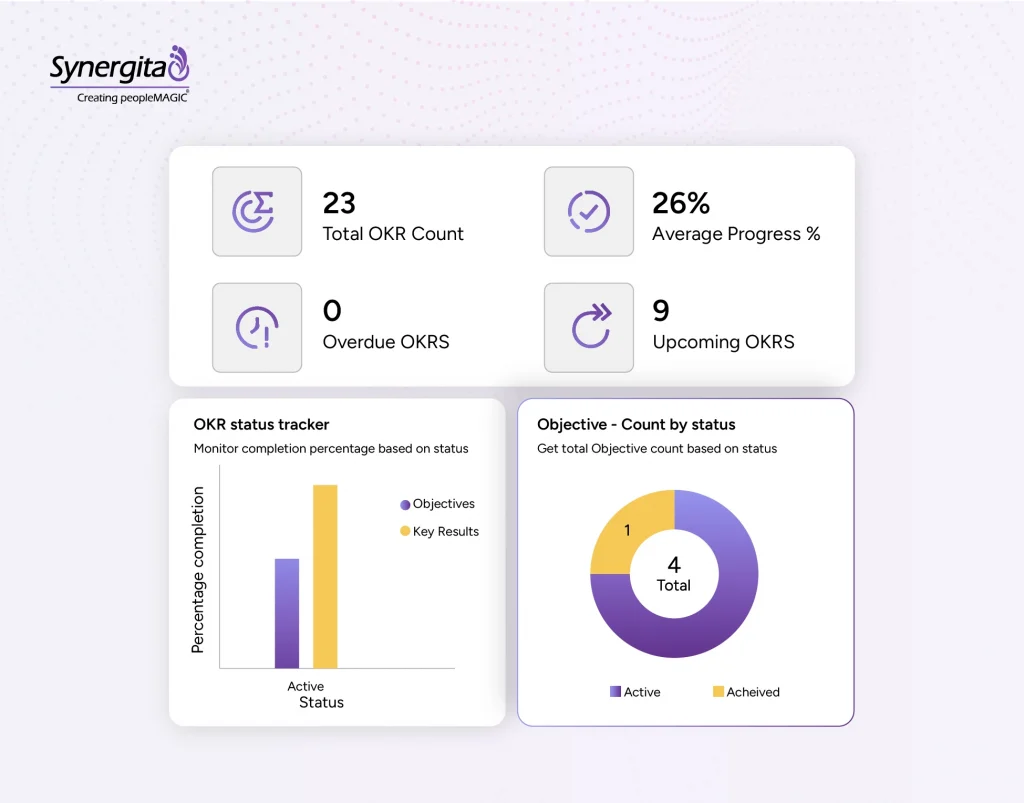
This is one of the essential features every OKR platform must have. Live dashboards and automatic progress updates reflect real work, such as tasks completed, metrics updated, and confidence scores adjusted. This gives both employees and managers a real-time view of the current status, instead of waiting weeks or months for updates.
For example, A marketing team sees their campaign-related key result fall behind schedule mid-quarter, pulls up the dashboard, and reassigns tasks.
How it solves real problems:
- Helps teams detect delays or execution bottlenecks early and avoid common OKR mistakes.
- Enables managers to reallocate resources or provide support instantly with live data.
- Keeps teams aligned with shifting priorities through immediate visibility of progress.
3. Continuous Feedback and Automated Reminders
Modern OKR software eliminates the need for manual follow-ups by sending smart reminders, prompting weekly or bi-weekly check-ins, and empowering teams to track progress anytime. This keeps OKR tracking dynamic and aligned with day-to-day work rather than becoming a once-a-month activity.
For instance, weekly OKR reminders help the team update progress on time, and stakeholders can take action if any blockers are flagged.
How it solves real problems:
- Maintains consistent momentum through timely reminders and check-ins.
- Prevents goal-tracking from becoming a once-a-month activity, leading to better discipline.
- Ensures blockers are surfaced early, enabling quick intervention and smoother execution.
4. Seamless Integrations with Top Tools
One of the most useful OKR software features is seamless integration with HRIS, project management, communication, and CRM tools. With real-time syncing, teams spend less time entering data and more time executing on the goals that matter.
How it solves real problems:
- Eliminates manual data entry and reduces the risk of outdated or inconsistent information.
- Syncs OKRs with daily tools, keeping execution tightly connected with ongoing work.
- Saves teams significant time by centralizing updates from HRIS, PM tools, CRMs, and communication apps.
5. Customizable OKR Templates
Customizable OKR templates help teams get started quickly by offering clear, ready-made structures for setting goals and key results. With these OKR software features, teams can use these templates as a starting point and tailor them to their specific priorities and workflows.
How it solves real problems:
- Removes the friction of starting from scratch, helping teams set OKRs faster.
- Ensures consistency across departments with unified goal-setting structures.
- Speeds up OKR adoption, especially for teams new to structured planning.
Suggested Reading: 5-Step Plan to Roll Out OKR in Your Company
6. AI-Powered Analytics
Modern AI-powered OKR tracking software goes beyond simple dashboards and highlights progress data, bottlenecks, and forecasts potential risks. These tools also give early warnings about lagging key results or resource constraints before issues escalate.
How it solves real problems:
- Predicts risks early so leaders can intervene before delays escalate.
- Highlights hidden bottlenecks using real data, improving decision accuracy.
- Guides resource allocation and prioritization with forward-looking insights.
7. Scalable Architecture
As organizations grow, their goal-setting requirements evolve accordingly. Flexible and scalable OKR software allows teams of any size, from startups to large enterprises, to adapt the platform to their structure, workflows, and growth pace. Moreover, robust performance, enterprise-grade security, and customizable settings ensure it supports long-term expansion.
How it solves real problems:
- Supports teams of all sizes, from small groups to thousands of employees.
- Adapts to changing business structures, priorities, and workflows.
- Ensures reliability, security, and performance as the organization scales.
8. Flexible OKR Structures
Modern software lets teams choose from various Key Result types: numeric, milestone-based, binary, qualitative, and customize scoring, cadence, and review cycles. This flexibility accommodates different departmental workflows and business realities.
How it solves real problems:
- Allows each department to create OKRs suited to its workflow
- Improves accuracy and relevance in goal-setting through custom scoring, cadence, and cycle settings.
9. Company-Wide Visibility and Transparency
A core OKR feature of effective goal-setting software is that it offers visibility into both team and individual goals. This helps team members understand how their efforts contribute to team objectives, improving alignment and collaboration. Synergita’s Hierarchy Tree strengthens this visibility by visually connecting goals across the organization.
For example, marketing and sales teams can refer to the same company-level goals instead of working in different directions. This shared visibility improves alignment, strengthens collaboration, and prevents conflicting campaigns.
How it solves real problems:
- Reduces duplicated efforts and prevents conflicting goals across departments.
- Helps employees understand how their work contributes to larger company objectives.
- Strengthens alignment and improves cross-functional execution.
10. Custom Reports
Custom reports in OKR software allow teams to dive deeper into performance reports by generating tailored views of metrics and team-wise outcomes. This flexibility ensures that each team gets insights aligned with their unique workflows and goals.
How it solves real problems:
- Converts scattered OKR data into actionable insights tailored to each team.
- Helps leaders quickly identify trends, gaps, or delays across departments.
- Supports informed decision-making by providing clear, contextualized performance views.
What Is the Main Purpose of OKR Software?
OKR software helps organizations implement their strategy as clear, measurable, and trackable goals that every team can align with. Instead of scattered spreadsheets or inconsistent check-ins, OKR software provides a structured system that keeps objectives visible, progress transparent, and execution disciplined. Here is what OKR software helps businesses to achieve:
1. Align Goals Across the Organization
OKR software aligns company-wide, team, and individual objectives so that all effort is directed in one direction. This reduces redundant work and departmental silos, making it easier for every team to contribute to common strategic goals. According to Stanford University research, teams that collaborate effectively can be up to 50 percent more productive.
2. Create Clarity and Focus
By defining clear, measurable objectives and key results, OKR software ensures teams concentrate on what truly matters. This helps teams avoid distractions and ensures they focus on high-value outcomes.
3. Enable Real-time Tracking and Transparency
Unlike static documents, OKR software offers live dashboards and progress updates. This visibility helps identify roadblocks early and enables leaders to make quicker, better-informed decisions.
4. Helps Building Accountability
With clearly assigned key results and transparent progress tracking, individuals and teams know what they are accountable for. This clarity promotes ownership, makes performance measurable, and reduces the risk of overlooking critical tasks.
5. Support Data-driven Decisions
OKR software helps companies analyze progress trends, detect bottlenecks, and respond proactively when something is off track. This allows organizations to adapt quickly and align resources where they matter most, especially in fast-moving environments.
Final Takeaway
A top-class goal-setting software can be a game-changer for businesses. It enables teams to structure goals effectively, track progress with precision, and translate strategy into measurable outcomes. By using goal-setting software, you can track your progress and employees’ achievement rate.
OKR software offers clear benefits, but you need to use the right platform to translate those advantages into real impact. A modern, AI-powered OKR solution like Synergita helps your organization adopt OKRs faster, track progress accurately, and turn strategies into measurable results. Try Synergita OKR Free for 7 Days, and see how it simplifies OKR goal setting and execution.

Frequently Asked Questions
OKR software offers real-time progress tracking, reminders, integrations, and alignment features that spreadsheets cannot provide. Spreadsheets are also difficult to maintain and lack transparency.
OKR software is suitable for startups, small and medium businesses, and large enterprises. Leadership teams, department heads, managers, and employees can use it to align goals, track execution, and evaluate outcomes.
Most modern OKR platforms like Synergita integrate with HRIS systems, project management tools, CRMs, communication apps, and data sources. Integrations help automate progress updates and reduce manual work.
Yes. Synergita’s Hierarchy Tree visually maps company-level goals to teams and individuals, improving alignment and helping everyone understand how their work contributes to organizational outcomes.
Yes, Synergita offers a 14-day free trial so businesses can explore all features, including real-time tracking, feedback, analytics, and reporting, before making a decision.