
Your annual review is coming up, but one question comes first: which types of performance appraisals should your organization use? Rating scales, 360-degree feedback, continuous check-ins, or goal-based reviews: most companies pick one and run it for years without asking whether it still fits.
The problem is that there is no single best method. The evidence you need to justify a promotion is not the evidence a manager needs to coach someone, and neither is what HR needs for succession planning. The right appraisal method depends on the business decision you’re trying to make and the evidence needed to support it.
By the end of this guide, you’ll understand the different types of performance appraisals, how each method works, where it fits best, and why leading organizations combine multiple methods to build a more effective performance management process.
| TL;DR – 30 Seconds Quick Takeaway A single appraisal method is not good for every role or evaluation objective. Use MBO and goal-based reviews to measure progress against clear business objectives. Use continuous feedback to improve coaching, engagement, and employee development throughout the year. Combine multiple appraisal methods for more objective, transparent, and accurate performance evaluations. |
| Table of contents 1. What are the most effective types of performance appraisals 2. Why choosing the right appraisal system is important 3. Which type of performance appraisal is right for your organization? 4. Best practices for implementing performance appraisals 5. Performance appraisal selection checklist 6. Final Takeaway 7. Frequently Asked Questions |
What are the most effective types of performance appraisals
The main types of performance appraisals include 360-degree feedback, MBO, BARS, OKR-based reviews, continuous performance management, self-appraisals, balanced scorecards, and goal-based reviews. Each is designed for different performance and business needs.
1. 360-Degree feedback
360-degree feedback is also known as multi-rater or multi-source feedback. This feedback method collects performance insights from multiple sources, including managers, peers, direct reports, and sometimes customers. Instead of relying only on a supervisor’s opinion, it evaluates workplace behaviors, collaboration, communication, and leadership skills from different perspectives.
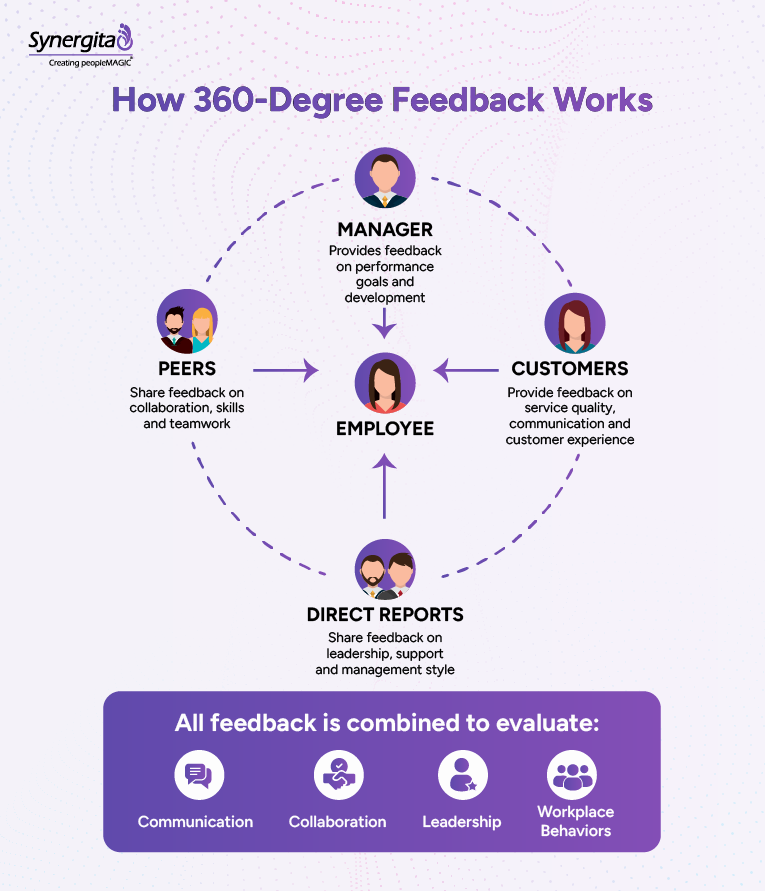
Best suited for:
- Leadership development
- Managerial roles
- Team-based environments
2. Management by objectives (MBO)
Management by Objectives (MBO) evaluates employees based on their ability to achieve mutually agreed goals. Managers and employees set measurable objectives at the beginning of a review period and assess performance based on the level of achievement.
Best suited for: Sales teams, project-based roles, and positions with measurable targets.
3. Behaviorally anchored rating scale (BARS)
Behaviorally Anchored Rating Scale (BARS) uses traditional rating scales with specific examples of expected workplace behaviors. Instead of using vague ratings such as “excellent” or “needs improvement,” BARS evaluates employees against clearly defined behavioral standards.
Best suited for: Roles where job behaviors, service quality, or competency assessment are critical.
4. OKR-based performance appraisals
OKR-based appraisals evaluate employees based on progress toward Objectives and Key Results (OKRs). This approach connects individual contributions with broader organizational goals and helps teams track employees’ contributions toward measurable outcomes.
Best suited for:
- Technology and SaaS companies
- Growing startups and scaling teams
- Organizations with strong goal-alignment needs
5. Continuous performance management
Continuous performance management replaces the traditional once-a-year review cycle with regular check-ins, feedback conversations, goal updates, and coaching discussions. It helps managers address challenges earlier and provides employees with ongoing guidance.
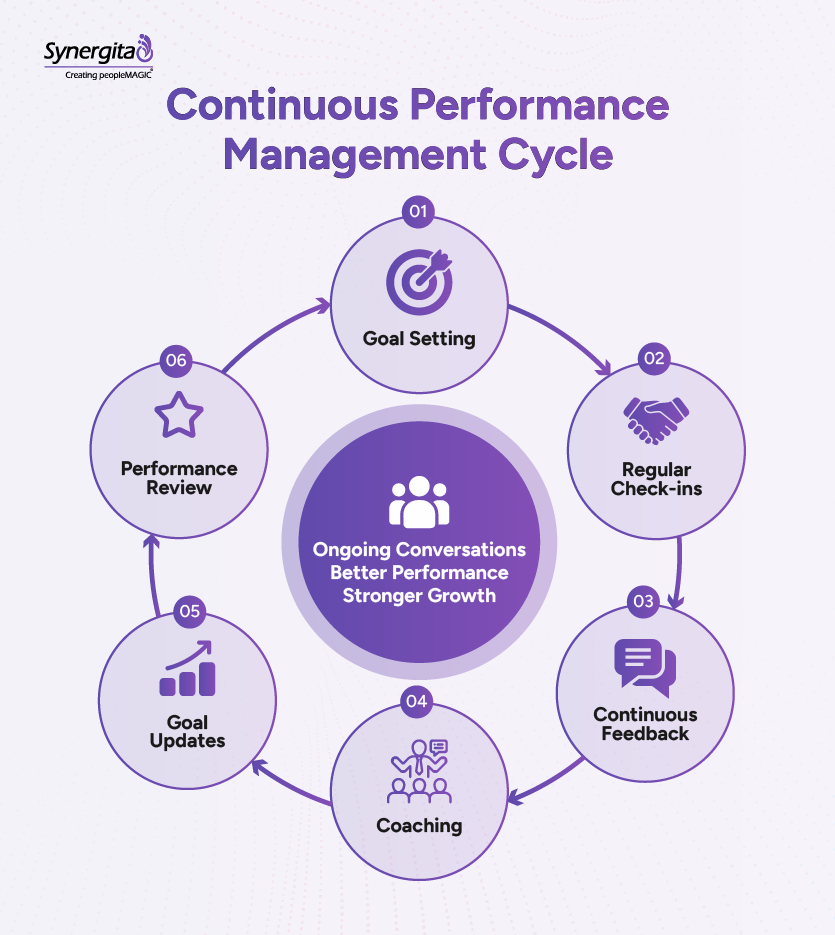
Best suited for: Organizations focused on employee development, engagement, and agile goal management.
6. Self-appraisals
Self-appraisals allow employees to evaluate their own achievements, challenges, and development goals before a formal performance discussion. This encourages employees to reflect on their contributions and creates a more balanced review conversation.
Best suited for: Organizations that want to improve employee ownership and make performance discussions more collaborative.
7. Balanced scorecard appraisals
Balanced Scorecard appraisals measure performance across multiple areas, including financial results, customer outcomes, internal processes, and learning or development goals. This prevents organizations from evaluating employees based on a single metric alone.
Best suited for: Managers, leadership roles, and cross-functional positions.
The most effective performance review categories add goal-based evaluations for measurable outcomes, behavioral assessments for skills and collaboration, and continuous feedback for employee growth.
This blended approach creates fairer evaluations while supporting both business performance and employee development.
Why choosing the right appraisal system is important
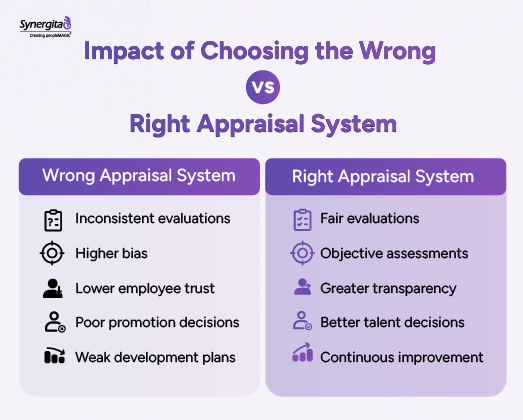
The right performance appraisal system improves evaluation accuracy, reduces bias, and helps organizations make fair decisions about employee performance. The impact of using the wrong appraisal system is reflected in how employees and managers perceive the review process.
According to Deloitte’s 2025 Global Human Capital Trends report, 61% of managers and 72% of employees don’t trust their organization’s performance management process. In many cases, the issue lies in using the wrong appraisal approach rather than poor management.
A well-designed appraisal process offers several advantages:
- Improve evaluation accuracy by matching appraisal methods to specific roles and performance goals.
- Reduce bias and increase consistency with standardized rating criteria and objective performance measures.
- Build employee trust through transparent review processes and clearly defined expectations.
- Support better HR decisions for compensation, promotions, succession planning, and employee development.
- Encourage continuous improvement by combining structured reviews with regular feedback and coaching.
The business impact goes beyond better reviews. A McKinsey report found that organizations with a strong focus on employee performance are 4.2× more likely to outperform their peers, achieve 30% higher average revenue growth, and report five percentage points lower attrition.
The best performance reviews combine goal-based evaluations, continuous feedback, and manager assessments for a complete view of employee performance.
Which type of performance appraisal is right for your organization?
The right type of performance appraisal depends on what you want to measure. Different methods are designed for different purposes, such as goal achievement, compensation, promotions, leadership development, or employee growth.
The table below shows which performance appraisal methods work best for different evaluation goals.
| Evaluation Goal | Recommended Appraisal Method | Why It is Suitable |
| Measure goal achievement | Management by Objectives (MBO) | Tracks measurable goals |
| Support compensation decisions | Graphic Rating Scale + MBO | Ensures fair, consistent ratings |
| Identify employees for promotion | Manager Review + 360-Degree Feedback | Evaluates performance and potential |
| Improve employee performance | Continuous Feedback + Critical Incident Method | Supports timely coaching |
| Develop future leaders | 360-Degree Feedback | Identifies leadership strengths |
| Plan succession | Balanced Scorecard | Measures long-term impact |
Using different types of performance reviews, such as goal-based evaluations, continuous feedback, and multi-source assessments, creates a more balanced and accurate picture of employee performance.
This approach also improves fairness, supports employee development, and leads to better performance decisions.
Best practices for implementing performance appraisals
Use this checklist to ensure your performance appraisal process is fair, consistent, and effective.
☐ Set clear performance criteria: Define goals, KPIs, and competencies upfront.
☐ Standardize manager evaluations: Use rating guidelines and calibration to reduce bias.
☐ Document performance continuously: Record achievements and feedback throughout the year.
☐ Encourage two-way conversations: Discuss achievements, challenges, and future goals.
☐ Review the process regularly: Refine the appraisal process based on feedback and business needs.
☐ Support reviews with continuous feedback: Use annual appraisals with regular check-ins and coaching.
Implementing these best practices becomes much easier when performance reviews, goals, and feedback are managed in a single system instead of multiple spreadsheets and manual processes.
One example is Canara Robeco, which simplified its complex, multi-level appraisal process with Synergita. By replacing manual reviews with Synergita performance management software, the organization improved consistency, transparency, and the overall review experience for both managers and employees.
Final takeaway
Depending on a single review method for every role leads to ineffective appraisal and missed opportunities to develop talent. A combination of structured appraisals and regular feedback creates an appraisal framework useful for both employees and the organization.
Modern performance management platforms like Synergita make it easier to apply different appraisal methods for different roles and review scenarios.
Book a demo to see how Synergita simplifies modern performance appraisals with flexible review methods, continuous feedback, and real-time performance insights.

Frequently Asked Questions
The main types of performance evaluation include manager-led, multi-source, outcome-based, and continuous OKR-based feedback. These appraisal types are suitable for evaluating employee performance for different roles.
There is no single most accurate performance appraisal method. Goal-based and outcome-driven evaluations work best for measurable roles, while 360-degree feedback provides broader insights for leadership development when anonymity and structured feedback are maintained.
Annual performance reviews are not being replaced but are supported by continuous feedback. Many organizations now combine different types of performance reviews, including annual evaluations and continuous feedback.
Seven common kinds of performance appraisal are Management by Objectives (MBO), Graphic Rating Scale, 360-Degree Feedback, Self-Assessment, Peer Appraisal, Critical Incident Method, and the Balanced Scorecard. Most organizations combine these methods based on their performance management goals.
The 5 C’s of performance are commonly defined as Clarity, Competence, Commitment, Collaboration, and Continuous Improvement. These principles help organizations set clear expectations, develop employee capabilities, encourage teamwork, and drive consistent performance.
You can choose appraisal types based on the business decision you need to make. Goal-based methods are good for measurable outcomes, while continuous feedback and 360-degree reviews are better suited for employee development and leadership growth.