


Quick Summary
- Performance reviews are most effective when conducted regularly, not just once a year. Continuous feedback helps identify strengths, address skill gaps, and keep individual goals aligned with business priorities.
- Annual reviews fall short due to delayed feedback, recency bias, lack of real-time visibility, and missed opportunities for timely course correction.
- Engagement and outcomes improve with ongoing feedback: only 21% of employees globally are engaged, while teams that receive regular, meaningful feedback are up to 3.6× more likely to be engaged.
- Continuous performance reviews, supported by modern performance management software, enable real-time insights, shared accountability, fair data-driven decisions, and higher long-term engagement.
In many organizations, performance issues are analyzed only when they show up in outcomes such as missed targets, disengaged employees, or resignations. Effective performance reviews and continuous feedback can prevent these situations, yet many organizations treat them as an annual ritual rather than an ongoing management practice.
Research shows that only about 21% of employees worldwide are engaged in their work. On the other hand, teams that receive regular and meaningful feedback are up to 3.6 times more likely to be engaged than those that receive only annual feedback.
In this blog, we will explore why performance reviews are essential and how continuous feedback can benefit your business.
| Table of Contents 1. Why Performance Reviews Are Important for Businesses? 2. Why Are Annual Performance Reviews Not Enough for Today’s Organizations? 3. How Continuous Performance Reviews Deliver Better Outcomes? 4. Conclusion 5. Frequently Asked Questions |
Why Performance Reviews Are Important for Businesses?
When performance reviews are conducted regularly and thoughtfully, they help organizations improve productivity, support employee growth, and make informed talent decisions. This is why performance review is important in today’s fast-changing work environment. Let’s look at the key benefits of performance reviews.

1. Identify Strengths and Skill Gaps
One of the most important performance review benefits is that it helps managers assess what employees do well and where they need support. Regular reviews, along with 360-degree feedback, give leaders a structured way to provide personalized feedback rather than relying on assumptions or isolated observations.
Performance reviews help:
- Highlight individual strengths and high-impact contributions
- Identify skill gaps that require training or upskilling
- Provide clarity on career progression and development paths
2. Create a Culture of Continuous Feedback
Traditional annual reviews often result in delayed or surprising feedback. Modern performance reviews replace this approach with ongoing conversations that promote transparency and continuous improvement through employee feedback loops. With regular check-ins and performance reviews:
- Eliminate once-a-year surprises
- Encourage meaningful manager–employee conversations
- Build trust through timely and transparent feedback
3. Align Individual Goals with Business Objectives

Another key reason why performance reviews are essential is that they help ensure the employees are working towards the organizational goals. Without this, all the efforts can become fragmented, misaligned, and fail to contribute meaningfully to business outcomes. When employees understand the purpose behind their goals, they are more motivated to deliver results that matter.
Effective performance reviews help:
- Set clear expectations and measurable outcomes
- Connect individual contributions to company goals
- Improve accountability and execution across teams
Also Read: How to Align Employee Performance Management with Business Goals
4. Improve Employee Engagement and Retention
Employees are more engaged when they feel seen, heard, and valued. Performance reviews provide a formal space to recognize contributions and address concerns before they escalate. Gallup research shows that highly engaged teams have up to 78% lower absenteeism and 18% lower turnover. An engagement-driven performance review benefits businesses through:
- Increased motivation through recognition and appreciation
- Stronger sense of belonging and purpose
- Reduced attrition due to clearer growth opportunities
5. Make Data-Driven Performance Decisions
Data-backed performance review insights remove bias and help organizations make informed decisions about employee performance. This approach also empowers organizations to make fair and objective decisions. This structured approach allows organizations to act with confidence by:
- Strengthening succession planning: Identifying high-potential employees using historical performance data.
- Ensuring decision transparency: Maintaining clear performance records to support people-related decisions.
Why Are Annual Performance Reviews Not Enough for Today’s Organizations?
In today’s fast-moving work environment, a once-a-year evaluation is not effective and does not support continuous improvement and meaningful employee development.
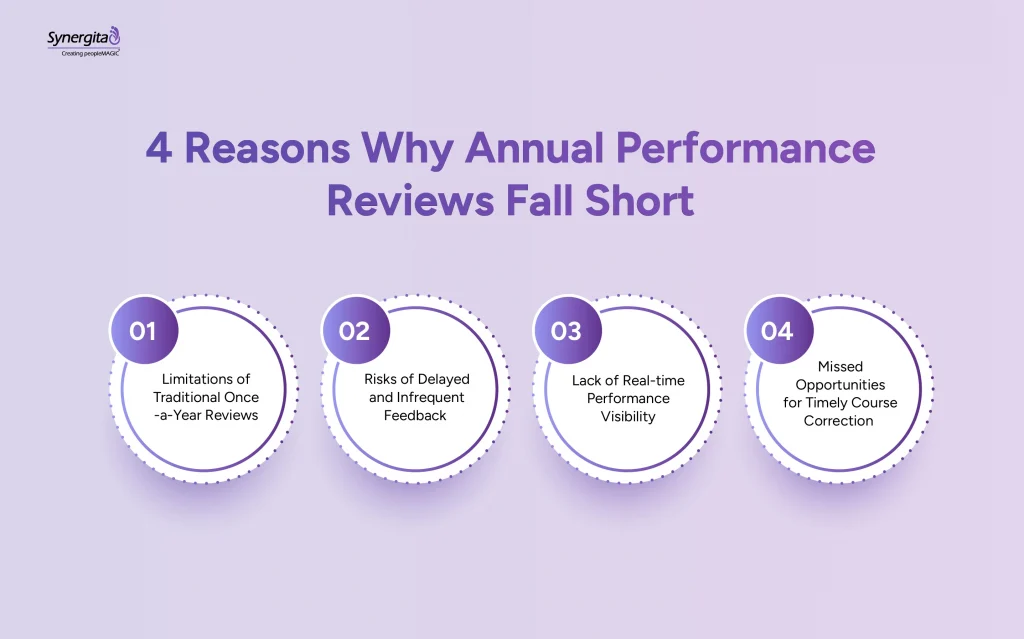
1. Limitations of Traditional Yearly Reviews
Yearly reviews can be influenced by recent events rather than an employee’s performance over time. This approach lacks accuracy and reduces the impact of feedback on actual performance improvement.
2. Risks of Delayed and Infrequent Feedback
When feedback is given after a long time, it loses relevance and effectiveness. Employees miss timely guidance, and small performance issues can grow into larger problems before they are addressed.
3. Lack of Real-time Performance Visibility
Annual reviews do not provide managers with real-time insight into employee performance and the challenges they are facing. Without real-time visibility, it becomes difficult to track and intervene when performance starts to drift.
4. Missed Opportunities for Timely Course Correction
Infrequent reviews delay coaching, recognition, and corrective actions that could otherwise improve outcomes. Continuous check-ins allow teams to set correct expectations and improve performance while there is still time to make an impact.
How Continuous Performance Reviews Deliver Better Outcomes?
Continuous performance reviews provide a structured way to evaluate progress, address challenges early, and support employee growth in real time. Let’s look at how continuous performance appraisal addresses performance issues in a timely manner.
1. Feedback when it matters most
Instead of waiting months for formal reviews, continuous feedback helps employees correct course immediately. This results in faster improvement and fewer surprises at year-end.
2. Clear visibility into performance trends
Ongoing reviews create a consistent record of progress, challenges, and achievements. Modern performance management software consolidates this data into a single, real-time view, giving managers real-time visibility without relying on fragmented inputs or memory-based evaluations.
3. Greater Accountability
Frequent check-ins also promote shared accountability between managers and employees. Performance management tools ensure accountability by documenting feedback, review inputs, and follow-up actions, thereby clearly defining responsibilities.
4. Higher Engagement through Consistent Support
When managers provide continuous and constructive feedback, employees feel supported rather than judged. Moreover, regular recognition, coaching, and clarity on expectations build trust and long-term engagement.
5. Data-driven Insights for Better Decisions
Continuous reviews generate consistent performance data over time. It helps ensure fair evaluations and supports better development plans and decisions regarding growth, recognition, and rewards.
Suggested Reading: How is Continuous Feedback Better than Annual Review?
Conclusion
Performance reviews require time and effort, but when done consistently, they improve engagement, clarity, and overall business performance. Rather than treating reviews as an annual obligation, organizations benefit most when feedback becomes part of regular, ongoing conversations.
This is where performance management software like Synergita adds real value. These tools provide a structured system for continuous evaluation of employee performance. With today’s workforce expecting timely feedback and transparency, investing in the right technology helps reduce administrative effort while making performance discussions more effective and impactful.
Try the Synergita Performance Management Tool free for 14 days and see how it streamlines performance appraisals.
Frequently Asked Questions
Performance reviews help in clarifying expectations, encourage continuous improvement, and align individual performance with organizational goals.
Traditional reviews happen once or twice a year and do not give a real-time picture of employee performance. However, continuous reviews involve regular check-ins, real-time feedback, and ongoing goal adjustments.
They provide employees with recognition, guidance, and frequent feedback, which increases motivation and fosters a sense of value in the organization.
Common mistakes include relying solely on annual feedback, failing to tie reviews to goals, ignoring employee input, and delaying follow-up actions after reviews.
Synergita performance management software supports continuous performance reviews, 360° feedback, goal setting, continuous feedback, sentiment analysis, and real-time analytics to support performance and engagement.
Synergita is cloud-based and designed for easy setup by HR teams, with customizable templates and workflows that match organizational review cycles and policies.