
A nonprofit can deliver every program on schedule but may not be able to answer one practical question: Did the work produce the intended results? That challenge is reflected in a 2024 Leadership Impact Study, where 40% of nonprofit respondents said their organization lacked impact data.
Without clear outcome targets, teams may spread limited funding and staff time across activities that do not support their main priorities.
OKRs for nonprofits link daily responsibilities with measurable program outcomes. They give program leaders, fundraisers, volunteers, and board members shared objectives, clear targets, and a practical way to report progress to funders and communities.
The following 10 nonprofit OKR examples cover program reach, fundraising, donor retention, volunteer engagement, partnerships, operations, and impact measurement. Each example includes a focused objective and key results that teams can adapt to their mission.
| Table of contents 1. Why do nonprofits need OKRs? 2. How can nonprofits implement OKRs? 3. What are 10 examples of OKRs for nonprofits? 4. How can nonprofits adapt OKRs to improve OKR adoption? 5. How can nonprofits move forward with OKRs? 6. How to select the right OKR software for nonprofits? 7. Final takeaway 8. Frequently asked questions |
| TL;DR Set mission-aligned objectives with specific, measurable key results. Use nonprofit OKRs to track programs, funding, volunteers, partnerships, and beneficiary outcomes. Review progress weekly or biweekly and revise targets when resources or community needs change. Select OKR software with simple updates, clear ownership, shared access, and funder-ready reports. |
Why do nonprofits need OKRs?
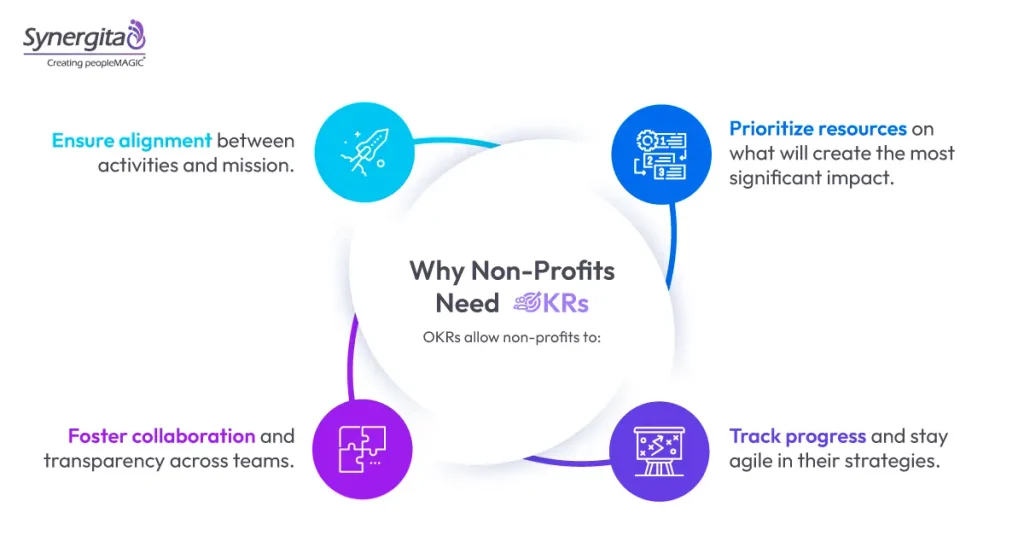
Nonprofits need OKRs to connect daily work with their mission, prioritize limited resources, measure program outcomes, and show teams, boards, funders, and communities how their programs create impact.
OKR software for non-profits gives teams one place to assign goals, record updates, and review results.
For nonprofits, it’s easy to get lost in daily activities, spread thin across too many projects, or become reactive to emerging issues, all of which can dilute their core mission.
Strategic planning remains a challenge across the sector; more than 40% of nonprofit boards still don’t have a board-approved written strategic plan.
OKR software gives teams one place to assign goals, record updates, and review results. Teams can then compare progress, identify delays, and report results.
How can nonprofits implement OKRs?
Nonprofits can implement OKRs by setting mission-aligned objectives, defining measurable key results, assigning ownership, and reviewing progress weekly or biweekly. Each of these OKR examples illustrates a clear pathway for nonprofits to align their activities with their mission and track progress.
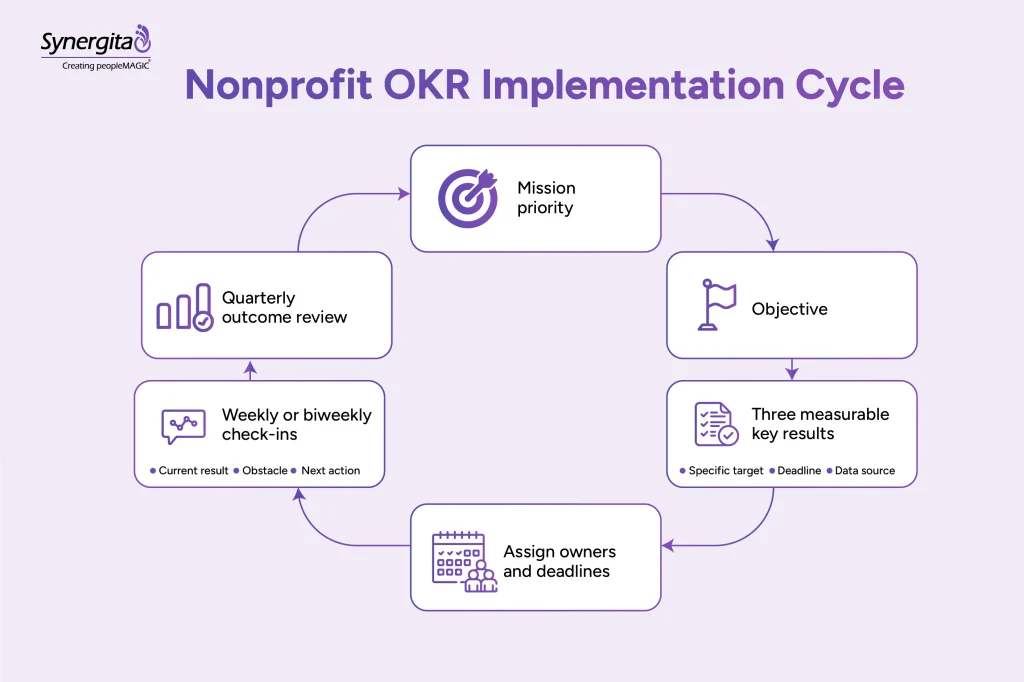
Starting with a small number of objectives can improve OKR adoption and make regular progress reviews easier for staff. To implement OKRs successfully, nonprofits should:
- Set Realistic Objectives: Each objective should be mission-aligned and realistically achievable.
- Define Measurable Key Results: Key results should be specific, quantifiable, and time-bound.
- Review and Adapt: Regular reviews ensure that OKRs remain relevant and achievable, allowing teams to make adjustments as needed.
Each example of OKRs for nonprofits below shows how organizations can connect daily activities with their mission and track progress.
Suggested reading: OKR Implementation Guide: How to Successfully Roll Out OKRs in Your Organization
What are the 10 OKR examples for non-profits?
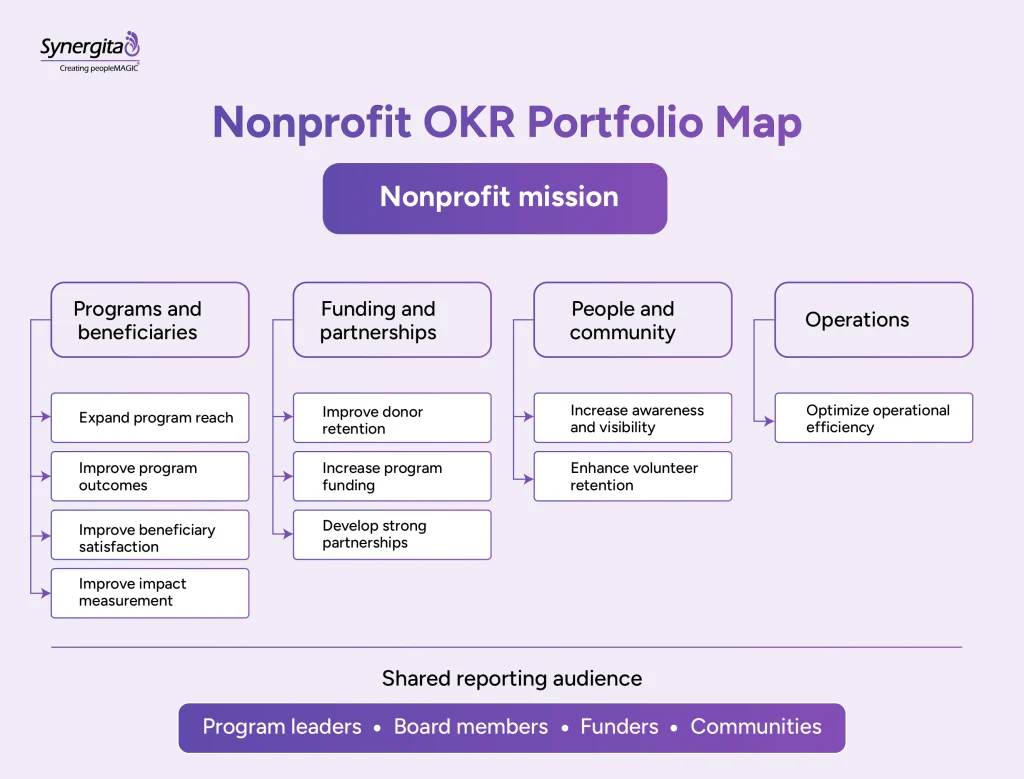
Nonprofit OKRs can support program delivery, fundraising, donor retention, volunteer engagement, partnerships, operational performance, and impact measurement. The following 10 examples show how to turn mission-driven priorities into measurable results.
1. Expand program reach
Nonprofits usually aim to expand their reach into communities where their programs can have the greatest impact. This OKR focuses on increasing access while measuring program growth.
Objective: Expand our literacy program to reach new underserved areas.
- KR 1: Increase the number of underserved communities served from 5 to 10 by Q2.
- KR 2: Increase the number of enrolled students by 30% by Q3.
- KR 3: Increase program capacity to serve 20% more students within six months.
2. Improve donor retention
Consistent funding is crucial for non-profits, making donor retention a key priority. This OKR focuses on keeping donors engaged and encouraging long-term support.
It’s a real challenge sector-wide: the Association of Fundraising Professionals’ Fundraising Effectiveness Project found that overall U.S. donor retention edged up to just 43.3% in 2025, highlighting the importance of making donor retention a measurable priority.
Objective: Boost donor retention and build long-term relationships.
- KR 1: Increase annual donor retention rate from 60% to 75%.
- KR 2: Achieve a 40% open rate for quarterly donor communications.
- KR 3: Increase repeat donations by 20% by year-end.
3. Increase awareness and visibility
Community engagement OKRs can help nonprofits track outreach events, public participation, campaign reach, and interactions with the people they serve. This OKR focuses on increasing visibility through outreach events and digital campaigns.
Objective: Raise awareness about our mission and programs.
- KR 1: Increase engagement from target audiences by 25% by Q3.
- KR 2: Increase qualified website traffic from new audiences by 30% by year-end.
- KR 3: Organize three outreach events, engaging at least 500 new individuals.
4. Enhance volunteer retention
Volunteers are essential to many non-profits. Keeping them motivated and involved is key to sustaining program success.
Objective: Improve volunteer engagement and retention rates.
- KR 1: Increase volunteer engagement from 70% to 85% by Q2.
- KR 2: Increase volunteer retention from 50% to 70% by year-end.
- KR 3: Increase the percentage of volunteers completing required training from 75% to 95% by year-end.
5. Increase program funding
Nonprofits need a steady influx of funding to operate effectively. This OKR aims to diversify and increase funding sources.
Objective: Increase funding from diverse sources to support our mission.
- KR 1: Increase grant funding by 25% by Q2.
- KR 2: Raise $50,000 through crowdfunding by Q3.
- KR 3: Secure $30,000 in corporate sponsorships by Q4.
6. Improve program outcomes
For non-profits that deliver services, maintaining high program quality is critical. This OKR focuses on delivering impactful, quality programs that meet the needs of beneficiaries.
Objective: Enhance the quality and impact of our literacy programs.
- KR 1: Increase the percentage of participating students reading at grade level from 55% to 70% by Q4.
- KR 2: Achieve a 90% program satisfaction rate among students and teachers.
- KR 3: Track and report on literacy progress, aiming for a 15% improvement in reading levels by year-end.
7. Optimize operational efficiency
Operational efficiency can help non-profits make the most of limited resources. This OKR is aimed at streamlining processes to reduce costs and improve productivity.
Objective: Increase operational efficiency to maximize resource utilization.
- KR 1: Reduce overhead costs by 10% through process improvements by Q4.
- KR 1: Achieve 95% completeness across required program data fields by Q2.
- KR 3: Decrease administrative time spent on reporting by 30% through automation.
8. Develop strong partnerships
Partnerships can open up new resources and networks, helping non-profits extend their reach and effectiveness.
Objective: Build and use partnerships to expand resources and impact.
- KR 1: Increase the number of active community partnerships from 5 to 10 by Q2.
- KR 2: Increase the number of beneficiaries reached through partner-supported programs by 30% by year-end.
- KR 3: Secure $30,000 in shared resources through partnerships by year-end.
9. Improve impact measurement
Data-driven decision-making allows non-profits to better demonstrate their impact and improve accountability. This OKR focuses on enhancing data practices.
Objective: Improve data collection and reporting to measure program impact effectively.
- KR 1: Achieve 95% completeness across required program data fields by Q2.
- KR 2: Increase the percentage of programs reporting standardized outcome metrics to 100% by Q3.
- KR 3: Deliver quarterly impact reports covering 100% of active programs by Q4.
10. Improve beneficiary satisfaction
Ensuring that beneficiaries are satisfied and engaged helps non-profits understand the needs and preferences of the communities they serve.
Objective: Increase beneficiary engagement and satisfaction with programs.
- KR 1: Increase beneficiary satisfaction from 65% to 75% by year-end.
- KR 2: Increase beneficiary feedback response rates to 70% by Q3.
- KR 3: Increase the percentage of beneficiaries reporting that programs meet their needs to 85% by year-end.
How nonprofits can adapt OKRs to improve OKR adoption
Nonprofits can improve OKR adoption by linking every objective to their mission, defining measurable outcomes, reviewing progress regularly, and adjusting key results as community needs and available resources change.
Here are a few key takeaways for non-profits adopting OKRs:
- Align OKRs with mission: Every objective should reflect the mission, ensuring all resources and activities contribute to a meaningful outcome.
- Measure impact with clear key results: Specify quantitative targets that allow for measurable success. Increase the percentage of participating students reading at grade level from 55% to 70% by Q4.
- Review and adjust regularly: Nonprofits face shifting needs. Regular OKR check-ins ensure adaptability, so the organization can stay responsive to the communities they serve.
- Share progress across teams: OKRs promote clarity and accountability, showing each team member how their work supports the organization’s goals.
Suggested Reading: A Guide To Weekly OKR Check-Ins: Best Practices, Checklists And Importance
How to select the right OKR software for nonprofits?
When selecting OKR software for a non-profit, check whether staff can create goals, update key results, and review progress without extensive training. The platform should also support the organization as programs, locations, and reporting requirements expand.
Focus on these capabilities:
- Simple progress updates: Staff should be able to record updates during weekly or biweekly check-ins.
- Clear ownership: Each objective and key result should have an assigned owner and deadline.
- Cross-team access: Program, fundraising, volunteer, and leadership teams should be able to view shared goals.
- Flexible pricing: Costs should remain manageable as the organization adds employees or volunteers.
- Useful reports: Reports should support board reviews, grant applications, funder updates, and annual impact reporting.
- Permissions: Administrators should control who can view, edit, or approve sensitive goals.
Test the software with one team before introducing it across the organization. A short trial can show whether staff can update goals easily and whether reports provide the information leaders need.
Final takeaway
Nonprofits gain the most benefits from OKRs when teams understand what success looks like and progress is tracked continuously rather than reviewed only at the end of the year. Without a structured system in place, it becomes difficult to connect daily program work back to the mission as an organization scales across new locations, funders, and initiatives.
Synergita OKR Management Software supports goal alignment across teams, real-time progress tracking, and automated reporting, so program leaders spend less time compiling status updates and more time focused on mission-critical work.
Start a free trial and see how Synergita can help your nonprofit turn mission priorities into measurable results.
Frequently asked questions
OKRs for nonprofits are a goal-setting framework that connects mission-driven objectives with measurable key results. They help organizations track program outcomes, align teams, prioritize resources, and demonstrate impact to boards, funders, and communities.
One example of OKRs for nonprofits is the objective: ‘Improve donor retention and engagement. Key results might include increasing donor retention from 60% to 75%, achieving a 40% newsletter open rate, and increasing donor engagement by 20%.
OKR software helps nonprofits centralize goals, assign ownership, monitor progress, and automate reporting. It gives program teams, leaders, and boards clear visibility into how daily activities contribute to measurable mission outcomes.
Start with a few mission-aligned objectives, define measurable key results, assign an owner to each goal, and schedule regular check-ins. Keep the process simple and provide clear guidance to support OKR adoption across teams.
Nonprofits measure success by tracking outcomes such as program reach, donor retention, volunteer participation, beneficiary satisfaction, funds raised, service quality, and progress toward specific mission goals.
Nonprofits should review OKRs weekly or biweekly to track progress and address obstacles. A more detailed monthly or quarterly review helps teams evaluate results, adjust priorities, and set new goals.
Nonprofits can use OKRs to track fundraising, program delivery, donor retention, volunteer participation, community engagement OKRs, operational costs, partnerships, and impact reporting.
Small nonprofits can begin with spreadsheets, but OKR software for non-profits provides clearer ownership, automated updates, and centralized reporting.