
A leadership team sets annual goals for every department. Six months later, most teams have met their targets. Finance reduced costs, sales increased revenue, and HR filled open roles, but the company’s biggest priority has barely moved.
This disconnect shows traditional goal setting may not always be effective. OKRs address this problem by connecting the company’s larger objectives to team and individual goals. Without clear alignment, employees may not understand what is expected of them.
According to a nationally representative Gallup study of 18,665 employees, only 47% of U.S. employees strongly agree that they know what is expected of them at work.
This is where understanding the difference between OKRs and traditional goal setting is important. OKRs connect broader objectives to measurable results and can link company priorities with team and individual goals. Traditional goal-setting methods can provide clear, fixed targets, but their effectiveness depends on how those goals are set, communicated, and reviewed.
| TL;DR OKRs pair objectives with measurable key results and regular progress reviews. Traditional goal setting can use annual, role-based, or long-term targets depending on the method. The main differences are goal structure, alignment, measurement, review frequency, and flexibility. Organizations can use OKRs alongside traditional goals when they serve different planning needs. |
| Table of contents 1. What is the definition of an OKRWhat are traditional goal-setting methods 2. What are the different types of goal setting 3. OKRs vs Traditional goal setting: What are the key differences 4. What are the advantages and disadvantages of each approach 5. OKRs vs Traditional goal setting: What are the key differences ← duplicate 6. How does Synergita simplify your goal-setting process 7. Final takeaway 8. Frequently asked questions |
What is the definition of OKR?
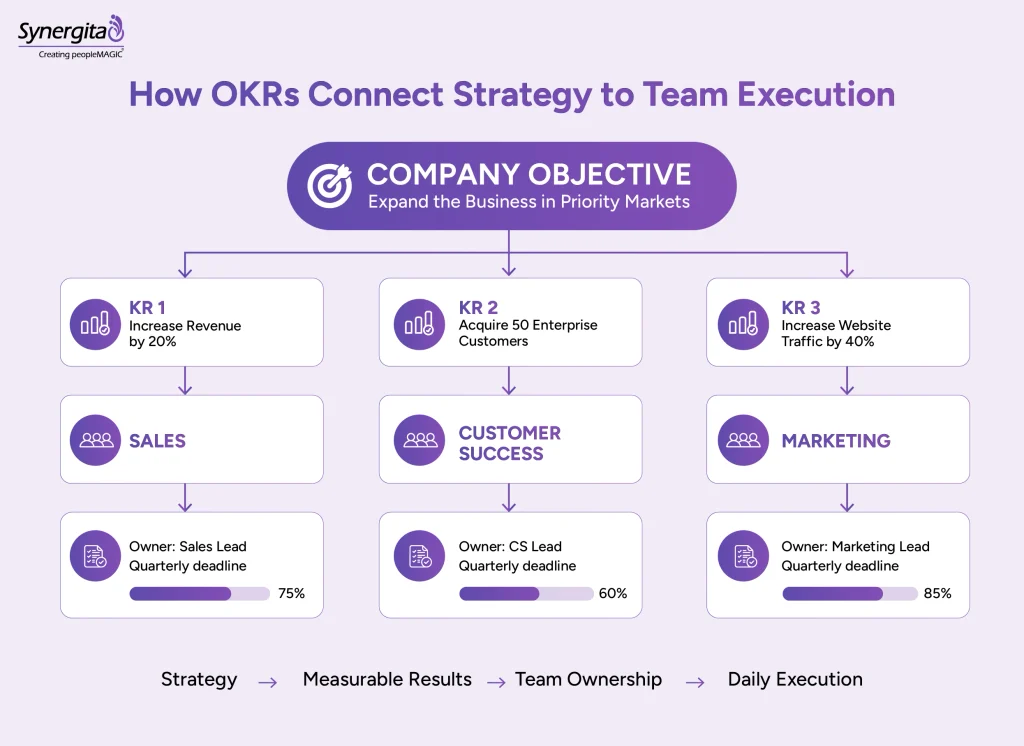
An OKR, or Objectives and Key Results, is a goal-setting framework that connects a clear objective with measurable results. The objective defines what the organization or team wants to achieve, while the key results show how progress and success will be measured.
Intel popularised OKRs in the 1970s. Companies such as Google, LinkedIn, and Netflix have since adopted the framework.
In recent years, OKRs have expanded beyond the technology sector into retail, manufacturing, FMCG, healthcare, and education. Organisations across these industries use OKRs to align goals, build team accountability, support collaboration, and drive measurable outcomes.
The OKR goal-setting framework connects ambitious objectives with measurable key results.
OKRs consist of two elements: Objectives and Key Results.
Objectives describe clear and ambitious outcomes that employees, teams, or organizations want to achieve. They’re usually ambitious, challenging, and aligned with the company’s overall strategy.
Key results are specific, measurable, time-bound metrics used to track progress toward the objective. They provide a quantitative way to determine whether the objective has been achieved. In short, the objective is “what,” and the key results are “how.”
To learn how OKRs support organizational change across industries, read: How OKRs Make Digital Transformation Easy and Effective
Example of OKRs focused on business growth:
Objective: Expand the business in priority markets
- KR 1: Increase revenue by 20% by the end of Q2.
- KR 2: Acquire 50 new enterprise customers in target markets.
- KR 3: Boost website traffic by 40% through targeted marketing campaigns.
This example pairs a growth-oriented objective with measurable, time-bound key results. The objective states the intended result, and the key results provide specific metrics to track progress and confirm alignment with the goal.
What are the traditional goal setting methods?
Traditional goal setting covers structured methods that organisations use to define, assign, and review targets over a set period. In this approach, an organization or an individual sets a goal they want to accomplish without defining specific, measurable, and achievable objectives or key results.
It also involves setting long-term goals that are specific, achievable, relevant, and time-bound. These goals are usually set at the beginning of the year, reviewed periodically, and evaluated at the end of the year. Managers or senior leaders often set these goals for employees and teams.
Traditional goal setting usually focuses on outcomes rather than the process used to achieve them. Although these goals may align with the organisation’s vision, some traditional methods offer limited flexibility when priorities change.
What are the different types of goal setting?
The main types of goal setting include OKRs, SMART goals, Management by Objectives, annual goals, appraisal-based goals, and long-term strategic goals. When comparing different goal setting methods, organisations should consider review frequency, employee input, measurement, and flexibility.
If you are considering OKR alternatives, these are some of the traditional goal-setting methods organisations commonly use.
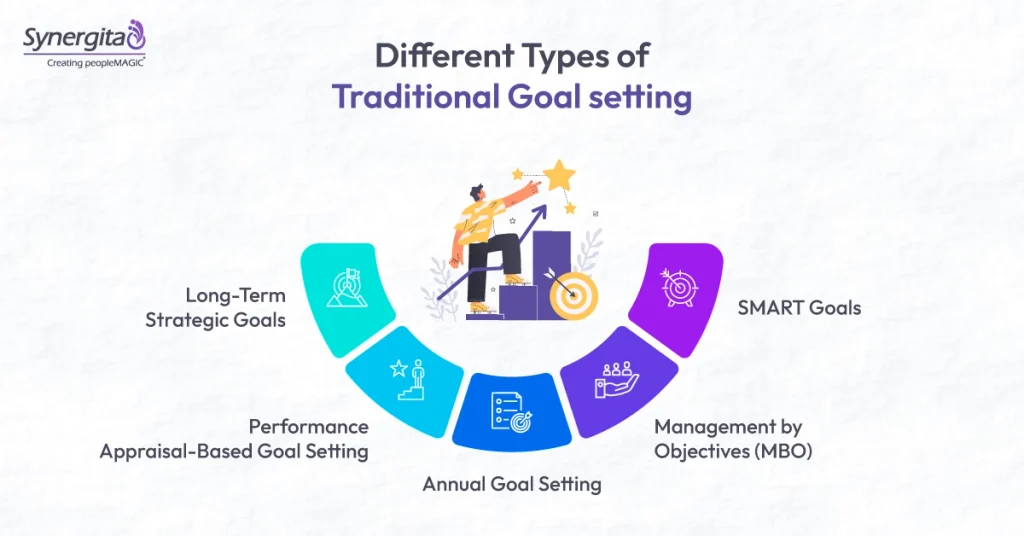
1. SMART goals
SMART goal setting is one of the most widely used traditional goal-setting frameworks. It focuses on making goals Specific, Measurable, Achievable, Relevant, and Time-bound. SMART goals may cover short- or long-term periods, with reviews based on their deadlines.
2. Management by Objectives (MBO)
MBO is a goal-setting approach introduced by Peter Drucker. Managers and employees work together to define measurable objectives. These goals are clear and measurable, but the process follows a top-down approach: managers set broad objectives, which then cascade to employees, teams, and departments. Progress is reviewed periodically, and results are assessed at the end of the period.
Suggested reading: Management By Objectives: Process, Benefits, and Best Practice
3. Annual goal setting
Many organizations set annual goals at the start of the year and review them at year-end. Goals can range from financial targets to personal development milestones, but they’re typically specific and measurable.
4. Performance appraisal-based goal setting
This method is used alongside performance appraisals, where goals are set as part of an employee’s performance evaluation. These goals are typically specific, linked to the employee’s role, and reviewed at the next appraisal, then reset or adjusted for the coming year.
5. Long-term strategic goals
Long-term goals are typically set over several years and align with the organization’s strategic direction. They’re more abstract, focusing on overall growth, market positioning, and innovation. They serve as the company’s long-term roadmap, with progress evaluated at regular intervals.
OKRs vs Traditional goal setting: What are the key differences?
The OKR vs goals comparison focuses on structure, measurement, alignment, and review frequency. OKRs connect ambitious objectives with measurable results, while traditional goals often use fixed targets and longer review cycles.
| Factor | OKRs | Traditional Goal Setting |
| Structure | Objectives + measurable key results | Defined goals or targets |
| Focus | Key strategic priorities | Multiple short- or long-term goals |
| Alignment | Links company, team, and individual goals | Depends on the goal-setting approach |
| Measurement | Quantifiable key results | Varies by goal and method |
| Employee input | Encourages team participation | Varies by organization |
| Flexibility | Can adapt during the cycle | Depends on the review process |
| Time frame | Usually quarterly | Often annual or long-term |
| Reviews | Regular check-ins | Periodic or annual reviews |
| Progress tracking | Continuous tracking of key results | Depends on the process used |
| Best suited for | Changing priorities and strategic alignment | Stable priorities and defined targets |
What are the advantages and disadvantages of each approach?
OKRs offer stronger alignment, measurable progress, and greater flexibility, but they require regular participation and careful implementation. Traditional goal setting is usually simpler and more predictable, but it can become rigid, disconnected, or difficult to adjust when priorities change.
Comparing the strengths and limits of these goal setting methods can help leaders choose an approach that matches their business needs.
Advantages of OKRs:
- Clear objectives and measurable key results align individuals, teams, and the organisation around shared priorities.
- OKRs make organizations more agile.
- The collaborative approach to goal setting gives employees more input and increases commitment.
Disadvantages of OKRs:
- Setting up an OKR system takes time.
- The focus on measurable outcomes can lead to a focus on hitting metrics at the expense of work quality, where employees prioritize hitting key results over the quality of the work.
- Frequent or poorly explained changes can cause confusion.
- Staying focused on long-term goals can be difficult.
Advantages of Traditional Goal-Setting:
- Straightforward and simple to implement.
- The top-down approach keeps everyone working toward the same goal.
- A longer time frame provides stability and clarity for employees.
Disadvantages of Traditional Goal-Setting:
- Can lack specificity.
- Can be too vague and rigid.
- Employees may struggle to know where to start and how to proceed.
- Lacks collaboration and shared alignment toward a common goal.
- Aggressive, top-down goals can demotivate employees.
- Goals assigned from above may be less effective than goals employees help create themselves.
Traditional review cycles can also leave problems unnoticed for too long. Gallup found that 56% of U.S. employees formally review their performance goals with their manager only once a year, highlighting the value of more frequent progress conversations.
OKRs vs traditional goal-setting: Which one should you choose?
When selecting a goal-setting framework, there is no single approach that works for every organization. Consider how you set goals, track progress, and adjust priorities to see which method fits your way of working. Here is a simple way to decide which one to consider in which situation.
| When you need | Consider |
| Strong alignment across company, teams, and individuals | OKRs |
| Regular progress tracking and check-ins | OKRs |
| Flexibility when priorities change | OKRs |
| Longer planning cycles | Traditional goal setting |
| A simple structure for defined targets | Traditional goal setting |
| Both long-term direction and measurable short-term outcomes | A combination of both |
Organizations can also use both approaches together. For example, annual goals can help businesses set broader priorities, while OKRs can turn those priorities into measurable outcomes for teams and individuals.
How does Synergita simplify your goal-setting process?
Synergita simplifies goal setting by giving organizations one place to create OKRs, assign ownership, track progress, conduct check-ins, and view how individual and team goals connect with company priorities. Teams can identify delayed goals before the review cycle ends.
- Simple OKR creation: Create clear objectives and measurable key results through an easy-to-use interface.
- Clear ownership: Assign every OKR to the appropriate employee, team, or department.
- Real-time progress tracking: Instead of identifying a disconnect at the six-month mark, leaders see the gap forming in week three or four, while there’s still time to redirect effort.
- Automated check-ins: Prompt employees to update their progress regularly and identify delayed goals sooner.
- Customizable dashboards: Give leaders and teams a role-specific view of the goals, updates, and results relevant to them.
- OKR hierarchy: See how individual, team, departmental, and organizational OKRs connect.
- Slack integration: Update and monitor OKRs within a tool employees already use.
- AI and human support: Use an AI support buddy alongside assistance from Synergita’s dedicated support team.
Whether you are introducing an OKR software or improving an existing process, Synergita helps your team create visible goals, maintain accountability, and act on progress.
Final takeaway
The choice between OKRs and traditional goal setting should start with your current goal-setting process. Look at where goals are breaking down: Are teams unclear about priorities? Are individual goals disconnected from company objectives? Are progress issues discovered only during formal reviews?
If these problems are familiar, an OKR framework can introduce clearer connections between objectives, measurable results, ownership, and ongoing check-ins. If your existing process already gives employees clear targets, ownership, and appropriate review points, you may not need to replace it.
Synergita replaces scattered spreadsheets, emails, and reports with one shared system for creating goals, assigning ownership, conducting check-ins, and tracking progress. Give every team clearer direction and timely visibility.
Start your free Synergita trial today.
Frequently asked questions
OKRs pair a specific objective with measurable key results and short review cycles. Traditional goals are broader targets set annually with less frequent tracking. OKRs generally offer more flexibility and cross-team alignment.
Yes. OKRs are one of several goal setting methods, alongside SMART goals, MBO, and annual goal setting OKR. What sets OKRs apart is pairing ambitious objectives with quantifiable key results reviewed quarterly.
Common OKR alternatives include SMART goals, Management by Objectives (MBO), and annual goal-setting frameworks. These tend to suit organizations that prioritize stability and long-term planning over frequent adjustment.
Neither method is always better. OKRs is suitable for teams that need shared priorities, measurable results, and frequent reviews. Traditional goals work better when priorities remain stable, and teams need fixed, long-term targets.
Yes. Organisations can use traditional goals for long-term direction and OKRs for achieving shorter, measurable objectives. This approach links annual plans with team outcomes and allows regular progress reviews.
OKRs combine an ambitious objective with measurable key results. SMART goals focus on making one goal specific, measurable, achievable, relevant, and time-bound. Teams can also use SMART criteria when writing key results.
OKRs should be reviewed weekly or monthly and formally assess them each quarter. Traditional goals are usually reviewed monthly, quarterly, or annually, depending on the organization’s performance cycle.