
For a Chief of Staff (CoS), the greatest challenge is often defining success in a role with boundless responsibility and ambiguous metrics. Your team operates under their guidance, yet an expected result can remain invisible. This lack of a measurable framework turns proactive leadership into chaos.
This is true for 90% of businesses, as they fail to execute their strategies successfully, often due to ineffective tracking, the very gaps a Chief of Staff exists to close. This guide provides the definitive framework to translate your CoS’s broad mandate into focused, outcomes-driven Objectives and Key Results (OKRs).
Key Takeaways
- Your CoS’s goals should quantify their outcome, not their activity.
- Structure your CoS’s priorities around Strategic Alignment, Operational Excellence, Cross-Functional Collaboration, Executive & Stakeholder Effectiveness, and Talent & Culture.
- Anticipate and plan for buy-in resistance, misalignment traps, and the “set-and-forget” fallacy.
- The right platform automates alignment tracking and provides the analytics to prove your team’s impact.
- The ultimate goal is to build a system where strategy connects to execution, and your team’s value is evident in the agility of the entire organization.
3 Important Roles the Chief of Staff Plays in Your Team
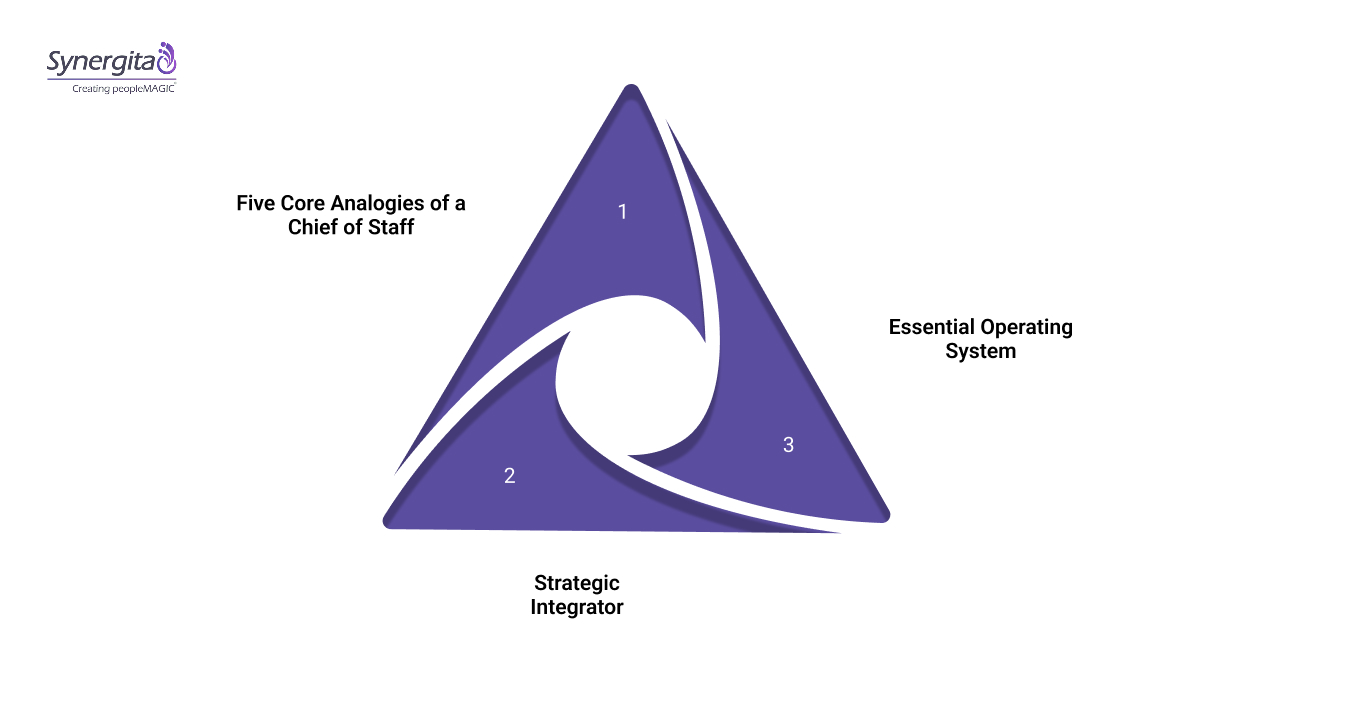
Unlike a department head with defined operational boundaries, your Chief of Staff oversees the entire organization’s health and velocity. They are the strategic integrator who ensures the executive office’s vision translates into organization-wide execution.
Here’s a brief overview of how their role works:
1. Five Core Analogies of a Chief of Staff
An effective CoS operates as the CEO’s Confidant, the Organizational Traffic Manager, the Cross-Functional Collaboration, the Honest Broker, and the Chief Communicator.
2. Strategic Integrator
CoS is the critical link between the C-suite’s strategic objectives and the departmental team responsible for delivering them. It involves establishing feedback loops to monitor progress.
3. Essential Operating System
OKRs are not just another administrative task. You should consider this to be your team’s core operating system that delivers results across the breadth of the CoS’s responsibilities.
These responsibilities play a significant role in operating your organization’s workflow. OKRs also play a crucial role in supporting CoS. How? You can find that below.
Also Read:Logistics OKR Examples: 15 Best Objectives And Key Results
How Do High-Impact OKRs Help the Chief of Staff?
For the Chief of Staff, whose success is uniquely tied to the performance of the entire organization, a poorly constructed OKR is a strategic misstep. It can obscure your CoS’s impact and dilute the company’s focus.
This section dissects the architecture of high-stakes OKRs, providing the precise framework you need to design goals.
1. Managing Organizational Effectiveness
- OKRs change your quarterly business review into a catalyst for decisive action.
- It can also embed a culture of continuous feedback within the leadership team.
2.Designing Measurable Key Results (KRs)
- A KR must be a verifiable result, not a task. You can expect to reduce the average time to identify project blockers from 72 to 24 hours using the new tracking system.
3. Balancing Ambition with Realism
- Using the CoS’s unique cross-functional view to assess realistic ambition, OKRs help schedule regular check-ins to adapt KRs proactively.
If OKRs and CoS align with each other, how can your team take full advantage of CoS’s responsibilities?
Also Read: Building a Successful OKR Culture for Teams
15 Key Result Areas and Actionable OKR Examples for Your CoS
For a Chief of Staff, the true test of a framework is in its application. Each set targets a specific organizational outcome, providing you with a library of options to deploy based on your company’s current-quarter priorities.
Here are 20 unique OKR examples for CoS, organized across five critical domains of responsibility and what you’ll expect from them:
Domain 1: Strategic Alignment & Execution
- Objective: Ensure flawless execution and alignment of the company’s top strategic initiative for the year.
- KR 1: Achieve 100% on-time delivery of the first three major milestones for the initiative.
- KR 2: Reduce the number of cross-departmental blockers reported by initiative teams by 50% through proactive facilitation.
- KR 3: Implement a bi-weekly initiative health dashboard with a 95% adoption rate by the leadership team.
- Objective: Establish a system for tracking and learning from strategic misses.
- KR 1: Implement a standardized post-mortem process for all initiatives that miss targets by >15%.
- KR 2: Document and socialize 5 key strategic learnings company-wide each quarter.
- KR 3: Ensure 100% of documented learnings are reviewed for incorporation into the next planning cycle.
- Objective: Cement CoS’s position as the market leader in customer-centric innovation.
- KR 1: Launch a new “Voice of Customer” insights forum attended by 100% of product and engineering leaders.
- KR 2: Reduce the average time from customer feedback to documented product consideration by 30%.
- KR 3: Co-author and publish 2 internal case studies on customer-driven product decisions.
The CEO’s vision becomes diluted as it cascades through departments, leading to misaligned team goals and wasted effort. The Chief of Staff lacks a single system to visualize and enforce alignment, making it impossible to ensure all work ladders up to top priorities.
Synergita’s Cascading OKRs provide a visual hierarchy that connects company objectives directly to team and individual goals. The Digital Cockpit gives the Chief of Staff and all leaders a single source of truth to see how every piece of work contributes to the core strategy.
Domain 2: Operational Excellence
- Objective: Systematize the executive office to maximize leadership bandwidth and decision velocity.
- KR 1: Reduce the average CEO email volume requiring direct response by 20% through filtering and delegation protocols.
- KR 2: Achieve a 48-hour maximum turnaround for standard approval requests from department heads.
- KR 3: Design and implement a new executive meeting scorecard, increasing decision clarity scores by 40%.
- Objective: Eliminate one major source of recurring operational friction for our teams.
- KR 1: Identify and map the top 3 cross-functional process pain points through structured interviews.
- KR 2: Pilot a redesigned process for the #1 pain point with two teams, targeting a 50% reduction in cycle time.
- KR 3: Create a playbook for enterprise-wide rollout of the new process based on pilot results.
- Objective: Master and optimize the company’s capital allocation review process.
- KR 1: Standardize the request for proposal (RFP) template for all capital requests over $X, achieving 100% compliance.
- KR 2: Reduce the average deliberation time for capital committee decisions by 15% without sacrificing rigor.
- KR 3: Implement a quarterly review of past investments against projected ROI, reporting findings to the CFO.
Also Read: What Every Manager Needs to Know About Setting Objectives
Domain 3: Cross-Functional Collaboration & Communication
- Objective: Shatter departmental silos and instill a “One Company” mindset.
- KR 1: Launch and facilitate 4 cross-departmental “problem-solving squads” to address shared challenges.
- KR 2: Increase the utilization rate of the shared project management platform by 40% across all teams.
- KR 3: Co-create and launch a recognition program that specifically rewards collaborative behavior.
- Objective: Revolutionize internal communication to be more transparent, timely, and engaging.
- KR 1: Increase the open rate for all-company emails from leadership to over 85%.
- KR 2: Launch a monthly “Ask Me Anything” session with the CEO, with 70%+ live participation from staff.
- KR 3: Reduce the spread of misinformation (measured by pulse survey) by 30% following major announcements.
- Objective: Build a high-trust, high-accountability culture within the Senior Leadership Team (SLT).
- KR 1: Implement a peer feedback mechanism for the SLT, with 100% participation each quarter.
- KR 2: Facilitate quarterly “vulnerability and strategy” sessions focused on long-term bets, not just short-term updates.
- KR 3: Increase the score for “CoS feel confident in the commitments of other departments” on the leadership survey by 15 points.
The Chief of Staff spends excessive time manually gathering updates and playing “meeting telephone” to connect teams, rather than facilitating strategic work. Synergita integrates directly with workflow tools (Jira, Slack, MS Teams) to bring goal-centric collaboration into daily work.
Automated nudges and reminders for updates, combined with a platform for continuous peer and 360-degree feedback, break down communication barriers. This creates a transparent, connected environment where cross-functional progress happens organically.
Domain 4: Executive & Stakeholder Effectiveness
- Objective: Amplify the CEO’s external presence and thought leadership.
- KR 1: Secure 3 high-profile speaking engagements or podcast interviews aligned with strategic messaging.
- KR 2: Increase the CEO’s relevant social media following/engagement by 25%.
- KR 3: Develop a bank of 5 signature “stories” that the CEO can use to illustrate the company vision.
- Objective: Strengthen strategic relationships with our top 10 most critical external partners.
- KR 1: Create and execute individualized engagement plans for each key partner.
- KR 2: Facilitate at least one strategic, non-transactional touchpoint per partner per quarter.
- KR 3: Identify and explore 2 new potential areas for collaborative value with partners.
Domain 5: Talent & Culture Development
- Objective: Elevate the quality and impact of leadership team meetings.
- KR 1: Introduce and facilitate a “red team/blue team” debate on the quarter’s biggest strategic decision.
- KR 2: Implement a pre-meeting reading discipline, with 100% completion for core materials.
- KR 3: Increase the post-meeting “energy and alignment” score (via quick poll) by 20%.
- Objective: Future-proof the leadership bench by strengthening succession readiness.
- KR 1: Work with HR to ensure 100% of mission-critical roles have a documented, vetted succession plan.
- KR 2: Identify and create visibility for 3 high-potential leaders through special project assignments.
- KR 3: Institute a quarterly talent review with the CEO and CHRO focused on mobility and risk.
While these examples provide an actionable plan, their true test lies in implementation. That’s where even the best-crafted OKRs encounter predictable organizational and human challenges.
Also Read: OKR Best Practices 2026: Tips to Set and Achieve Better Goals
4 Common OKR Implementation Challenges You Must Know
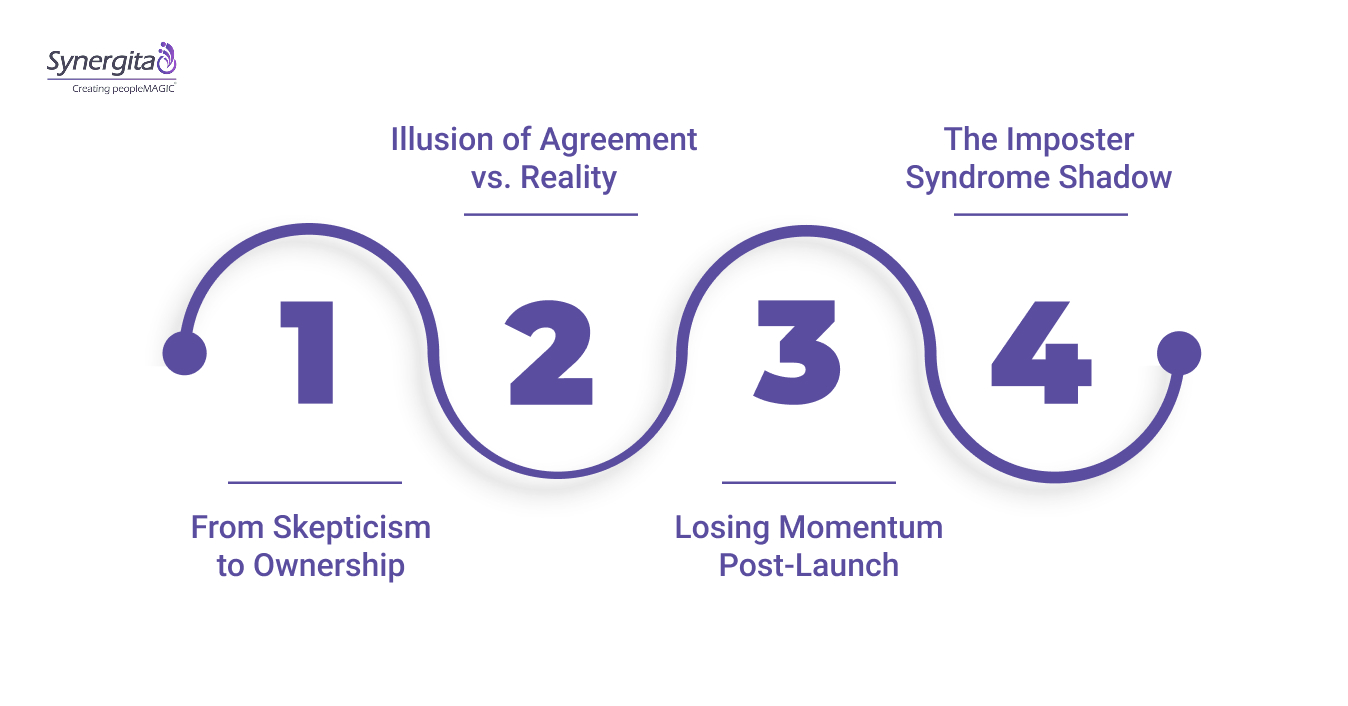
Success requires anticipating and strategically managing these common roadblocks. So, how will your team find success among implementation challenges without any pitfalls?
Here are a few challenges you must know about:
- From Skepticism to Ownership: A primary challenge is moving the leadership team from passive agreement to active ownership. OKRs imposed without genuine commitment become a checkbox exercise.
- Illusion of Agreement vs. Reality: Teams may create OKRs that seem aligned but operate in isolation, creating hidden silos. A marketing team’s “Increase Lead Generation” OKR might conflict with sales’ “Improve Lead Quality” goal if not proactively connected.
- Losing Momentum Post-Launch: The Chief of Staff battles meeting fatigue while trying to institute actionable updates that maintain focus without becoming bureaucratic overhead. The challenge is making the review process valuable enough that leaders engage with it voluntarily.
- The Imposter Syndrome Shadow: For a role focused on influence and facilitation, defining measurable impact can feel contrived. The pressure to set “stretch goals” can exacerbate the fear of visible, measurable failure.
How Synergita Helps the Chief of Staff’s Enablement Platform
Synergita helps these universal challenges from persistent problems into manageable processes. It provides the specific tools a Chief of Staff needs to lead OKR implementation effectively, turning friction into flow.
- Synergita facilitates ownership through collaborative OKR drafting and visual alignment views. Leaders can see their goals’ direct connection to the CEO’s priorities in real-time, making abstract alignment concrete.
- The platform’s OKR Buddy (AI) helps translate resistant leaders’ intentions into well-structured goals, reducing the “this doesn’t work for me” friction.
- Automated weekly check-in reminders and progress nudges maintain momentum with minimal administrative effort from the Chief of Staff.
For teams ready to evolve their practice, the next step is to evaluate how a dedicated platform can embed these principles into your organizational rhythm. Explore how Synergita can automate alignment to truly help your CoS’s role as a strategic integrator.
A Final Thought: From Planning to Execution
The fundamental problem for a Chief of Staff is a surplus of ambiguity. In 2026, you’re asking CoS to turn executive vision into a company-wide reality without any friction.
This can trap your team in a cycle of reactive facilitation, where your CoS’s potential is capped by the limits of manual coordination.
Synergita shifts the paradigm by providing the operating system that the Chief of Staff role has always lacked. Its automated rhythm of check-ins and integrations turns goal management from chaos to a continuous flow of insight.
Consider how Synergita is built to illuminate progress, so that it can exponentially increase your team’s value. Discover this is specifically designed to solve the core challenges of strategic orchestration.
FAQs
1. How do you start OKRs as a new Chief of Staff?
Run a focused pilot with one team or initiative first. Use the learnings to refine the process before a full company rollout.
2. What if a Key Result becomes outdated mid-quarter?
Formally retire it in the system and replace it with a relevant one. This demonstrates strategic adaptability to the rest of the organization.
3. How do you track OKRs for a pure enablement team?
Measure service-level outcomes (e.g., stakeholder satisfaction scores) rather than just task completion.
4. What’s the one habit that guarantees OKR success?
The weekly check-in. A 10-minute progress update prevents quarterly surprises and keeps goals alive.
5. How do I handle confidential OKRs (e.g., M&A)?
Use a platform feature for confidential OKRs, visible only to pre-approved executives, to maintain discretion while ensuring alignment.