
Most OKRs don’t fail suddenly; they slip off track, and the team doesn’t notice it. Without structured tracking, you miss the early signs until it’s too late to fix anything. Many organizations face the same issues every quarter because generic tracking methods like weekly meetings and spreadsheets can’t show risks early.
Quick Takeaway
- Generic OKR tracking methods like weekly meetings and spreadsheets are ineffective because they are unstructured and cannot identify risks early.
- Managers need proactive, structured techniques such as traffic-light scoring, confidence tracking, and milestone mapping to track OKRs effectively and prevent quarter-end surprises.
- A key result is 50% complete, but with confidence dropping from 8 to 4, it needs immediate attention, even if the numbers look acceptable on paper.
- Using modern OKR tracking software helps businesses monitor OKR progress and provides AI-driven insights to identify risks and make data-driven decisions.
You’ve set quarterly OKRs with your team. Week 6 rolls around, and you ask for updates. Everyone says they’re ‘on track,’ but when the quarter ends, three out of five key results fall short. Sound familiar?
The problem is that generic tracking doesn’t work. Weekly status meetings aren’t enough, and spreadsheets get outdated. As a manager, how do you track OKRs to ensure your team consistently achieves its goals quarter after quarter?
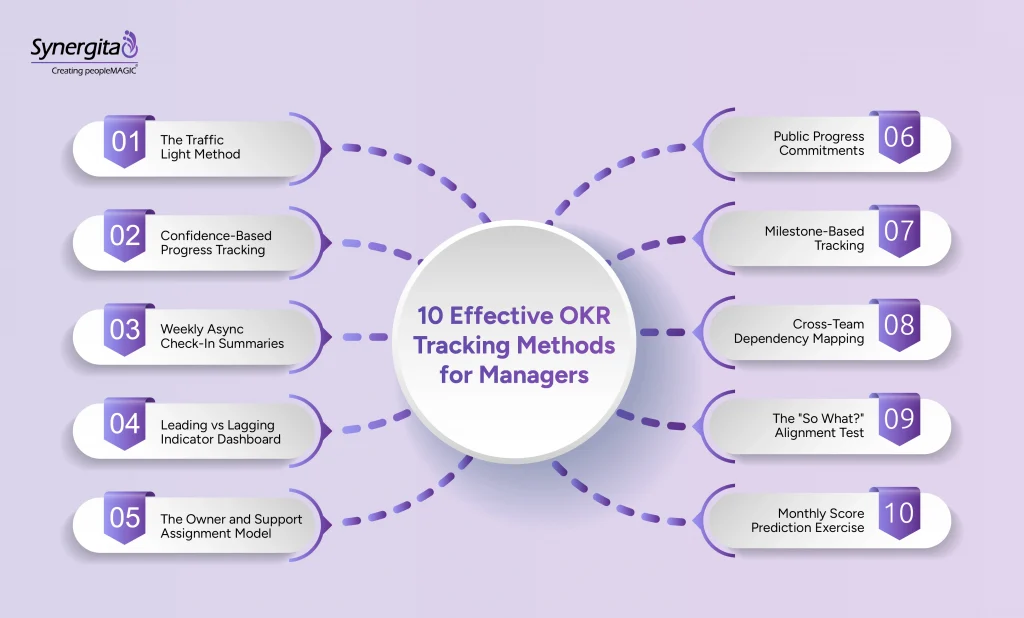
This guide covers 10 proven OKR tracking techniques managers use to maintain visibility, catch problems early, and keep teams accountable without micromanaging.
| Table of Contents 1. What Are the Top OKR Tracking Techniques for Managers? 2. Final Thought 3. Frequently Asked Questions |
What Are the Top OKR Tracking Techniques for Managers?
Here are the most effective OKR progress tracking techniques for managers.
1. The Traffic Light Method (Red/Yellow/Green Scoring)
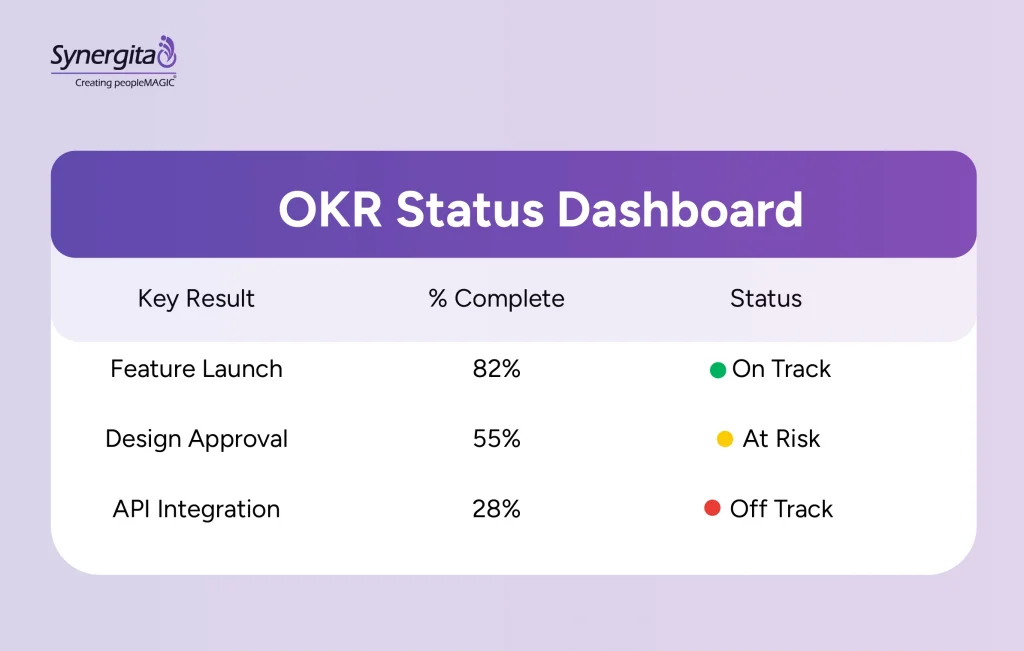
In this method, you can assign red, yellow, or green to each key result based on progress and risk level. Green indicates on track (70–100%), yellow signals at risk (40–70%), and red indicates off track (<40%). By using this method, you can eliminate ambiguity and see what needs attention instantly without reading lengthy progress reports.
How to implement:
- Review OKRs weekly and assign colors based on actual progress
- Green: Keep going, no action needed
- Yellow: Schedule a conversation to remove blockers
- Red: Immediate intervention, reprioritize resources, or escalate
Manager action: Address all reds in your next 1-on-1, yellows within the week.
Example: Product team shows 2 green KRs (features launching on schedule), 1 yellow (design delayed by the vendor), and 1 red (API integration blocked, requiring an immediate sprint reallocation).
Suggested Reading: An Ultimate OKR Tracking Guide
2. Confidence-Based Progress Tracking
This OKR-tracking method for managers lets you track your team’s confidence level (1-10 scale) in achieving each KR, along with the percentage of completion for each KR. A KR at 50% complete, with confidence dropping from 8 to 4, needs immediate attention, even though the numbers look acceptable. Confidence scores catch the early signals before they become major blockers.
How to implement:
- Ask your team members, “How confident are you we’ll hit this target?” in weekly check-ins
- Track confidence trends over time in your OKR tracking tool
- Declining confidence means an early warning that requires investigation
Manager action: When confidence drops 2+ points week-over-week, dig deeper in your next conversation.
Example: The sales team is 60% to quarterly revenue target, but confidence drops from 9 to
5. On further investigation, you discover that deals are slipping due to poor pipeline quality, which requires immediate focus.
3. Weekly Asynchronous Check-In Summaries
In weekly check-ins, team members submit brief written updates (5 minutes maximum) before your weekly meeting using a simple template. This transforms meetings from status reporting into problem-solving sessions, as you are aware of the bottlenecks and ready to address them.
Here is a template you can share with your team to collect updates.
- Progress this week: [specific accomplishment]
- Current status: [% complete or milestone reached]
- Blockers: [what’s stuck]
- Help needed: [specific ask]
Manager action: Review all updates 24 hours before the meeting, identify patterns, and prepare solutions to remove the bottlenecks.
Example: On Friday, the marketing director reviews updates and notices that four campaigns are delayed because one stakeholder hasn’t approved the designs. She speaks with the stakeholder to get the approvals before Monday. As a result, the Monday meeting focuses on improving campaigns rather than discussing delays.
4. Leading vs Lagging Indicator Dashboard
These indicators are most effective when structured within an OKR dashboard that highlights risk patterns in real time. Lagging indicators tell you if you succeeded; leading indicators tell you if you’re on track before the quarter ends.
A recent report shows that employees who receive regular feedback can be twice as productive as those who don’t.
How to set up:
- For each KR, identify 2-3 activities that drive the outcome
- Track both weekly
- If leading indicators drop, intervene before lagging indicators reflect the problem
Manager action: When leading indicators decline 20%+ from baseline, you should course-correct immediately, rather than waiting for outcomes to confirm the problem.
Example: KR to increase MRR by 25%. Leading indicators: demos conducted, trial activations, pipeline value. In week 4, demos are down 40%, intervene now, don’t wait for MRR miss.
5. The Owner and Support Assignment Model
Assign 1 owner (accountable for the outcome) and 1-2 support roles (contributors) to every KR. This eliminates diffusion of responsibility where everyone assumes someone else is handling it. The owner makes decisions, reports progress, and is accountable; support roles provide input and execute specific tasks.
How to implement:
- Document ownership at quarter start
- The owner must be empowered to make decisions
- Support roles have specific, bounded contributions
- In tracking meetings, ask the owner directly
Manager action: If an owner repeatedly misses commitments, it signals capacity issues or unclear authority; address it privately.
Example: KR to reduce support response time, Owner: Support Manager, Support: Product Manager (bug fixes), Engineering Lead (automation tooling).
6. Public Progress Commitments
Each KR owner publicly commits to specific progress for the coming week at the end of the team meeting. The following week begins the review of whether commitments were met. Social accountability drives action. Research shows that managers influence 70% of how engaged an employee feels, according to Gallup, and public commitments amplify this effect.
How to implement:
- Last 5 minutes of weekly meeting: “What will you move forward with this week?”
- Next meeting opens: “Did you achieve what you committed to?”
- If missed: “What blocked you? What needs to change?”
Manager action: Acknowledge delivered commitments immediately; address repeated misses as capacity or clarity issues.
Example: Designer commits to finalizing 3 screens by Tuesday, delivers 2, blocked by missing content. Team immediately assigns a copywriter to unblock Wednesday delivery.
7. Milestone-Based Tracking
Break quarterly KRs into weekly or biweekly concrete milestones instead of vague percentage updates. Milestones are binary, either done or not done, eliminating the ambiguity of “we’re 40% complete.”
Example transformation:
- Vague: We’re 40% done with the redesign
- Milestone: Week 4: Wireframes approved. Week 6: High-fi designs complete. Week 8: Dev handoff. Week 10: QA. Week 12: Launch.
How to implement: Define specific milestones during OKR planning, and track weekly completion.
Manager action: When a milestone slips, immediately assess the impact on subsequent milestones and adjust.
Example: Product launch milestone tracking shows design approval delayed by 2 weeks; the manager immediately extends the development timeline and adjusts the launch date rather than compromising quality.
8. Cross-Team Dependency Mapping
Visualize which of your OKRs depend on other teams’ deliverables at the start of each quarter, when cascading OKRs, and alignment across teams. Many OKRs fail not because your team underperformed, but because a blocking dependency wasn’t tracked.
A McKinsey Study found that 74% of respondents who felt their managers provided effective feedback and coaching reported their companies had effective performance-management systems.
How to implement:
- Map all dependencies during quarter planning
- Identify “blocking” (must have) vs “supporting” (nice to have) relationships
- Schedule bi-weekly alignment check-ins with dependency owners
Manager action: Review dependency status in your team check-ins, and escalate delays to leadership immediately.
Example: The Product team’s Q2 launch KR is blocked by Marketing’s content completion KR. A weekly sync catches the 3-week delay early, allowing for adjustments.
9. The “So What?” Alignment Test
For each Key Result, answer “If we achieve this, so what? How does it impact company objectives?” This prevents teams from working on low-impact activities disguised as OKRs. If you can’t clearly articulate the business impact, clarify it or eliminate the KR.
How to implement:
- During planning: Ask “so what?” for every proposed KR
- During tracking: If the answer becomes unclear, reprioritize
- Test: Can you explain the impact on your CEO in one sentence?
Manager action: Ruthlessly deprioritize or kill KRs that fail this test mid-quarter.
Examples:
- Good KR: “Launch 3 new features.” So what? “Solves top 3 churn drivers, increasing retention 15%.” The impact is clear
- Bad KR: “Attend 5 conferences.” So what? The answer is, “Networking?” Vague, clarify, or remove.
10. Monthly Score Prediction Exercise
At mid-quarter (week 6 of 13), ask each KR owner to predict the final quarter score assuming nothing changes. This forces realistic assessment and reveals optimism bias or hidden blockers before it’s too late to course-correct.
How to implement:
- Week 6: “If we continue at this pace, what score will we get?”
- Compare the prediction to the current trajectory
- Discuss: “What must change to improve our predicted score?”
Manager action: Use predictions to trigger resource reallocation, scope adjustments, or strategic pivots while you still have 7 weeks remaining.
Example: The team predicts a 0.4 score (40%) on the customer acquisition KR despite being “on track.” The prediction exercise reveals pipeline quality issues, triggering an immediate prospecting sprint and messaging adjustment.
Final Thought
Tracking OKRs is about maintaining visibility, catching problems early, and keeping teams aligned without micromanaging. The 10 techniques we discussed in this guide give you a practical toolkit for OKR performance tracking for managers.
If you are confused, start with 2-3 techniques that solve your biggest pain points. Traffic light scoring and async check-ins can be useful for most managers. Besides, you can add confidence tracking and use modern OKR management software to automate workflows and help you make data-driven decisions.
Synergita offers these techniques on a single platform, with automated check-ins, visual dashboards, confidence tracking, and AI-powered insights. Start your 14-day free trial of Synergita and implement these techniques with your team.

Frequently Asked Questions
The Traffic Light Method is one of the most effective OKR tracking methods as it provides instant visibility using red, yellow, and green scoring. This helps managers quickly identify and remove risks.
Managers should review OKRs weekly. It allows them to track declining confidence, slipping milestones, and take corrective action before quarter-end surprises.
The common causes behind OKR failure during a quarter are using outdated spreadsheets, unclear accountability, and a lack of early intervention. Without structured tracking techniques, risks remain hidden until it’s too late to recover.
OKR software like Synergita automates OKR creation, tracking, and check-ins, and provides AI-driven insights, helping managers implement a structured OKR-tracking process.