


Many organizations believe their performance appraisal process is fine, but employee engagement and performance outcomes often tell a different story. In most cases, the gap is due to using the wrong performance appraisal system.
Quick Takeaways
- Only 14% of employees feel inspired by performance reviews; the appraisal system you choose determines which side of that gap you land on.
- There is no universal appraisal system. Match the type to your business stage, team structure, and feedback culture.
- Development planning is the section managers’ responsibility, and employees care about most. Without it, an appraisal is just a report card.
- The right system fails without trained managers. Deploy the conversation before you deploy the tool.
Gallup research found that only 14% of employees strongly agree their performance reviews inspire them to improve, and in roughly one in three cases, reviews actually make performance worse. The type of employee appraisal systems you have adopted is responsible for that gap.
Yet most organizations use outdated approaches that do not reflect how modern teams actually work. That’s why choosing the right appraisal system is important to evaluate employee performance correctly, improve engagement, retention, and growth.
In this blog, we cover what is employee performance appraisal system, its purpose, the key types of employee appraisal systems and how to choose the right one for your organization.
| Table of Contents 1. What Is a Performance Appraisal System and Its Purpose 2. 7 Types of Employee Appraisal Systems 3. How to Choose the Right Appraisal System for Your Organization 4. Pre-Appraisal Checklist for Managers 5. How to Structure a Performance Review Form 6. Final Thoughts 7. FAQ |
What Is a Performance Appraisal System and Its Purpose
A performance appraisal system is a structured process for evaluating an employee’s work against pre-set goals, behavioral expectations, and role-specific competencies. It involves the manager, sometimes peers and direct reports, and employees themselves.
According to McKinsey research, companies that focus on their people’s performance are 4.2 times more likely to outperform their peers, achieving an average 30% higher revenue growth and experiencing 5 percentage points lower attrition.
An effective appraisal system helps you identify:
- Where your top performers are and whether they are at flight risk
- Where your skill gaps are before they impact project outcomes
- Which managers are building teams versus breaking it
- Whether your compensation strategy reflects actual contribution
Top 7 Types of Employee Appraisal Systems
Selecting the right performance appraisal system is essential for evaluating performance correctly. Here are the top seven employee appraisal systems you can choose from based on your requirements.
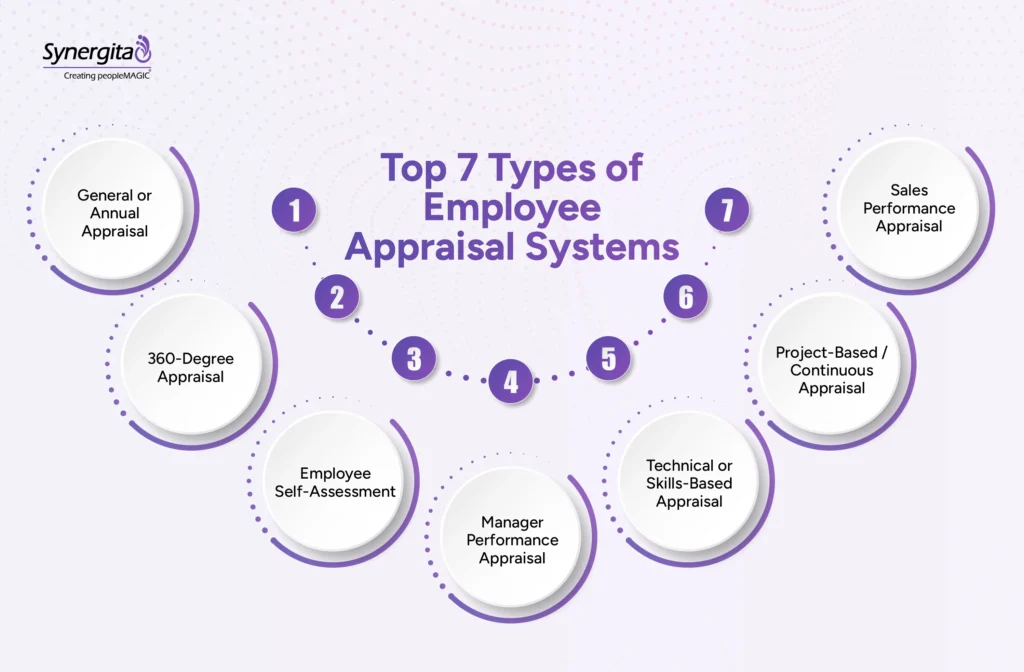
1. General or Annual Appraisal
The most common type of appraisal system across all industries. The manager and employee meet at the end of the fiscal year to review goal completion, discuss performance, and set targets for the next cycle.
- Suitable for: Stable, process-driven environments where roles and goals do not change significantly through the year.
- Not suitable for: Startups, high-growth teams, or any organization where priorities shift quarterly.
2. 360-Degree Appraisal
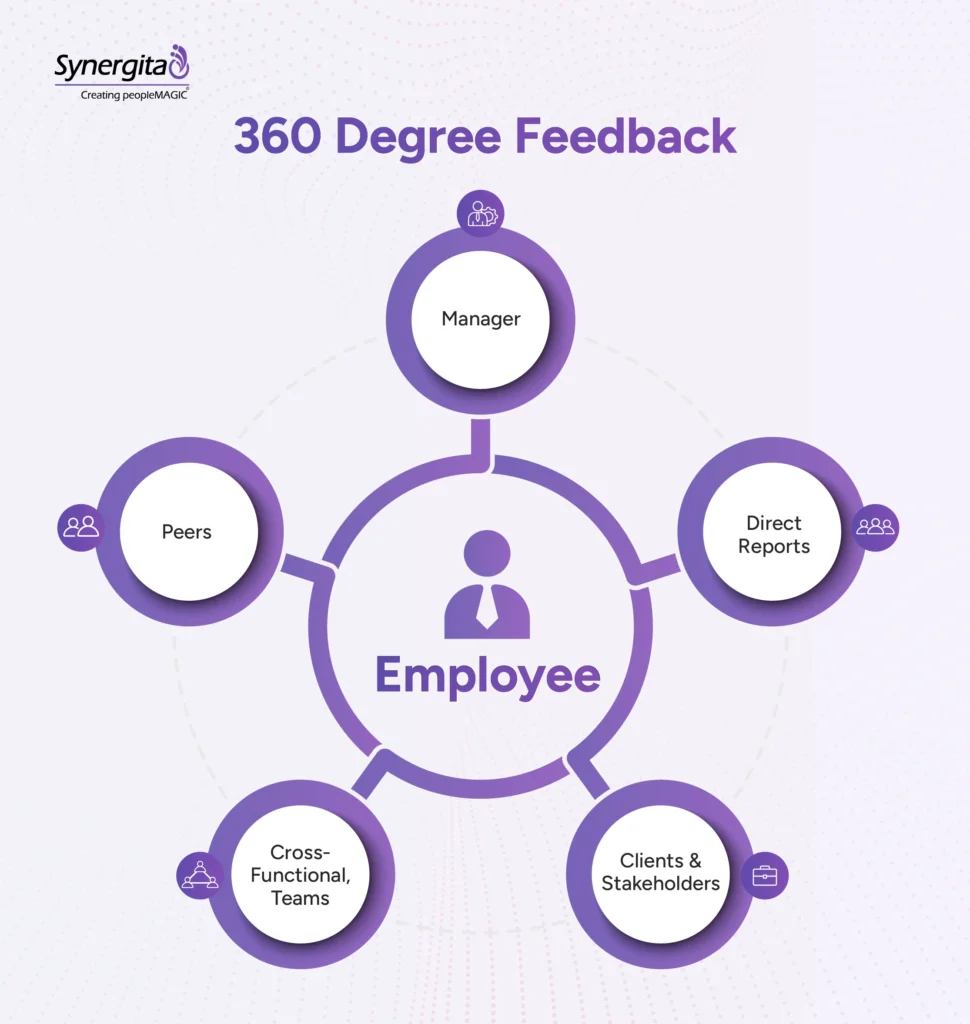
The 360-degree performance appraisal collects feedback from every direction: direct manager, peers, cross-functional collaborators, direct reports, and sometimes external stakeholders like clients. The employee is evaluated by multiple people and on different criteria and not just the manager’s perspective.
This type is the most effective at identifying behaviors and other aspects a manager never sees but a peer or client experiences.
- Suitable for: Mid-size to enterprise organizations focused on leadership development and culture health.
- Not suitable for: Organizations with low trust or weak feedback culture, where employees may hesitate to give honest input or misuse anonymity.
3. Employee Self-Assessment
The employee evaluates their own performance before meeting with their manager. This is then compared with the manager’s evaluation, resulting in a more honest conversation about performance.
It also helps managers with two things: Employees who overrate themselves need clearer benchmarks and those who underrate themselves need confidence-building.
- Suitable for: Organizations that want employees to actively reflect on their performance and take ownership before formal evaluations.
- Not suitable for: When managers ignore the self-assessment entirely and the exercise becomes a formality.
4. Manager Performance Appraisal
This type of appraisal evaluates managers on criteria like communication, decision-making, the support they provide, and the culture they create. Feedback is collected anonymously to encourage honest responses.
Many organizations avoid this because it requires executives to accept that bad management is a structural risk, not just a people problem. But this reluctance can impact business performance.
iHire’s 2025 Talent Retention Report reveals, 24.2% of employees left due to poor company leadership, and 22.8% quit because they were unhappy with their direct manager.
- Suitable for: Organizations serious about retention and leadership quality.
- Not suitable for: Organizations where managers have unchecked authority and no accountability mechanism in place.
5. Technical or Skills-Based Appraisal
This type of performance appraisal system is used for role-specific technical expertise rather than behavioral competencies.
For an engineer, it evaluates code quality, system design, and debugging depth. For a financial analyst, it might assess modeling accuracy and regulatory knowledge.
This is best-suited in industries where specialized skills are critical and skills gaps can impact revenue or compliance risk.
- Suitable for: Technology companies, financial services, healthcare, and any sector where role-specific expertise is the core output.
- Not suitable for: Roles that rely on collaboration, cross-functional work, or leadership development, where behavioral aspects are equally important.
6. Project-Based / Continuous Appraisal
Rather than waiting for the year-end performance review, this approach evaluates employees at the close of each project or sprint. Feedback is given while context is fresh, performance data is specific, and the employee can act on it immediately.
- Suitable for: Agile teams, consulting firms, agencies, any organization with discrete project cycles.
- Not suitable for: Administrative and support functions without clear project milestones.
Suggested Reading: 7 Steps to Build Continuous Feedback Culture
7. Sales Performance Appraisal
Sales performance appraisals evaluate revenue-generating employees against hard metrics: quota attainment, pipeline generation, deal velocity, win rate, and revenue contribution.
This type of performance appraisal system is the most data-rich but also the most context-dependent. A rep who missed quota during a market contraction needs a different conversation than one who missed it during a high-growth quarter.
A sales appraisals should also include evaluating selling behaviors, forecasting accuracy, and how the rep develops long-term client relationships and not just closes deals.
- Suitable for: Revenue-generating roles with measurable KPIs.
- Not suitable for: When sales goals are set unrealistically and the appraisal becomes a demoralizing exercise rather than a developmental one.
How to Choose the Right Appraisal System for Your Organization
Before picking an employee performance review system, you need to answer three questions:
- How fast does your business move?
- How mature is your feedback culture?
- How much capacity does your HR team actually have?
Startup or early-stage team (under 50 people)
- Start with project-based appraisals; annual cycles are too slow, and feedback loses context in a few weeks.
- Add self-assessment early to build a culture of ownership before you scale.
Scaling fast (50 to 500 people)
- Introduce 360-degree reviews at the leadership level to catch manager-related attrition.
- Build a consistent general appraisal framework so performance standards do not vary across teams.
Enterprise (500 and above)
- Use a combination of different systems. General appraisal for yearly appraisal, 360-degree for leadership, project-based for agile teams, sales-specific for revenue functions
Remember one thing: do not roll out a system if your managers are not equipped to run that. Also, the system is only as good as the process behind it. Following performance appraisal best practices ensures your organization has the right tools and managers are trained to run the conversation.
Pre-Appraisal Checklist for Managers
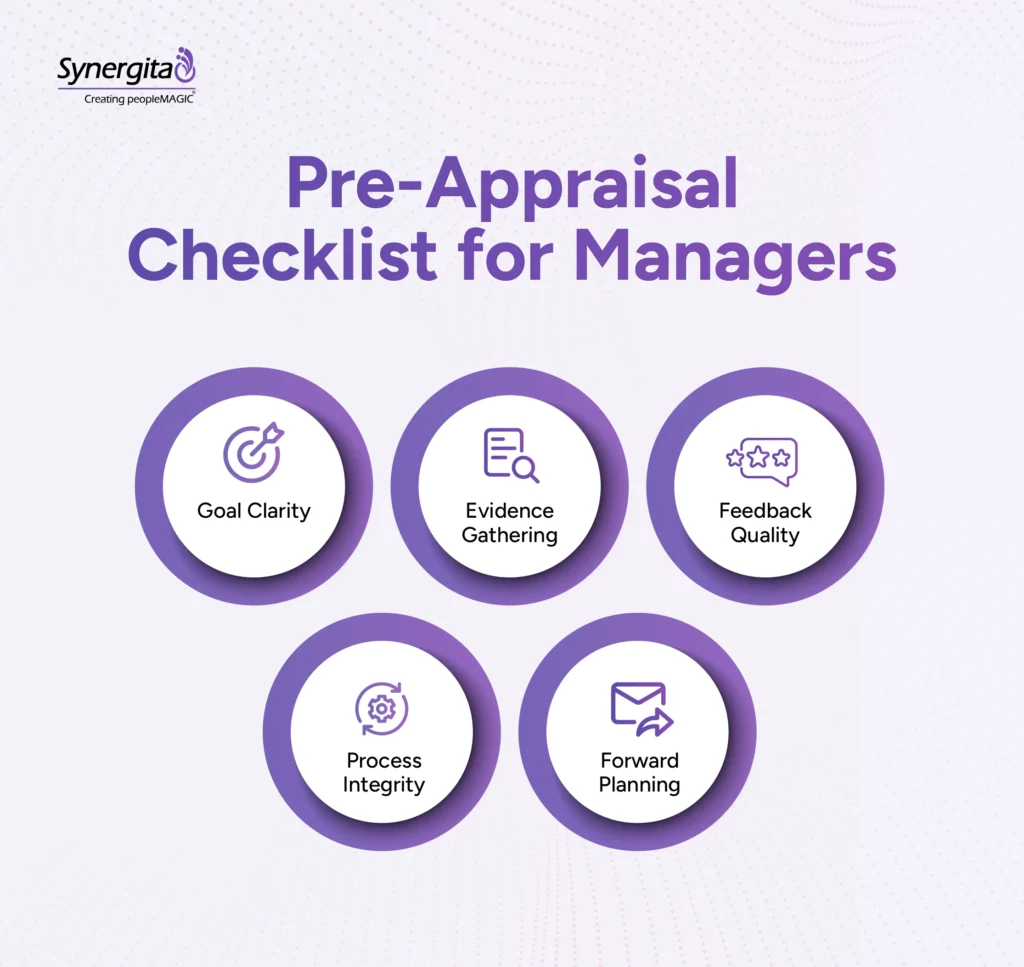
Before conducting any type of performance review, you should have the right inputs, context, and clarity. This quick checklist helps managers prepare effectively.
Goal Clarity
- Were goals set at the start of the review period in writing?
- Were goals specific, measurable, and tied to team or business objectives?
- Were goals revised if the employee’s role or priorities changed mid-cycle?
Evidence Gathering
- Do you have performance data from the last review period, not just the last month or quarter?
- Have you reviewed any relevant output: reports, project results, client feedback, peer feedback?
Feedback Quality
- Have you used an effective feedback model to structure the conversation?
- Is your feedback specific and based on actions, not personality traits?
- Have you identified at least one clear development opportunity with a concrete action?
Suggested Reading: 15 Effective Feedback Models with Definition and Examples
Process Integrity
- Has the employee completed a self-assessment before the meeting?
- Is there time allocated for the employee to respond and ask questions, not just receive feedback?
Forward Planning
- Are new goals ready to be set at the end of this appraisal?
- Have you identified training, mentorship, or support needed to improve performance?
How to Structure a Performance Review Form
A review form is effective if it is designed around what you actually need to know. Here is how to structure one that serves the organization and the employee.
1. Goal Review Section
List each goal from the prior review period and evaluate them one by one.
For each one, mention
- Was it achieved?
- What was the evidence?
- What got in the way if it was not?
This section should not contain surprises. Any gaps or delays should have been discussed during the year, not discovered at review time.
2. Skills Assessment (Technical and Behavioral)
Split this into two parts. Technical skills assess role-specific competency. Behavioral skills assess how the employee works, including collaboration, communication, ownership of problems, and adaptability.
Give weightage according to the role: an engineer’s technical skill should carry more weight than their presentation skills but it’s the opposite for a client-facing account manager.
3. Retrospective: What Worked and What Did Not
“What went well” is not a feel-good exercise. It is a diagnostic. Understanding the reason behind strong performance, the environment, resources, team dynamics, and manager support tells you what to replicate.
“What could have gone better” identifies the areas for improvement, not just shortcomings.
4. Development Planning
This section determines whether the appraisal focuses on growth or just a documentation exercise. It should answer three questions:
- What skill or behavior will this employee develop in the next period?
- What resources or support will be provided?
- How will we measure progress?
Without a development plan, an appraisal is just a report card. With one, it is a retention tool for organizations.
Final thoughts
A poorly designed employee appraisal system is one of the reasons why many companies lose top performers. You need to choose the right appraisal system, based on your company size, team structure, the roles and the feedback culture you want to build.
An effective appraisal system turns performance conversations from annual anxiety into a development opportunity. Besides that, you need the right tools to implement a structured review system.
Synergita’s AI-powered performance management tool helps you roll out the appraisal system we discussed and provide key insights on performance evaluation. Start a free trial today.
Frequently Asked Questions
A performance appraisal system helps organizations evaluate employee performance against predefined goals and expectations. It enables you to identify strengths, weaknesses, and areas for growth.
Common types of performance appraisal systems include general appraisals, 360-degree appraisals, self-assessments, technical/skills-based appraisals, and sales performance appraisals.
It depends on your organization’s size and structure. Annual appraisals are ideal for stable, process-driven environments. Fast-moving or agile teams should use continuous appraisals where feedback is given at the close of each sprint or project.
Yes, large enterprises with multiple teams and different operations should use a combination of systems based on each team’s requirements. For example:
General appraisals for all employees
360-degree for leadership and roles that requires collaboration
Project-based for agile teams
Skills-Based appraisal for roles that need hard skills
Sales appraisal for sales team
A well-designed appraisal shows employees their growth is taken seriously. Without it, top performers may feel they are overlooked and more likely to leave.

Thanx so much. this has really helped me because. we want to do appraisal at our work place and we had no clue on how to do it.