
Most businesses invest significant time in strategic planning but struggle to translate strategy into consistent execution. One common reason is the lack of clarity between high-level ambitions and the specific actions required to achieve them. Understanding the differences between goals and objectives helps teams move from vision to measurable results.
Quick Takeaway
- Understanding the difference between goals and objectives helps teams align execution with strategy, prioritize work, and avoid confusion.
- Goals provide strategic direction, while objectives define the measurable steps needed to achieve them.
- Goals are broad, long-term, and inspirational, often spanning 1–3 years. Objectives are specific, measurable, and time-bound, typically set for shorter periods like quarters.
- The most effective approach is to use an OKR management system to set 2–3 ambitious goals, break each into 3–5 measurable objectives, and then track them.
Your team just spent 3 hours in a planning meeting and walked out with a list of 15 items, but nobody can tell you which are goals and which are objectives. Does this sound familiar?
This confusion isn’t just about terminology. When teams use goals and objectives interchangeably, they may not have a clear idea of priorities. A Gallup research shows that only 41% of employees agree that they know what their company stands for. It shows unclear organizational direction can create confusion and misalignment across teams.
Over time, leadership pulls in one direction while teams focus on something else. So, in this guide, we will explore the fundamental difference between goals and objectives and learn how to use them effectively.
| Table of Contents 1. Goals vs Objectives: Quick Comparison 2. What Are Goals?What Are Objectives? 3. 7 Core Differences of Goals vs Objectives 4. When to Use Goals vs When to Use Objectives 5. Conclusion 6. Frequently Asked Questions |
Goals vs Objectives: Quick Comparison
Goals are broad, long-term outcomes that provide strategic direction (what you want to achieve). Objectives are specific, measurable actions with clear deadlines that define how you will achieve those goals. Here is a quick comparison.
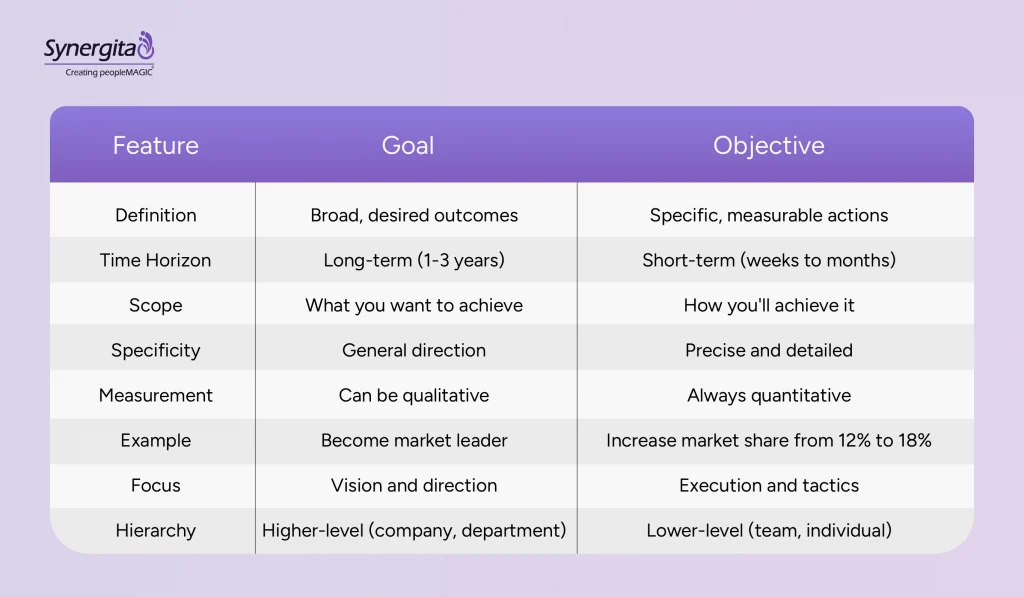
What Are Goals?
Goals are broad, long-term outcomes that provide direction and purpose. They answer “What do we want to achieve?” and create a shared vision for teams and organizations.
Characteristics of Effective Goals
Effective goals share five key characteristics:
- Inspirational: They motivate teams and create shared purpose
- Long-term: Usually spans 1-3 years
- Qualitative: Can be descriptive rather than purely numeric
- Strategic: Align with company vision and mission
- Flexible: Allow multiple paths to achievement
Suggested Reading: How to Align Employee OKRs with Organization OKRs
Real-World Goal Examples
Company-Level:
- Become the most trusted brand in cybersecurity
- Achieve $100M annual recurring revenue
- Expand into 5 new international markets
Department-Level:
- Build a high-performing sales organization
- Create an exceptional customer experience
- Develop innovative product features that delight users
Individual-Level:
- Advance to a senior management position
- Become a recognized thought leader in my field
- Achieve work-life balance
What Are Objectives?
Objectives are specific, measurable actions that define how you’ll achieve your goals. They answer “How will we get there?” and provide concrete steps toward broader aspirations.
Characteristics of Effective Objectives
Effective objectives follow the SMART framework:
- Specific: Clear and unambiguous
- Measurable: Quantifiable with metrics
- Actionable: Define concrete steps
- Time-bound: Have clear deadlines
- Realistic: Achievable with available resources
- Aligned: Directly support higher-level goals
Real-World Objective Examples
Supporting Company Goals:
- Increase website traffic from 50K to 75K monthly visitors by June 30
- Reduce customer churn from 8% to 5% in Q2
- Ship 3 new features per quarter with <2% bug rate
Supporting Department Goals:
- Hire 5 senior engineers with <60 days time-to-hire
- Achieve 95% customer satisfaction score on support tickets
- Generate a $2M pipeline from 10 enterprise accounts
Supporting Individual Goals:
- Complete AWS certification by March 31
- Publish 2 industry articles per month
- Conduct 15 customer interviews in Q1
7 Core Differences of Goals vs Objectives
Objectives define the specific actions and steps needed to reach a goal. Many businesses use the Objectives and Key Results (OKR) framework to structure measurable objectives, ensuring clarity, alignment, and measurable progress.
1. Scope and Breadth
Goals are broad, encompassing, and wide-ranging. They set direction for entire organizations or large functions, with multiple objectives supporting a single goal.
Objectives are narrow, focused, and specific. They target individual aspects of a goal, with each objective being self-contained.
Example:
- Goal: Build world-class engineering culture
- Objective 1: Reduce average time-to-hire from 90 to 45 days
- Objective 2: Achieve 90%+ engineering satisfaction in quarterly survey
- Objective 3: Ship 85% of committed features on-time each sprint
2. Time Horizon
Goals operate long-term, typically 1-3 years, sometimes 5 years. They can span multiple quarters or fiscal years and provide enduring direction.
Objectives are short to medium-term, from weeks to months, rarely beyond 1 year. They’re usually set quarterly or semi-annually to create urgency and momentum.
3. Measurement and Specificity
Goals can be qualitative or directional without precise numeric targets. Success is often subjectively assessed. Example: Deliver exceptional customer service.
Objectives are always quantitative and measurable with specific numeric targets. Success is objectively verifiable. Example: Reduce support response time from 4 hours to 1 hour.
The Test: If you can say “Did we achieve it?” with a clear yes/no, it’s an objective. If you ask “How well are we doing?” and need interpretation, it’s a goal.
4. Hierarchy and Organizational Level
Goals are set at higher organizational levels: Company to Division to Department. through cascading OKRs that translate strategy into team-level execution. They operate on a strategic planning horizon.
Objectives are set at lower organizational levels: Department to Team to Individual. They operate on a tactical execution horizon.
5. Language and Framing
Goals use aspirational, inspirational language with vision-focused terminology: Become, Build, Create, Establish. Example: Become the most innovative company in our industry.
Objectives use action-oriented, concrete language with results-focused terminology: Increase, Reduce, Achieve, Launch, Complete. Example: File 15 patents in Q3.
6. Flexibility vs. Rigidity
Goals offer flexibility in approach with multiple paths to achievement and room to adjust tactics while maintaining direction.
Objectives are more rigid and specific, with defined paths to completion. Changes require formal adjustment.
7. Why vs. How
Goals answer Why are we doing this? They provide purpose and meaning, connecting to mission and vision.
Objectives: answer How will we do this? They provide actionable steps and define the execution plan.
When to Use Goals vs When to Use Objectives
Use Goals When:
- Setting Strategic Direction: Company annual planning, department strategy sessions, long-term vision casting
- Inspiring and Aligning Teams: Creating shared purpose, rallying the organization around a mission, and cultural transformation
- Defining Success Broadly: Multiple valid paths to achievement, room for creativity and innovation
- Time Horizon is Long: 1-3 year planning, multi-quarter initiatives, foundational changes
Examples: Become the most trusted brand in our industry, build a world-class remote-first culture
Use Objectives When:
- Defining Specific Actions: Quarterly planning, sprint planning, project kickoffs
- Ensuring Accountability: Clear ownership needed, measuring individual/team performance, tracking progress
- Making Goals Actionable: Breaking down strategy into tactics, defining execution plan, creating roadmaps
- Time Horizon is Short: Weekly/monthly/quarterly, clear deadlines needed, immediate action required
Examples: Increase conversion rate from 2% to 3.5% by March 31, Close 10 enterprise deals totaling $1M in Q2.
Conclusion
Understanding the difference between goals and objectives helps you choose the right framework for achieving the targets. Goals provide the strategic direction and inspiration your team needs, while objectives deliver the tactical roadmap to get there.
You can set 2-3 ambitious goals that align with your organization’s vision and break each goal into 3-5 specific, measurable objectives with clear deadlines and ownership. If you are looking to implement structured goal and objective tracking, you can use Synergita’s AI-powered OKR tool. It helps you set, track, and helps you achieve both goals and objectives with a real-time dashboard.
Start your 14-day free trial today and see how it transforms strategy into measurable outcomes across your organization.

Frequently Asked Questions
Goals are broad, long-term desired outcomes that provide strategic direction, while objectives are specific, measurable actions with clear deadlines that define how you’ll achieve those goals. Goals answer “what” and “why,” objectives answer “how” and “when.”
Typically, 3-5 objectives per goal work best. Too few objectives may not fully address the goal, while too many can create confusion and dilute focus. Each objective should make a meaningful contribution to achieving the goal.
Not necessarily. While objectives must be quantifiable, goals can be qualitative or directional. However, adding measurable indicators to goals helps track progress. For example, “Build brand awareness” (goal) supported by “Achieve 10K social followers” (objective).
Review objectives weekly or bi-weekly to ensure teams stay on track. Review goals quarterly to assess overall strategic progress and make necessary adjustments in response to market conditions or organizational changes.