



You set a revenue target for a quarter but when it ends, the goal is not achieved. Most of the time, it is not because the goal was wrong, but because it was never broken down into clear, executable steps. Short-term goals help you turn big targets into action items that teams can actually execute.
Quick Takeaway
- Short-term goals help startups turn broad ambitions into clear, executable actions that drive measurable progress within a quarter.
- The 15 examples cover key areas like revenue, product validation, marketing, operations, hiring, and partnerships.
- The goals should be linked to a specific metric, timeline, and execution plan rather than vague intentions.
- Using a performance management system ensures short-term goals are assigned to the right people, tracked consistently, and reviewed before the quarter runs out of time.
Most startups fail because their ambitions are never translated into structured, executable goals. A Brightline Study found that companies miss about 20% of their strategic objectives on average because of poor implementation. It also reports that around 90% of senior executives admit their organizations struggle to achieve all strategic goals for the same reason.
Short-term goals help founders stay focused, validate assumptions quickly, and give them a baseline to track and manage employee performance throughout the quarter. In this guide, we will cover what short-term goals are, 15 short term goal examples, and how to set and execute them efficiently.
| Table of Contents 1. What is a Short-Term Goal for a Business 2. Best Short Term Goals Examples for Businesses 3. How to Set and Execute Short-Term Goals Using a Performance Management System 4. Final Takeaway 5. Frequently Asked Questions |
What is a Short-Term Goal for a Business
Short term goals for a business is an outcome you plan to achieve within a quarter that directly maps to quarterly cycles and is placed below your annual company objectives to create organization-wide alignment between strategy and execution.
For instance, a long-term goal might be to reach $1M in annual revenue by the end of year two. A relevant short-term goal connected to it could be to close 8 new paid accounts this quarter by targeting one well-defined customer segment. Long-term goals provide vision, while short-term ones give the team something to execute on a weekly basis.
An example of a short term goal for a business is to increase quarterly revenue by 20% by acquiring 10 new customers.
This goal is effective because it is clearly defined and easy to track:
- Time-bound: 90 days
- Measurable: 20% revenue growth, 10 new customers
- Actionable: Focused on a defined segment
Best 15 Short Term Goals Examples for Businesses
Here are 15 examples of short term goals for businesses across different segments.
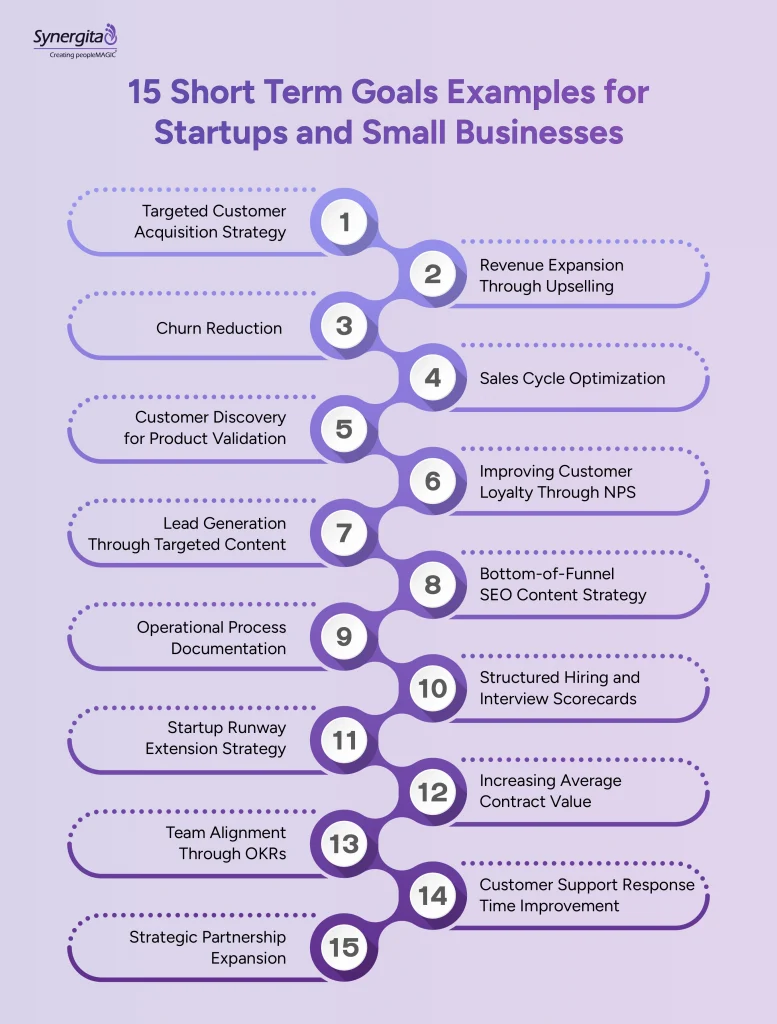
Revenue and Sales
1. Targeted Customer Acquisition Strategy
Close 10 new paying customers this quarter by running a structured outbound campaign targeting one specific customer persona. A defined target with a specified method prevents the scattered selling that stalls early-stage pipelines.
- Pick one customer persona and build the campaign around their specific pain points before expanding to others.
- Set a weekly pipeline target, for example, 15 new outreach contacts per week to ensure that progress is visible before the quarter ends.
- Track conversion at each stage to determine whether the strategies are working properly or need to be changed.
2. Revenue Expansion Through Upselling
Increase monthly recurring revenue (MRR) by 20% within 90 days with an upsell campaign to existing customers. Most early-stage startups focus entirely on acquisition while ignoring the customers they already have.
- Segment your existing customer base and identify the top 20% who are most likely to benefit from an upgrade.
- Run the upsell campaign in month one so you have two months to course-correct if conversion is lower than expected.
- Track the upsell revenue so you know which product and customer segment is giving the results.
3. Churn Reduction
Reduce monthly churn from 8% to 5% this quarter by introducing a 30-day check-in process. For early-stage SaaS businesses, churn reduction is often the fastest way to net revenue growth, yet most businesses don’t pay attention to this.
- Review every account that churned in the last 90 days before designing the check-in sequence.
- Schedule the check-ins at day 14, and day 30 to catch disengagement before it becomes a cancellation.
- Use the check-ins to surface product gaps, not just to confirm satisfaction.
4. Sales Cycle Optimization
Shorten the average sales cycle from 45 days to 30 days within 90 days by rebuilding the objection-handling section of the pitch. Faster cycles mean more at-bats per quarter without adding a single headcount.
- Every salesperson should log the top three objections they encounter each week for the first 30 days.
- Rebuild the pitch to address the two most common objections before the prospect raises them.
- Test the revised pitch with five prospects before rolling it out to the whole team.
Product and Customer Validation
5. Customer Discovery for Product Validation
Conduct 15 customer discovery interviews within the next 30 days to validate or invalidate your top two product assumptions. 15 conversations can help the team detect a costly mistake before months of building compound the problem.
- Talk to churned customers and hesitant prospects, not just your happy users
- Document findings immediately after each call while the detail is fresh, then review all 15 together before drawing conclusions.
6. Improving Customer Loyalty Through NPS
Achieve a Net Promoter Score of 40 or above from your current customer base before the end of Q3. An NPS below 30 signals that the product or experience needs improvement before you increase acquisition spending.
- Run the NPS survey in month one so you have the full quarter to act on results rather than just measure them.
- Follow up personally with every detractor (score 0-6) within a week; these conversations surface the most actionable feedback.
- Identify the one or two experience gaps mentioned most frequently and treat those as product or process priorities for the quarter.
- Survey the same cohort again at quarter-end to measure whether changes moved the score.
Marketing and Growth
7. Lead Generation Through Targeted Content
Generate 100 qualified leads this quarter through content targeting three specific topics your ICP actively searches for. Topic-specific content aligned to one buyer persona consistently outperforms broad awareness plays, and it compounds over time in a way that paid campaigns do not.
- Use the exact language your customers use to describe the problem. This is what they type into search engines, which makes the content relevant.
- Define “qualified lead” before the campaign starts so the metric is meaningful, not just a traffic number.
8. Bottom-of-Funnel SEO Content Strategy
Publish eight search-optimized blog posts targeting bottom-of-funnel keywords within 90 days to drive trial signups directly from organic traffic. Bottom-of-funnel content converts faster and requires far less volume to justify the investment compared to awareness-level content.
- Map each post to a specific keyword with clear commercial intent, comparison, pricing, and alternative keywords consistently drive trial signups.
- Write a clear call to action in every post that connects the topic directly to your product’s value.
- Track signups from organic traffic separately so you know which posts are actually converting, not just ranking.
Operations and Hiring
9. Operational Process Documentation
Document the five core operational processes your team runs daily within 30 days so that execution does not depend completely on individual knowledge.
- Find a person who runs each process and writes the documentation to surface gaps they had not noticed.
- Use a consistent format across all five documents so they are easy to follow for anyone new to the role.
- Test each document by having a second person follow it without help and note where they get stuck.
10. Structured Hiring and Interview Scorecards
Build a structured interview process with defined scorecards before the first candidate enters the pipeline. Hiring without a scorecard means each interviewer evaluates for something different, and misaligned early-stage hires cost far more in lost time and momentum than a delayed hire would have.
- Write the scorecard before opening the role, define the three or four qualities that actually predict success in the position.
- Align every interviewer on what they are evaluating before the first interview, not after.
- Set a decision deadline for each candidate to prevent the indefinite loops that cause good candidates to drop out.
Financial and Runway
11. Startup Runway Extension Strategy
Extend cash runway by three months this quarter by reducing burn in two non-critical spend categories identified through a line-item budget review. Runway extension without fundraising gives founders more leverage in their next raise and more time to reach a position of strength before that conversation happens.
- Build the line-item budget review into week one and categorize every expense as critical, important, or deferrable.
- Target two deferrable categories rather than spreading small cuts across many lines, which saves less and disrupts more.
- Set a new monthly burn target and track it weekly so drift is visible before the end of the quarter.
12. Increasing Average Contract Value
Increase average contract value by 20% within one quarter by introducing a higher-tier pricing option built around the features your most active users rely on most.
- Survey your most active customers before building the tier; ask directly what they would pay more for, rather than guessing.
- Price the new tier based on value delivered, not on cost-plus logic.
- Test the new pricing with five to ten prospects in conversations before publishing it publicly.
- Track ACV weekly from launch so you can identify whether the tier is converting or needs repositioning before the quarter ends.
Team and Leadership
13. Team Alignment Through Performance Management
Set clear quarterly goals for every team member within the first two weeks of the quarter, with individual check-ins and continuous feedback scheduled at the four and eight-week marks. Teams that know what they are working toward and why consistently outperform teams operating on task lists without any strategic context.
- Involve team members in setting their own goals rather than handing targets down from the top.
- Limit each person to three goals maximum. When people have more goals, the focus gets affected and nothing is achieved properly.
- Make all goals visible to the whole team so everyone understands how individual goals connect to company priorities.
- Use a performance management system to set, track, and manage goals effectively.
Suggested Reading: 7 Steps to Create Continuous Feedback Culture
14. Customer Support Response Time Improvement
Reduce average response time on critical customer issues to under four hours within 30 days. Set up a dedicated support rotation and a clear escalation process for critical issues before setting the target.
- Set up automated acknowledgement so customers know their issue is logged even before someone responds directly.
- Review average response time weekly for the first month and share it with the team so the improvement is visible and owned collectively.
Business Development
15. Strategic Partnership Expansion
Close two strategic partnership agreements within 90 days that expand distribution into a channel your current team cannot reach cost-effectively on its own. Partnerships with existing distribution are often faster to revenue than building a new acquisition channel from scratch.
- Start by mapping who already sells to your ICP; the list of genuine partners is usually shorter and more obvious than founders expect.
- Define success metrics for the partnership in writing before signing; vague agreements produce vague results.
- Set a 60-day review to assess whether the partnership is generating a real pipeline or just goodwill. In case it does not produce results, don’t hesitate to walk away.
4 Key Benefits of Setting Short-Term Goals
Short-term goals have a lot of benefits. Here are the key advantages of setting short-term goals.
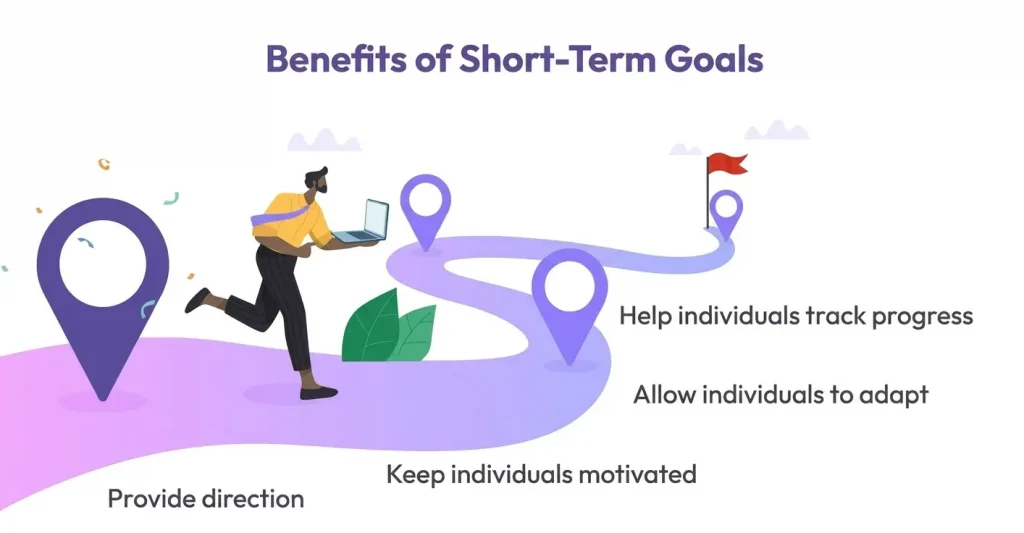
1. Increased Motivation
Short-term goals are easier to achieve and provide motivation that propels employees to achieve goals. This is crucial for sustaining effort for long-term goals.
2. Provide Clear Direction
Short-term goals provide a clear map of how to march to long-term success. They provide a clear direction, which helps one to avoid distractions.
3. Measurable Progress
Short-term goals are specific and measurable and follow the SMART goal framework, allowing you to track progress and identify areas that need improvement.
4. Adaptability
Short-term goals can be adjusted as circumstances change, making them adaptable to the current situation. This flexibility ensures short term goals remain relevant for businesses.
How to Set and Execute Short-Term Goals Using a Performance Management System
A performance management system is a tool to connect short-term team goals to the people responsible for delivering them. It helps to assign an owner to every goal, a measurable outcome, and a structured tracking system to check the progress.
Here is a well-structured short-term goal for a startup sales team set using a performance management framework:
Goal: Build a repeatable, predictable sales motion this quarter.
- Performance Metric 1: Close 12 new paid accounts by the end of Q3.
- Performance Metric 2: Reduce average sales cycle from 40 days to 28 days.
- Performance Metric 3: Achieve a 30% lead-to-demo conversion rate.
Each metric has a number, a deadline, and a clear definition of what to be achieved. This allows you to course-correct mid-quarter rather than finding the gap on the last day.
Final Takeaway
Execution is what separates startups that find their footing from the ones that run out of time before the product does. Short-term goals that are specific, tracked, and connected to real business outcomes are what make execution repeatable rather than occasional.
Start with three goals this quarter, write them down where your team can see them, and build a review cadence before the week is out.
If you are looking to structure your short-term team goals, try the Synergita performance management system to set, track, and align short-term goals across your entire organization. Get started free today.
Frequently Asked Questions
You should set three to five per team or function. Early-stage startups with small teams often achieve better results with three sharp, well-resourced goals than with five goals competing for the same limited attention.
Yes, short-term goals must be connected to the larger business objective. Before setting any short-term goal, ask one question: does achieving this bring the business closer to its long-term objective? If the answer is no, you should reconsider the goal rather than investing time and resources into it.
You should investigate if the target was unrealistic. Did priorities shift mid-cycle? Was there a resource or support gap? The answers give you an idea of how to fix it for next quarter.
Weekly check-ins for operational visibility and bi-weekly structured reviews for founders and managers. The teams that consistently hit their goals are the ones that review frequently to course-correct when needed.
Yes, you can change short-term goals based on market situations and business requirements. The idea of short-term goals is to help businesses achieve bigger and long-term company objectives, so adjust them when required but ensure you review it properly and communicate the reason behind it to the team.