
Not sure what to write under the “areas of improvement” section in a self-appraisal ?
For many employees, this is the most challenging part of a performance review. Nobody wants to highlight their weaknesses, but avoiding the question or relying on generic responses can make it harder to demonstrate a commitment to growth.
Areas of improvement in a self-appraisal reflect an employee’s willingness to learn, adapt, and prepare for greater responsibilities, which directly contributes to career growth through continuous learning and development.
According to LinkedIn’s 2025 Workplace Learning Report, 84% of employees agree that learning adds purpose to their work. Well-chosen improvement areas can strengthen your case for promotions, stretch assignments, and future opportunities.
In this guide, we explain how to identify development areas, avoid common self-appraisal mistakes, and write improvement statements that support long-term career growth.
| TL;DR: – Strong self-appraisals focus on a small number of high-impact improvement areas, not exhaustive weakness lists. – The most effective improvement statements are specific, measurable, and supported by an action plan related to real outcomes. – Use a structured filter (such as Impact, Data, Exposure, Actionability) to ensure you only include development areas that actually influence performance. – Improvement sections are most effective when they show intentional growth aligned with role expectations and future career progression. |
| Table of Contents 1. What is Area of Improvement in Self Appraisal? 2. How to Identify Self Evaluation Areas of Improvement Examples That Accelerate Career Growth 3. Top Areas of Improvement at Work Examples for Employees 4. Best Practices for Writing Areas for Development Performance Review Comments 5. Final Takeaway 6. Frequently Asked Questions |
What is Area of Improvement in Self Appraisal?
Areas of improvement in a self-appraisal are the skills, behaviors, or work habits an employee wants to strengthen over time. They show self-awareness and a willingness to develop professionally. They are signals that you understand your own performance and have a plan to grow.
There is an important difference between a weakness and an area of improvement:
| Weakness | Area of Improvement |
| “I am bad at presenting.” | “I am working on presenting data more clearly to non-technical teams.” |
| “I miss deadlines.” | “I am improving how I prioritize tasks when multiple projects overlap.” |
| “I am not a team player.” | “I am building habits to involve the team earlier in my planning.” |
The difference is clear: one focuses on a limitation, while the other focuses on improvement.
Why Is Identifying Areas of Self Development Important
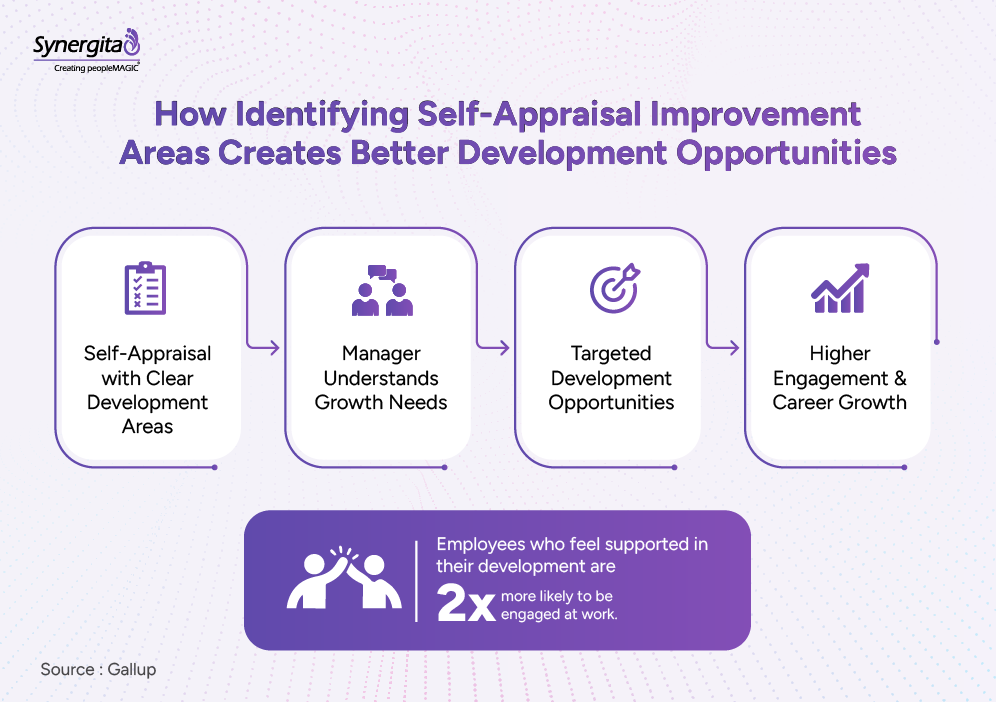
A well-written self-appraisal helps your manager understand where to invest in your development. It also gives you a stronger case for promotions, stretch assignments, and pay reviews.
According to a Gallup report, employees who feel their manager supports their development are twice as likely to be engaged at work.
When you skip the development section or fill it with generic lines, you leave that opportunity on the table.
Common Mistakes to Avoid When Writing Self Improvement Areas
- Writing the same improvement area every year with no progress shown
- Using vague phrases like “I want to grow” without explaining how
- Listing too many weaknesses and making the appraisal sound like a complaint
- Only writing strengths and leaving development areas blank
How to Identify Self Evaluation Areas of Improvement Examples That Accelerate Career Growth
Finding the right improvement areas in self evaluation is about selecting those that will improve your performance trajectory. A structured approach helps you avoid generic statements and ensures your self-appraisal reflects real, intentional growth.
To avoid low-impact improvement areas, evaluate each potential development opportunity using a structured filter before including it in your self-appraisal.
The I.D.E.A. Filter for Choosing Improvement Areas
Before including any improvement area in your self-appraisal, assess it using four criteria:
- Impact: Does improving this area directly improve your performance outcomes, delivery quality, or readiness for the next role?
- Data-backed: Has this been reflected in manager feedback, 360-degree feedback, project retrospectives, or missed expectations? Improvement areas should be backed by evidence, not assumptions.
- Exposure: Is this visible in your day-to-day work or noticeable to stakeholders? High-visibility areas tend to carry more weight in performance evaluations.
- Actionability: Can you realistically improve this within a defined time frame (for example, one quarter or a review cycle) with clear effort and practice?
A strong self-appraisal includes only improvement areas that meet at least three of the four criteria. Anything below this threshold should be excluded, as it results in low-impact statements.
Classifying Improvement Areas Before You Write Them
Once you have identified potential improvement areas, group them into these four categories to make your selection more focused:
- Execution gaps: Use this category when missed deadlines, prioritization issues, or delivery inefficiencies are directly affecting output quality or speed.
- Capability gaps: Use this category when a specific skill gap is limiting performance and requires deliberate improvement through practice, training, or experience.
- Behavioral gaps: Use this category when working style issues are affecting collaboration, ownership, or consistency in execution.
- Career-direction gaps: Use this category when the improvement area signals readiness (or lack of readiness) for the next level role, especially in leadership or cross-functional influence.
Each category serves a different purpose in the evaluation process. Execution gaps show reliability, capability gaps show growth potential, behavioral gaps show working effectiveness, and career-direction gaps signal long-term ambition.
Applying This to Your Self-Appraisal
Once you classify your improvement areas, you can convert them into clear, structured statements. The most effective self-appraisals do not just mention what needs improvement; they explain what is being done to improve it and how progress will be measured.
This approach ensures your improvement areas are specific, defensible, and aligned with both current performance expectations and future career growth.
Top Areas of Improvement at Work Examples for Employees
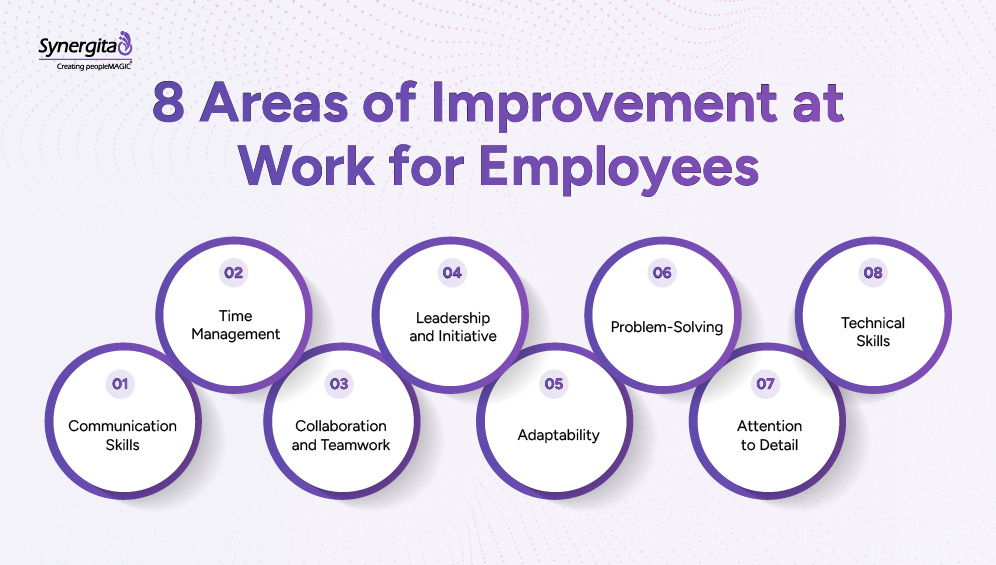
Here are eight common areas of improvement at work examples for employees, along with simple statements you can adapt for your own review.
1. Communication Skills
Communication is one of the most frequently discussed areas in performance reviews. It includes how effectively you share ideas, listen to others, and communicate across teams.
According to SHRM, 43% of managers say Generation Z employees lack key power skills such as communication and problem-solving. This shows why communication development should be a common focus in performance reviews.
Self-appraisal sample statements
- “I want to improve how I share project updates with stakeholders outside my team. My plan is to use a clearer format and ask for feedback after each update.”
- “I am working on listening more actively in meetings instead of preparing my response while others are still speaking.”
- “I plan to improve my written communication by keeping updates shorter and more structured.”
2. Time Management
This is an execution gap, especially when competing deadlines affect delivery consistency. It becomes a valid self-appraisal improvement area when supported by missed timelines or workload feedback and has clear scope for correction within a review cycle.
Self-appraisal sample statements
- “I take on more than I can realistically finish in a sprint. I am working on estimating effort more accurately before committing.”
- “I want to improve how I prioritise tasks when multiple deadlines overlap. I am testing a weekly planning routine to help me stay focused.”
- “I plan to reduce time spent on low-priority tasks by reviewing my task list each Monday against team goals.”
3. Collaboration and Teamwork
This is generally a behavioral gap, especially when collaboration issues affect team alignment or ownership clarity. It should be included only when it is visible in team interactions and reflected in peer or manager feedback.
Self-appraisal sample statements
- “I tend to work independently for too long before sharing progress. I am building a habit of checking in with the team earlier on complex tasks.”
- “I want to get better at giving feedback to peers in a way that is direct but constructive.”
- “I plan to contribute more actively to team discussions rather than sharing my views only when asked.”
4. Leadership and Initiative
Leadership is an important area for development performance review discussions across all job levels. It’s not limited to managers. Taking ownership, solving problems proactively, and supporting team success are valuable leadership skills at any level.
Self-appraisal sample statements
- “I want to move from executing tasks to identifying improvements on my own. I will bring one process improvement idea to the team each month.”
- “I am working on taking initiative in ambiguous situations instead of waiting for clear direction.”
- “I plan to mentor a junior colleague this year as a first step toward a leadership role.”
5. Adaptability
Adaptability is the ability to adjust effectively when priorities, processes, or workplace demands change. According to the U.S. Bureau of Labor Statistics, adaptability is among the most in-demand skills across occupations in its 2024–2034 projections.
Self-appraisal sample statements
- “When tools or processes changed this year, I found the transition harder than expected. I want to build more flexibility into how I work.”
- “I am working on staying effective even when priorities shift mid-project.”
- “I plan to volunteer for one project outside my usual scope each quarter to stretch my comfort zone.”
6. Problem-Solving
Problem-solving can be an area for development when employees identify challenges but struggle to recommend practical solutions. This is a common improvement area in performance reviews where employees are expected to move from identifying issues to offering solutions.
Self-appraisal sample statements
- “I want to shift from reporting problems to bringing proposed solutions. I will practice this in team meetings by preparing a suggested next step before raising any issue.”
- “I am working on analysing root causes before jumping to fixes.”
- “I plan to use data more consistently when making recommendations, rather than relying only on instinct.”
7. Attention to Detail
This area is commonly identified when errors could have been avoided with more thorough reviews before submission. The cost of poor quality consumes between 10% and 30% of annual revenue for the average manufacturer, while world-class facilities keep that figure below 5%. This applies not only for manufacturing but in other areas as well, showing why attention to detail and quality checks are important workplace skills.
Self-appraisal sample statements
- “Two deliverables this year had errors I caught only after sending. I am adding a checklist review step for all client-facing work.”
- “I want to build better quality checks into my workflow, especially under tight deadlines.”
- “I plan to build in a 24-hour review buffer for high-stakes outputs.”
8. Technical Skills
Employees can identify technical skill gaps by reviewing the tools, systems, or knowledge required for their current or future roles.
Self-appraisal sample statements
- “I want to improve my proficiency in [tool/platform] to reduce reliance on the engineering team for routine tasks. I plan to complete the vendor certification by Q3.”
- “I am building my data analysis skills by completing an online course this quarter.”
- “I plan to improve my knowledge of [domain area] by attending two industry webinars this half-year.”
Best Practices for Writing Areas for Development Performance Review Comments
These self evaluation improvement areas examples help employees create more structured self-appraisals.
1. Keep it specific
“I want to improve my communication” tells your manager nothing. “I want to improve how I present project status to senior leaders”, gives them something to work with.
2. Focus on Growth
Your improvement areas should show a willingness to develop new skills and take on greater responsibilities.
3. Add a plan
To make your development goals meaningful, pair each one with a concrete action you can follow through on.
A simple format that works: What you want to improve + What you will do + By when
Example: “I am developing my presentation skills by completing a public speaking workshop by Q2 and presenting in at least two cross-team meetings before year-end.”
4. Balance your appraisal
A good self-appraisal covers both strengths and areas for growth.
A rough guide: spend 60% on what is going well and 40% on where you are headed. A strong self-appraisal highlights both your accomplishments and the areas you are actively working to improve.
Self-Appraisal Summary Examples
Individual contributor: “This year I [key achievement]. I also [second achievement]. Going forward, I am focused on improving [area 1] by [action], and [area 2] by [action]. These will directly support [team goal or career step].”
Team lead: “This review period, I focused on [team priority] and achieved [result]. My biggest development area is [skill]. I plan to address this by [specific action] before [date].”
These self appraisal summary examples help employees clearly present achievements and areas of improvement in a structured way.
Final Takeaway
Writing about areas of improvement in a self-appraisal is the first step. The most effective self-appraisals are built on self-awareness, supported by feedback, and linked to clear development goals.
Rather than choosing generic improvement areas, focus on those that have the greatest impact on your performance, career growth, and future opportunities. The best improvement statements are specific and backed by a plan for progress.

Frequently Asked Questions
The most commonly cited areas across roles are communication, time management, and collaboration. Beyond these, leadership and initiative, adaptability, and technical skill development come up frequently, especially during promotion cycles or role transitions.
Three that apply nearly universally: (1) communicating clearly across different audiences, (2) managing priorities when multiple deadlines compete, and (3) taking initiative without waiting for direction. These three reflect the behaviours most managers associate with high-potential employees.
Here is one that works: “I am improving how I communicate project updates to stakeholders outside my team. I am switching to a clearer weekly format and will ask for feedback from two cross-functional leads after each update.” It is specific, has a plan, and focuses on impact, not the shortcomings.
Five strong ones:
(1) Executive communication and presentation,
(2) Prioritisation under competing demands,
(3) proactive problem-solving,
(4) cross-team collaboration,
(5) A role-specific technical skill.
Together, they cover the behavioural and hard-skill dimensions most employers weigh in development reviews.
A weakness is a gap with no direction. An area of improvement is the gap with a plan. Performance reviews respond much better to the second. When you name what you are improving and how you are improving it, the same information reads as ambition rather than deficiency.
Two to three is the right range. One feels like you are not being honest. Four or more makes it look like you are struggling. Choose the areas with the most direct impact on your next career move or your team’s current goals.
The most effective approach is to document them in a shared goal-tracking system and check in on progress during monthly one-on-ones, not just at the annual review. This keeps development goals active through the year and ensures your next self-appraisal is backed by real data, not just memory.