
Productivity losses from attrition and disengagement in median-size S&P 500 companies can range from $228 million to $355 million annually.
Despite significant investments in people programs, many HR initiatives fail to deliver the desired impact because goals are unclear. That’s where OKRs come in. HR OKR examples provide a structured method for teams to define goals, assign ownership, and track progress quarter by quarter.
This blog covers 20 examples of human resources OKRs across different areas, common mistakes to avoid and practical tips for scoring OKRs effectively.
| TL;DR – The 30 Seconds Takeaway Disengaged employees cost US businesses over $550 billion a year, yet most HR teams still run initiatives without clear goals or measurable outcomes. HR OKRs are effective when they are linked to business outcomes and owned by a person, not shared across a team with no one accountable. The examples in this guide show how HR can apply OKRs across functions such as hiring, engagement, retention, learning, and performance management. To get results, tailor OKRs to your organization’s needs, avoid common mistakes like unclear or overly ambitious goals, and review progress regularly. |
| Table of Contents 1. 20 Effective OKR Examples for Human Resources 2. How HR OKRs Change the Way People Teams Operate 3. Common Mistakes to Avoid When Setting OKR for HR 4. How to Calculate OKR Score and Track HR OKRs 5. Final Thoughts 6. Frequently Asked Questions |
20 Effective OKR Examples for Human Resources
These OKR examples for HR cover the full scope of the people function, from employee engagement and talent acquisition to performance improvement and career development using OKRs.
1. Objective: Improve employee engagement and satisfaction
- KR 1: Increase employee engagement survey participation by 20%
- KR 2: Achieve a 10% increase in employee Net Promoter Score (NPS)
- KR 3: Reduce voluntary turnover rate by 15%
2. Objective: Enhance talent acquisition processes to attract top talent
- KR 1: Decrease time-to-fill for open positions by 20%
- KR 2: Increase diversity in the candidate pool by 15%
- KR 3: Improve offer acceptance rate by 10%
3. Objective: Create a diverse and inclusive workplace culture
- KR 1: Increase representation of underrepresented groups in leadership positions by 15%
- KR 2: Achieve 95% completion rate for inclusion and belonging training
- KR 3: Achieve a 20% improvement in employee ratings of inclusivity in the workplace
4. Objective: Enhance overall employee performance and productivity
- KR 1: Implement quarterly performance reviews for all employees
- KR 2: Provide 20 hours of training per employee per quarter
- KR 3: Increase employee satisfaction with feedback frequency by 20%
5. Objective: Develop and nurture leadership skills among employees
- KR 1: Launch a new leadership training program
- KR 2: Increase participation in leadership development programs by 25%
- KR 3: Achieve a 15% improvement in employee ratings of leadership effectiveness
6. Objective: Prioritize employee well-being and work-life balance
- KR 1: Increase employee satisfaction with work-life balance by 20%
- KR 2: Implement wellness initiatives resulting in a 15% reduction in stress-related absenteeism
- KR 3: Improve access to mental health resources and support services
7. Objective: Enhance performance management processes for better outcomes
- KR 1: Implement quarterly check-ins between managers and employees
- KR 2: Increase employee participation in goal-setting by 25%
- KR 3: Improve manager feedback frequency by 20%
8. Objective: Drive continuous learning and development initiatives.
- KR 1: Increase employee participation in training programs by 30%
- KR 2: Achieve a 20% improvement in employee satisfaction with learning opportunities
- KR 3: Develop 3 new skills development programs aligned with business needs
9. Objective: Improve Employee Listening and Feedback Programs
- KR 1: Increase employee survey participation from 65% to 85%
- KR 2: Reduce the average time to act on employee feedback from 60 days to 30 days
- KR 3: Improve employee confidence in leadership communication by 20%
10. Objective: Identify and develop high-potential talent for future leadership roles.
- KR 1: Increase internal promotion rate of identified high-potential employees from 20% to 35%
- KR 2: Implement mentorship programs for aspiring leaders
- KR 3: Create individual development plans for potential successors
11. Objective: Enhance the onboarding process for new hires.
- KR 1: Decrease time-to-productivity for new hires by 20%
- KR 2: Improve new hire onboarding satisfaction scores by 25%
- KR 3: Implement a buddy/mentor system for all new hires
12. Objective: Develop and implement effective workforce planning strategies.
- KR 1: Conduct workforce analysis to identify skill gaps
- KR 2: Develop recruitment strategies to address identified skill gaps
- KR 3: Implement training and development programs to upskill existing workforce
13. Objective: Enhance employee recognition and rewards programs.
- KR 1: Increase employee participation in recognition programs by 30%
- KR 2: Achieve a 20% increase in employee satisfaction with rewards and recognition
- KR 3: Implement a peer-to-peer recognition system
14. Objective: Reduce absenteeism rates and improve employee attendance.
- KR 1: Implement a comprehensive attendance tracking system
- KR 2: Provide incentives for good attendance and punctuality
- KR 3: Develop initiatives to improve employee well-being and reduce stress-related absenteeism
15. Objective: Enhance employee relations and foster a positive workplace culture.
- KR 1: Implement regular employee feedback surveys
- KR 2: Increase employee satisfaction with communication channels
- KR 3: Address and resolve employee grievances in a timely manner
16. Objective: Build a Strong Employer Brand
- KR 1: Increase employer review ratings across recruitment platforms by 15%
- KR 2: Grow employee referral hires from 12% to 25% of total hires
- KR 3: Increase career page application conversion rate by 20%
17. Objective: Ensure compliance with labor laws and regulations
- KR 1: Conduct regular audits to assess compliance status
- KR 2: Provide training to HR staff and managers on relevant labor laws
- KR 3: Implement processes to address any compliance gaps identified during audits
18. Objective: Review and enhance employee benefits offerings
- KR 1: Conduct a comprehensive review of existing benefits packages
- KR 2: Gather employee feedback on desired benefits and perks
- KR 3: Implement new benefits or enhance existing ones based on feedback and market trends
19. Objective: Enhance HR technology infrastructure for better efficiency and effectiveness.
- KR 1: Upgrade the HRIS system to improve data management and reporting capabilities
- KR 2: Implement self-service portals for employees to access HR information and services
- KR 3: Provide training to HR staff on using new technology tools effectively
20. Objective: Strengthen Internal Mobility and Career Growth
- KR 1: Increase internal role fills from 15% to 25%
- KR 2: Ensure 90% of employees have documented career development plans
- KR 3: Increase participation in internal job postings by 30%
Looking for more industry-specific OKR examples? Explore Synergita’s collection of OKR templates and examples covering HR, sales, marketing, engineering, and leadership teams. These ready-to-use frameworks can help you accelerate OKR adoption and reduce the time spent creating goals from scratch.
How HR OKRs Change the Way People Teams Operate
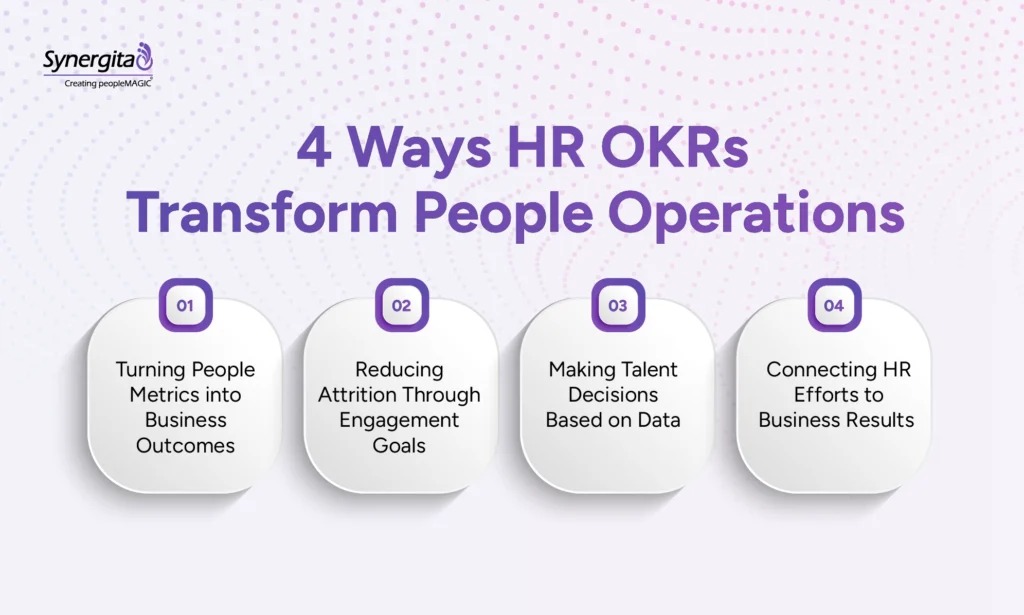
HR OKRs help HR teams move beyond tracking activities to focusing on measurable business impact by linking people initiatives directly with organizational goals. Gallup estimates that disengaged employees cost the global economy $8.8 trillion in lost productivity each year. This shows the importance of aligning HR efforts with clear, outcome-driven goals.
Here’s how HR OKRs change the way teams operate across four key areas.
1. Turning People Metrics into Business Outcomes
HR OKRs push teams beyond tracking metrics such as headcount and turnover. By linking people’s initiatives to measurable business outcomes, HR shifts from a reporting function to a strategic partner.
2. Reducing Attrition Through Engagement Goals
Without clear goals, it can be difficult to understand whether engagement initiatives are actually working. HR OKRs turn priorities such as employee engagement, retention, and satisfaction into measurable targets, helping teams identify issues early and take timely action.
3. Making Talent Decisions Based on Data
When hiring, development, and performance priorities are structured as OKRs, decisions rely more on evidence than intuition. This enables HR teams to identify what’s working and what’s not, allocate resources effectively, and drive greater consistency in recruitment, onboarding, and performance management.
4. Connecting HR Efforts to Business Results
HR teams manage initiatives that affect every stage of the employee lifecycle. OKRs give measurable outcomes to those initiatives, making it easier to show leadership exactly where people’s programs are driving growth and where they are not.
Common Mistakes to Avoid When Setting OKR for HR
Many HR teams adopt OKRs but fail to see results because their goals lack clarity and measurability. Understanding the most common pitfalls can help turn OKRs into a more effective management tool.
1. Writing Activity-Based Key Results
“Conduct 4 training sessions per quarter” tells you what HR did. It doesn’t tell you whether it worked. A stronger key result is “increase employee satisfaction with learning opportunities by 20%.” This is the difference that separates effective HR OKRs from ineffective ones.
2. Setting too Many OKRs at Once
HR covers a wide scope, including recruitment, engagement, compliance, L&D, and performance. Trying to run OKRs across all of them in one cycle spreads attention too thin. A practical limit is 3–4 objectives per cycle, with 2–3 key results for each.
3. Disconnecting HR OKRs from Business Goals
When HR OKRs are disconnected from business results, it becomes difficult to demonstrate their value and secure ongoing investment.
Every HR objective should answer one question: Why does the business care about this outcome right now?
4. Reviewing OKRs Only at Quarter-End
OKRs deliver better results when progress is reviewed regularly, not just at the end of the quarter. Frequent check-ins help keep goals relevant and actionable.
5. Setting Targets that Are Too Easy
The purpose of OKRs is to drive meaningful progress, not just guarantee completion. Even partial achievement of an ambitious goal delivers more value than full completion of an easy one. Consistent perfect scores are a signal to recalibrate, not celebrate.
6. Skipping Ownership
In large HR teams, shared goals become no one’s priority. Each OKR needs a named owner, one person accountable for driving it forward and reporting on progress.
How to Calculate OKR Score and Track HR OKRs
Setting HR OKRs is the first step. Regular OKR scoring and tracking help HR teams understand what’s working, identify gaps early, and improve outcomes.
The 0.0–1.0 Scoring Scale
Each key result is scored between 0.0 and 1.0 at the end of the cycle. The standard interpretation:
- 0.0–0.3: Minimal progress, needs a root-cause review before resetting
- 0.4–0.6: Meaningful progress with gaps, worth continuing with adjustments
- 0.7–0.9: Strong result, ambitious goal, substantial progress
- 1.0: Either exceptional execution or the target wasn’t ambitious enough
A score of 0.6–0.7 across your HR OKRs is generally the target zone. It indicates that the goals were ambitious and the team made meaningful progress toward achieving them.
How to Track HR OKRs
Tracking HR OKRs should be an ongoing process rather than a quarter-end exercise. It helps HR teams understand whether initiatives are on track and what actions should be taken to achieve the desired outcomes. Here are four areas to focus on when tracking HR OKRs.
- Progress updates: Measure how far each key result has advanced against its target.
- Key HR metrics: Monitor indicators such as engagement scores, attrition rates, time-to-fill, training participation, or internal mobility rates.
- Risks and blockers: Identify obstacles that may delay progress and take corrective action early.
- Ownership and accountability: Ensure each OKR has a designated owner responsible for reporting updates and driving execution.
As HR OKRs grow across teams and departments, tracking them manually can become difficult. Dedicated OKR tracking software helps companies set goals, track progress, and gain visibility into key results across the organization.
Suggested Reading: OKR Tracking Techniques for Managers
How Often Should HR OKRs Be Reviewed
- Weekly: Brief check-in on progress, blockers, and confidence levels for each key result
- Monthly: Review progress and address potential issues before they affect outcomes.
- Quarterly: Complete scoring, review key successes and challenges, and use those insights to shape the next OKR cycle.
Final Thoughts
HR goals become more effective when they are clearly defined and measurable. Whether you are starting with broad employment goals examples or refining existing targets, these OKR examples for HR provide a practical way to translate priorities such as engagement, retention, and talent acquisition into actionable outcomes.
Start with the area where your organization has the most urgent gap and then try them across other areas. If you want a faster way to get started, Synergita’s AI-Powered OKR management software helps HR teams create aligned, measurable OKRs in seconds.
Ready to put these HR OKR examples into practice? Try Synergita OKR for free
Frequently Asked Questions
Five examples of HR OKRs include:
Reduce time-to-fill open positions by 20%.
Increase leadership training participation by 25%.
Achieve 95% completion rate for performance reviews.
Reduce voluntary turnover by 15%.
Increase the new hire 90-day satisfaction score by 25%.
The 7 C’s of HR are Culture, Communication, Competence, Commitment, Compensation, Compliance and Change Management.
To get the best out of your employees, you should focus on clear communication, continuous support, and timely recognition.
OKR for HR should be reviewed regularly, usually through weekly or biweekly check-ins and a more comprehensive review at the end of each quarter. Frequent reviews help HR teams monitor progress, address challenges early, and keep priorities on track.
Good talent acquisition OKR examples include reducing time-to-hire, improving quality of hire, increasing offer acceptance rates, strengthening candidate experience, and improving diversity in hiring.
For example, Objective: Build a high-performance recruiting function.
Key results:
Reduce average time-to-fill from 45 to 30 days
Increase the offer acceptance rate from 80% to 90%
Grow referral hires from 10% to 25% of total fills
HR OKRs help improve employee retention by turning priorities such as engagement, career development, and employee experience into measurable goals. This helps HR teams to identify concerns early, track progress, and take the right actions to reduce turnover.