
A feature launch is only successful when it creates real value for users and the business. Yet many product teams track completed features instead of measuring how those features improve the product.
In fact, Pendo research across SaaS products reveals that up to 80% of software features are rarely or never used. Setting outcome-driven product OKRs ensures engineering effort is spent on capabilities that users actually adopt.
The 20 product OKR examples below cover growth, customer experience, quality, innovation, and collaboration, showing how high-performing teams set clear objectives, track the right metrics, and deliver measurable business outcomes.
| TL;DR – A Quick Takeaway Product OKRs work best when aligned with key outcomes like growth, retention, quality, and innovation. The right OKRs connect product goals with broader business strategy. Measure business and customer outcomes, not outputs like features shipped. Review and refine product OKRs regularly to stay aligned with changing customer and business priorities. |
Table of Contents 1. What are the best product OKR examples for different product goals 2. Why product OKRs are important for high-performing teams 3. How to choose the right product OKRs for your team 4. Common product OKR mistakes to avoid 5. Final takeaway 6. Frequently asked questions |
What are the best product OKR examples for different product goals
These OKR examples for product teams are grouped by outcomes, making it easier to find the right goals for your current priorities.
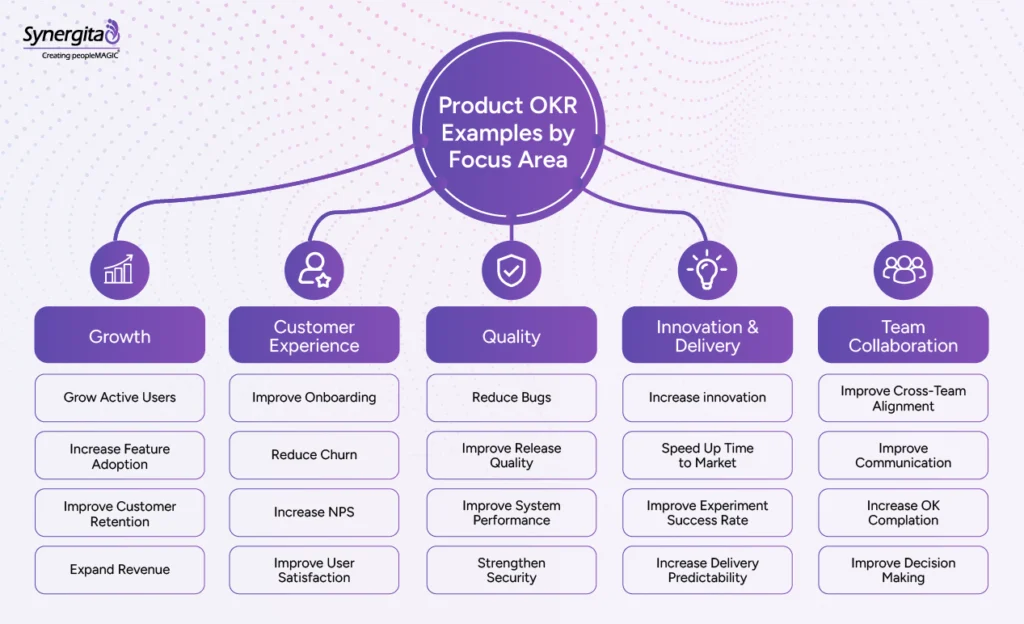
Product growth OKR examples
Focus on these OKRs when your goal is to increase adoption, expand usage, and improve product performance.
1. Increase active users
Objective: Grow consistent product usage across the existing user base.
Key Results:
- Increase weekly active users from 48,000 to 60,000
- Improve average sessions per active user from 3.8 to 5 per week
- Reduce inactive users by 20% over the quarter
Importance: Signups show interest, but active usage reflects whether customers continue finding value in the product.
2. Improve feature adoption
Objective: Help more customers discover and regularly use high-value product features.
Key Results:
- Increase adoption of the primary feature from 22% to 40%
- Reduce time-to-first-value from 5 days to 2 days
- Improve feature satisfaction score from 4.0 to 4.5 out of 5
Importance: One of the most valuable product OKRs focuses on ensuring customers actually use the features your team builds.
Pendo’s own benchmark research across its customer base found the median feature adoption rate sits around 6.4%, with top-performing products reaching roughly 15.6%, so this OKR helps teams improve feature engagement intentionally.
3. Expand customer base
Objective: Expand product adoption into new customer segments.
Key Results:
- Increase qualified trial signups by 30%
- Achieve a 25% activation rate from the new target segment
- Generate 500 new paying customers from targeted markets
Importance: These OKR examples for product teams align product strategy with business expansion goals.
Learn how to align your OKRs step-by-step to keep teams from pursuing separate priorities.
4. Increase revenue from existing customers
Objective: Increase customer lifetime value by expanding product usage.
Key Results:
- Increase expansion revenue by 18%
- Improve premium feature adoption from 20% to 35%
- Reduce account downgrades by 15%
Importance: Strong product management OKRs measure how product improvements contribute to revenue growth.
Customer experience OKR examples
Customer experience OKRs help product teams remove user friction, improve satisfaction, and create smoother product journeys.
5. Improve onboarding
Objective: Improve the onboarding experience to help new users achieve value faster.
Key Results:
- Increase onboarding completion rate from 60% to 80%
- Increase new user activation rate from 55% to 75%
- Increase Day-30 retention from 45% to 60%
Importance: A smooth onboarding experience helps users understand the product faster, increasing the chances they stay engaged and become long-term customers.
6. Reduce churn
Objective: Increase long-term customer retention.
Key Results:
- Reduce quarterly churn from 8% to 5%
- Improve renewal rate from 82% to 90%
- Reduce at-risk accounts by 25%
Importance: Retaining existing customers helps protect revenue and strengthens long-term product growth by ensuring users continue to receive value.
7. Increase NPS
Objective: Improve overall customer satisfaction and advocacy.
Key Results
- Increase Net Promoter Score from 35 to 50
- Increase survey response rate from 18% to 35%
- Resolve 90% of customer feedback items within two weeks
Importance: Customer feedback helps product teams identify issues early, understand user needs, and improve experiences before they impact retention.
8. Improve user satisfaction
Objective: Improve the overall user experience across the product.
Key Results:
- Increase CSAT from 82% to 90%
- Reduce average support resolution time by 35%
- Reduce usability-related support tickets by 25%
Importance: Customer satisfaction helps product teams identify friction points that product usage data alone may not reveal.
Product quality OKR examples
These product quality OKRs help teams improve stability, reliability, and overall product performance by delivering a more dependable user experience.
9. Reduce bugs
Objective: Improve product stability for end users.
Key Results:
- Reduce critical production bugs by 40%
- Resolve high-priority defects within 48 hours
- Reduce defect-related support tickets by 30%
Importance: Fewer bugs improve the user experience, increase customer confidence, and help teams deliver a more reliable product.
10. Improve release quality
Objective: Improve the quality and stability of every product release.
Key Results:
- Reduce production incidents by 35%
- Increase automated test coverage from 65% to 85%
- Reduce hotfix releases by 50%
Importance: High-quality releases reduce customer disruption, build trust, and enable teams to deliver new features with confidence.
11. Increase system reliability
Objective: Improve system reliability and platform stability.
Key Results:
- Achieve 99.95% uptime
- Reduce Mean Time to Resolution (MTTR) by 40%
- Reduce service outages by 30%
Importance: A reliable product builds customer trust, improves user experience, and supports long-term customer retention.
12. Reduce technical debt
Objective: Reduce technical debt to improve engineering efficiency.
Key Results:
- Reduce technical debt backlog by 30%
- Improve build time from 20 minutes to 10 minutes
- Reduce engineering rework by 20%
Importance: Managing technical debt helps teams build new features faster, reduce maintenance effort, and improve long-term product performance.
Innovation & delivery OKR examples
These product OKRs help teams boost delivery, encourage innovation, and validate ideas before investing in full-scale development.
13. Product discovery
Objective: Identify and validate customer problems before prioritizing new product initiatives.
Key Results:
- Conduct 30 customer discovery interviews
- Validate 90% of roadmap initiatives through customer research before development.
- Reduce low-adoption feature releases by 25%
Importance: Strong product discovery helps teams build solutions that solve real customer problems while reducing wasted development effort.
14. Experimentation goals
Objective: Validate product solutions through experimentation before full-scale rollout.
Key Results:
- Run 10 A/B tests on key product experiences
- Validate 80% of product hypotheses using experiment results
- Increase successful experiment outcomes by 25%
Importance: Experimentation helps product teams test proposed solutions with real users, reducing the risk of launching features that fail to deliver value.
15. Improve product-market fit
Objective: Strengthen product-market fit for target customers.
Key Results:
- Increase Day-90 retention from 45% to 60%
- Increase customer referrals by 20%
- Improve product-market fit survey score from 35% to 50%
Importance: Improving product-market fit ensures the product solves real customer problems and delivers long-term business success.
16. Accelerate product delivery
Objective: Shorten the time from idea to product release.
Key Results:
- Reduce release cycle time from 4 weeks to 2 weeks
- Increase deployment frequency by 50%
- Reduce release delays by 40%
Importance: Faster releases help teams respond quickly to customer feedback and deliver value more consistently.
Team collaboration OKR examples
These product team OKRs strengthen collaboration across product, engineering, design, and business teams to improve delivery and product outcomes.
17. Engineering alignment
Objective: Improve product and engineering alignment to deliver releases on schedule.
Key Results:
- Reduce sprint scope changes by 40%
- Improve sprint predictability to 90%
- Increase cross-team planning satisfaction to 4.5/5
Importance: Better alignment helps teams deliver projects on time with fewer disruptions.
18. UX collaboration
Objective: Deliver a more consistent user experience across every product release.
Key Results:
- Reduce design revisions by 30%
- Reduce design-to-development handoff delays by 40%
- Achieve 95% design system adoption across new features
Importance: Effective collaboration between product and design improves delivery speed while maintaining a high-quality user experience.
19. Stakeholder communication
Objective: Improve transparency and communication across stakeholders.
Key Results:
- Increase stakeholder awareness of roadmap priorities from 70% to 90%
- Reduce ad hoc status requests by 40%
- Achieve 90% stakeholder satisfaction with roadmap communication
Importance: Clear communication keeps teams aligned, improves decision-making, and reduces unnecessary meetings.
(Note: If your team also collaborates closely with external business partners, explore our guide to Partnership OKR examples and strategies.)
20. Improve customer feedback implementation
Objective: Turn customer feedback into product improvements faster.
Key Results:
- Resolve 80% of validated high-priority customer requests each quarter
- Increase the percentage of validated customer feedback incorporated into the roadmap from 50% to 80%
- Increase customer satisfaction with implemented improvements to 90%
Importance: Acting on customer feedback helps product teams continuously improve the product and ensure development aligns with evolving customer needs.
Strong examples are useful, but effective product OKRs also follow a few consistent principles that make them measurable and achievable.
Why product OKRs are important for high-performing teams
Product OKRs help teams translate product goals into measurable business outcomes. By aligning product initiatives with business priorities and tracking the right product metrics, they improve collaboration, guide better decisions, and help teams deliver products that increase user adoption, retention, and business growth.
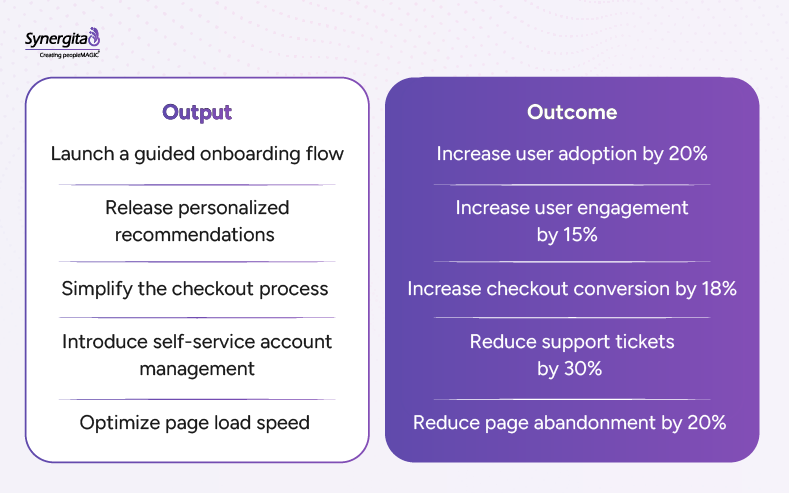
Shift the focus from outputs to outcomes
Launching a feature is only one step in the product journey. Product OKRs help teams evaluate whether that feature delivered the intended results, such as better adoption, engagement, or retention.
This outcome-driven approach helps prioritize initiatives that create measurable business impact.
Cross-functional alignment
Cross-functional alignment helps product, engineering, design, marketing, sales, and customer success teams work toward shared objectives instead of optimizing separate metrics. Product OKRs provide a common framework that aligns every team around measurable product goals.
This level of cross-functional cohesion pays off directly in bottom-line performance. Research by Harvard Business Review shows that companies with highly aligned teams are more than twice as likely to be top financial and strategic performers.
Connect product goals to business strategy
Product management OKRs connect day-to-day product work with broader business goals. They help teams prioritize the right initiatives, focus on measurable outcomes, and ensure every product decision contributes to long-term business success.
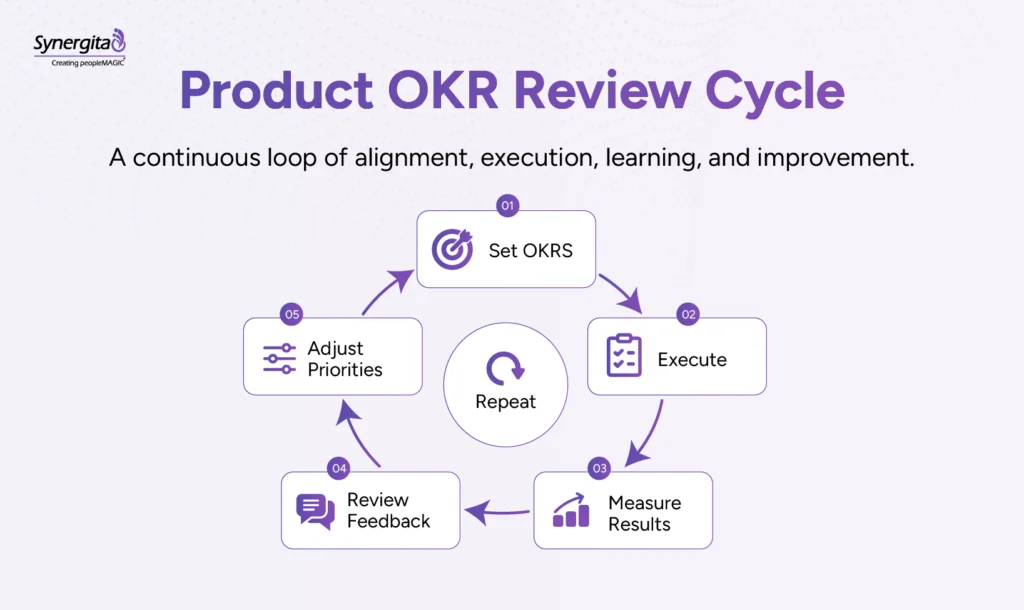
Adapt quickly to changing priorities
Customer needs, market conditions, and business priorities can change quickly. Regularly reviewing product OKRs helps teams adapt to changing priorities, respond to customer feedback, and stay aligned with business goals while continuously improving product performance.
How to choose the right product OKRs for your team
The best product OKRs depend on your team’s priorities and the outcomes you want to achieve. Start by identifying your primary product goal, such as improving adoption, reducing churn, increasing product quality, or generating revenue, then choose product metrics that accurately measure progress toward that objective.
Key product metrics to track
Track the product metrics that best align with your product goals:
- Adoption: Measures how many users actively use a feature.
- Activation: Tracks how quickly new users experience value.
- Retention: Shows whether customers continue using the product over time.
- Net Promoter Score (NPS): Measures customer satisfaction and loyalty.
- Revenue: Tracks growth through expansion, upsells, and conversions.
- Engagement: Measures how deeply users interact with the product.
Common product OKR mistakes to avoid for better product performance
Avoiding common OKR mistakes helps product teams create product OKRs that stay aligned with business goals and deliver measurable results.
- Measuring outputs instead of outcomes: Prioritize customer and business outcomes over feature delivery.
- Tracking the wrong metrics: Track metrics that show real business impact, such as customer retention, engagement, and revenue.
- Setting too many objectives: Limit the number of product OKRs to keep teams focused on the highest priorities.
- Ignoring business strategy: Align product goals with company objectives to ensure every initiative supports broader business outcomes.
- Skipping regular reviews: Review and update product OKRs regularly to reflect changing business priorities and customer needs.
Final takeaway
A product team’s biggest challenge is ensuring every goal creates a measurable impact. Without clear Product OKRs, teams can waste engineering effort on low-value features, miss customer needs, and lose alignment with business priorities.
By focusing on outcome-based objectives and the right product metrics, teams can reduce decision-making time, prioritize confidently, and improve product performance. Synergita’s AI-powered OKR software helps product teams create, track, and align OKRs with real-time visibility and AI-assisted insights.
Start your free trial today.

Frequently asked questions
Product OKRs are objectives and key results that guide product teams toward measurable outcomes like customer value, retention, and revenue, rather than tracking output volume such as features shipped or tickets closed each quarter.
Most high-performing product teams set 2 to 4 objectives per quarter, each with 3 to 4 key results, since too many objectives dilute focus and make progress difficult to track across teams.
Product OKRs set a specific, time-bound goal and the results that prove it, while product KPIs like activation rate or churn are ongoing indicators used to measure progress toward those product team OKRs.
Product management OKRs are measured using specific, quantifiable key results related to metrics like activation, retention, feature adoption, or revenue, reviewed on a consistent quarterly cadence to track real progress against product goals.
Yes, OKRs improve product performance by connecting daily engineering and design decisions to measurable outcomes, helping teams prioritize work that impacts product success metrics like retention and revenue instead of just shipping features.
Strong product success metrics include activation rate, feature adoption, retention, NPS, and expansion revenue, since these are connected to whether the product delivers lasting value rather than one-time engagement.