
Most hybrid teams struggle with one problem: everyone is working, but not everyone is working toward the same priorities.
When goals are spread across spreadsheets, project tools, chat messages, and manager notes, it becomes difficult to track who owns what, which objectives are on track, and where teams need support. This becomes even more challenging when employees work from different locations and time zones.
Hybrid work remains a significant part of the US workforce. According to the US Bureau of Labor Statistics, 22.6% of employed Americans teleworked or worked from home for pay in March 2026.
OKR software for hybrid teams gives leaders and employees one place to view objectives, key results, progress, ownership, and dependencies, reducing the need for constant status meetings.
In this guide, we compare seven leading OKR platforms for businesses based on hybrid-team usability, goal alignment, integrations, reporting, scalability, and pricing.
| TL;DR Choose Synergita for affordable, scalable OKR management with guided goal creation and integrations for hybrid teams. Look for simple progress tracking, clear ownership, asynchronous check-ins, and integrations with your existing tools. Run a pilot with a small hybrid team before implementing the platform company-wide. |
| Table of Contents 1. What is OKR software for hybrid teams? 2. The 7 best OKR software for hybrid teams in 2027 3. How to select the right OKR software for hybrid teams? 4. Challenges of using an OKR platform for remote teams and how to solve them 5. Final takeaway 6. Frequently asked questions |
What is OKR software for hybrid teams?
OKR software for hybrid teams is a centralized platform that helps organizations create, align, and review Objectives and Key Results (OKRs) across distributed and remote teams.
An OKR platform for remote teams should make it easy for employees to see their goals, update progress, and stay connected with company priorities. It gives employees and managers a shared view of priorities, ownership, and progress regardless of where they work.
Efficient OKR software for hybrid teams should support:
- Company, department, team, and individual OKRs
- Asynchronous progress updates and reminders
- Goal alignment and hierarchy views
- Real-time dashboards and reporting
- Integrations with everyday work tools
- Clear ownership of objectives and key results
- AI assistance without adding administrative work
This makes OKR tracking for hybrid teams easier by giving employees and managers one place to see goals, updates, and progress.
The 7 best OKR software for hybrid teams in 2027
The OKR tools for hybrid teams below are evaluated for hybrid-team alignment, usability, reporting, integrations, and scalability. If you’re also comparing the best OKR tools for remote teams, focus on features that support regular updates and clear goal ownership.
Quick comparison
| SLNO | OKR software | Best for | Standout strength | Current starting pricing |
| 1 | Synergita | Startups, SMEs, and enterprises looking for a cost-effective OKR tool | Quick implementation with AI-assisted OKR creation | Free; paid from $3/user/month |
| 2 | Weekdone | Small teams | Weekly OKR check-ins | Free up to 3 users; paid plans scale |
| 3 | Mooncamp | Mid-sized and enterprise teams | Goal alignment with OKR tracking and dashboards | Starts at €7/user/month |
| 4 | Betterworks | Enterprises | Goals + performance management | $8/user/month listed |
| 5 | Profit.co | Custom frameworks | Flexible OKR strategy execution | Custom proposal |
| 6 | WorkBoard | Large enterprises | AI strategy execution | Custom enterprise pricing |
| 7 | Lattice | HR-led organizations | People + OKR alignment | $8/seat/month |
Shortlist OKR tools based on how easily employees can update their OKRs each week, rather than on the number of features shown in a sales demo.
1. Synergita
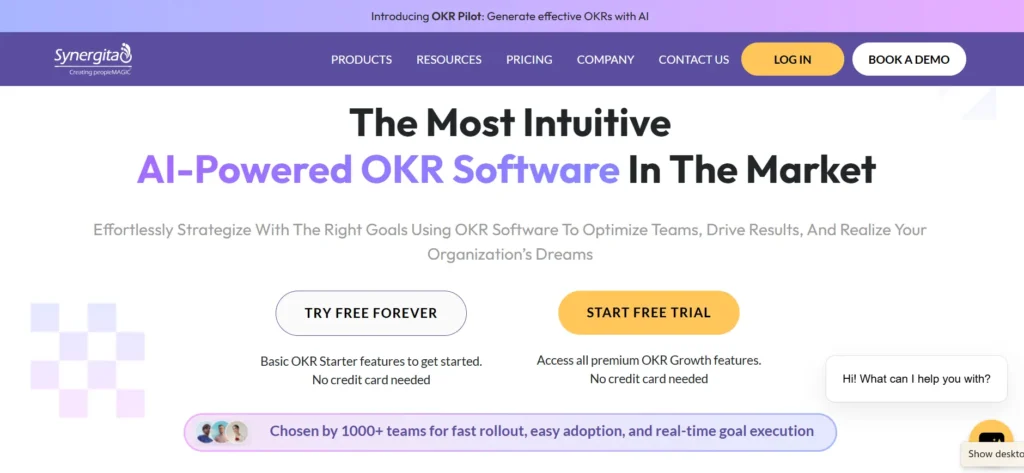
Synergita is a cost-effective OKR platform for organizations of all sizes, from startups and growing teams to large enterprises looking to align goals without the high costs of traditional enterprise OKR platforms. It is the best overall choice for hybrid organizations that want structured goal management without paying enterprise-level prices.
Synergita provides OKR management software for hybrid teams with structured goal setting, alignment, check-ins, and progress reporting in one platform. The platform supports company, team, and individual OKRs with features like goal alignment, hierarchy views, approval workflows, check-ins, reporting, and AI-assisted OKR creation.
Teams can start with a free plan, scale through flexible pricing options, and access advanced capabilities, such as integrations with Jira, Microsoft Teams, Slack, and HRIS platforms.
Best for: Growing SMBs, mid-market businesses, and distributed organizations that want an affordable system they can scale.
Key Capabilities:
- Cascading OKRs and hierarchy visualization
- AI-assisted OKR creation
- Automated nudges and check-ins
- Custom reports and dashboards
- Workflow and integration support
- Enterprise security options on higher plans
Pricing:
Synergita OKR pricing is designed for businesses of every size, with a free plan for small teams and affordable paid tiers.
- Free for up to three users
- OKR Lite starts at $3 per user/month, billed annually
- OKR Growth is $6 per user/month, billed annually
2. Weekdone
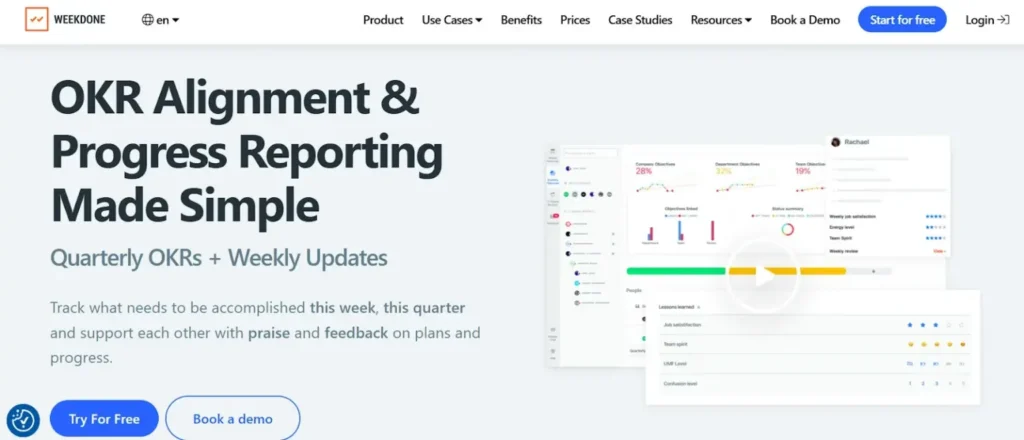
Weekdone is a good fit when your main priority is building an OKR habit without introducing a heavy strategy platform.
Its approach connects quarterly OKRs with weekly Plans, Progress, and Problems reporting. Teams can use weekly check-ins, OKR hierarchy views, dashboards, feedback, recognition, and automated reports to keep progress visible between meetings.
Best for: Small and mid-sized teams introducing OKRs.
Key Capabilities:
- Quarterly OKRs
- Weekly check-ins
- Goal hierarchy views
- Automated progress reporting
- Integrations with Slack, Microsoft Teams, Jira, Asana, and Zapier
- OKR coaching and onboarding support
Pricing: Free for up to three users, with a 14-day trial for larger teams. Paid pricing scales with company size.
Weekdone’s strength is simplicity. Hybrid teams that struggle with inconsistent updates may find its weekly check-in structure easier to adopt than a more complex enterprise platform.
3. Mooncamp
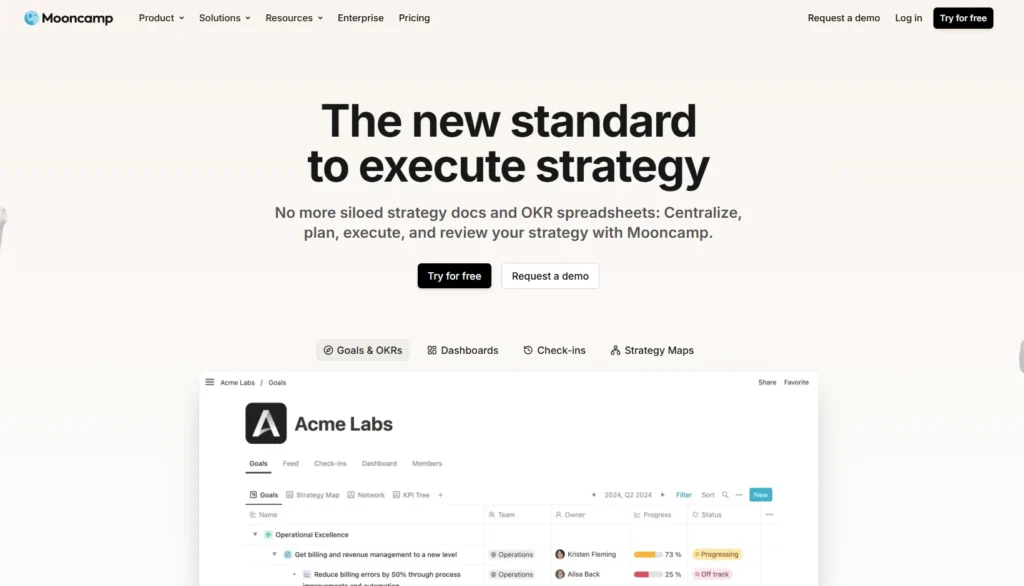
Mooncamp is an OKR and strategy execution platform designed to help organizations align company goals, team objectives, and individual contributions in one place. It helps hybrid teams connect strategic priorities with measurable outcomes through OKRs, check-ins, dashboards, and automated progress tracking.
Best for: Mid-sized and enterprise teams that need structured OKR management with strong strategy alignment and reporting capabilities.
Key Capabilities:
- Company, team, and individual OKRs
- Strategy maps and goal hierarchy views
- Regular OKR check-ins and reminders
- Custom dashboards and progress reporting
- KPI tracking and analytics
- Integrations with Jira, Microsoft Teams, Slack, and other work tools
Pricing: According to Mooncamp’s official website, both plans are billed annually.
- Basic: $7per user/month
- Premium: $10 per user/month
- A free trial is available, but a credit card is required.
4. Betterworks
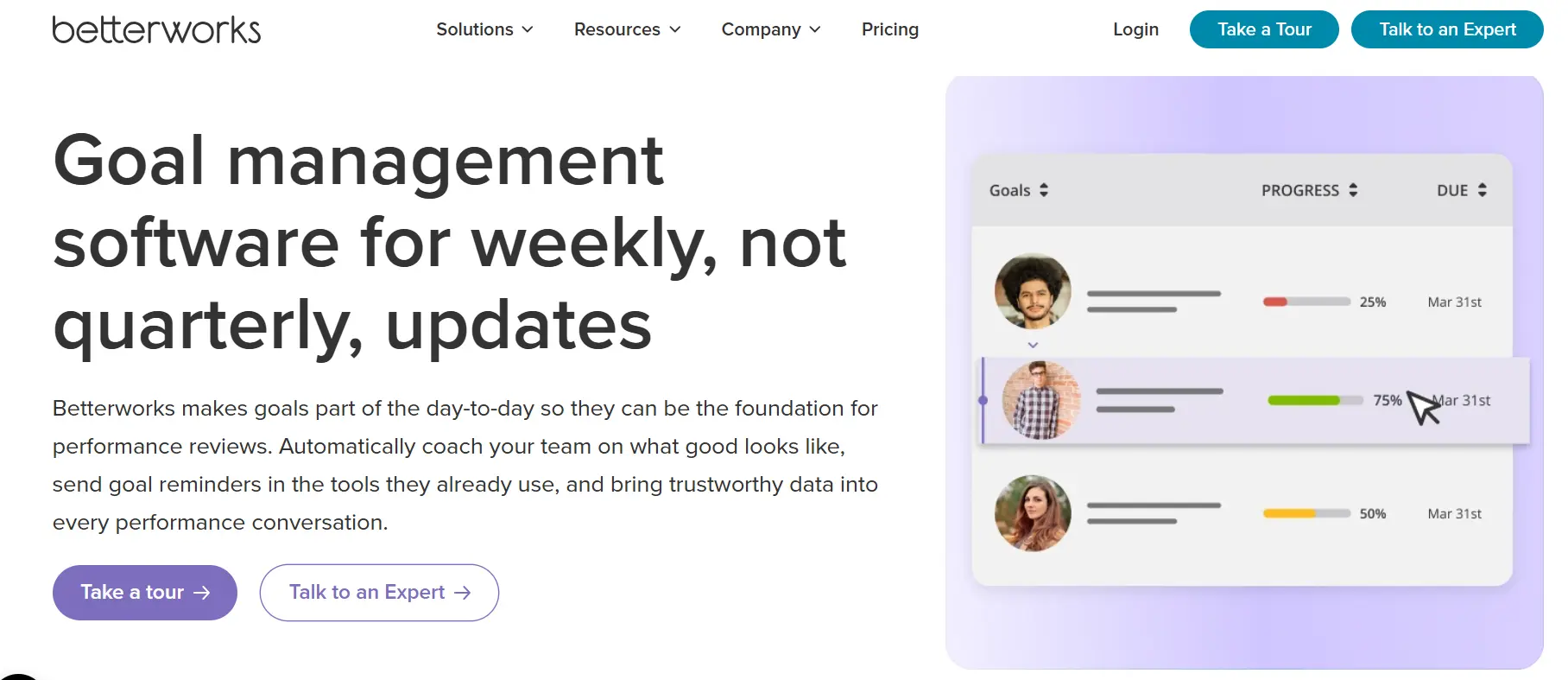
Betterworks connects OKRs closely with continuous performance management.
Organizations can cascade company priorities into team and individual goals, update progress during the cycle, and bring goal data into performance conversations. Betterworks also offers AI-assisted goal creation and integrations with systems such as Workday, Salesforce, Jira, and Slack.
Best for: Mid-market and enterprise companies combining OKRs with structured employee performance programs.
Key Capabilities:
- Company, team, and individual goals
- AI goal assistance
- Continuous feedback and 1:1s
- Performance review integration
- Enterprise integrations
Pricing: Betterworks currently lists its Performance package, including Goals & OKRs, at $8 per user/month, subject to its commercial terms.
The platform is especially relevant when HR and business leaders want one connected record of goals, feedback, and performance.
5. Profit.co
Profit.co suits organizations that want more configuration around how strategy moves from goals into execution.
Its platform combines OKRs with task management and can expand performance management, project portfolio management, and other strategy frameworks. That flexibility helps companies with multiple departments that don’t all operate the same way.
Best for: Mid-sized and larger organizations with complex or highly customized strategy processes.
Key Capabilities:
- Multi-level OKRs
- Task and initiative management
- AI strategy assistance
- KPI libraries
- Enterprise integrations and SSO
- Modular expansion
Pricing: Profit.co currently uses proposal-based pricing according to selected modules and user count. Guided onboarding and a customer success manager are included in its listed commercial model.
Profit.co is worth considering when basic OKR tracking for hybrid teams feels too restrictive and your organization needs room to configure its operating model.
6. WorkBoard
WorkBoard has moved beyond conventional OKR tracking toward AI-supported enterprise strategy execution.
The current WorkBoardAI platform connects strategy, outcomes, OKRs, portfolios, initiatives, projects, people, and investment data. Its AI agents can assist with OKR creation, cross-team dependencies, reporting, meeting preparation, and risk identification.
Best for: Large enterprises managing complex cross-functional strategy and execution.
Key Capabilities:
- Enterprise OKR alignment
- Strategy and portfolio management
- AI-assisted OKR cycles
- Automated QBR and management reporting
- Cross-team dependency visibility
- Broad enterprise integrations
Pricing: WorkBoard uses custom enterprise pricing and does not publish a standard free tier.
For a 50-person company, it may offer more depth than necessary. For a global organization managing hundreds of interconnected priorities, that depth can become the reason to choose it.
7. Lattice
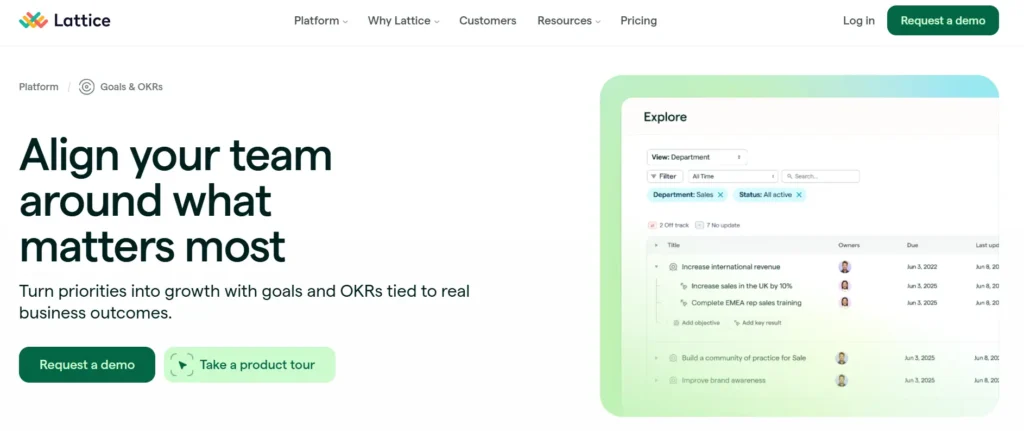
Lattice is a strong option when HR already plays a central role in goal management.
Its Goals & OKRs product supports cascading goals, progress updates, configurable workflows, reminders, and integrations. Goal progress can also be incorporated into 1:1s and performance conversations, giving managers more context when discussing employee contribution.
Best for: People-led organizations that want OKRs closely tied to performance and manager workflows.
Key Capabilities:
- Cascading goals
- Progress updates
- Goal reminders
- 1:1s and feedback
- Jira and Salesforce integrations
- Performance management options
Pricing: Lattice currently lists Goals & OKRs at $8 per seat/month. Its broader Foundations package is $13 per seat/month, and the company states a minimum annual agreement of $4,000.
Lattice makes the most sense when goals are part of a broader people-management strategy rather than a standalone strategy execution program.
How to select the right OKR software for hybrid teams?
When comparing OKR management software for hybrid teams, focus on how easily your team can set goals, track progress, and stay aligned across locations. The best OKR software should fit the way your team already works.
Employees also continue to favor workplace flexibility. A Pew Research Center survey found that 72% of US hybrid workers would choose to retain a hybrid arrangement. This increases the need for tools that keep goals, ownership, and progress visible across locations.
- Easy to use: Employees should be able to create and update OKRs without lengthy training.
- Simple check-ins: Regular progress updates should be quick enough to fit into the team’s normal routine.
- Clear goal alignment: Make sure employees can see how their goals connect with team and company objectives.
- Useful integrations: Check whether the platform works with tools your team already relies on, such as Slack, Microsoft Teams, or Jira.
- Practical reporting: Managers should be able to see progress and identify goals that need attention without chasing employees for updates.
- Room to grow: Consider whether the pricing and features will still work as your team expands.
Challenges of using an OKR platform for remote teams and how to solve them
Buying OKR software doesn’t automatically create alignment. Poor implementation can turn another promising platform into another tab employees ignore. Good OKR tracking for remote teams keeps progress visible even when employees work different hours or from different locations.
1. Tool fatigue
Remote employees may already use Slack, Teams, Jira, project management software, HR systems, and multiple dashboards.
Solution: Prioritize OKR tools with integrations, reminders, and lightweight check-ins. Employees should be able to update progress without constantly changing context.
2. Misalignment across time zones
A leadership decision made during one team’s working hours may reach another team a day later. OKR software for remote employees can give distributed teams a shared view of priorities, ownership, and progress, even when employees work different hours.
Solution: Keep objectives, owners, key results, changes, and progress visible asynchronously. A good OKR platform becomes the source that employees can check without waiting for another meeting.
3. Resistance to adoption
The biggest OKR failure is often behavioral. Employees see goal updates as management reporting rather than something that helps them prioritize.
Solution: Start with a limited number of meaningful objectives. Keep check-ins short and show employees how their work contributes to a larger outcome.
4. Activity gets mistaken for progress
Completing ten tasks does not automatically mean a key result has improved.
Solution: Define measurable outcomes such as conversion rate, revenue retention, cycle time, adoption, quality, or customer satisfaction. Use initiatives as the work and key results as the evidence that the work succeeded.
Final takeaway
The biggest challenge with hybrid teams is aligning their work with business priorities and ensuring they are productive. OKR platforms built for hybrid teams address this problem and make alignment easier. Before choosing a tool, focus on whether it fits your team’s working style, adoption habits, and the way progress is measured.
The best OKR tool for hybrid teams is not the platform with the most features. It is the one that helps managers to keep goals visible and connected to results.
Synergita OKR helps hybrid teams set, align, and track goals and give every stakeholder shared visibility into the progress. Try Synergita today free for 14 days and see how it helps you implement OKRs across your hybrid team.
Frequently asked questions
To create an OKR, you need to start with a clear Objective that describes what you want to achieve, then define Key Results that show how you will measure success. Here are the key steps:
Identify the priority
Write a specific and outcome-focused Objective
Add 2–5 measurable Key Results
Assign ownership
Review progress regularly
When you are handling a hybrid team, you should use an OKR platform to make goals, owners, updates, and progress visible across locations and time zones.
Yes. Spreadsheets can work for a small team testing OKRs for the first time.
They become difficult to manage as teams, objectives, dependencies, and reporting requirements grow. Dedicated OKR software adds automated reminders, alignment views, ownership, integrations, and real-time reporting that spreadsheets usually require people to maintain manually.
OKR software for remote employees gives distributed teams a shared place to track priorities, ownership, and progress.
They also support asynchronous updates, reducing dependence on meetings for status information. Remote employees can see what changed, which goals are at risk, and how their work connects to broader company objectives regardless of location or time zone.
Yes. Small businesses can benefit from OKR software when several people or teams need visibility into shared priorities.
Look for affordable pricing, easy onboarding, simple check-ins, and the ability to scale later. Free or low-cost entry plans can also help small companies test an OKR process before rolling it out more widely.
The primary benefit is shared alignment around measurable outcomes. Office and remote employees can see the same priorities, understand ownership, update progress asynchronously, and identify objectives that need attention. This reduces information gaps and helps managers focus conversations on results instead of collecting status updates.
The best OKR software for hybrid teams is a platform that allows goal setting, progress tracking, alignment, and asynchronous check-ins from different locations and time zones. Synergita is a strong option for organizations looking for affordable, scalable OKR management with AI-assisted OKR creation, goal alignment, automated check-ins, reporting, and integrations with tools such as Jira, Slack, and Microsoft Teams.