Quick answer: Performance management and performance appraisal differ in scope and timing. Performance management is the year-round process of setting goals, tracking progress, coaching, and developing employees. A performance appraisal is a formal, periodic evaluation that rates past performance and informs pay decisions. The appraisal is one event inside performance management, and using both produces fairer, evidence-based reviews.
A year-end performance review sometimes misses months of an employee’s work. A recent achievement or failure may get more weight than earlier contributions, while skill gaps that could have been addressed months ago go unnoticed. This makes it difficult for managers to evaluate performance fairly and help employees improve.
Research highlights this problem. According to SHRM, 77% of HR executives surveyed by CEB (now Gartner) said annual performance appraisals do not accurately reflect employee performance. The WifiTalents Report 2026 also reports that 40% of employees feel their performance reviews are biased, while 51% consider them inaccurate.
Understanding the differences helps HR teams decide how to handle ongoing feedback, formal ratings, and compensation decisions.
In this blog, we explain the difference between performance appraisals and performance management and how to use both for effective performance evaluation.
TL;DR: The 30-Second Takeaway
- Use both approaches: Integrate ongoing performance management with formal appraisals for fairer, evidence-based evaluations.
- Track progress year-round: Set measurable goals and review progress through regular check-ins.
- Reduce rating bias: Document achievements, feedback, and skill gaps instead of depending on managers’ memory.
- Link reviews to action: Use appraisal findings to guide compensation, promotions, coaching, and employee development.
| Table of ContentsWhat is a performance appraisal?What is performance management?Performance management vs performance appraisal: Key differencesHow does performance management reduce bias in appraisals?Performance appraisal vs performance management: Which one should you use?What are the benefits of combining performance management and appraisal?What to look for in a performance management systemIs your performance system working? A quick checklistFinal thoughtsFrequently asked questions |
What is a performance appraisal?
A performance appraisal, also called an employee performance appraisal, is a structured, formal evaluation of an employee’s past performance over a set period, usually a year, half-year, or quarter.
Performance appraisal in management produces a documented rating, a compensation recommendation, and a record HR can refer to for promotions, legal defensibility, and workforce planning. It happens at set intervals, follows one format for everyone, and looks at what has already happened.
The main objectives of performance appraisal are to document performance, standardize ratings across teams, inform pay and promotion decisions, and provide a defensible record for HR actions.
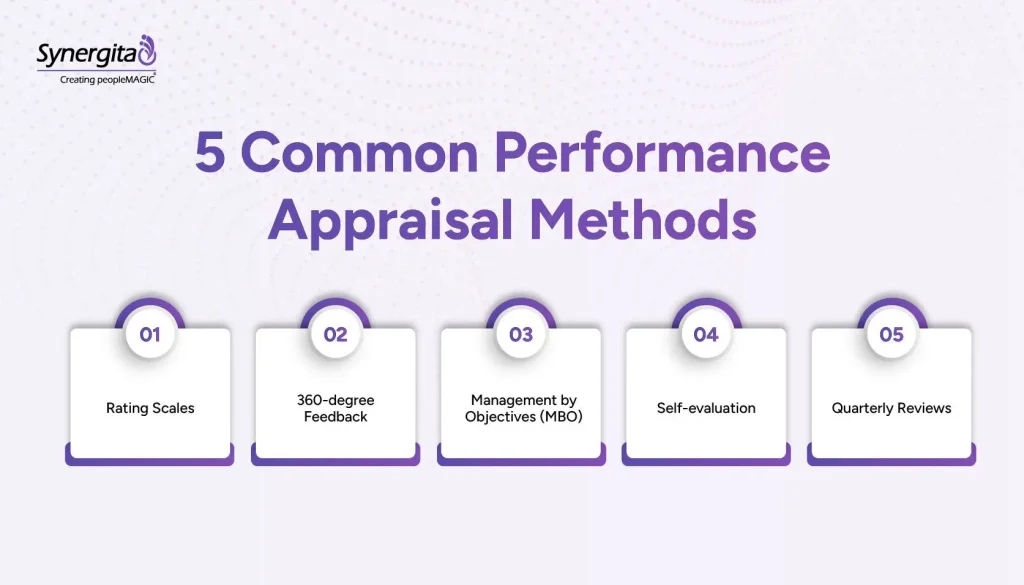
Common employee performance appraisal systems and methods include:
Rating scales: Managers score employees on predefined competencies, ensuring consistency across teams and ease of benchmarking.
360-degree feedback: Input from peers, direct reports, and cross-functional collaborators gives a fuller picture than manager-only ratings.
Management by Objectives (MBO): Performance is evaluated against specific, pre-agreed goals, with an outcome-focused rather than behavior-focused approach.
Self-evaluation: Employees assess their own performance before the formal review, allowing them to reflect on their achievements and development needs.
Quarterly reviews: Formal appraisals held every three months instead of once a year. Each rating covers a shorter period, so managers rely less on memory.
What is performance management?

Performance management is an ongoing process of setting clear expectations, tracking progress, providing continuous feedback, and developing employees. It ensures their work contributes to organizational goals.
The goal of performance management is to identify performance gaps early, recognize high performers, and provide coaching to employees who need support.
A complete performance management system has five core components:
- Planning: Setting goals and KPIs at the start of each period, with agreement between the manager and employee.
- Monitoring: Tracking progress through regular one-on-ones, dashboards, and check-ins, not end-of-year recall.
- Coaching: Providing feedback in context, connected to specific projects or behaviors.
- Rating: Conducting periodic formal evaluations as part of the appraisal process.
- Rewarding: Recognition and compensation decisions anchored to documented performance data.
Performance management vs performance appraisal: Key differences
Performance management guides employee performance throughout the year. Performance appraisal records how an employee performed during a defined period and provides a basis for formal decisions.
Performance management covers the full review cycle, while performance appraisal is the formal evaluation conducted during that cycle.
The table below compares the key areas in which they differ and overlap.
| Aspect | Performance Management | Performance Appraisal |
| Frequency | Continuous, year-round | Periodic: annual, semi-annual, or quarterly |
| Time focus | Present and future development | Past performance review |
| Primary purpose | Develop people, align goals, improve output | Rate, document, and inform pay decisions |
| Who drives it | Manager and employee, two-way dialogue | Manager-led formal review |
| Feedback type | Real-time, specific, and contextual | Periodic, structured, and rating-based |
| Outcome | Behavior change, skill growth, goal alignment | Rating score, documented HR record |
| Business use | Retention, productivity, engagement | Compensation, promotion, and legal defense |
| Data source | Ongoing notes, goal tracking, peer input | Manager’s recollection and formal review documentation |
| Bias risk | Lower, because data is collected throughout the year | Higher: recency bias and the halo effect are common |
| Employee response | Ongoing engagement and involvement | Potentially defensive responses to unexpected year-end feedback |
| Legal defensibility | Better supported by consistent documentation throughout the review period. | Provides a formal record for HR decisions |

How does performance management reduce bias in appraisals?
Performance management can reduce recency bias by giving managers records of goals, feedback, and achievements from across the review period. Managers still need clear rating criteria and calibration discussions to limit subjective judgments.
These are the biases that most often distort appraisals:
- Recency bias: The last few weeks of the period count more than the other eleven months.
- Halo effect: One strong trait or achievement lifts the rating on every other competency.
- Leniency bias: A manager rates employees higher than performance justifies, often to avoid difficult conversations.
- Central tendency bias: A manager rates everyone near the middle of the scale, which hides both high and low performers.
Regular check-ins, goal tracking, and peer input give managers a year-long record to rate against. Employee self-assessment and 360-degree feedback add perspectives beyond a single manager’s assessment.
Bias cannot be removed completely, so calibration discussions across managers remain useful before ratings are finalized.
Performance appraisal vs performance management: Which one should you use?
Use both. Performance management is the year-round system, and the appraisal is the formal rating step inside it.
An appraisal on its own leaves managers rating a full year from memory. Ongoing management on its own leaves pay and promotion decisions without a standardized, documented rating. Run continuous check-ins, goal tracking, and coaching through the year, then use the appraisal to record the outcome and inform compensation.
Decision criteria
Use these questions to decide where to invest first.
| Situation | Lean on | Why |
| You need to make pay, promotion, or termination decisions | Performance appraisal, backed by management data | The decision needs a documented, standardized rating |
| Skill gaps or missed goals surface only at year-end | Performance management | Regular check-ins catch problems while they can still be fixed |
| Employees say reviews feel like a surprise | Performance management | Frequent feedback removes the surprise |
| Managers rate from memory | Performance management | Goal tracking and notes create a year-long record |
| You have regular feedback but no formal records | Performance appraisal | A scheduled review turns informal feedback into documented ratings |
| You must defend an HR decision | Both | The appraisal is the record, and management supplies the evidence |
A practical workplace example
This is an illustrative scenario, not a customer case.
A 120-person services firm runs one review each December. A team lead rates a developer as ‘meeting expectations’ because the missed release in November is still fresh in the lead’s mind.
The developer shipped four on-time releases earlier in the year, and test coverage has slipped since June without anyone raising it. The developer is surprised, the lead cannot point to specifics, and HR has little documentation if the rating is challenged.
Now, change one thing: the lead holds monthly one-on-ones, logs goals and progress after each meeting, and gives feedback within days of each release. In June, the lead flags the test coverage gap and agrees on a fix.
By December, the appraisal draws on twelve months of notes. The rating is still a formal evaluation, but it is more accurate, specific, and less likely to surprise the employee.
Real-world example: Adobe’s move to ongoing check-ins
In 2012, Adobe replaced annual reviews and stack rankings with Check-in, a process built on ongoing conversations. Managers and employees set goals at the start of the year, then check in at least every eight weeks, according to a Fortune report.
Adobe has said its old process consumed about 80,000 manager hours a year. After the change, it reported a drop in voluntary attrition and an increase in involuntary departures among employees who were not meeting expectations.
Adobe did not drop pay decisions. It kept an annual Rewards Check-in to guide compensation, according to What Matters. Ongoing management handled the coaching, and a lighter formal step handled pay. Results at one company do not guarantee the same outcome elsewhere.
What are the benefits of combining performance management and appraisal?

Regular check-ins give employees feedback throughout the year. HR can then use documented goals, achievements, and development gaps to support appraisal ratings and pay decisions.
Continuous performance management runs throughout the year and includes aligning employee work with company goals, regular one-on-one coaching, and real-time feedback.
The annual appraisal records the employee’s progress, achievements, and remaining development needs.
Here is how the performance appraisal process works alongside performance management across the year:
- Goals are established and documented at the beginning of the performance period.
- Monthly or biweekly check-ins take place, with data captured in a performance management system.
- Feedback is given within days of a relevant event and not held until Q4.
- A midyear review captures progress and adjusts goals if business priorities change.
- Employee self-assessment is submitted before the formal appraisal, and that input shapes the final rating.
- The formal appraisal and compensation decisions are based on twelve months of documented data.
What to look for in a performance management system
Look for an employee performance management platform that connects goals, check-ins, structured reviews, feedback, and reporting in one place, and integrates with the HR tools you already use.
When tools operate separately, information remains scattered across files and people’s memories, recreating the very problem this post addresses.
Check these five areas when you compare options:
- Goal tracking
Employees and managers should be able to set goals, see progress at any time, and adjust goals midyear. Ask whether progress updates feed into review data automatically.
- Structured reviews
Look for configurable review cycles, self-assessment, rating scales, and appraisal history, so formal evaluations follow one consistent process.
- Feedback
The system should support continuous feedback between check-ins, plus 360-degree and peer input where you need them.
Suggested Reading: How to Build a Continuous Feedback Culture
- Reporting
Managers and HR need dashboards and customizable reports on goals, feedback, and review results, so decisions rest on data.
- Integrations
Confirm that the platform connects with your HRIS and communication tools so employee data does not need to be entered manually.
See the Synergita integrations list for an example of what to compare.
Is your performance system working? A quick checklist
Use this checklist to see whether your performance review process is continuous, data-driven, and fair, or dependent on year-end reviews.
☑ Goals are set and documented at the start of each period
☑ Managers hold structured monthly one-on-ones
☑ Feedback is given within days of a relevant event, not saved for the annual meeting
☑ Employees self-assess their performance before the appraisal
☑ Skill gaps are identified and addressed through training and development
☑ Pay and promotion decisions are based on specific performance data
☑ The performance appraisal process is applied consistently to every employee, regardless of their relationship with the manager
Final thoughts
Annual performance appraisals without ongoing performance management lead to disengagement, unfair pay decisions, and unexpected attrition.
To ensure effective performance evaluation, you need both performance management and performance appraisal so employees always know where they stand, what is expected, and how they can improve.
With Synergita, you can build an efficient, continuous performance system that tracks goals, captures real-time feedback, and provides the data needed for more accurate, evidence-based appraisals and decisions. Contact us to learn how Synergita simplifies performance management.

Frequently Asked Questions
The objectives of performance appraisal include documenting output, standardizing ratings across teams, supporting pay decisions, and providing legal defensibility for HR actions.
Performance management is a continuous process of goal setting, coaching, and feedback. A performance appraisal is a formal evaluation of an employee’s performance over a specific period. Depending on the organization’s review cycle, appraisals may take place annually, semiannually, quarterly, or at other defined intervals.
Yes, but the results may be less reliable. Without ongoing performance management, appraisals rely on managers’ memories, invite bias, produce surprise ratings, and offer no structured employee development.
The five components of performance management are planning, monitoring, coaching, rating, and rewarding. Planning sets clear goals and expectations, monitoring tracks progress, coaching provides feedback and guidance, rating evaluates performance against established criteria, and rewarding recognizes achievements through incentives, promotions, or other forms of recognition.
Regular feedback, clear goals, and recognition help employees understand expectations, track their progress, address performance gaps, and discuss development needs with their managers.
Benefits include timely feedback, earlier skill-gap detection, ratings based on documented evidence, fewer year-end surprises, and stronger manager-employee trust.
Software platforms such as Synergita support ongoing feedback and development conversations through goal tracking, regular check-ins, continuous feedback, 360-degree reviews, and employee development plans. These tools help managers monitor progress, address performance gaps, and support employee growth throughout the year.
No. Performance management is the year-round system, and the appraisal is its formal rating step. Organizations that keep the appraisal but add ongoing check-ins get ratings based on documented, year-round data.
Monthly or biweekly one-on-ones work well for many teams, with a midyear review to adjust goals. Feedback tied to a specific event should follow within days.
Effective performance management includes setting SMART goals (Specific, Measurable, Achievable, Relevant, Time-bound), continuous and 360-degree feedback, a focus on employee development, and data-driven insights for reviews.