
A high performer leaves when no one expected it. But the real issue started much earlier. Months passed. No acknowledgement, no direction, and no conversation that made them feel staying with the organization was worthwhile.
TL;DR: The 30-Second Takeaway
- The Problem: Most US employees receive feedback once a year, long after the moment to act on it has passed.
- The Shift: Gallup finds that employees who receive valuable feedback are five times more likely to be engaged and 48% less likely to look for another job
- The Fix: Implement a continuous feedback framework with four parts: clear criteria, set cadence, multi-directional input, and documented action items after every session.
- The Impact: The organizations using continuous feedback see higher engagement scores, make better promotion decisions and face fewer legal issues related to attrition.
- Keep reading to know: How continuous feedback benefits your business and how you can build a culture of continuous feedback.
Most organizations do not have a feedback process. They have a feedback event, one conversation per year where managers try to complete the review and move on.
Meanwhile, small issues go unaddressed, high performers feel overlooked, and the data needed to make informed decisions on people’s performance is never collected. According to a recent report, only 19% of US millennials receive routine feedback, and just 17% say it is meaningful.
Continuous feedback addresses this problem through timely, structured performance review. In this blog, we will explore seven key benefits of continuous feedback, how to build an ongoing feedback system, and common mistakes to avoid with continuous feedback.
| Table of Contents 1. Continuous Feedback: Key Benefits and How to Build an Effective System 2. What are the Benefits of Continuous Feedback 3. How to Build a Continuous Feedback Framework 4. Common Mistakes to Avoid When Implementing Continuous Feedback 5. Final Takeaway 6. Frequently Asked Questions |
What are the Benefits of Continuous Feedback
Continuous feedback impacts employee performance, engagement, and decision-making. Let’s look at the key benefits it offers.
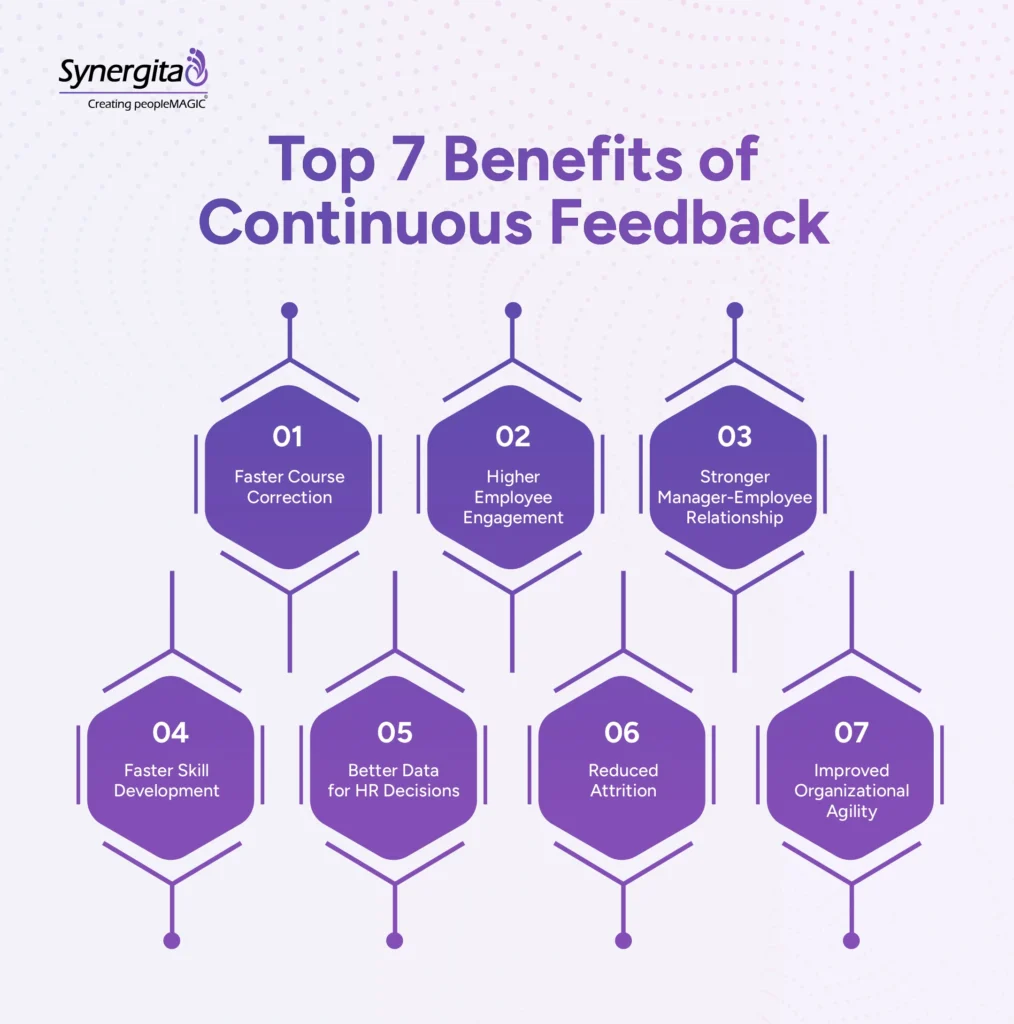
1. Faster Course Correction
Outcome: Performance gaps are fixed before they become disciplinary conversations.
A skill gap caught within one or two months can be addressed through coaching. However, if it is caught in the 11th month, it becomes a Performance Improvement Plan. Continuous feedback catches the early-warning system that annual reviews cannot provide.
The result is:
- Fewer Performance Improvement Plans and HR escalations
- Lower cost of fixing issues early
- Managers spending more time developing people rather than documenting failures
2. Higher Employee Engagement
Outcome: Highly engaged employees perform better and stay longer.
Employees who strongly agree that they receive valuable feedback are 5 times more likely to be engaged and 48% less likely to be job hunting. But what boosts employee engagement?
People stay where they feel heard, seen, and supported. Continuous feedback creates that environment throughout the year.
3. Stronger Manager-Employee Relationship
Outcome: Managers become coaches, not just evaluators.
When honest input becomes a routine, employees stop treating the annual review as a verdict and start approaching their manager whenever they need any help at work. The outcome is problems are discussed and addressed earlier, before they start affecting performance and derail projects.
4. FasterSkill Development
Outcome: Skills improve faster because learning is applied immediately on the job.
Most training does not make a big impact because there is no follow up. Employees walk out of the session, go back to their desks, and start working the way they were doing it earlier. If a manager focuses on implementing the learnings, it can address these issues and change employee behavior. This happens only when a culture of continuous feedback is adopted.
5. Better Data for HR Decisions
Outcome: Performance decisions are based on evidence, not subjective judgment
Promotion and pay decisions built on impressions create bias and put the organization at legal risk. When there is no record, you can’t defend your decisions. Continuous feedback provides that record. Goal completion rates, dated observations, and peer input give HR concrete data to make decisions. The company can justify the decisions and defend them.
6. Reduced Attrition
Outcome: Employees stay longer because they receive recognition and see growth opportunity
Employees do not leave because the work is hard. Rather, they leave because they don’t get recognition and don’t see a clear path for growth and development. Most organizations analyze performance only when something goes wrong.
Continuous feedback helps managers spot both problems early. When companies recognize employees regularly, pay fairly, and push for growth, employees find a reason to stay, resulting in less attrition and lower replacement costs.
7. Improved Organizational Agility
Outcome: Strategy is executed faster without waiting for the next review cycle.
When feedback is aligned to business priorities, there is no twelve-month lag between strategy and execution. Managers redirect in real time. Employees adjust without waiting for the next review cycle.
The organization moves forward faster, giving it an advantage in rapidly-changing markets.
How to Build a Continuous Feedback Framework
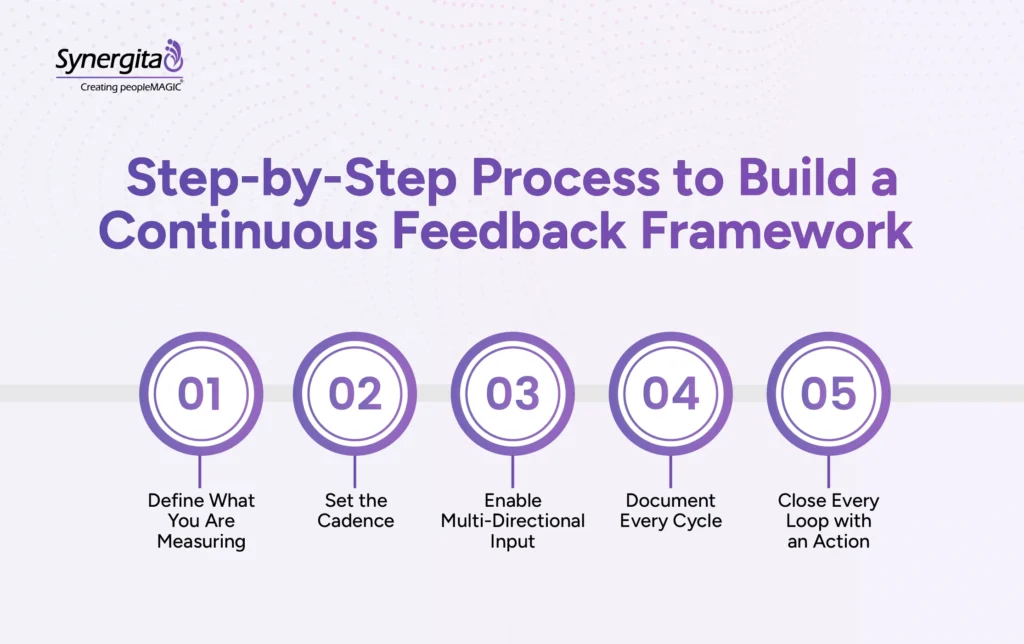
Many organizations avoid continuous feedback because they don’t know how to start. Here is a step-by-step method to build a continuous feedback framework.
1. Define What You Are Measuring
Before any feedback conversation, define the benchmark every employee is evaluated against; competencies, measurable goals, and behavioral indicators. Without this clarity, two managers evaluating the same employee can arrive at completely different conclusions.
For example, if your manager leaves tomorrow, could their replacement run the same feedback conversation and reach the same conclusions? If not, you’re measuring the manager’s judgment, not the employee’s performance.
2. Set the Cadence
A vague commitment like “more regular feedback” sounds good in theory, but without structure and a performance management software, continuous feedback doesn’t happen consistently.
A defined cadence creates consistency, visibility, and provides data, without which feedback becomes unreliable.
- Weekly: Five to ten minutes. What moved forward, what is stuck, what needs to be changed
- Monthly: Structured 1:1 meeting with documented observations related to competencies or goals
- Quarterly: Formal goal-progress review plus comprehensive feedback from different sources
- Annually: A summary of twelve months of documented conversations, not a reconstruction of them.
The annual review becomes the easiest meeting of the year, because it’s just a summary of twelve months of documented conversations.
3. Collect Input From Every Direction
Manager-only feedback has a structural problem: the manager sees a fraction of what the employee actually does.
A 360-degree feedback system captures input from all directions: manager-to-employee, employee-to-manager, and peer-to-peer. Each direction catches what the others miss.
If leadership is exempt from structured feedback, you have not built accountability but just a hierarchy.
4. Document Feedback Every Single Time
Spoken feedback can be forgotten, but documented feedback becomes data.
A structured template that captures what was observed, the impact, and the agreed next step, logged after every formal session, is sufficient. Free-form notes produce inconsistent records. Templates produce auditable ones.
5. Close Every Loop or Do Not Open It
Every session should end with three things: what will change, who owns it, and by when. That action becomes the first item of the next conversation. If you skip it, the feedback conversation becomes irrelevant and ineffective.
Common Mistakes to Avoid When Implementing Continuous Feedback
When implementing continuous feedback, you need to avoid some common mistakes.
| Mistake | Why It Happens | What to Do Instead |
| Feedback without structure | Managers default to vague praise or general critique | Use competency-anchored templates for every session |
| Frequency without quality | Regular check-ins happen, but nothing meaningful is discussed | Train managers to give specific, example-based feedback employees can act on |
| One-way feedback | Feedback only comes from the manager | Include input from peers and direct reports as part of the process |
| No documentation | Feedback is verbal and not documented | Create a summary after each session with key points and next steps |
| Inconsistent application | Some teams follow the process; others skip it | Use modern tools and implement it across all teams |
| No follow-through | Actions agreed but never followed up | Start every session by reviewing what was agreed last time |
| Senior staff exempted | Leadership is not evaluated | Apply the same framework at every level. Accountability is a must. |
Final Takeaway
Every undocumented performance conversation is a risk. Every skipped check-in is a gap in the record. Every employee who leaves without warning is proof that the feedback system is not working.
Synergita’s AI-powered performance management software gives you the system to capture ongoing feedback, 360-degree input, and data-driven insights to evaluate performance accurately. It helps you build the right system to manage employee performance across the organization.
Start your free trial today.
Frequently Asked Questions
Continuous feedback is an ongoing performance conversation with structured check-ins, documented actions, and real-time input that replaces the traditional once-a-year review cycle.
Continuous feedback helps businesses identify performance gaps early, keeps employees engaged, and builds the data trail for promotion and retention decisions.
Annual reviews happen once a year and managers rely on memory to evaluate performance. Continuous feedback documents it in real time, making appraisals an evaluation of employee performance throughout the year. This results in more accurate ratings and faster course correction.
You need to track engagement scores, attrition rates, promotion accuracy, and whether agreed actions from each session are actually completed next time.
Continuous feedback keeps a record of performance around the year which helps managers and employees to course-correct in the right time. Employees also know where they stand and work on improving performance.