
A growing SaaS company needs to hire engineers quickly for a new product initiative, but critical roles remain open. Existing employees absorb the extra workload, while managers struggle to provide meaningful development opportunities. Over time, the added strain can contribute to turnover, yet HR may not know whether the risk is concentrated in specific teams or spread across the company.
Filling critical roles is difficult. 75% of employers globally report difficulty of filling roles. When hiring slows, the impact rarely stays within recruiting. Open roles increase workloads, which can increase turnover risk.
Talent management issues are connected workforce challenges, not isolated problems. Weak processes can create skills gaps, slow hiring, limit employee growth, and reduce visibility into workforce risks. A stronger talent management strategy helps organizations identify and address these issues earlier.
| TL;DR – A Quick Takeaway Talent management issues can increase turnover, reduce employee performance, slow business growth, and complicate HR operations. Clear goals, regular feedback, development opportunities, and structured leadership planning can help address common talent management challenges. Better workforce data can help HR and managers identify skills gaps, retention risks, high performers, and future leaders quickly. A performance management system can help organizations align employee work with business priorities, address performance and development needs earlier. |
| Table of Contents 1. What are talent management issues 2. 8 common talent management issues and their solutions 3. How talent management problems affect business growth 4. How performance management software can solve talent management issues 5. Final takeaway 6. Frequently asked questions |
What are talent management issues
Talent management issues are challenges organizations face when hiring, developing, managing, and retaining employees. They arise when hiring, development, performance, and retention are managed as separate activities rather than as parts of one talent management strategy.
SHRM reports that nearly seven in ten organizations struggle to fill full-time regular positions. About one-third of U.S. job openings also remained unfilled in mid-2025 because available workers lacked the required experience.
These figures also show why organizations need better visibility into their existing workforce, including:
- The skills they currently have
- The skills they require
- How employees can develop into future roles
8 common talent management issues and their solutions
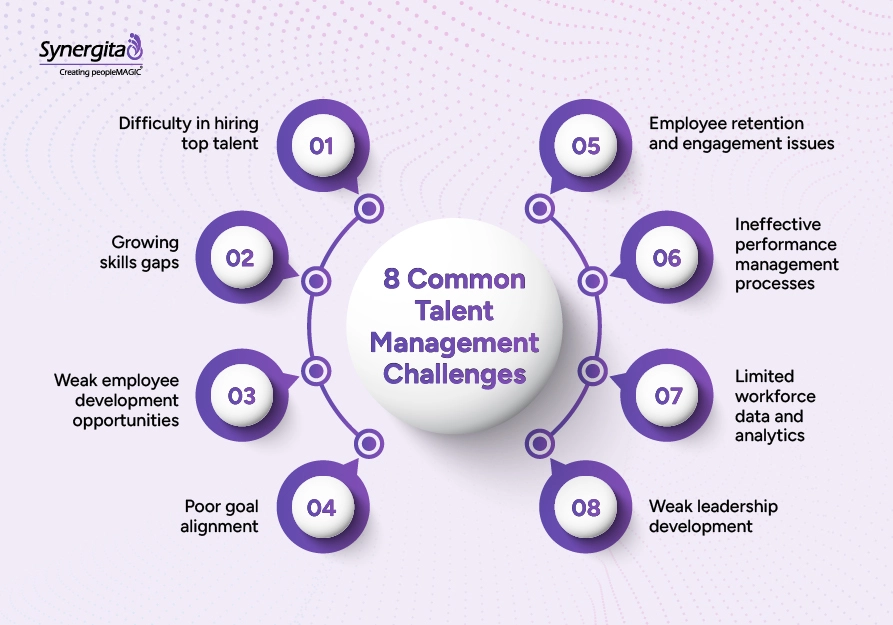
The most common talent management issues include difficulty in hiring skilled employees, widening skills gaps, limited development opportunities, poor goal alignment, low employee engagement and poor retention, ineffective performance management, limited workforce insights, and weak leadership pipelines.
Each issue affects a different stage of the employee lifecycle, but together they make it difficult to build a high-performing workforce.
1. Difficulty in hiring top talent
Competitive hiring markets, slow recruitment cycles, and weak employer branding make talent acquisition one of the hardest parts of the job. Talent acquisition challenges can make it difficult to fill critical roles, especially when hiring demand exceeds the available skills in the market.
These talent acquisition challenges can become more costly when slow hiring processes cause strong candidates to accept competing offers.
For example, a 300-person SaaS company needs five software engineers for a new product initiative. Qualified candidates apply, but inconsistent evaluations and slow feedback stretch interviews for weeks. By the time offers are made, several candidates have accepted other roles. This delays product development and increases pressure on the existing team.
Solutions:
- Build a strong employer value proposition focused on growth, purpose, and culture, not just pay.
- Speed up communication with candidates and clearly explain what to expect at each stage of the hiring process.
- Use a structured recruitment process with consistent evaluation standards to improve hiring quality and reduce bias.
2. Growing skills gaps
As technology evolves, many organizations find it difficult to keep workforce skills aligned with changing job requirements. Without proactive workforce planning, skills gaps continue to grow.
Solutions:
- Review workforce skills regularly to ensure employees are prepared for evolving roles and business priorities.
- Provide targeted learning opportunities that help employees build the skills needed for their current and future roles.
3. Weak employee development opportunities
When employees cannot see a clear path forward, they disengage long before they resign. Employees who lack access to learning and career growth opportunities become disengaged and eventually seek opportunities elsewhere.
For instance, a growing sales team has high-performing account executives ready for larger roles, but managers lack clear criteria for identifying and preparing future team leads. Employees don’t know what they need to demonstrate for promotion, so some eventually look elsewhere for better career opportunities.
Solutions:
- Create personalized development plans with clear learning goals, practical actions, and realistic timelines.
- Enable continuous learning through microlearning and just-in-time resources built into daily workflows
- Define clear career paths and the skills employees need to progress into their next role.
4. Poor goal alignment
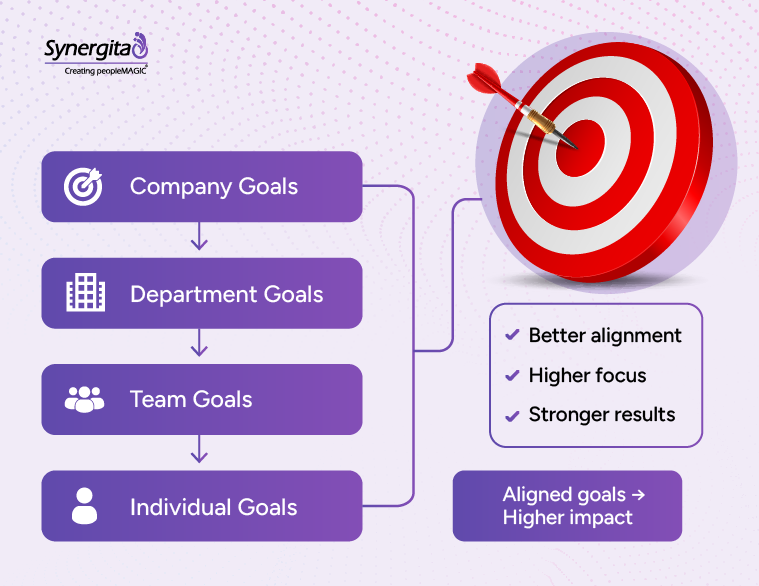
Employees are more productive when they understand how their work contributes to company goals. Unclear goals can send teams in different directions. Moreover, poor goal alignment can affect multiple stages of the employee lifecycle, from hiring and onboarding to performance management and career development.
Solutions:
- Use a structured talent management framework that cascades objectives from leadership to individual contributors.
- Use shared goal tracking so employees and managers can monitor progress and stay aligned across teams.
- Schedule regular check-ins to help employees understand how their work supports team and business goals.
5. Employee retention and engagement issues
Talent retention challenges arise when employees lack clear growth opportunities, recognition, or consistent feedback. High-performing employees are more likely to leave when they experience burnout, receive little recognition, or don’t see opportunities to grow.
Solutions:
- Build a structured feedback culture with recognition built into regular workflows, not annual events.
- Recognize employee contributions consistently and visibly.
- Improve the overall employee experience by acting on pulse survey and stay interview data.
These talent retention challenges usually become difficult to manage when employees lack recognition, career growth, and regular feedback. Employee retention challenges can also increase when managers fail to recognize early signs of disengagement or address employee concerns.
6. Ineffective performance management processes
Many organizations still depend on annual performance reviews, irregular feedback, and subjective evaluations, making it difficult to measure employees’ true contributions.
Solutions:
- Implement continuous feedback to support or replace annual performance reviews with ongoing check-ins.
- Track measurable outcomes linked to goals rather than relying on manager impressions alone.
7. Limited workforce data and analytics
Decisions based on assumptions rather than workforce data can lead to poor talent decisions and delayed action. When employee information is spread across multiple systems, HR teams struggle to identify high performers, spot retention risks, and make informed talent decisions.
These workforce challenges become difficult to address when HR and managers lack a unified view of employee performance, skills, and engagement data.
Solutions:
- Keep employee data in one system instead of managing separate records.
- Use people analytics to spot performance and engagement trends before they contribute to employee turnover.
- Give HR and managers access to workforce insights that support faster talent decisions.
8. Weak leadership development
Without a strong leadership pipeline, organizations have to hire externally for critical roles that could have been filled by existing employees. Consider an engineering manager with strong individual contributors who are ready for larger roles but no structured way to assess leadership readiness. Without a structured process, the manager cannot identify development needs or prepare employees for those leadership roles, leaving the company dependent on external hiring.
Solutions:
- Use performance and development data to identify future leaders.
- Build structured succession plans for every business-critical role.
- Develop managers actively, since manager quality directly influences team-level engagement and retention.
How talent management problems affect business growth
Talent management problems begin within people processes, but their consequences quickly spread across the business. A disconnected approach can turn a hiring delay into higher team workload, a skills gap into slower execution, or weak development into avoidable employee turnover.
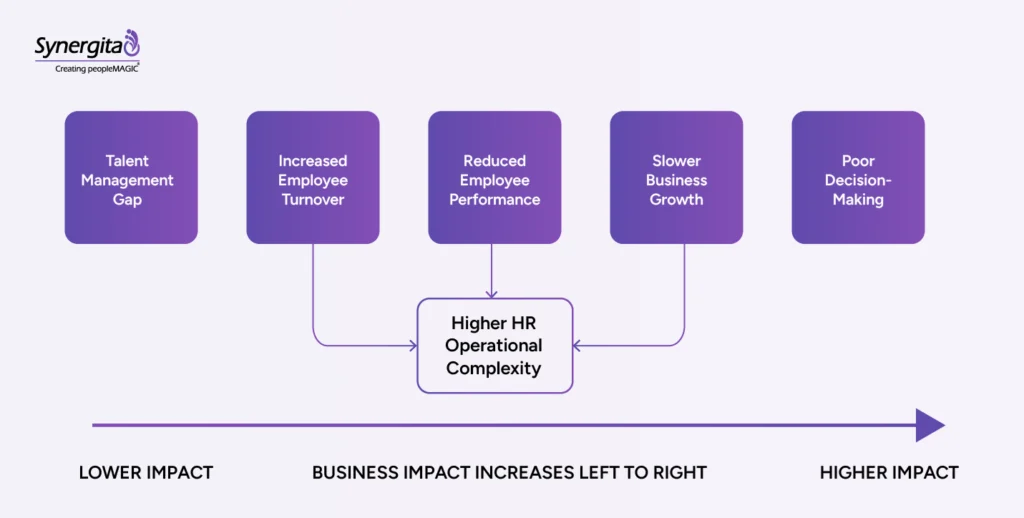
1. Increased employee turnover
When employees leave due to weak development, poor management, or limited recognition, the organization loses more than the individual. Teams lose experience and must redistribute work while HR begins another hiring cycle.
Operational impact: Higher workload, longer replacement cycles, and greater pressure on remaining employees.
2. Poor employee performance
Unclear goals, inconsistent feedback, and subjective evaluations make it difficult for employees to understand what is expected of them. Problems can continue for months when managers lack regular visibility into progress.
Operational impact: Missed goals, repeated corrections, inconsistent output, and more time spent by managers addressing performance issues.
3. Slower business growth
Skills shortages, vacant critical roles, and weak leadership pipelines can limit an organization’s ability to execute its plans. Even a strong strategy can slow down when the workforce does not have the capacity or skills to deliver it.
Operational impact: Delayed projects, slower execution of strategic initiatives, and increased dependence on external hiring.
4. Greater HR operational complexity
Disconnected systems and manual processes force HR teams to spend time collecting and reconciling information. That reduces the time available for investigating workforce risks and supporting managers.
Operational impact: Longer reporting cycles, duplicated work, delayed decisions, and less time for strategic workforce planning.
5. Poor talent decisions
Incomplete workforce information makes it challenging to identify high performers, understand skills gaps, prepare successors, or determine why employees are leaving.
Operational impact: Reactive hiring, weak succession planning, missed internal mobility opportunities, and delayed intervention when workforce risks arise.
How performance management software can solve talent management issues
Performance management software like Synergita can connect goals, feedback, performance reviews, development, and employee data in one system. This gives HR teams and managers a clear view into workforce needs and helps them address talent management issues earlier.
1. Align employee goals with business priorities
Performance management software connects individual and team goals with organizational objectives, helping employees understand how their work contributes to business priorities. This can reduce poor goal alignment and improve workforce focus.
2. Support continuous feedback
Regular check-ins and continuous feedback give managers more clarity into employee progress than depending on only annual reviews. Gallup found that only 2 in 10 employees strongly agree that their performance is managed in a way that motivates them to do outstanding work.
3. Connect performance with employee development
Performance data can help managers identify skill gaps, development needs, and employees who may be ready for larger responsibilities. This makes it easier to create targeted development plans and strengthen the talent management process.
4. Identify potential retention risks
Changes in performance, engagement, feedback, and development can provide useful signals when employees may be at risk of leaving. Bringing these insights together can help managers respond earlier to challenges of retaining top talents.
Final takeaway
Talent management issues are caused by a lack of connection between hiring, performance, development, and retention. When these areas operate separately, HR teams can miss early warning signs and managers may not be able to make informed decisions. A connected approach is more effective because it helps organizations address workforce issues.
Synergita brings goals, feedback, performance reviews, development, and employee insights together in one platform. This gives HR teams and managers greater visibility into workforce needs and supports more informed talent decisions.
Ready to improve your talent management process? Start your free trial today.
Frequently asked questions
The most common talent management challenges involve hiring, skills gaps, employee development, performance, retention, workforce visibility, and leadership readiness. These challenges overlap rather than occur independently. For example, limited development opportunities can increase retention risk, while poor workforce visibility can make skills gaps harder to address.
Talent management problems often result from disconnected processes, unclear goals, inconsistent feedback, and reactive workforce planning. These gaps can make employee needs and workforce risks harder to identify early. Small process problems can also compound over time.
Talent management issues can increase employee turnover when employees lack growth, recognition, clear expectations, or consistent feedback. High-performing employees may look elsewhere when they cannot see a clear path for development or advancement. Managers may also miss early signs of disengagement when employee information is fragmented.
The talent management process commonly includes attraction, recruitment, onboarding, development, and retention. These stages are connected rather than independent activities. A weakness in one stage can affect the next, such as poor onboarding affecting development or limited career growth contributing to turnover.
HR can improve talent management by identifying workforce gaps, addressing their root causes, and connecting related talent processes. This approach can also help HR teams address human resource challenges before they affect retention, performance, or business growth.
Effective talent management practices connect performance, development, workforce planning, and employee growth. Regular feedback helps managers understand progress throughout the year instead of relying only on annual reviews. Structured development and career paths help employees understand how they can progress.
Technology can improve talent management by connecting employee information, reducing manual work, and making workforce patterns easier to identify. Centralized information can help HR and managers view performance, goals, development, and employee trends together. This can make skills gaps and potential retention risks easier to identify.
Organizations can identify talent management problems early by monitoring workforce patterns and connecting information across talent processes. Changes in turnover, performance, engagement, skills, or hiring can reveal emerging risks. Reviewing these signals by team, role, manager, or tenure can help identify where problems are concentrated.