
Organizations that set clear goals are more likely to improve performance, stay aligned, and achieve better outcomes. Research from Group & Organization management found that companies that set goals were more profitable than the ones that did not.
OKRs and KPIs are two widely used frameworks that help organizations set goals and measure performance. While the two are often used together, they serve different purposes, and understanding the difference is essential for effective execution.
This guide explains the difference between OKR vs KPI, how they work together, and when to use them to achieve better business results.
TL;DR — 30-Second Quick Takeaway
- The Problem: Many teams confuse OKRs and KPIs, even though they serve different purposes. Mixing them up can lead to unclear goals and wasted effort.
- The Fix: Use KPIs to track business performance and OKRs to drive growth and strategic goals.
- The Impact: Businesses that clearly separate OKRs and KPIs create better alignment, set clearer goals, and achieve results more effectively.
- Keep reading to: Learn the difference between OKRs and KPIs, explore real examples, and understand how to use them effectively in your business.
| Table of Contents 1. What are OKRs? 2. What are KPIs? 3. Differences Between OKR and KPI 4. OKR and KPI Examples 5. OKRs vs KPIs: When to Use Each (or Both) 6. Final Takeaway 7. Frequently Asked Questions |
What are OKRs?
OKR stands for Objectives and Key Results. An OKR system is a framework or methodology that helps enterprises set goals and track progress toward specific objectives through measurable results.
Objectives are qualitative, inspirational, and time-bound. The key results help quantify the objectives using specific, verifiable metrics.
Key features of OKRs:
- Goal-driven: OKRs focus on clear and ambitious objectives.
- Measurable outcomes: Progress is tracked through specific and time-bound key results.
- Team alignment: OKRs connect company, team, and individual goals.
- Regular reviews: They are usually reviewed quarterly to track progress and adjust priorities.
When to use OKRs:
- Launching a new product, entering a new market, or driving a specific business transformation
- Needs a shared goal with clear accountability and a defined deadline
- To move beyond tracking activity and start measuring the actual impact of your team’s work
What are KPIs?
KPIs, or Key Performance Indicators, are metrics businesses use to measure ongoing performance. They act like a dashboard, helping teams continuously track business health and progress.
Common KPIs include revenue, customer satisfaction scores, employee productivity, and churn rates. Unlike OKRs, KPIs are ongoing metrics that continuously track performance over time across teams and periods.
KPIs help businesses quickly spot what is working and what needs immediate attention. They are the standard health checks every team runs, regardless of what strategic goals are in play.
Key features of KPIs:
- Continuous monitoring: KPIs track performance regularly to measure business health.
- Quantitative metrics: KPIs use measurable data like revenue, rates, and scores.
- Operational focus: They measure how well business processes perform.
- Early warning system: KPI drops help identify problems before they grow.
When to use KPIs:
- You need a consistent baseline to monitor business performance across departments or reporting periods
- You want to hold teams accountable to operational standards without resetting goals every quarter
- A metric has dropped, and you need clear data to diagnose the problem before setting an OKR to fix it
Suggested Reading: 15 KPI Tools to Track Performance in 2026
Differences Between OKR vs KPI
Understanding the difference between OKR and KPI helps businesses use them more effectively. Here is a clear breakdown:
| Criteria | OKR | KPI |
| Focus | What you want to achieve | What you want to monitor |
| Nature | Qualitative + quantitative | Primarily quantitative |
| Scope | Organizational or team-level goals | Department or team metrics |
| Time frame | Quarterly or annual cycles | Ongoing, continuous |
| Purpose | Drive change and alignment | Track health and performance |
OKRs are externally focused on outcomes and growth. KPIs are internally focused on maintaining and measuring performance standards.
A simple way to remember it: an OKR might say, “Increase sales by 20% next quarter.”
A KPI reports “Sales of Product X grew 20% in Q3.”
One sets the ambition; the other confirms whether it happened. That is the core of OKR KPI thinking: two tools, one performance system.
OKR and KPI Examples
Seeing real OKR and KPI examples side by side makes the difference much easier to apply.
OKR Example (Marketing Team): <H3>
- Objective: Become the top brand in our category for enterprise buyers
- Key Result 1: Increase organic traffic by 40% by the end of Q3
- Key Result 2: Generate 200 qualified enterprise leads per month
- Key Result 3: Achieve a Net Promoter Score of 50+ from enterprise prospects
KPI Examples (Marketing Team): <H3>
- Monthly website traffic
- Cost per lead (CPL)
- Email open rate
- Customer acquisition cost (CAC)
OKRs help drive strategic growth, while KPIs track day-to-day performance. Both are important, but they serve different purposes.
OKRs vs KPIs: When to Use Each (or Both)
According to a PwC survey, about two-thirds of CEOs said executing a strategy is more challenging than developing it, and 80% believed their strategy was not well understood within their own organization.
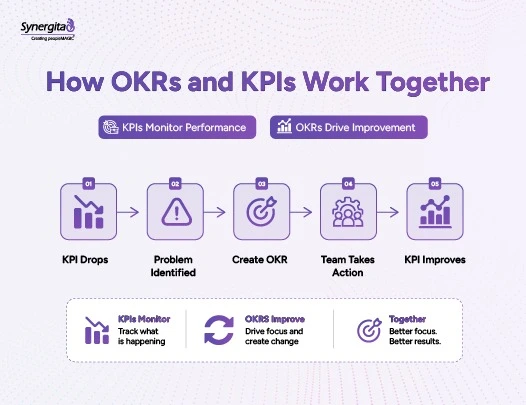
Connecting strategy to execution is where OKRs and KPIs play an important role. Many businesses treat them as competing frameworks, but they deliver the bestresults used together for the right purpose.
Use KPIs when:
- You need to track ongoing business health
- You want consistent benchmarks across teams or periods
- The goal is monitoring and accountability, not transformation
Use OKRs when:
- You are launching something new or entering a new market
- You need to align a team around a bold, time-sensitive goal
- You want to motivate people beyond just hitting numbers
Use both when:
- Your KPIs reveal a performance gap (e.g., customer retention is dropping)
- You set an OKR to fix it (e.g., “Improve customer onboarding experience this quarter”)
Many high-performing companies run OKRs at the strategic level and KPIs at the operational level simultaneously. OKRs drive business growth, while KPIs keep performance on track along the way.
Also Read: How OKRs and KPIs Together Create a Stronger Path to Success
Final Takeaway
OKRs and KPIs serve different purposes, but they work best when used together. KPIs help monitor business performance, while OKRs help in strategic growth and improvement.
The top organizations use both frameworks together: KPIs to understand how the business is performing today and OKRs to focus teams on the goals they want to achieve next. When you understand the difference between OKR and KPI, it helps create better alignment, clearer priorities, and stronger business results.
If you want to connect your team’s daily work to measurable business outcomes, try the Synergita OKR tool. Book a demo to see how Synergita simplifies goal setting and progress tracking.
Frequently Asked Questions
OKR sets the direction, what you want to achieve, and by when. KPI measures ongoing performance health. OKRs are time-bound, ambitious goals with measurable outcomes. KPIs are continuous metrics that track business health.
The 4 pillars of a strong KPI are: a clear metric, a defined target, a specific timeframe, and an accountable owner. Without these, a KPI is just a number with no direction.
Another word for KPI is performance metric, business indicator, success measure, or benchmark. While these terms are sometimes used interchangeably, KPI is the most commonly used term for measuring business performance.
The 5 key elements of an OKR are: an Objective, 3–5 measurable Key Results, a defined timeframe, an owner, and a grading system to track progress at the end of each cycle.
Neither is better on its own. KPIs track stability; OKRs drive growth. The right choice depends on your goal, whether to monitor performance or transform it.
An effective OKR and KPI template should include a clear objective, 3–5 measurable key results, a defined timeframe, an assigned owner, and supporting KPIs to track ongoing performance.
Yes, you can use KPIs to monitor ongoing business health and OKRs to drive focused improvement. When a KPI drops, set an OKR to fix it. They work best as a system, not as alternatives.
An effective OKR and KPI template should include a clear objective, 3–5 measurable key results, a defined timeframe, an assigned owner, and supporting KPIs to track ongoing performance.