
Goal setting has evolved significantly since Peter Drucker introduced Management by Objectives (MBO). Businesses operate in more dynamic environments today, making traditional annual goal-setting practices less effective.
According to Forbes, only 2% of leaders believe they will achieve 80% to 100% of their goals, while 95% of employees don’t understand their company’s strategy.
These numbers raise important questions about how organizations set, communicate, and track goals. The 30 verified goal-setting statistics below show the key findings from leading studies that help businesses set clear goals and achieve them successfully.
| TL: DR – A Quick Takeaway Specific, challenging goals outperform vague objectives, especially when they’re written down, assigned to an owner, and reviewed regularly. An if-then implementation plan produces a medium-to-large boost in goal follow-through, per a 94-study meta-analysis by Gollwitzer and Sheeran. Employees who understand what’s expected of them at best-practice levels drive a 9% profitability gain and an 11% quality improvement, per Gallup’s Q12 meta-analysis. The biggest barrier to execution isn’t ambition; it’s that 95% of employees don’t understand their organization’s strategy well enough to act on it. |
| Table of Contents 1. 30 Goal-Setting statistics every business leader should know 2. 3 best practices to build an effective goal-setting system 3. Final Takeaway 4. FAQ |
30 Goal-Setting statistics every business leader should know
Research shows that goals are more effective when they are specific, challenging, measurable, and supported by regular feedback. The facts on goal setting point to three habits that consistently improve execution.The following statistics on setting goals reveal what separates successful organizations from the rest
Goal achievement statistics
- Specific, difficult goals produce performance over 250% higher than the easiest goals assigned to the same task, according to Locke’s Goal Difficulty Function from [A Theory of Goal Setting & Task Performance]
- The OKR Impact Report 2022 found that 90% of companies use the OKR Framework to enhance their strategy and promote communication.
- Among the most widely cited writing down goal setting statistics, in the Dominican University of California study led by Dr. Gail Matthews, 70% of participants who sent weekly progress updates to a friend achieved their goals, compared to 35% of those who kept goals to themselves and never wrote them down.
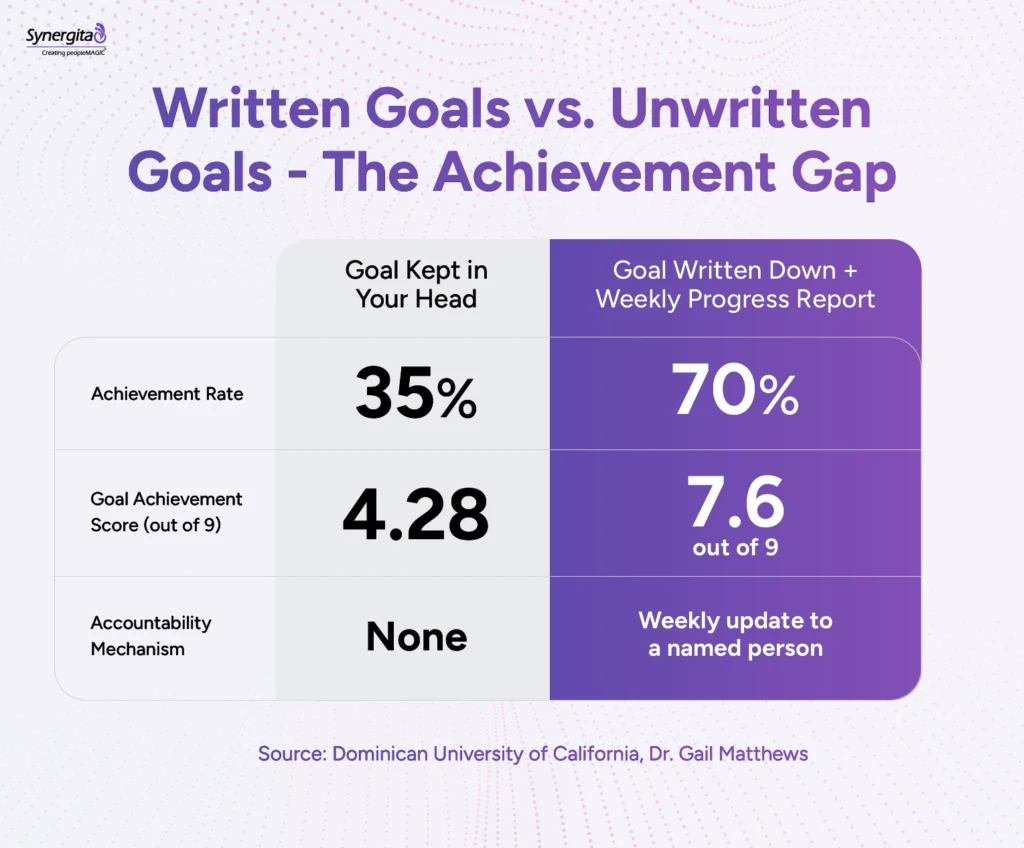
- In that same study, the group that wrote goals, made action commitments, and reported progress weekly scored 7.6 out of 9 on goal achievement. The group with unwritten goals scored 4.28, nearly half as much.
- A meta-analysis of 94 independent studies by Gollwitzer and Sheeran found that forming an “if-then” implementation plan produces a medium-to-large effect (d = 0.65) on whether a goal actually gets achieved.
- Setting strategic goals does not always translate into successful execution. An HBR study found that only 20% of companies successfully complete around 80% of their strategic goals, highlighting the challenges organizations face in effective goal setting, tracking, and execution (HBR, 2019).
Goal alignment and strategy execution statistics
A clear strategy leads to better execution, yet many employees still don’t understand their organization’s goals well enough to act on them. The statistics highlight the impact of this disconnect.
- Fewer than 5% of employees understand their company’s strategy well enough to act on it, according to Kaplan and Norton’s landmark HBR research on strategy execution.
- Only 47% of U.S. employees strongly agree they know what’s expected of them at work, per Gallup’s Q2 2025 engagement data.
- Goal misalignment starts at the top. Research from London Business School found that 50% of senior managers could not correctly identify their organization’s top three strategic priorities. This shows how difficult it can be to communicate business goals across leadership teams.
- Many organizations struggle to maintain alignment after goals are created. Only 51% of companies attempt to develop aligned goals, and just 6% regularly revisit them, highlighting the gap between goal setting and continuous execution.
- Even when organizations define strategic priorities, execution often fails when goals are not supported by adequate resources. Only 11% of managers surveyed by HBR believe their company’s strategic priorities are fully backed by the financial and human resources required for successful execution.
- Strategic goals often fail when organizations cannot adapt resources to support changing priorities. Only 20% of managers are confident in their organization’s ability to shift personnel across units. This indicates that many companies struggle to realign workforce capacity with evolving strategic needs.
- Clear goals are essential for successful execution, yet many organizations struggle to define objectives and milestones effectively. The PMI Pulse of the Profession reports that 37% of projects fail due to poorly articulated goals and unclear milestones, showing how weak goal clarity can directly impact project outcomes.
- Even well-defined goals can fail without adequate resources to support execution. In fact, 9 in 10 managers expect some organizational initiatives to fail due to insufficient resources, directly affecting strategic goal completion.
Taken together, these findings show that goal clarity has a greater impact on performance development than motivation alone. Employees can only contribute effectively when they understand what they’re working toward.
OKR and goal framework statistics
Only annual planning alone is not effective in fast-changing business environments. Objective and key results (OKRs) help teams review, adapt, and realign goals throughout the year.
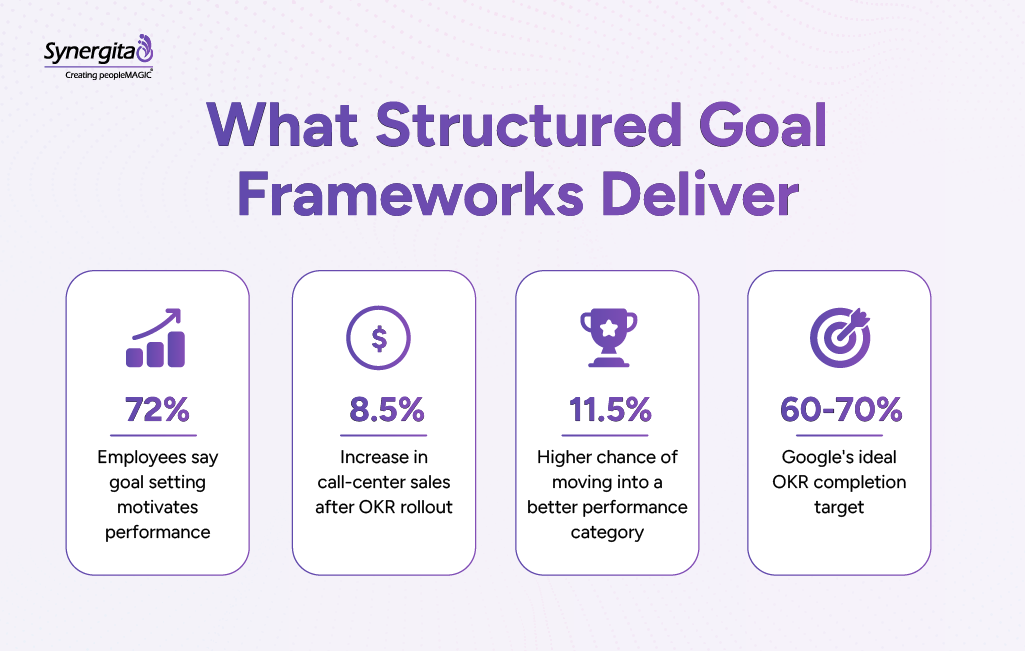
- 72% of employees cite goal setting itself as a strong motivator for performance, according to McKinsey’s 2025 research on performance management.
These findings show that employees perform better when goals are aligned with business priorities and are given regular feedback.
- When Sears Holding Company rolled out OKRs to 20,000 employees, call-center sales per hour rose 8.5%, from $14.44 to $15.67.
- Sears’ own tracking data goes further: employees who used OKRs consistently, rather than sporadically, were 11.5% more likely to move into a higher performance bracket during that same rollout.
- Google’s own OKR guidance sets the target success rate at 60% to 70% of a key result. Hitting 100% every time is treated as a sign that the goal wasn’t ambitious enough, not a win.
- A meta-analysis of 70 Management by Objectives (MBO) studies found that 68 reported measurable productivity improvements, demonstrating that organizations consistently perform better when goals are clearly defined, regularly reviewed, and supported by objective feedback.
- A comprehensive review of goal-setting research found that more than 90% of studies reported that specific and challenging goals led to higher performance than vague or easy goals, which is one of the most consistent findings in organizational psychology. (Locke & Latham, Building a Practically Useful Theory of Goal Setting and Task Motivation, American Psychologist)
- Organizations using OKRs report stronger strategic alignment. A Haufe Talent study found that 60% of employees working with OKRs clearly understand their company’s strategy, compared with only 37% in organizations without OKRs.
- According to Haufe Talent, 72% of employees using team OKRs understand their company’s vision, compared with only 50% of employees who don’t work with OKRs, showing how shared objectives improve strategic alignment across teams.
- Stretch goals are concentrated at the leadership level. A Forbes report found that 54% of senior executives set ambitious goals, while only 33% of frontline employees do the same, indicating the need for goal frameworks that encourage alignment and ambition across every level of the organization.
- Stretch goals remain the exception rather than the norm. Research from Leadership IQ found that only 43% of employees set challenging goals, showing why frameworks like OKRs encourage ambitious objectives that push teams beyond incremental improvements.
- The effectiveness of OKRs depends on consistent adoption across teams. At Sears Holding Company, inconsistent OKR usage resulted in only a 3% performance increase, while employees who used OKRs consistently achieved an 11.5% increase, highlighting the importance of regular OKR tracking and execution.
Goal clarity statistics
Goal clarity helps employees understand their role in the organization, strengthening engagement and retention. These motivational statistics show that employees stay engaged when goals are clear and aligned with business priorities.
- Employees are most motivated when their goals mix individual and team objectives (44%) and connect visibly to company-wide priorities (40%), per McKinsey’s goal-setting research.
- A global survey by the Project Management Institute (PMI) found that 37% of projects fail because organizational goals and business objectives are unclear, indicating how poor goal alignment affects execution well beyond individual performance.
Continuous goal management statistics
Organizations that consistently review and manage goals outperform those relying on annual planning alone. The following studies show why businesses are replacing one-time goal setting with continuous performance management.
- Organizations using OKRs with regular check-ins reported 23% higher goal attainment than teams reviewing goals infrequently, highlighting the value of continuous execution over annual planning.
- Goal setting is only the first step; consistent tracking determines whether those goals translate into results. However, 80% of organizations fail to track their business goals, creating a gap between strategic planning and execution
- Effective goal management requires organizations to regularly evaluate progress and adjust priorities when needed. However, 8 out of 10 managers report that their companies are slow to exit failing ventures, causing resources to remain tied up and limiting opportunities for strategic realignment and growth (HBR, 2015).
Core Insight: Across every study reviewed, the common denominator is not goal ambition; it’s consistent goal management. Organizations that regularly review, track, and align goals achieve stronger business outcomes than those relying on annual planning alone.
These statistics for goal setting show that execution depends as much on the process as the goals themselves. Understanding these goals statistics helps leaders build systems that improve execution, not just planning.
3 best practices to build an effective goal-setting system
Building an effective goal-setting system requires clear goals, regular progress reviews, and alignment with business priorities. Here are the three best practices.
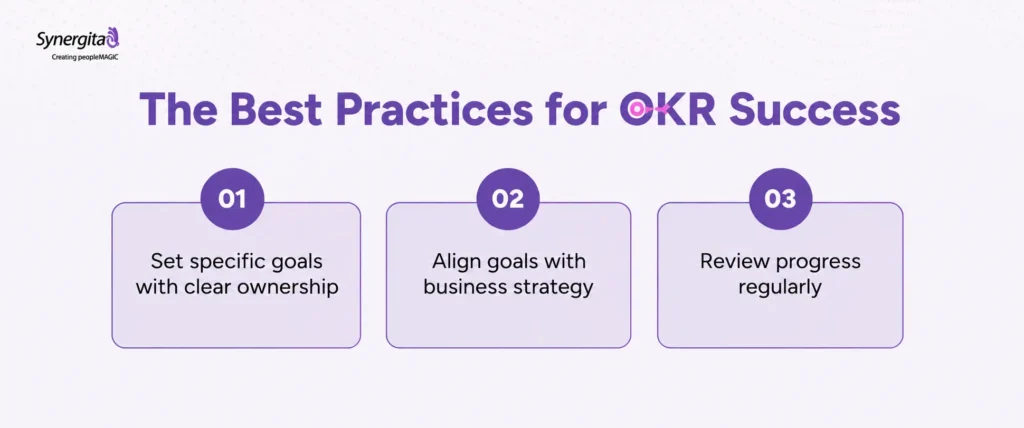
Set specific goals with clear ownership
The Dominican University research shows that written goals with clear accountability are far more likely to be achieved than unwritten intentions.
Align goals with business strategy
Ensure individual and team goals are aligned with the company’s strategic priorities. This helps to keep everyone focused on outcomes that contribute to business success.
Review progress regularly
This is the habit McKinsey’s fairness-factor research identifies as the strongest single differentiator between organizations with an effective performance system and those without one.
Final takeaway
A structured goal-setting framework like OKRs is essential for translating business strategy into measurable goals. The goals research reviewed throughout this guide points to one clear takeaway: regular reviews matter more than annual planning. The right OKR software helps businesses turn these best practices into an everyday goal management process.
OKR management software like Synergita helps companies create AI-powered OKRs in minutes and align them with business priorities. It also helps to cascade OKRs across departments, teams, and individual employees to ensure everyone is working toward the same organizational goal.
Start your free trial today.

Frequently asked questions
Research on strategy execution shows most companies fall short of their strategic goals, largely because fewer than 5% of employees understand the strategy they’re meant to execute, per Kaplan and Norton’s HBR research. These statistics about setting goals demonstrate why specific, measurable objectives outperform vague intentions
Yes. The Dominican University of California study found that people who wrote goals down, made action commitments, and reported progress weekly hit a 70% success rate, double the 35% rate of people who kept goals unwritten.
Gallup’s research links clear expectations directly to retention, estimating a 22% reduction in turnover when organizations move employees from uncertain to clear on what’s expected of them.
Difficult, specific goals outperform easy ones by over 250%, according to Locke and Latham’s original research, but only within a person’s actual skill range. Push past that range and performance drops sharply.
Begin with the two habits the research consistently supports: write the goal down with a named owner, and review it on a fixed cadence rather than annually. Google’s own OKR benchmark targets 60–70% key-result completion, treating 100% as a sign the goal wasn’t ambitious enough.