



Many early-stage SaaS startups fail because they build products the market doesn’t need. According to CB Insights, 43% of startups fail due to poor product-market fit.
The startups that reach product-market fit usually share one thing, and that is focus. They understand which milestones are critical at each stage of the journey. OKRs give that clarity and help you measure success at every stage of the journey, whether you’re validating a problem, building an MVP, getting your first customers, or proving real value.
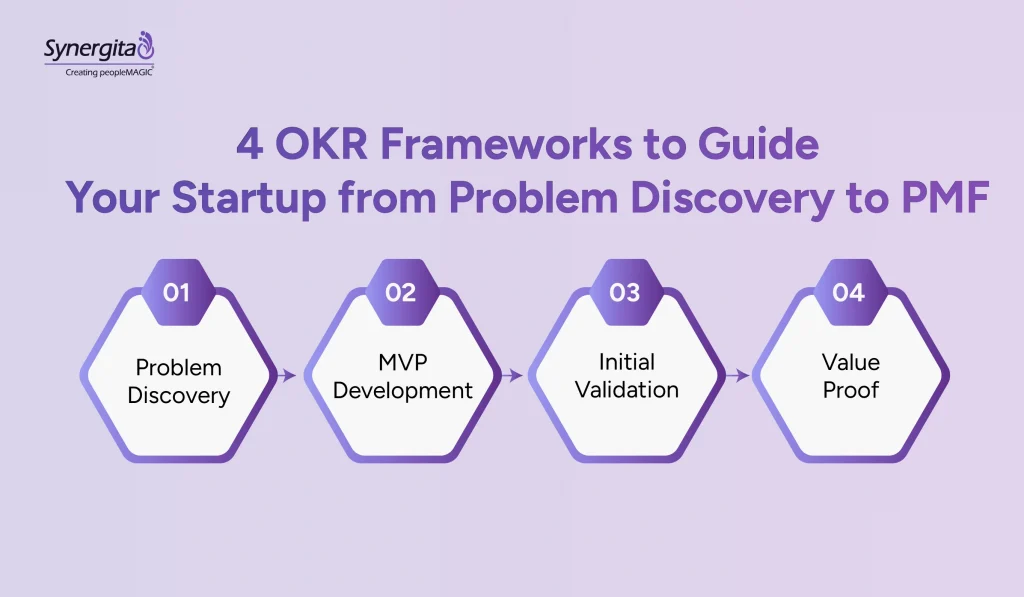
Below are four OKR frameworks for early-stage SaaS startups in problem discovery, MVP development, initial validation, and value proof. Find the stage of your startup below and track what is actually important.
4 OKR Frameworks for Early-Stage SaaS Startups
The four stages below represent sequential phases in your pre-PMF journey. Start with the stage that matches where you are now and use an OKR tool to set targets and track progress in real-time.
Stage 1: Problem Discovery
Objective: Identify a real, urgent, and valuable problem worth solving
Why is it important: Building something people want starts with finding a problem people actually have. Not a problem you assume exists, but one that’s frequent, painful, and currently unsolved. This OKR ensures you validate the problem before investing months in building a solution.
- Key Result 1: Conduct 30 structured interviews with a clearly defined ICP (Ideal Customer Profile)
- Key Result 2: At least 20 interviewees confirm the problem occurs frequently (weekly or more)
- Key Result 3: At least 15 interviewees rate the pain severity as 8/10 or higher
- Key Result 4: Identify current workarounds or existing solutions being used by 100% of interviewees
- Key Result 5: 5 interviewees express willingness to try a new solution
- Key Result 6: 2 interviewees agree to pilot a solution once built
Stage 2: MVP Development
Objective: Build a usable MVP that solves one clear identified problem
Why is it important: An MVP shouldn’t try to include every feature you have in mind. It’s about solving one core workflow end-to-end well enough that early users can complete their task without workarounds. This OKR keeps your team focused on delivering a usable product instead of chasing perfection.
- Key Result 1: Build an MVP covering 1 core workflow end-to-end (from start to finish)
- Key Result 2: Validate MVP functionality through 20 discovery calls with target users
- Key Result 3: Successfully onboard 2 pilot customers onto the product
- Key Result 4: Achieve 70% weekly active usage from pilot users
Stage 3: Initial Validation (Pre-PMF with v0.9)
Objective: Validate core value proposition with 1–2 active customers
Why is it important: Having users is different from having users who understand and extract value from your product. This OKR ensures your early customers can clearly articulate why they’re using your product and that they’re engaging with the core feature consistently.
- Key Result 1: At least 70% of active users engage with the core feature weekly
- Key Result 2: 80% of users can clearly articulate the primary value in their own words
- Key Result 3: At least 1 customer confirms the product delivers measurable improvement (time saved, cost reduced, or efficiency gained)
- Key Result 4: Secure 1 pilot customer willing to continue using (paid or committed renewal intent)
Stage 4: Value Proof
Objective: Prove our solution solves a high-value pain for our ICP
Why is it important: You’ve validated that users engage with your product. Now you need to prove it solves a problem important enough that they’d be significantly impacted without it. This stage helps determine whether the product is only useful or essential for customers.
- Key Result 1: Complete 15 in-depth customer interviews focused on value and impact
- Key Result 2: At least 5 ICP customers confirm the problem is among their top 3 operational challenges
- Key Result 3: 60% of users engage with the core workflow weekly without prompting or reminders
- Key Result 4: Obtain 2 explicit statements from customers that they would be significantly impacted if the product were removed
- Key Result 5: 1 customer agrees to pay for continued usage (or renew commitment)
How to Use These OKRs for Your Startup
Choose the stage that matches your current reality:
- Still validating the problem? Start with Stage 1.
- Building your first version? Focus on Stage 2.
- Have 1-2 customers using a beta? Use Stage 3.
- Need to prove value before raising or scaling? Apply Stage 4.
Once you identify the stage, you can follow these implementation best practices.
- Set quarterly cycles: Each of these OKRs works best as a 90-day sprint. Don’t try to accomplish all four stages at once; sequence them based on where you are today.
- Track progress weekly: OKRs only work if you review them regularly. Set aside 30 minutes each week to assess which key results are on track, which are lagging, and what needs to change.
- Adjust targets to your context: The numbers in these examples (30 interviews, 70% usage, etc.) are benchmarks. Adjust them based on your ICP size, product complexity, and available resources, but don’t make them too easy. OKRs should stretch your team.
- Don’t move to the next stage prematurely: It’s tempting to skip problem validation and jump straight to building. Resist. Each stage builds on the previous one. Skipping stages means building on assumptions rather than evidence.
Suggested Reading: A Complete Guide to OKR Tracking
Final Thoughts
The journey to product-market fit is full of uncertainty because everything seems urgent, but OKRs give you 3-4 things to focus on each quarter and let you ignore the rest. They help you define the goals before you start building, track whether you’re making progress, and give you clear signals when to make strategic changes.
These four OKR frameworks cover the essential milestones every early-stage startup needs to achieve: finding a real problem, building a usable solution, validating value with early customers, and proving the pain is significant enough to build a business around.
Start with your current stage, set clear targets, and review progress weekly. Synergita OKR software helps early-stage SaaS startups implement these frameworks, track progress, and send weekly check-in reminders, helping your team stay focused on achieving the goals.
Frequently Asked Questions
To determine this, you should look at what you’ve validated with real users, not what you’ve built. If you haven’t confirmed the problem exists through interviews, start at Stage 1, even if you’ve already started building.
That’s a red flag. If customers don’t commit to trying a solution, it means the pain isn’t urgent enough. You need to go back to Stage 1 and find a problem that is more critical.
Working on multiple stages is not recommended because each stage validates assumptions from the previous one. Jumping ahead means you’re building on guesses instead of evidence and data, which mean waste of time and resources.
Yes, achieving 60% of the OKR target is often a good sign. It means your OKRs were ambitious enough. You need to focus on what you learned, adjust your approach, and set new targets for the next quarter based on real data.