



Many projects fail due to unclear priorities. Progress may look solid in the beginning, but it doesn’t translate into real results in the end. Teams that rely on clearly defined objectives and key results avoid this, and that’s exactly what the following examples show.
Quick Takeaway
- Project managers often stay busy with tasks, but OKRs help shift focus to measurable outcomes that directly impact business goals.
- The 10 OKR examples for project managers cover core project areas like delivery, budgeting, stakeholder alignment, team performance, and process efficiency.
- A strong OKR includes a clear objective and up to three measurable key results and regular check-ins.
- Success with OKRs depends on writing effective OKRs, disciplined execution, and avoiding common mistakes like tracking outputs instead of outcomes.
Most project managers know what needs to be achieved, but the problem is ensuring the team works toward outcomes that are important for businesses and not just staying busy with tasks.
According to a PMI Pulse report, organizations that focus on skills like problem-solving, communication, collaborative leadership, and strategic thinking achieve a 72% project success rate in meeting business goals, compared to just 65% for those that do not.
The gap is due to the presence of a structured framework for translating organizational goals into measurable project outcomes. Objectives and Key Results (OKRs) help project managers address this challenge.
This guide covers 10 ready-to-use OKRs for project managers, a reusable template, steps for tracking OKR progress, and common mistakes to avoid when writing OKRs.
| Table of Contents – What Are OKRs in Project Management – What Are the Best OKR Examples for Project Managers – OKR Template for Project Managers – How Project Managers Can Track OKRs – Common OKR Mistakes Project Managers Should Avoid – Final Thought – Frequently Asked Questions |
What Are OKRs for Project Management
OKRs (Objectives and Key Results) in project management are a goal-setting framework that connects project-level work to organizational strategy. An Objective is a clear, qualitative statement of what the project team is working toward. Key Results are the specific, measurable outcomes that track the progress of the project.
What Are the Best OKR Examples for Project Managers
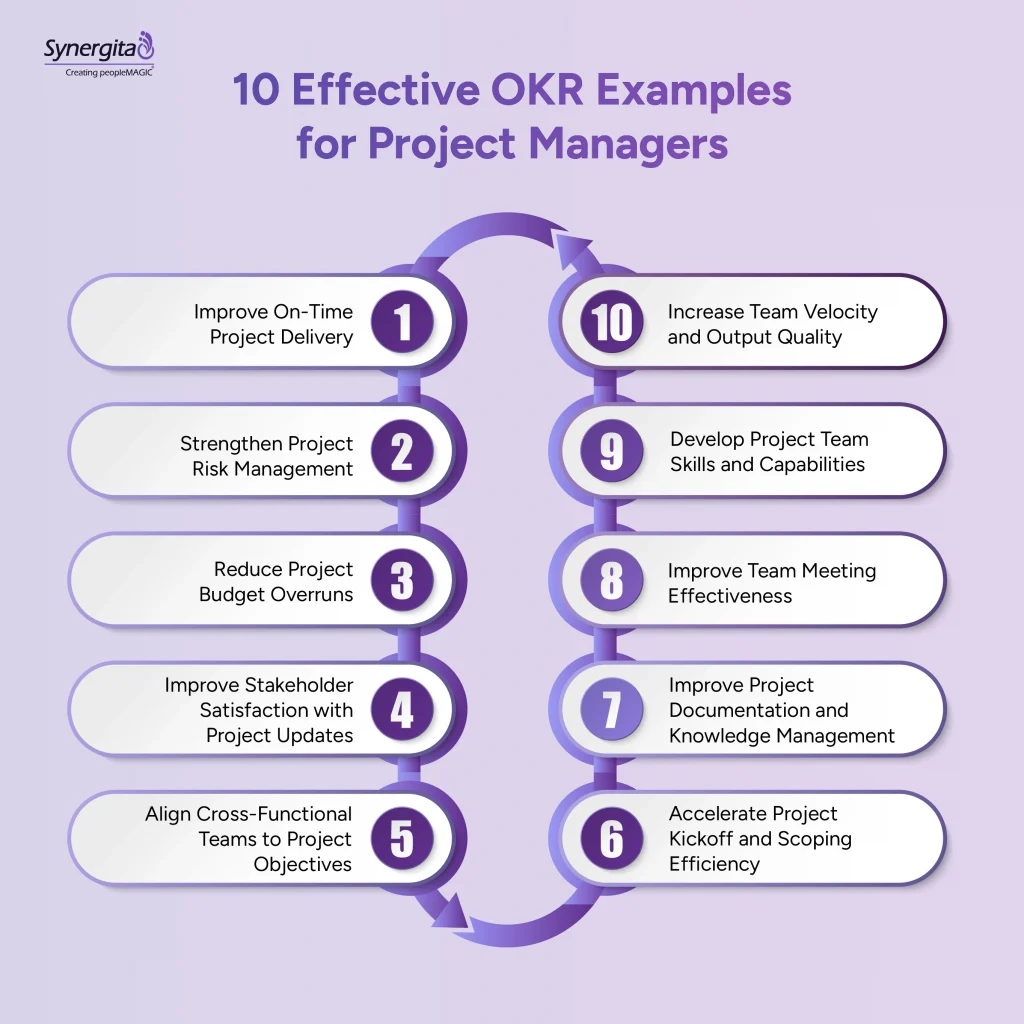
Here are top OKR examples for project managers across different categories.
Project Delivery and Execution
1. Improve on-time project delivery
Objective: Deliver all active projects on schedule without compromising the scope or quality of the outcome.
- Key Result 1: Reduce average project delay from 12 days to 4 days by the end of Q3.
- Key Result 2: Complete 90% of sprint milestones on time across all active workstreams.
- Key Result 3: Achieve a schedule performance index (SPI) of 0.95 or above on all projects.
2. Reduce project budget overruns
Objective: Bring all projects within the approved budget by improving cost forecasting accuracy.
- Key Result 1: Reduce cost variance to within 5% of the approved budget across all active projects.
- Key Result 2: Conduct budget reviews at the two-week and six-week marks on every project.
- Key Result 3: Identify and document cost overrun root causes within 48 hours of detection for every project.
3. Strengthen project risk management
Objective: Build a proactive risk management practice that prevents surprises from becoming crises.
- Key Result 1: Identify and document project risks within the first week of every new project kickoff.
- Key Result 2: Resolve 80% of flagged risks before they escalate to the project sponsor.
- Key Result 3: Reduce the number of unplanned project scope changes by 30% compared to last quarter.
Stakeholder Communication and Alignment
4. Improve stakeholder satisfaction with project updates
Objective: Increase stakeholder confidence in project progress through clearer, more consistent communication.
- Key Result 1: Achieve a stakeholder satisfaction score of 4.2 out of 5 in the end-of-quarter survey.
- Key Result 2: Publish structured project status reports every two weeks with no exceptions.
- Key Result 3: Reduce the number of unplanned stakeholder escalations by 40% compared to last quarter.
5. Align cross-functional teams to project objectives
Objective: Ensure every team contributing to the project understands their role in achieving the overall outcome.
- Key Result 1: Conduct a project alignment session with all contributing departments within the first 10 days of the quarter.
- Key Result 2: Achieve 90% completion of cross-functional dependencies on schedule.
- Key Result 3: Reduce the number of rework requests caused by misalignment by 50% compared to the previous quarter.
Team Performance and Development
6. Increase team velocity and output quality
Objective: Build a more productive and higher-quality delivery team this quarter.
- Key Result 1: Increase average sprint velocity by 20% without increasing team size.
- Key Result 2: Reduce post-launch defect rate by 35% compared to last quarter.
- Key Result 3: Achieve a team satisfaction score of 4.0 or above on the quarterly internal survey.
7. Develop project team skills and capabilities
Objective: Strengthen the team’s technical and collaborative capabilities to handle more complex projects.
- Key Result 1: Complete structured skills assessments for all team members by week three of the quarter.
- Key Result 2: Ensure 100% of team members complete at least one relevant development activity this quarter.
- Key Result 3: Reduce onboarding time for new project contributors from 10 days to 6 days.
8. Improve team meeting effectiveness
Objective: Eliminate low-value meetings and make high-value ones more productive.
- Key Result 1: Reduce total weekly meeting hours per team member by 25% by the end of Q2.
- Key Result 2: Achieve an average meeting effectiveness score of 4.0 or above in monthly pulse surveys.
- Key Result 3: Ensure 100% of project meetings have a defined agenda and documented action items.
Process Improvement and Risk Management
9. Improve project documentation and knowledge management
Objective: Build a documentation culture so project knowledge does not leave with the people who hold it.
- Key Result 1: Document all active project processes and decision logs within 30 days.
- Key Result 2: Achieve 95% documentation compliance across all project workstreams by quarter-end.
- Key Result 3: Reduce onboarding time for new contributors by 40% through improved documentation accessibility.
10. Accelerate project kickoff and scoping efficiency
Objective: Reduce the time lost between project approval and active execution.
- Key Result 1: Reduce the average time from project approval to kickoff from 15 days to 7 days.
- Key Result 2: Complete project scoping documents within 5 business days of kickoff for 100% of new projects.
- Key Result 3: Achieve stakeholder sign-off on project scope within 3 days of document submission for all Q3 projects.
OKR Template for Project Managers
Here is a sample OKR template you can use to structure OKRs at the start of every quarter. Fill in each field before any execution begins.
Objective: [What outcome do you want to achieve? Make it specific and time-bound to this quarter.]
Key Result 1: [Measurable outcome: include a baseline number and a target number]
Key Result 2: [Measurable outcome: include a baseline number and a target number]
Key Result 3: [Measurable outcome: include a baseline number and a target number]
Owner: [Name of person accountable for this objective]
Timeframe: [Quarter and year — e.g., Q3 2026]
Check-in cadence: [Weekly / Bi-weekly — when progress will be reviewed]
Current status: [On track / At risk / Off track — updated at each check-in]
You can add each objective to a maximum of three Key Results. More than three, and focus splits faster than the quarter can recover.
How Project Managers Can Track OKRs
The Brightline Initiative found that roughly 90% of senior executives admit their organizations struggle to achieve all strategic goals because of poor implementation. A consistent tracking cadence separates OKRs that bring results from the ones that don’t. Here are key tips on how to track OKRs effectively.
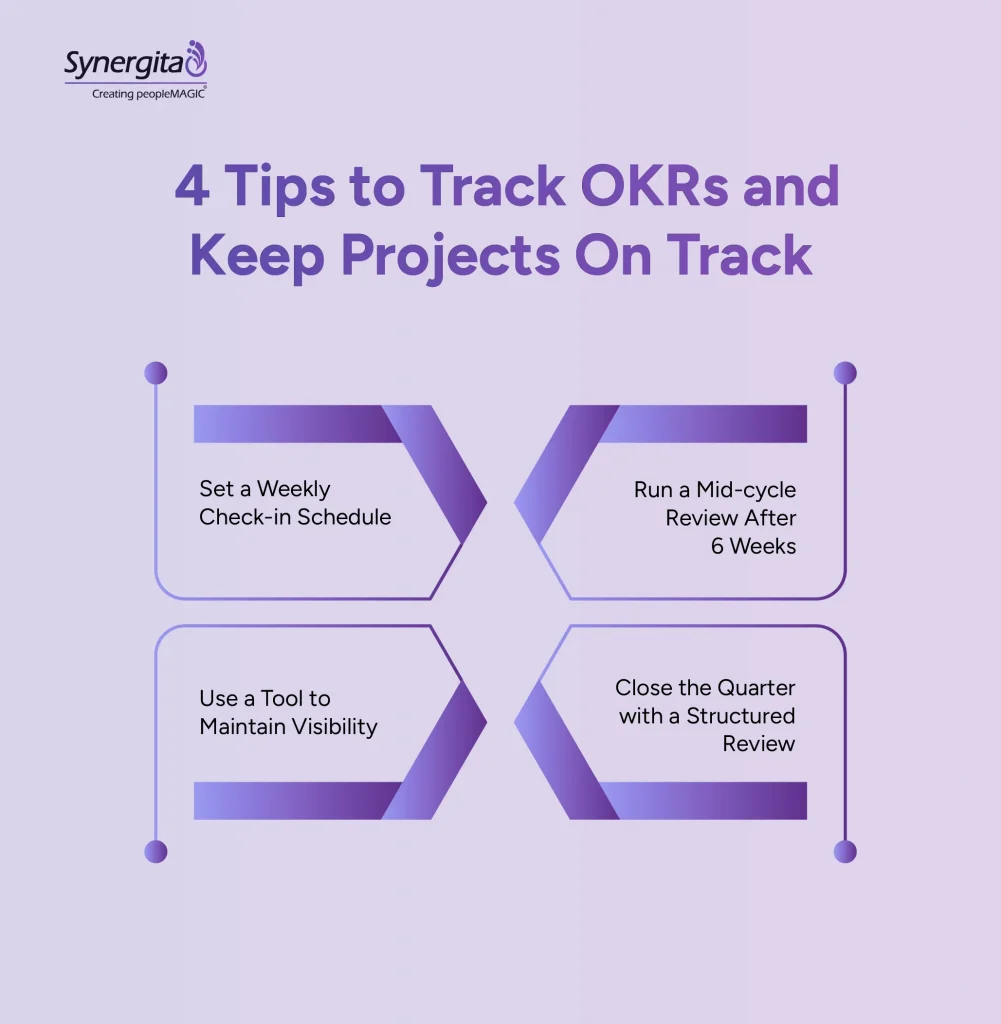
1. Set a Weekly Check-in Schedule
Reserve 15 minutes each week to review Key Results. The only question that matters: which Key Results are at risk and what changes this week? Keep it short, structured, and focused on action, not status reporting.
2. Run a Mid-cycle Review After 6 Weeks
At the halfway point, assess each OKR honestly. Is progress on track? Does the target need adjusting? Did priorities shift? This is where you course-correct while there is still time, not at quarter-end when it is too late.
3. Use a Tool to Maintain Visibility
When OKRs are tracked in spreadsheets or separate documents, alignment breaks down quickly, especially across cross-functional teams. A dedicated OKR tracking software like Synergita gives project managers a single view of every objective across teams, with real-time progress indicators and check-in prompts built in, so nothing falls through the cracks between planning and delivery.
4. Close the Quarter with a Structured Review
Document what was achieved, what was missed, and why. Use the findings to inform next quarter’s OKRs. Teams that run structured quarter-close reviews consistently write better OKRs the next cycle because they are building on evidence, not assumptions.
Common OKR Mistakes Project Managers Should Avoid
OKR mistakes can derail projects, cause delays, and result in wasted time and resources. Let’s look at the most common OKR mistakes you should avoid.
1. Measuring outputs instead of outcomes
Delivering a feature is an output. Increasing the feature’s adoption rate by 25% is an outcome. OKRs that track deliverables rather than results tell you what was built, not whether it worked.
2. Setting too many Key Results per objective
Three is the practical limit. Five Key Results per objective means the team is tracking a project plan, not an OKR. Fewer Key Results force sharper decisions about what actually matters.
3. Skipping the mid-cycle check-in
An OKR reviewed only at quarter-end is an OKR you can no longer influence. Build the four-week and eight-week reviews into the calendar before the quarter starts. These check-ins are where course corrections happen and where missed quarters are prevented rather than explained.
Final Thought
OKRs give project managers a disciplined way to connect daily tasks to outcomes that are important to the business. The ten examples we provided above cover the scenarios project teams face most often, from delivery and stakeholder alignment to team performance and process improvement.
Start with one objective this quarter, apply the template, and schedule reviews before the first week ends. But to streamline OKR management, you need the right system. Try the Synergita OKR tool to set, align, and monitor objectives and key results across your projects. Get started free today.

Frequently Asked Questions
A project manager should set one to three objectives per quarter, each with no more than three Key Results. Project managers overseeing multiple workstreams often do best with two focused objectives rather than four that compete for the same limited bandwidth.
No, milestones help in tracking whether deliverables are completed on time. OKRs track whether those deliverables are producing the outcomes the business needs. Both serve different purposes and work best when used together.
Weekly for active tracking and a structured mid-cycle review at the four-week mark. Weekly reviews keep the team aware of progress; the mid-cycle review is where you decide whether an OKR needs to be adjusted before it is too late to do anything about it.
Yes, and they fit naturally. Agile teams already operate in short cycles focused on outcomes. OKRs provide the strategic layer above sprint planning — defining what the team is ultimately working toward across a full quarter, which gives individual sprints clearer direction and shared context.