
Quick answer: An OKR sets a time-bound goal a team wants to achieve, while a KPI tracks ongoing business performance. OKR stands for Objectives and Key Results, and KPI stands for Key Performance Indicator. Teams use both to connect strategic priorities with performance measurement.
A KPI can show that customer retention is falling, but it won’t explain how your team should improve it. OKRs can help turn that performance gap into a time-bound objective with measurable key results. Understanding the difference between OKRs and KPIs helps teams monitor ongoing performance while setting goals to improve business outcomes. This guide compares OKRs and KPIs, shares practical examples, and explains how to use them together.
| Table of Contents 1. What are OKRs? Meaning, purpose, and key components 2. What are KPIs? Meaning, purpose, and examples 3. OKRs vs KPIs: Key differences explained 4. OKR and KPI examples: How they work in practice 5. When should you use OKRs, KPIs, or both? 6. Final takeaway |
What are OKRs? Meaning, purpose, and key components
OKRs stands for Objectives and Key Results. In business, the OKR meaning is a goal-setting framework that links an inspiring objective to measurable key results. Teams use it to set goals and track progress.
Google’s re: Work guide to OKRs and John Doerr’s book Measure What Matters are the two best-known references.
Objectives are qualitative, inspirational, and time-bound. Key results quantify the objective with specific, verifiable metrics.
Key features of OKRs
- Goal-focused: OKRs center on clear and ambitious objectives.
- Measurable outcomes: Progress is tracked through specific, time-bound key results.
- Team alignment: OKRs connect company, team, and individual goals.
- Regular reviews: Teams usually review them every quarter to check progress and adjust priorities.
When to use OKRs?
- You are launching a new product, entering a new market, or running a business transformation.
- Your team needs a shared goal with clear accountability and a defined deadline.
- You want to move beyond tracking activity and start measuring the impact of your team’s work.
Teams that run OKRs across several groups move from spreadsheets to OKR software, so progress stays visible to everyone.
What are KPIs? Meaning, purpose, and examples
KPIs, or Key Performance Indicators, are metrics businesses use to measure ongoing performance. They work like a dashboard, helping teams track business health and progress over time.
Common KPIs include revenue, customer satisfaction scores, employee productivity, and churn rate. Unlike OKRs, KPIs run continuously across teams and periods.
KPIs show quickly what is working and what needs attention. They are the standard health checks every team runs, whatever strategic goals are in play.
Key features of KPIs
- Continuous monitoring: KPIs track performance regularly to measure business health.
- Quantitative metrics: KPIs use measurable data such as revenue, rates, and scores.
- Operational focus: They measure how well business processes perform.
- Early warning system: A KPI drop points to a problem before it grows.
When to use KPIs?
- You need a consistent baseline to monitor performance across departments or reporting periods.
- You want to hold teams to operational standards without resetting goals every quarter.
- A metric has dropped, and you need clear data to diagnose the problem before setting an OKR to fix it.
Suggested Reading: KPI Monitoring Guide: What to Track and Why
OKRs vs KPIs: Key differences explained
OKRs and KPIs differ in purpose, OKRs define specific, time-bound goals a team wants to achieve, while KPIs measure ongoing business performance. OKRs focus on creating change and achieving strategic outcomes. KPIs track operational health through metrics such as revenue, customer retention, and employee productivity.
| Criteria | OKR | KPI |
| Focus | What you want to achieve | What you want to monitor |
| Nature | Qualitative objective plus quantitative key results | Primarily quantitative |
| Scope | Company, team, or individual goals | Process, team, or department metrics |
| Time frame | Quarterly or annual cycles | Ongoing, continuous |
| Purpose | Create change and alignment | Track health and performance |
| Relationship | Key results build on KPIs | KPIs give the baseline for key results |
OKRs help teams set goals and make changes based on business priorities, while KPIs track ongoing performance and show whether key activities are meeting their targets.
A simple way to remember it is to look at one goal from both sides:
- Objective: Win more enterprise customers
- Key result: Grow enterprise annual recurring revenue (ARR) by 20% by the end of Q3
- KPI: Enterprise ARR, tracked monthly
The key result sets the target. The KPI shows where you stand each month. One sets the ambition, and the other confirms whether the business is on track. That is how OKRs and KPIs work as one system.
OKR and KPI examples: How they work in practice
OKRs and KPIs work together to set business goals and measure progress. For example, a company may track customer retention as a KPI and set an OKR to improve retention by 15% within the next quarter.
The KPI shows current performance, while the OKR defines the improvement target and the key results used to measure it.
OKR example (marketing team)
- Objective: Become the top brand in our category for enterprise buyers
- Key Result 1: Increase organic traffic by 40% by the end of Q3
- Key Result 2: Generate 200 qualified enterprise leads per month
- Key Result 3: Achieve a Net Promoter Score of 50+ from enterprise prospects
Need more ideas? The OKR examples has examples by team and role.
KPI examples (marketing team)
- Monthly website traffic
- Cost per lead (CPL)
- Email open rate
- Customer acquisition cost (CAC)
How key results and KPIs connect
Key results use KPIs that marketing teams already track to measure progress toward a specific objective. KPIs provide the baseline, while key results set a measurable target within a defined period.
For example:
- Existing KPI: Monthly organic website traffic – 50,000 visitors.
- Objective: Increase organic visibility among enterprise buyers.
- Key result: Increase monthly organic website traffic from 50,000 to 70,000 visitors by the end of Q3.
The monthly website traffic KPI tracks ongoing performance, while the key result sets a specific improvement target. Cost per lead (CPL), email open rate, and customer acquisition cost (CAC) can remain supporting KPIs to monitor marketing performance.
In Synergita OKR, you can track each key result against the KPI behind it.
When should you use OKRs, KPIs, or both?
Use KPIs to monitor ongoing business performance and identify areas that need attention. Use OKRs when you want to turn those priorities into specific goals and measurable results. Use both when teams need to track current performance while working toward a business improvement.
According to a PwC survey of more than 500 senior executives found that nearly two-thirds of CEOs considered strategy execution harder than strategy development. It also found that 80% felt their company’s strategy was not well understood across the organization.
OKRs turn business priorities into clear goals, while KPIs help teams track progress.
Use KPIs when
- You need to track ongoing business health.
- You want consistent benchmarks across teams or periods.
- The goal is monitoring and accountability.
Use OKRs when
- You are launching something new or entering a new market.
- You need to align a team around a bold, time-sensitive goal.
- You want to motivate people beyond hitting numbers.
Use both when
- Your KPIs reveal a performance gap, such as falling customer retention.
- You set an OKR to fix it, such as “Improve the customer onboarding experience this quarter.”
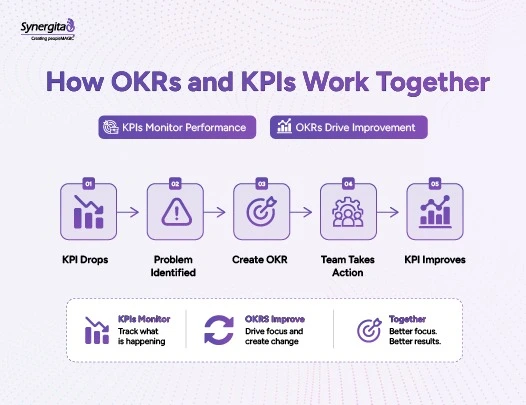
The loop runs in three steps:
- A KPI drops and shows a problem.
- The team sets an OKR to fix it.
- Key results track the recovery, and the KPI confirms it.
Synergita OKR helps teams set goals and track progress toward each key result in one place.
Many companies run OKRs at the strategic level and KPIs at the operational level at the same time. OKRs set the direction for growth, and KPIs keep performance on track along the way.
Also read: How OKRs and KPIs Together Create a Stronger Path to Success
Final takeaway
Before your next OKR cycle, review your existing performance metrics and identify the areas that need attention. Choose a priority, assign an owner, and define measurable key results with clear deadlines. Review progress regularly and use performance data to decide what needs to change in the next cycle.
Synergita OKR helps teams manage objectives, monitor progress toward key results, and keep business goals visible throughout the OKR cycle. Start a free trial today.
Prefer a walkthrough? Book a demo.
Frequently asked questions
An OKR defines a specific goal a team wants to achieve within a set period, supported by measurable key results. A KPI measures ongoing business performance through metrics such as revenue, customer retention, or employee productivity. OKRs focus on achieving change, while KPIs monitor performance.
Another word for KPI is performance metric, business indicator, success measure, or benchmark. While these terms are sometimes used interchangeably, KPI is the most commonly used term for measuring business performance.
Other close terms include:
• Performance indicator
• Success metric
• Business metric
• Performance measure
• The OKR equivalent of a KPI target is a key result.
The five key elements of the OKR framework are Focus, Alignment, Commitment, Tracking, and Stretching. Focus helps teams prioritize important goals; alignment connects individual and team objectives with organizational priorities; commitment establishes ownership; tracking monitors progress; and stretching encourages ambitious outcomes. These elements help organizations turn strategic priorities into measurable results.
Neither is better on its own. OKRs help teams achieve strategic goals, while KPIs measure ongoing business performance. Choose KPIs to monitor operational health and OKRs to drive improvement. Most businesses benefit from using both together.
Yes. Teams can use KPIs to identify performance gaps and OKRs to address them. For example, if customer retention drops, a team can set an OKR to improve customer onboarding and use key results to measure progress. The KPI then shows whether retention improves.