


Completing a performance review on time doesn’t mean it was effective. If employees question their ratings, managers avoid difficult conversations, or feedback does not change employee behavior, this means there are hidden appraisal challenges that reduce the effectiveness of your performance review process.
The biggest problems don’t appear after the appraisal when high-performing employees leave and the company can’t retain them. These are signs of deeper performance appraisal problems. Many of the problems of performance appraisal become visible only after employees lose confidence in the review process.
These challenges significantly impact the business. SHRM reports that 95% of managers are dissatisfied with their review system, and 59% say it brings less value. Here are the 50 appraisal challenges across different stages of the review process, so you can identify and address them before it costs your organization.
| Table of contents 1. Top 50 performance appraisal problems 2. How problems of performance appraisal affect your organization 3. Final Takeaway 4. Frequently asked questions |
| TL;DR Most issues in performance appraisal arise from unclear criteria, inconsistent ratings, and infrequent feedback. Explore 50 challenges across every stage of the performance appraisal process. Address common issues like manager bias, poor documentation, and recency bias to make performance reviews fairer and more consistent. Adopt continuous feedback and goal tracking to make appraisals more accurate and effective. |
Top 50 performance appraisal problems
The common problems in performance appraisal usually appear across assessment methods, review forms, manager execution, employee experience, and review timing. Understanding these challenges in performance appraisal helps organizations identify where their performance review process is ineffective and where you need improvement.
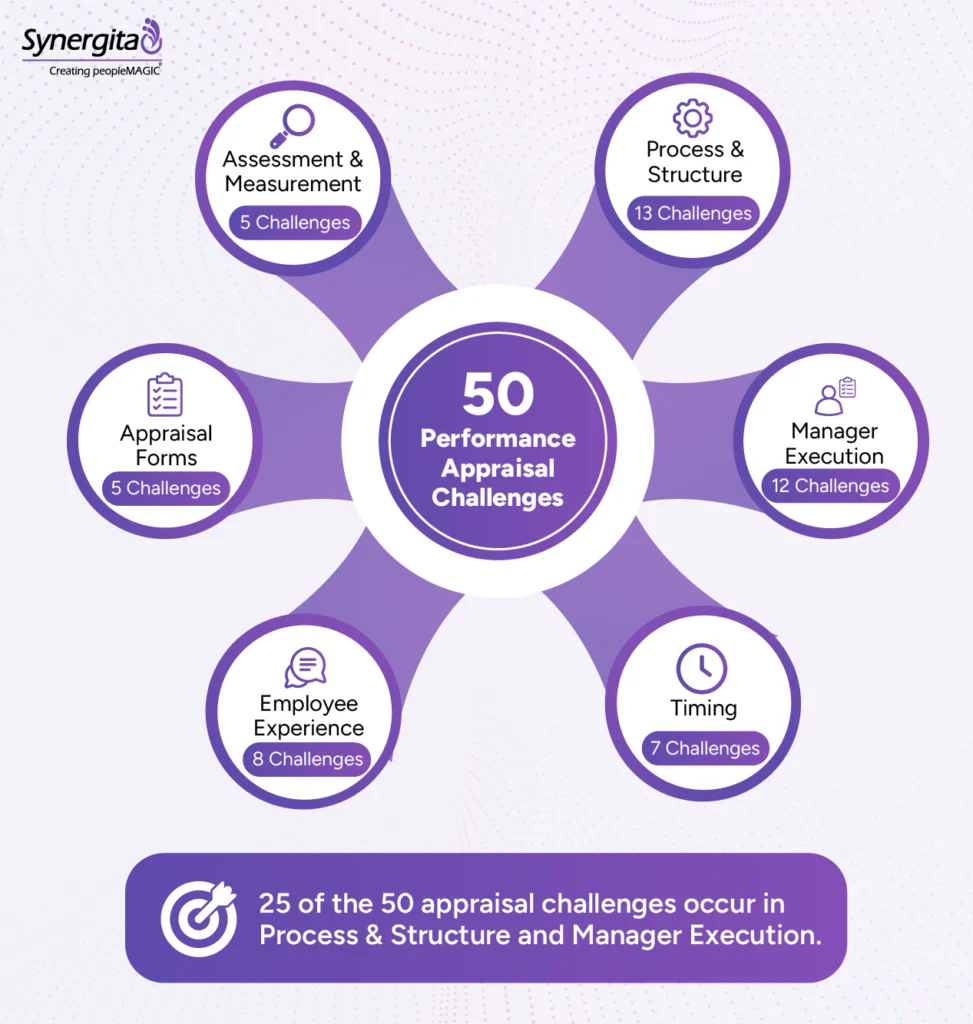
Assessment appraisal failures
1. Rating the person
Many reviews focus on personal traits, such as attitude or technical knowledge, instead of measurable performance. Evaluate employees based on measurable results such as work quality, productivity, and goal achievement, not personal traits or opinions.
2. Annual-only feedback
When performance reviews happen only once a year, problems can go unnoticed for months. Continuous feedback helps managers address issues sooner, provide timely feedback, and support employee growth throughout the year.
3. No success metrics
Many organizations track whether performance appraisals are completed, but they don’t measure whether the process actually improves employee performance, engagement, or retention. Without these insights, it’s difficult to know if the appraisal process is making a real difference.
4. No accountability
Managers are not held responsible for unfair, inconsistent, or poorly documented performance ratings. When this happens, biased evaluations can make employees lose trust in the appraisal process.
5. No real-time tracking
Annual reviews that rely only on memory can overlook important achievements and changes in performance. Keeping a record of employee performance throughout the year gives managers the information they need to make fair and accurate evaluations.
Structural issues in performance appraisal
These issues exist at the organizational level, where the appraisal process should support broader business goals but does not always deliver the expected results.
6. Disconnected from pay and promotion
Employees are less likely to trust the appraisal process when good performance does not lead to better pay, recognition, or career opportunities. Connecting reviews with rewards helps employees see the value of performing well.
7. Disconnected HR processes
Appraisals should support goal setting, learning, promotions, and other HR activities. When these processes aren’t connected, valuable performance data goes unused, and teams end up doing the same work twice.
8. Unstructured review process
When performance reviews are not structured and consistent, ratings can become inaccurate or unfair. As a result, organizations may find it difficult to identify strong performers and support employees who need improvement. A performance management tool supports modern appraisal methods like continuous and 360-degree feedback and OKR-based review.
9. No long-term performance tracking
Looking at only the current review cycle makes it difficult to understand an employee’s progress over time. Tracking performance across multiple review periods provides a clearer picture of growth and consistency.
10. No team-level evaluation
Organizations focus only on individual performance and forget to evaluate how well the team works together. This can hide teamwork problems and fail to recognize the efforts of contract or temporary workers who also contribute to results.
11. Focus only on poor performers
Common performance issues examples include missed goals, inconsistent work quality, poor collaboration, and lack of accountability. Most appraisal discussions focus on employees who are struggling, while top performers receive less attention. Recognizing and knowledge sharing from high performers encourages continuous improvement across the team.
12. Poor documentation
Incomplete or unclear records can lead to disagreements about ratings and decisions. Well-documented feedback helps managers support their evaluations and reduces the risk of disputes.
13. Single-reviewer decisions
Important decisions about ratings, promotions, and pay are often based on a single manager’s opinion. Having another person review the evaluation can reduce bias and make the process fairer and more consistent.
14. No validation of ratings
Organizations rarely check whether managers apply rating standards consistently. Regular reviews of appraisal data help identify differences and improve fairness across teams.
15. No peer comparison
Employees are usually evaluated on their own without comparing performance with others in similar roles. Structured comparisons help managers evaluate employees using the same standards.
16. Lack of rating transparency
Employees don’t understand the appraisal process and how ratings are determined or how decisions are made. Greater transparency builds trust and helps employees see the link between performance and outcomes.
Suggested Reading: Guide To Improve Employee Performance Appraisal Process
17. Limited decision-making authority
HR teams may manage the appraisal process, but in many cases lack the authority to improve it. Giving more ownership to decision-makers helps create a better process and makes it easier to introduce meaningful changes.
18. No appraisal ROI tracking
Businesses invest time and resources in appraisals without measuring the results. Tracking outcomes such as employee performance, engagement, and retention helps determine whether the process is delivering value
Form and instrument appraisal issues
A poorly designed appraisal form creates issues before the review even begins.
19. One form for every role
A single appraisal form for frontline staff, managers, and executives does not work well because each role has different responsibilities. A form designed for one type of employee may miss the skills, goals, and achievements that matter most for another role.
20. Forms don’t adapt to business needs
Business priorities change, but appraisal forms usually stay the same. This mismatch means the process can end up measuring goals that are irrelevant to the organization.
21. Equal weighting
When every factor on a form carries the same weight, core job responsibilities get scored the same as minor tasks. This distorts the final rating and fails to reflect what is actually important for the role
22. Conflicting ratings
When the score on a review does not match the written feedback, it creates confusion. Clear and consistent evaluations help employees understand their performance and areas for improvement.
23. Criteria mismatch
When the factors listed on an appraisal form don’t match an employee’s actual job description or goals, employees can lose focus on what’s expected of them. This is one of the most common structural flaws in performance appraisal forms.
Manager execution problems
A well-structured performance appraisal process can be ineffective without trained managers to run it.
24. No manager training
Many managers are asked to conduct appraisals through experience rather than proper training. This becomes a bigger challenge when reviews include career development discussions, which require stronger coaching and communication skills.
25. Avoiding difficult conversations
Some managers give similar or average ratings to everyone to avoid uncomfortable conversations. As a result, poor performance isn’t addressed, and excellent performance is not rewarded.
26. Manipulated ratings
Ratings are sometimes changed to support compensation or promotion decisions rather than accurately assess employee performance. This can result in inconsistent and biased evaluations.
27. Recency bias
Managers who don’t maintain a record of performance throughout the year tend to base ratings on the last few months rather than the full review period. This gives more importance to recent events and ignores an employee’s performance throughout the rest of the review period.
28. Culture over performance
Workplace norms can sometimes influence ratings more than employee performance. This may result in employees receiving standard ratings based on tenure or team practices instead of their actual contributions.
29. Inconsistent ratings across teams
Rating standards can differ from one manager to another. Without clear evaluation guidelines, employees doing similar work may receive very different ratings, making the process feel unfair.
30. Limited manager familiarity
New, recently promoted, or transferred managers may be asked to evaluate employees they have not worked with for long. This can result in ratings based on limited observations rather than a complete view of performance.
31. Unclear feedback
Feedback that is too general or vague leaves employees unsure about what they did well or where they needed improvement. Clear, specific comments help employees understand expectations and take necessary action.
32. Manager bias
Managers may unintentionally give higher ratings to employees with similar work styles, personalities, or opinions. This can result in biased evaluations, with some employees receiving more favorable ratings than others despite similar performance.
33. No reward for good reviewing
Managers who spend time providing thoughtful, evidence-based feedback are rarely recognized for their efforts. Without encouragement or accountability, many prioritize completing reviews quickly over delivering quality feedback.
34. Lack of manager ownership
Many managers treat appraisals as an HR obligation rather than a core part of their leadership role. This mindset leads to minimal investment and a tendency to blame HR when the process doesn’t work as intended.
35. High time, low value
Many managers spend significant time filling out appraisal forms but see little improvement in employee performance or engagement afterward. This lack of meaningful results makes the process frustrating for everyone involved.
Employee experience problems
These performance problems reduce employee confidence, engagement, and trust in the review process. Addressing these issues in performance appraisal helps improve employee experience and long-term retention.
36. Review anxiety
Unclear expectations and the absence of agreed-upon benchmarks can create stress for employees weeks before the appraisal conversation happens. Ongoing performance discussions throughout the year helps employees understand where they stand ahead of time can significantly ease that anxiety.
37. One-way feedback
When managers only share a rating and collect a signature, performance reviews become a checkbox activity instead of a meaningful conversation. Employees may feel unheard and less engaged in the process.
38. No self-assessment
Employees benefit when they can review their own performance regularly instead of waiting for annual feedback. Self-assessment gives them a clearer view of their progress and improvement areas.
39. No early performance alerts
Without early visibility into performance problems, managers may struggle to provide timely support. When there is no system to track performance changes, managers may not notice when an employee starts struggling. Modern performance management software can help managers document records of the performance of every employee and retrieve them anytime.
40. No input into reviewers
A lack of employee involvement in performance reviews can create doubts about fairness. Giving employees more visibility into the process, evaluation criteria, and review methods helps improve trust.
41. No appeal process
If employees disagree with their appraisal results, they should have a fair way to share their concerns. Without a review or appeal process, inaccurate ratings can continue without correction.
Suggested reading: How to Build a Fair Employee Performance Appeals System
42. Poor appraisals drive attrition
When top performers aren’t recognized differently from average ones, companies can lose their best talent. The absence of differentiated rewards for superior performance is one of the costliest consequences of a poor appraisal process.
43. Reduced trust and engagement
A poorly handled appraisal process can lower employee engagement, trust, and teamwork, and it can damage how the organization is perceived as an employer. Referrals from disengaged employees tend to drop as well.
Timing problems
Poor timing is one of the biggest problems in performance appraisal because delayed reviews reduce feedback quality and make performance discussions less relevant.
44. Lengthy appraisal forms
Long and complex appraisal forms can make the review process time-consuming. As a result, some managers may reuse feedback from previous reviews instead of providing fresh evaluations.
45. Backward-looking reviews
Many appraisals focus only on past performance instead of discussing future goals and development. A balanced review should help employees learn from the past while preparing for future success.
46. Poor review timing
When appraisal cycles don’t align with business goals or key performance periods, it becomes harder to evaluate employees fairly. Scheduling reviews at the right time makes performance discussions more relevant.
47. Fragmented review cycles
When employees are reviewed on different dates throughout the year, it becomes difficult to compare performance across teams. A common review cycle helps ensure more consistent and fair evaluations.
48. Annual reviews
Conducting appraisals only once a year makes it difficult to keep up with changing goals and performance expectations. More frequent reviews help employees stay aligned and improve continuously.
49. Generic rating scales
Standard rating scales fail to capture role-specific strengths and areas for improvement. This can make performance evaluations less accurate.
50. No performance tracking
Without tracking employee performance throughout the year, organizations can’t measure progress or identify improvement trends. Continuous tracking makes appraisals more accurate and helps evaluate whether the review process is delivering results.
How problems of performance appraisal affect your organization
Performance appraisal issues can have a much wider impact than expected. They can reduce employee morale, impact overall business performance, and make it harder for organizations to achieve long-term growth.
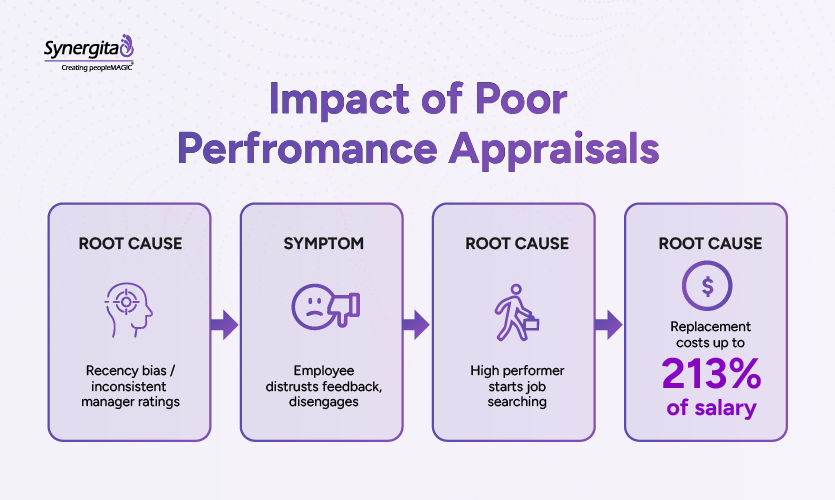
Here are the common consequences. These appraisal problems can impact engagement, productivity, and retention.
Lower employee engagement
Unclear expectations, inconsistent ratings, and poor feedback reduce trust and motivation, making employees less engaged in their work.
Reduced productivity
Without continuous feedback and clear goals, employees struggle to improve, leading to lower individual and team performance.
Higher turnover
When employees don’t trust the appraisal process, retention suffers, hiring costs rise, and team stability becomes harder to maintain.
Poor promotion and succession planning
Inaccurate evaluations make it difficult to identify and develop high-potential employees, resulting in weaker leadership pipelines.
Legal and compliance risks
Poor documentation and inconsistent evaluations can lead to disputes and increase the risk of legal and compliance issues.
Case Study: How Repos Energy Built a Scalable, Role-Based Appraisal System with Synergita
Final takeaway
Performance reviews rarely fail because of one bad manager or employee. Appraisal challenges become costly when they’re left unresolved. Start by addressing the issues that affect review quality, such as inconsistent ratings, unclear expectations, and limited feedback. Solving these first can improve decision-making, increase employee trust, and reduce administrative effort.
If you’re ready to move beyond annual reviews, Synergita Perform helps you connect goals, continuous feedback, and evidence-based evaluations in one platform.
Start a 14-day free trial to see how your existing appraisal process can become more accurate, consistent, and effective.
Frequently Asked Questions
The biggest appraisal challenges include unclear rating criteria, manager bias, inconsistent feedback, poor documentation, and annual review cycles that rely on memory instead of continuous performance data. These issues reduce appraisal accuracy, weaken employee trust, and make it harder to identify, reward, and develop high performers.
The most common problems in performance appraisal include recency bias, subjective ratings, inconsistent evaluations across managers, weak performance documentation, and limited employee feedback. These performance appraisal problems result in unfair ratings, lower engagement, and poor promotion or compensation decisions.
Appraisal failure usually occurs when managers lack training, rating criteria are unclear, and reviews are conducted only once a year. Without continuous feedback, goal tracking, and documented performance evidence, employees often perceive the process as subjective and unhelpful.
Organizations can reduce challenges in performance appraisal by defining clear performance standards, training managers, conducting regular check-ins, documenting performance throughout the year, and using 360-degree feedback. Continuous performance management creates more consistent, transparent, and evidence-based evaluations.
Unresolved appraisal challenges can reduce employee trust, lower engagement, and increase voluntary turnover. When high performers believe evaluations are unfair or inconsistent, they are more likely to seek opportunities elsewhere, increasing recruitment, onboarding, and replacement costs for the organization.
Performance management software helps solve appraisal problems by replacing annual reviews with continuous feedback, goal tracking, performance documentation, automated reminders, and analytics. These features reduce bias, improve rating consistency, and give managers evidence-based insights for fairer performance reviews.
Employees may discuss areas of improvement or weaknesses as part of appraisal conversations. These discussions help identify development needs and create plans for improving performance.

Thank you for sharing this amazing blog by Dr Sullivan. It would have been hard for to come across it if you’d not shared it here. These problems indeed trouble many companies at large.
The pleasure is ours, Jonni! The idea of sharing this blog was to educate more people about these problems.
Every employee face plenty of problems during their appraisals. And Hr’s also faces problems during employee’s appraisals. Becuase they have to manage their performance and it is not an easy task but with the help of Hr and Payroll software https://goo.gl/hUdkoY , HR’s can manage it.
Nice write-up. As yes every employee face many problem during their performance appraisal. The information you have shared is informative and is dominant. One should have to go through this blog for there better. Keep doing great job.