
A hospital unit runs short-staffed for months. Leadership tries a new schedule, then a hiring push, then a bonus for working extra hours. But none of these addresses the issues of high turnover.
The financial impact of high RN turnover can be significant. Hospitals lost an average of $5.19 million annually to RN turnover in 2025, according to the NSI National Health Care Retention & RN Staffing Report.
Addressing issues like burnout, unclear expectations, and inefficient workflows can improve employee performance and retention in the healthcare industry.
In this guide, we explain why performance improvement is important to the healthcare industry, how to implement it, and the challenges that can affect results.
| TL;DR Healthcare institutions can deliver better patient care by identifying and addressing clinical and operational performance gaps. By continuously refining processes, they can improve efficiency, reduce costs, and enhance the patient experience. Strengthening workforce performance, accountability, and cross-functional collaboration helps healthcare organizations achieve sustainable improvements and better outcomes. |
| Table of contents 1. What is performance improvement in healthcare? 2. Why is performance improvement essential in healthcare? 3. How to build a high-performance healthcare system? 4. 7 Steps to implement a healthcare performance improvement program 5. 5 Challenges in implementing performance improvement in healthcare 6. Quick checklist for performance improvement in healthcare 7. Final takeaway 8. Frequently asked questions |
What is performance improvement in healthcare?
Performance improvement (PI) in healthcare is a systematic approach to identifying gaps in healthcare and operations, testing changes, and measuring whether those changes improve results. It focuses on improving patient outcomes experience and operational efficiency.
Healthcare organizations need to continuously examine processes, collect and analyze performance data, identify areas for improvement, and adjust their approach based on the results.
Why is performance improvement essential in healthcare?
Performance improvement in healthcare improves clinical outcomes, workforce performance, operational efficiency, and financial performance. It provides a structured approach to identifying performance gaps, improving processes, and measuring whether changes produce better results.
Performance improvement can benefit healthcare organizations in several areas.
1. Align teams around shared goals
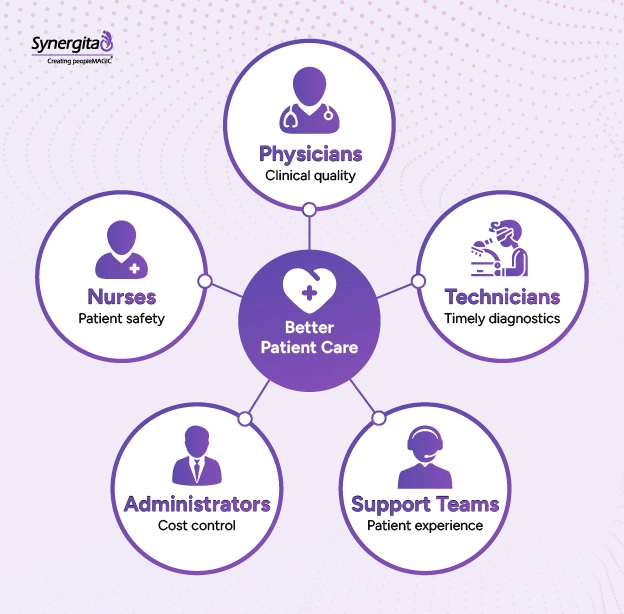
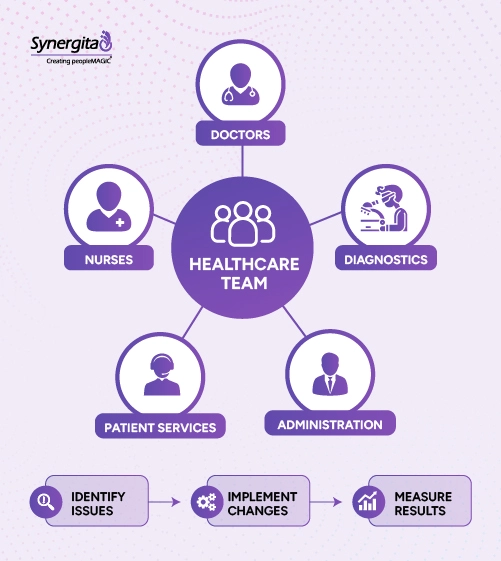
Healthcare involves physicians, nurses, technicians, administrators, and support teams working across different functions. Setting shared goals helps connect individual responsibilities with broader priorities such as patient safety, timely care, staff retention, and cost control.
2. Improve clinical and operational efficiency
Quality and performance improvement in healthcare helps teams examine how work moves through a process and identify delays, duplication, unnecessary steps, and resource constraints. AHRQ case studies on Lean principles in healthcare show that workflow redesign can improve efficiency, productivity, and patient satisfaction.
3. Support staff engagement and retention
Healthcare performance depends on the people delivering and supporting care. Giving staff regular feedback, involving them in improvement projects, and addressing workflow problems can create better working conditions.
In 2025, 41.9% of physicians reported at least one symptom of burnout, according to the AMA, showing why workforce experience should remain part of improvement efforts.
4. Strengthen patient outcomes and experience
Performance improvement healthcare focuses on measures such as medication safety, readmissions, wait times, care coordination, and patient experience. AHRQ notes that patient experience measures can also reveal problems with communication, delays, and other system issues that affect quality and efficiency.
5. Support data-based decisions
Healthcare leaders need reliable measures to understand whether an improvement step is working. Tracking performance indicators over time helps teams identify performance gaps, test changes, and decide where additional resources are needed. AHRQ recommends selecting quality improvement measures that guide implementation and reviewing data regularly to assess changes in care delivery.
6. Reduce avoidable costs and waste
Inefficient processes can consume staff time, equipment, supplies, and other resources without improving care. A JAMA analysis estimated annual waste in the US healthcare system at $760 billion to $935 billion, highlighting the financial opportunity for organizations that reduce unnecessary spending.
7. Improve communication across departments
Patients move between departments, teams, and care settings. Poor communication can create delays, duplicated work, and gaps in care. Performance improvement initiatives can establish shared measures, clearer responsibilities, and better handoffs between teams.
How to build a high-performance healthcare system
A high-performance healthcare system needs three foundations: reliable performance data, clear ownership, and standardized processes. These elements give teams the information and structure needed to identify gaps, implement changes, and track results.
1. Build a data-driven performance system: Centralize data from multiple sources to get a clear view of your organization’s performance. By combining patient data, operational metrics, and staff feedback, healthcare teams can accurately assess where improvements are needed.
A strong analytics system can help leaders make informed decisions, monitor performance trends, and track improvement over time.
2. Establish clear ownership: Assign ownership for each improvement initiative and give teams clear responsibilities, targets, and decision-making authority. Clear accountability helps ensure that performance initiatives move beyond planning and become part of everyday operations.
3. Implement industry best practices: Adopting industry best practices across your healthcare system helps standardize care delivery and improve efficiency. By identifying and implementing proven methods in specific areas, you can ensure a higher level of service while minimizing errors and inefficiencies.
7 Steps to implement a healthcare performance improvement program
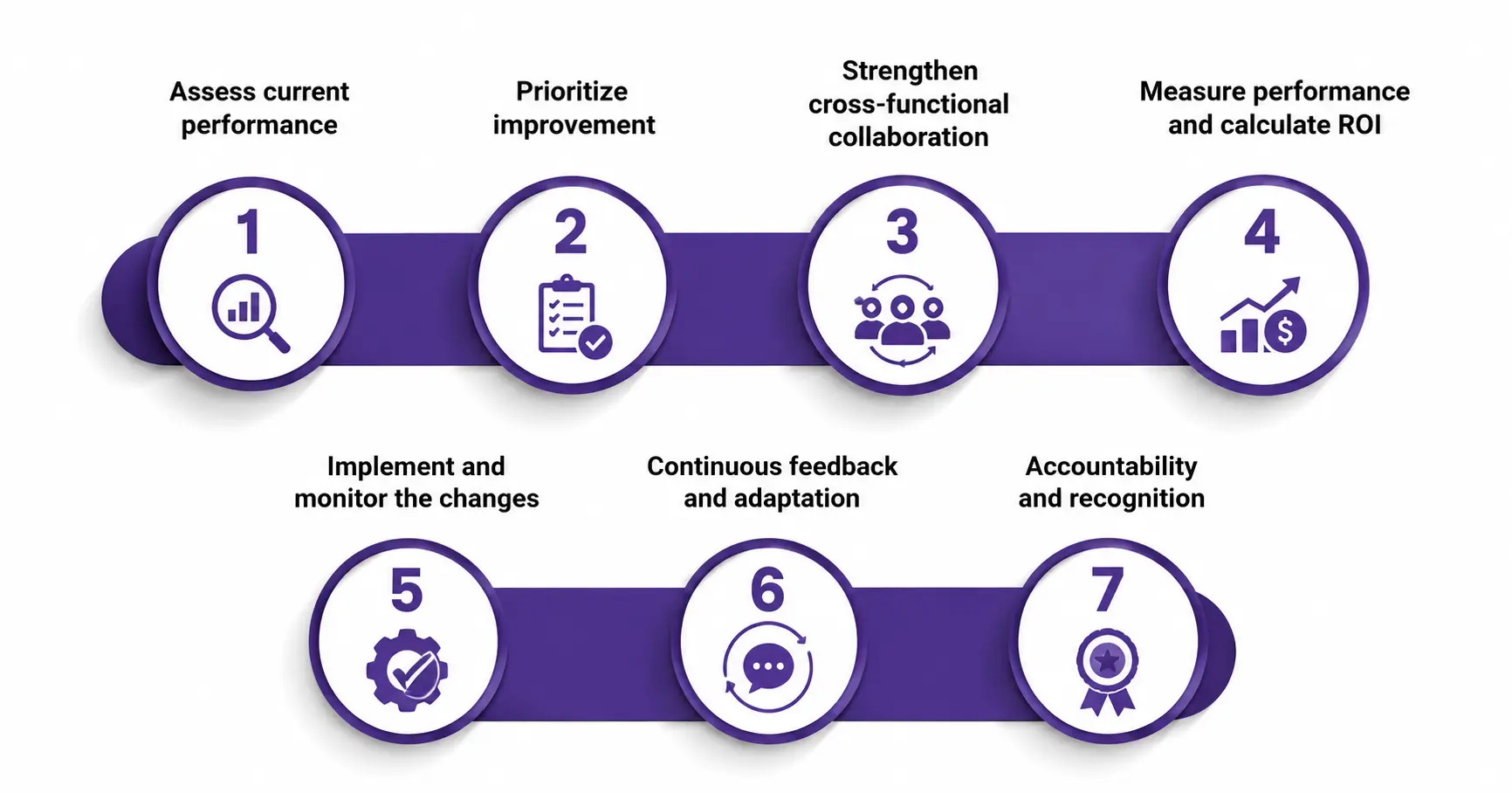
A performance improvement plan in healthcare should identify measurable gaps, set clear goals, assign accountable teams, track relevant KPIs, and establish a process for reviewing and refining changes.
Use these seven steps to plan, implement, and measure a healthcare performance improvement program.
1. Assess current performance
The first step in a healthcare performance improvement program is to assess current performance across clinical, operational, financial, and workforce measures. Measuring the baseline helps teams determine where healthcare performance improvement efforts should focus.
Measuring the baseline helps teams determine where health care performance improvement efforts should focus.
Depending on the organization’s priorities, this could include patient wait times, readmission rates, medication errors, staff turnover, patient satisfaction, or operating costs. Establishing baseline measurements also gives teams a reference point for evaluating future progress.
2. Prioritize improvement
Healthcare organizations may have several performance gaps. Rank improvement opportunities according to their impact on patient care, operational performance, workforce needs, cost, and implementation feasibility.
Prioritizing projects based on patient impact, feasibility, cost, and available resources helps teams direct effort where it is most needed.
3. Build cross-functional improvement teams
A performance improvement program requires leadership at every level. Assigning cross-functional teams responsible for each initiative ensures that each project gets the attention and resources it needs. Strong cross-functional communication also helps these teams share information, coordinate decisions, and address issues across departments.
These teams should include healthcare professionals from various departments, who can bring diverse perspectives to the table. Give these teams the authority to make decisions and implement changes.
4. Measure performance and calculate ROI
Each initiative should have a specific outcome and a way to measure progress. Set a baseline, define the target, and establish a timeframe for achieving it.
For example, an emergency department improvement project could aim to reduce average patient wait time from 90 minutes to 60 minutes within six months. Relevant KPIs give teams a clear way to determine whether an intervention is producing the expected result.
5. Implement and monitor the changes
Put the selected improvement into practice and track the relevant KPIs throughout implementation. Compare current results with the baseline to identify whether performance is improving, declining, or remaining unchanged.
If a new discharge process reduces delays but creates additional documentation work for nurses, the team can investigate the issue and adjust the process. Regular monitoring allows teams to address unintended effects before they become larger problems.
6. Continuous feedback and adaptation
Regular feedback helps teams identify performance issues, make adjustments, and respond to changing needs. A continuous feedback culture also gives employees opportunities to share what is working, what is not, raise concerns, and suggest improvements.
7. Accountability and recognition
Performance improvement requires clear ownership at every level. You should assign owners to each improvement goal, define their responsibilities, and review progress against agreed targets.
Give teams regular opportunities to:
- Report barriers
- Suggest changes
- Performance review data
At the same time, recognize and celebrate successes. Acknowledging progress motivates teams to keep pushing for improvement. Recognition can also improve employee engagement and retention, which are critical in high-stress healthcare environments.
5 Challenges in implementing performance improvement in healthcare
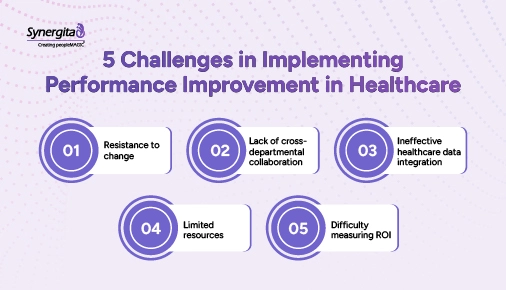
Healthcare organizations can face several barriers when implementing performance improvement initiatives. Common issues include resistance to new processes, disconnected departments, fragmented data, limited resources, and difficulty measuring results.
Resistance to change
Healthcare teams may hesitate to adopt new processes or technologies, especially when they are used to established systems and workflows. Clear communication, practical training, and involving staff in the improvement process can make new changes easier to adopt.
Lack of cross-departmental collaboration
Performance improvement involves multiple departments, but teams may work with different priorities, processes, and performance measures. Setting up shared goals, clear responsibilities, and regular communication can help teams collaborate better.
Ineffective healthcare data integration
Healthcare organizations may rely on multiple systems for clinical, operational, financial, and workforce information. When these systems do not connect effectively, teams can struggle to access reliable data, compare performance, and make timely decisions.
Limited resources
Staffing shortages, budget constraints, and competing operational priorities can make it difficult to dedicate enough time and people to improvement initiatives. Organizations need to prioritize projects based on their expected impact and available resources.
Difficulty measuring ROI
Some improvements, such as better patient experience or staff engagement, may not produce immediate financial returns. Defining relevant KPIs, establishing baseline measurements, and tracking results over time can help organizations evaluate whether an initiative is delivering the expected outcomes.
Addressing these barriers early can help healthcare organizations maintain momentum and turn performance improvement initiatives into measurable changes in care delivery and operations.
Quick checklist for performance improvement in healthcare
Use this checklist to assess whether your performance improvement program has the core elements needed to produce measurable results:
☐ Identify performance gaps using clinical, operational, financial, and workforce data.
☐ Set measurable goals with clear baselines, targets, and timelines.
☐ Assign accountable teams with defined roles and decision-making authority.
☐ Align departments around shared goals to improve communication and coordination.
☐ Track relevant KPIs such as wait times, readmissions, staff turnover, and patient satisfaction.
☐ Collect regular feedback from healthcare teams involved in the improvement of the healthcare process.
☐ Review performance data to determine whether interventions are producing the expected results.
☐ Address implementation barriers such as resistance to change, resource constraints, and disconnected systems.
☐ Document successful performance improvement in health care so effective practices can be adopted across other teams.
☐ Recognize progress and maintain accountability to keep improvement efforts moving forward.
Final takeaway
Performance improvement in healthcare institutions helps them improve patient care, workforce performance, and operational efficiency. By setting measurable goals, monitoring relevant KPIs, and addressing process gaps, healthcare teams can achieve intended goals.
The right technology can make this process easier by bringing goals, employee performance data, feedback, and progress tracking into one place. For healthcare organizations looking to strengthen these areas, Synergita’s performance management software can support goal alignment, ongoing feedback, and performance tracking across teams.
Book a demo and explore how Synergita can support your healthcare performance improvement efforts.
Frequently asked questions
Performance improvement can help healthcare organizations reduce process delays, improve patient outcomes, support staff performance, and control avoidable costs. The results depend on the goals selected, the measures used, and how effectively teams implement and monitor changes.
Healthcare organizations can use analytics and reporting tools, performance management software, goal setting platforms to improve patient outcomes and experience and reduce costs.
Healthcare leaders can evaluate projects based on patient impact, operational needs, feasibility, cost, and available resources. This helps healthcare leaders determine which performance gaps require immediate attention and which can be addressed later.
Cross-departmental collaboration helps teams coordinate changes that affect multiple stages of care delivery. Shared goals, clear responsibilities, and regular communication can reduce duplicated work, improve handoffs, and give teams a common view of performance.
Process improvement in healthcare involves reviewing clinical and administrative workflows to remove unnecessary steps, reduce errors, improve efficiency, and support better care delivery. A process improvement healthcare initiative may involve mapping workflows, identifying bottlenecks, testing changes, and measuring the results.
Performance indicators in healthcare are measurable values used to evaluate care quality, operational efficiency, workforce performance, or financial results. Examples include patient wait times, readmission rates, medication errors, patient satisfaction, staff turnover, absenteeism, and cost per case.
A performance improvement plan in healthcare defines the performance gap, desired outcome, responsible teams, KPIs, timeline, and actions required to improve results. Reviewing the plan against baseline data helps healthcare leaders determine whether the intervention is producing the expected outcome.