



TL;DR
- Continuous feedback culture significantly boosts engagement and performance; 84% of employees feel more engaged with quick feedback.
- Leaders must create psychological safety so employees view feedback as constructive rather than punitive; clear expectations help make feedback timely, specific, and actionable.
- Feedback should be part of everyday work through regular check-ins, project retrospectives, and real-time exchanges, while managers focus on coaching, and 360-degree feedback enhances collaboration.
- Leveraging technology helps businesses maintain a continuous feedback culture by capturing insights, tracking participation, and ensuring data-driven decision-making.
Timely and continuous feedback shapes employees’ everyday performance and boosts engagement. In fact, 84% of employees say they feel more engaged when they receive quick feedback. But can continuous feedback be implemented easily?
Most teams think building a feedback culture is simple: just tell people to share feedback more often, and the rest will follow.
But in reality, it rarely works that way. You try rolling out a new feedback process, send a few reminders, maybe even run a training session, and for a short while, it looks like things are moving. Then participation slows, conversations stop, and feedback slips back into once-a-year reviews.
So how do you build a continuous feedback culture as a part of everyday work? This blog provides actionable steps to successfully adopt a culture of continuous feedback in your organization.
| Table of Contents 1. How to Build a Continuous Feedback Culture: A Step-by-Step Method 2. Why Building a Culture of Continuous Feedback Is Important? 3. Common Challenges in Building a Culture of Feedback and How to Solve Them 4. Conclusion 5. Frequently Asked Questions |
How to Build a Continuous Feedback Culture: A Step-by-Step Method
Implementing a continuous feedback culture requires a clear strategy. Here are the steps to incorporate it in today’s business environment.
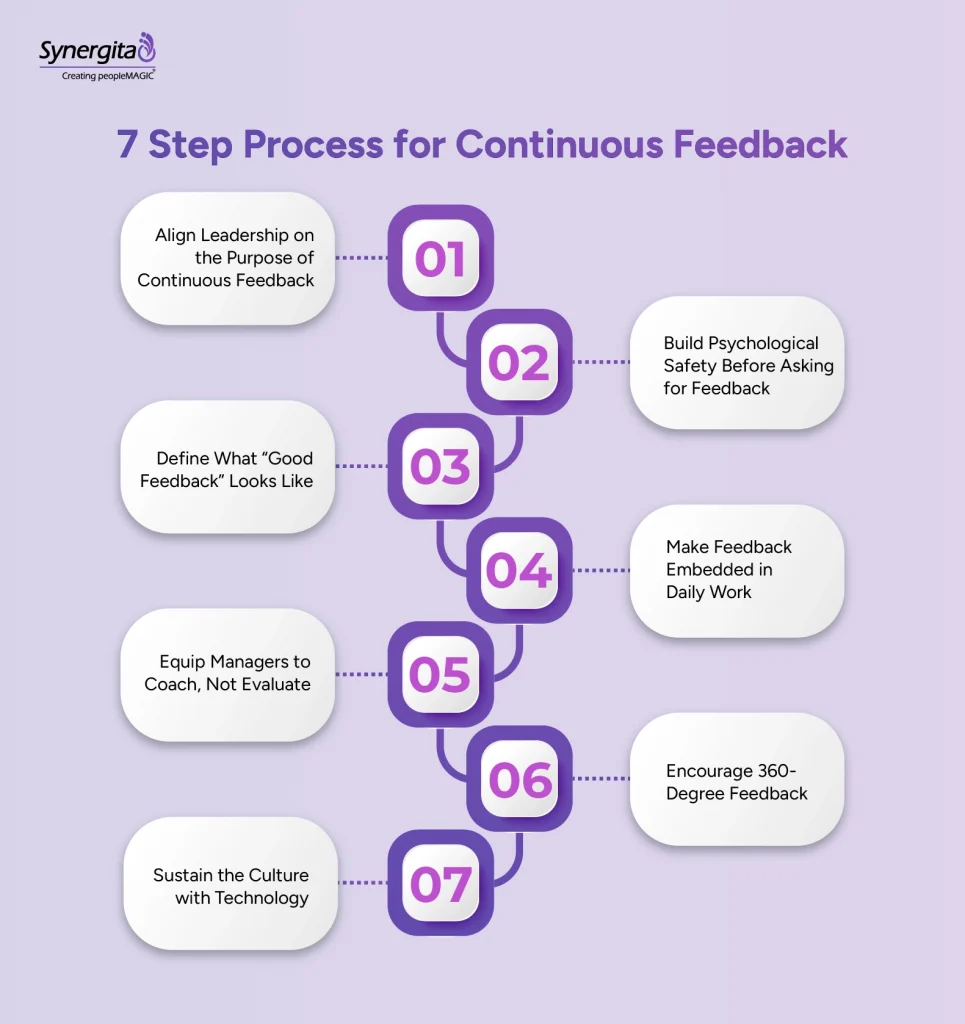
1. Align Leadership on the Purpose of Continuous Feedback
Creating a continuous feedback culture should start at the top, as leadership culture strongly influences how feedback is perceived and practised. Leaders need to present feedback as a tool for growth and learning, not as a way to monitor or control performance.
When leaders openly ask for and share feedback, it normalizes the idea that feedback is part of everyday work and sets expectations for the rest of the organization.
To ensure leadership alignment:
- Establish organization-wide principles that explain why continuous feedback is important and how it connects to business outcomes.
- Ask leaders to openly share how feedback has shaped their thinking or actions.
- Keep feedback expectations consistent across leadership messaging and day-to-day communication.
Also Read: How Leadership Shapes Culture and Organizational Structure
2. Build Psychological Safety Before Asking for Feedback
A culture of continuous feedback cannot exist without psychological safety. Employees and managers need to feel comfortable sharing and receiving honest input without fear of negative consequences. Psychological safety creates an environment where feedback is viewed as constructive conversation rather than criticism.
Companies can build psychological safety by focusing on a few practical actions:
- Encouraging leaders to invite dissenting viewpoints during discussions.
- Responding to feedback with curiosity rather than defensiveness.
- Reinforcing that mistakes are learning opportunities, not failures.
3. Define What “Good Feedback” Looks Like
Many organizations struggle with feedback because people are not sure what it actually means. Without clear expectations, feedback can become vague and delayed, causing employees to ignore it.
According to Gallup, when employees receive meaningful feedback at least once a week, engagement levels rise sharply, with around 80% reporting they feel fully engaged, regardless of the location. A continuous feedback culture can be successfully implemented when it is timely, specific, and actionable.
To standardize feedback quality:
- Introduce simple, effective feedback models to improve the quality of feedback.
- Provide examples of effective and ineffective feedback.
- Reinforce that feedback should focus on observable behaviors and outcomes.
4. Make Feedback Embedded in Daily Work
To ensure feedback is continuous, it must be integrated into everyday workflows rather than treated as a periodic exercise, a core principle of agile performance management. When team members exchange feedback as work is in progress, they can correct mistakes, learn more quickly, and stay on track.
Here are the ways to integrate feedback into the workflow:
- Incorporate feedback into weekly or bi-weekly one-on-one meetings.
- Use retrospectives after every project to implement immediate learnings in the next project.
- Encourage informal, real-time feedback after key interactions.
5. Equip Managers to Coach, Not Evaluate
Managers play a key role in implementing and sustaining a culture of feedback. When managers focus solely on evaluation, team members feel uncomfortable and do not participate in the feedback conversations. A coaching mindset helps to focus on development, problem-solving, and future improvement, making employees feel comfortable and engaged.
To ensure managers work like coaches, organizations should:
- Train managers in coaching-based feedback techniques.
- Encourage forward-looking feedback rather than retrospective judgment.
- Provide a safe environment for managers to practice giving feedback.
6. Encourage 360-Degree Feedback
A continuous feedback culture is more effective when it isn’t limited to managers alone. When peers and cross-functional teams share feedback openly, it improves collaboration and accountability. This is important for projects that involve multiple teams, where success depends on how well people work together, not just on individual performance.
The best way to encourage 360-degree feedback is:
- Normalize peer feedback during collaborative projects.
- Recognize and reward constructive peer feedback behaviors.
- Provide simple mechanisms for sharing peer insights
Also Read: Benefits of 360-degree Feedback – A Complete Guide
7. Sustain the Culture with Technology
Without visibility and reinforcement, feedback practices can fade over time. Modern technologies like performance management systems help institutionalize feedback by making it easy to capture insights, track patterns, and close feedback loops at scale.
To sustain momentum:
- Use feedback data to identify trends and improvement areas.
- Track participation and feedback frequency to monitor adoption.
- Share insights transparently to reinforce accountability.
Why Building a Culture of Continuous Feedback Is Important?
Continuous feedback ensures faster and real-time performance improvement, better employee engagement, strategic goal alignment, improved manager effectiveness, and better decision-making.
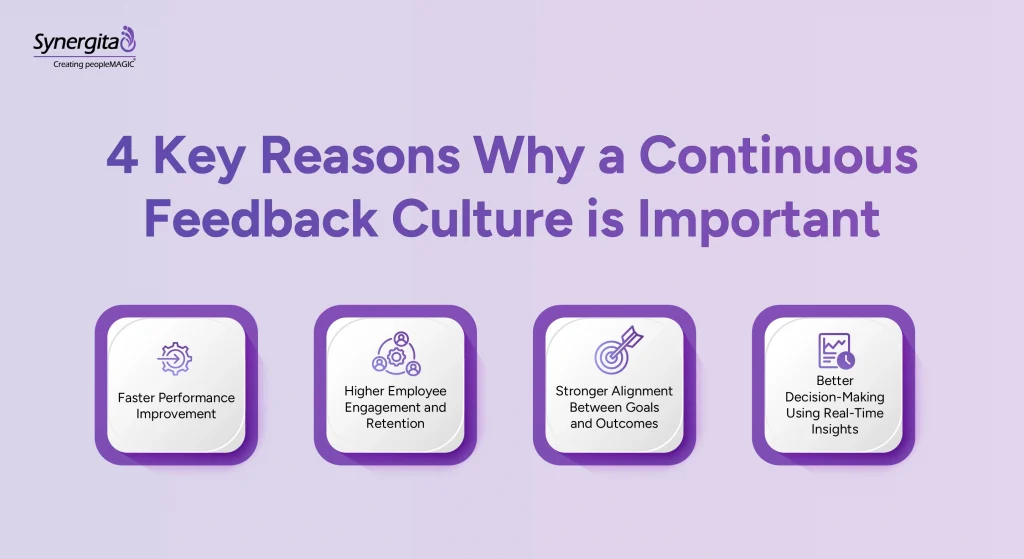
1. Faster Performance Improvement
When feedback is provided in real-time, employees can act immediately on observations rather than waiting months. This reduces errors and helps teams continuously improve outcomes rather than waiting until the end of the quarter or year.
2. Higher Employee Engagement and Retention
Employees who receive meaningful feedback at least weekly are far more engaged than those who don’t. Gallup Research shows that 80% of employees who received meaningful feedback in the past week reported they were fully engaged. Regular feedback improves motivation, strengthens the employee experience, and helps retain employees longer.
Also Read: 9 Ways to Enhance Employee Experience
3. Stronger Alignment Between Goals and Outcomes
Continuous feedback keeps goals visible and expectations aligned across teams. Regular conversations also help connect daily work to defined outcomes and reduce the gap between execution and business priorities. Employees can understand how their efforts contribute to the company’s goals.
4. Better Decision-Making Using Real-Time Insights
Regular feedback gives leaders reliable data to understand what is moving and what is stuck. They can also find which skills or capacity gaps are slowing execution. Instead of waiting for end-of-quarter reviews, managers can make earlier decisions about priorities, resources, and development before performance issues affect outcomes.
Common Challenges in Building a Culture of Feedback and How to Solve Them
Building a feedback culture is challenging, and many organizations struggle to implement it effectively. Here are the most common challenges teams face and how to address them.
1. Feedback Fatigue
When feedback is too frequent, vague, or process-heavy, employees start skipping it, and participation drops.
Solution: Keep feedback brief, relevant, and tied to real work and avoid turning every interaction into a formal review cycle.
2. Manager Inconsistency
Some managers may give regular feedback, while others avoid it, leading to uneven experiences across teams.
Solution: Set clear expectations for feedback frequency and quality. Provide simple guidelines and support, such as prompts or check-ins, instead of strict processes.
3. Lack of Follow-Through
In many organizations, feedback is shared, but feedback loops are not closed, discouraging employees from speaking up again.
Solution: Acknowledge feedback, agree on next steps, and communicate what will change. Even when action is not possible, explaining the reason builds trust.
4. Fear of Consequences
Many employees hesitate to be honest when giving feedback due to fear of judgment or consequences, leading to surface-level input.
Solution: Separate feedback from performance ratings and encourage managers to ask for feedback first. The way leaders respond can impact how employees share feedback.
5. Poor Adoption
When feedback feels like an extra task or its value is unclear, teams stop using it, and it becomes just another process that no one is interested in.
Solution: Link feedback directly to outcomes teams care about, such as execution speed, goal clarity, or development. Start with a small group, demonstrate its impact, and integrate feedback into existing meetings.
Conclusion
Building a continuous feedback culture means making feedback a natural part of how work is done, decisions are made, and teams improve. When feedback is specific and provided on time, it creates clarity, trust, and momentum across the organization.
However, without the right system, maintaining consistency is difficult. This is where Synergita Performance Management Software helps teams incorporate feedback into everyday workflows through regular check-ins, structured conversations, and clear follow-through.
If you want to move feedback from intention to impact, explore how Synergita can help your teams build a continuous feedback culture. Start a free trial to see how it works in practice.
Frequently Asked Questions
A continuous feedback culture is an approach to sharing regular, real-time feedback rather than relying solely on annual or quarterly reviews. It helps employees improve performance, correct mistakes early, and stay aligned with expectations.
Continuous feedback improves clarity, reduces rework, and strengthens accountability. When feedback is given on time, teams can act faster and make decisions based on real-time insights rather than assumptions.
Feedback should be given regularly through quick check-ins, project-based feedback, or weekly conversations. The goal is consistency and relevance, not formal sessions.
You can build a continuous feedback culture by setting clear goals, focusing on outcomes instead of tasks, trusting teams to execute, and encouraging them to implement the feedback in the next sprint or project.
You can use modern performance management tools that support regular check-ins and a structured feedback process to make it easier to sustain a continuous feedback culture.