
A company can have well-defined objectives and still miss its targets when teams lack visibility into progress, ownership, and changing priorities. As priorities change and teams work across different tools, leaders lose visibility into whether key objectives are moving forward or quietly falling behind.
OKR software for businesses helps create a centralized system that connects strategic objectives to measurable results, tracks progress regularly, and identifies execution gaps before they affect business outcomes.
In this blog, we compare the top OKR software platforms for businesses in 2027, based on usability, scalability, integrations, reporting capabilities, AI features, and pricing to help you find a solution that matches your team’s needs and growth plans.
| TL;DR Compare the best OKR software for businesses based on features, pricing, AI capabilities, and scalability.Identify the right platform for your business size, workflows, and long-term growth goals. Use a practical evaluation checklist to avoid costly implementation and adoption mistakes. Make a confident software decision with side-by-side comparisons of the top OKR tools in 2027. |
| Table of Contents 1. What are the best OKR software platforms for businesses? 2. Why businesses need OKR software today 3. How OKR software improves business performance 4. How to choose the right OKR software for your business 5. Final takeaway 6. Frequently asked questions |
What are the best OKR software platforms for businesses?
The best OKR tools for companies aren’t defined by the longest feature list; they’re defined by how well they fit your business. Your team size, growth plans, and whether you need a dedicated OKR platform or a broader performance management suite should shape your decision.
Here’s how the leading OKR platforms compare.
| Software | Best For | Starting Price |
| 1. Synergita OKR | Businesses of any size that need Cost-effective OKR platform | $3/user/month (Free plan available for up to 3 users)Free trial for 14 days |
| 2. Lattice | OKRs with performance management and employee reviews | $11/seat/month |
| 3. Betterworks | Managing OKRs alongside enterprise performance processes | Quote-based pricing |
| 4. WorkBoard | Connecting strategy execution with operational business data | Quote-based pricing |
| 5. Profit.co | Organizations needing OKRs, KPIs, and strategy execution | Quote-based pricing |
| 6. Weekdone | OKRs with simple weekly planning and progress tracking | $10/user/month |
1. Synergita OKR
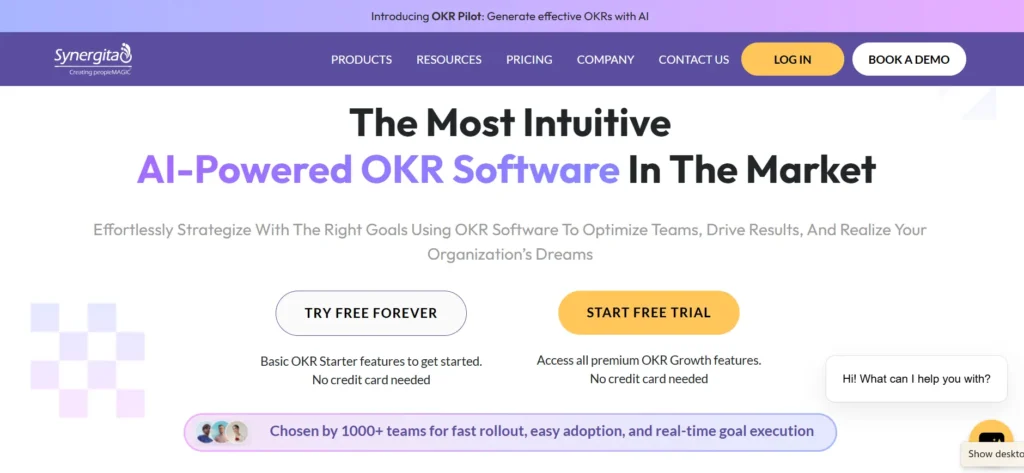
Synergita OKR software works well for growing businesses that want a dedicated OKR platform to align strategy with execution. By using flexible goal alignment, early progress insights, and native integrations, it helps teams connect company goals with individual execution through cascading objectives, hierarchy visibility, and structured check-ins.
Why choose this platform
- Suitable for businesses looking for a dedicated OKR platform with affordable pricing and room to scale.
- Supports both cascading and flexible goal alignment to accommodate different organizational structures.
- Offers an affordable alternative to enterprise-grade OKR platforms for organizations with straightforward goal management needs.
Core capabilities
- AI-generated, context-aware OKR suggestions
- Hierarchy tree dashboards for real-time, org-wide progress visibility
- Native integrations with Jira, Microsoft Teams, Slack, and HRIS tools
- Flexible OKR structures and check-in cadence
Synergita OKR pricing
Synergita provides affordable pricing plans for businesses looking to adopt dedicated OKR software.
| Plan | Price | Key Features |
| OKR Starter | Free forever | Up to 3 users, basic dashboards, OKR templates |
| OKR Lite | $3/user/month (annual) | Unlimited users & objectives, approval workflows, hierarchy tree |
| OKR Growth | $6/user/month (annual) | AI OKR Pilot, cascading OKRs, Jira/Teams/Slack/HRIS integrations, SSO |
2. Lattice
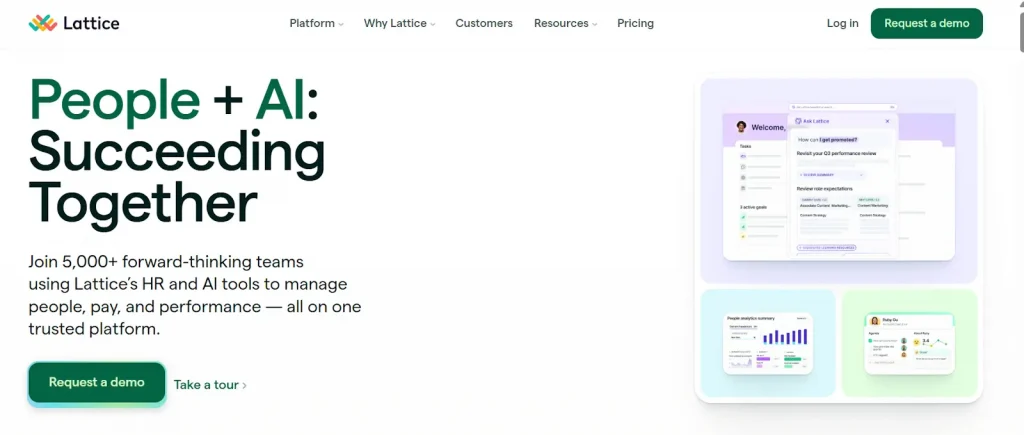
Taking an integrated approach to goal and performance management, the platform links OKR progress with reviews, feedback, and employee development. It is well-suited for organizations looking for goal management, performance evaluations, and employee development to operate within a single system.
Why choose this platform
- Well-suited for organizations that want to manage goals and employee performance within a single platform.
- Helps HR teams connect business objectives with employee development.
- A good choice for companies that prioritize continuous feedback, structured reviews, and long-term talent growth alongside OKRs.
Core capabilities
- Team and individual OKR tracking tied to review cycles
- Continuous feedback and praise mechanisms
- Customizable review templates, including 360-degree feedback
- Slack, BambooHR, and HRIS integrations
Pricing model:
- Pricing depends on the selected products
- Goals & OKRs starts at $8 per seat/month
- Performance + Goals & OKRs bundle starts at $13 per seat/month.
- Employee engagement and compensation are available as add-ons
- Custom enterprise pricing
3. Betterworks
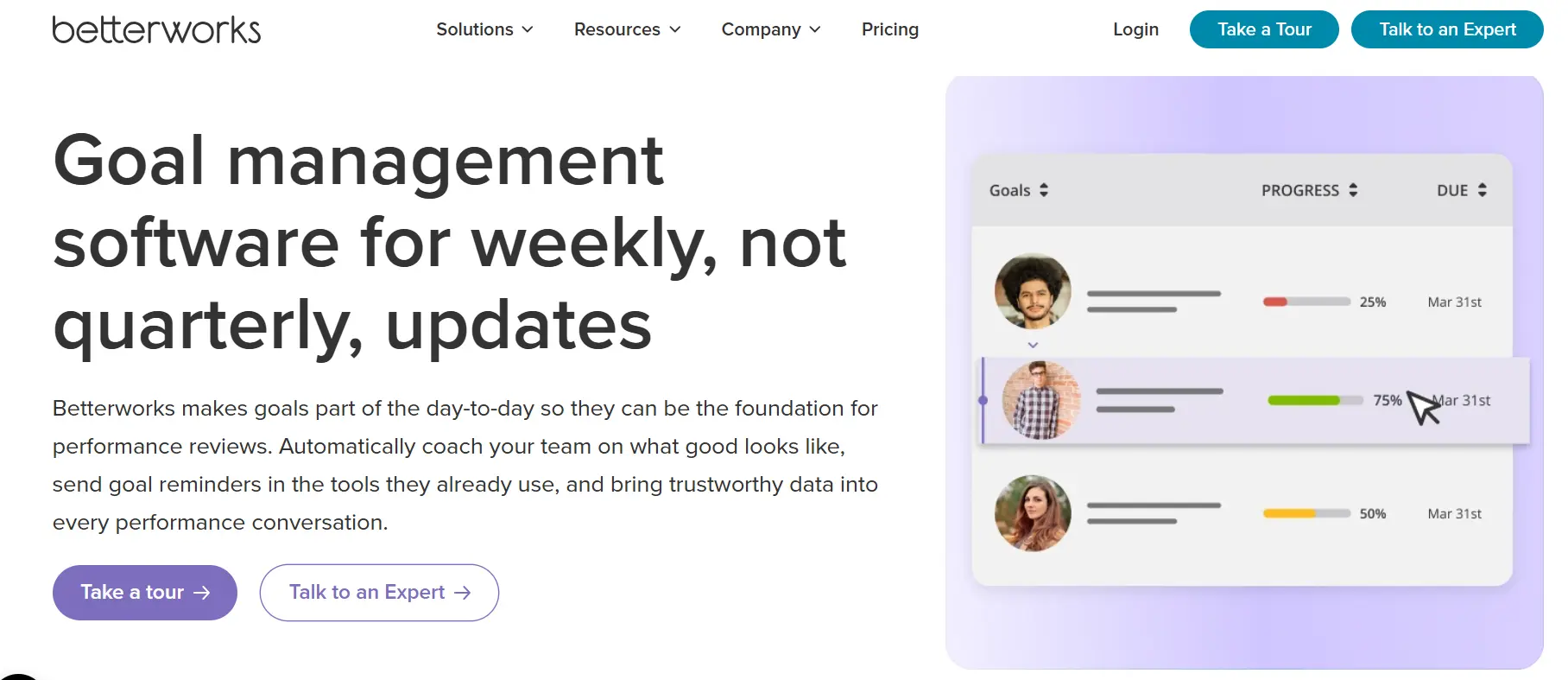
Focused on enterprise performance management, Betterworks includes OKR functionality alongside continuous feedback and employee development tools. It is designed for enterprises looking for a unified approach to strategy execution and employee performance.
Why choose this platform
- Built for large enterprises managing goal alignment across multiple business units and global teams.
- Suitable for organizations with mature performance management processes and complex governance requirements.
- Helps leadership maintain strategic alignment while supporting large-scale organizational change and execution.
Core capabilities
- Cascading goal hierarchies across large, complex org structures
- AI-generated performance insights and flight-risk indicators
- Calibration module with visual distribution curves
- External feedback loops for client-facing roles
Pricing model:
Betterworks uses custom, quote-based pricing that varies based on an organization’s size, requirements, and selected modules.
4. WorkBoard
For organizations managing complex strategies at scale, WorkBoard offers a platform designed to connect OKRs directly to live operational data rather than being manually updated. Its 2025 acquisition of Quantive consolidated two of the largest enterprise OKR players into one platform.
Why choose this platform
- Designed for enterprises executing complex strategic initiatives across multiple business units.
- Helps leadership connect strategic priorities with measurable execution across the organization.
- Good for companies that need executive visibility into business performance and strategic progress.
Core capabilities
- Automated reporting from connected data sources
- Dynamic scorecards and AI-generated action plans
- Broad integration catalog, including Jira, Salesforce, and HRIS platforms
- Enterprise-scale rollout support
Pricing model:
Custom quote-based pricing based on requirements
5. Profit.co
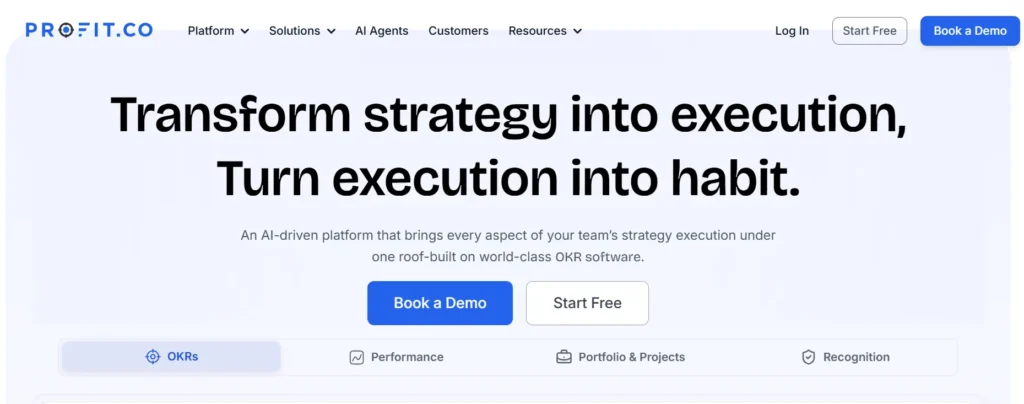
Profit.co is an OKR management platform that supports goal setting with additional strategy-execution capabilities, including Balanced Scorecards, project portfolio management, and performance management. It is designed for organizations looking for a broader approach to managing goals, KPIs, and business initiatives.
Why choose this platform
- Suitable for organizations that want to manage OKRs, KPIs, and strategic initiatives from one platform.
- Works well for leadership teams that measure both strategic outcomes and operational performance together.
- A practical choice for businesses looking to standardize goal management across departments without using separate strategy tools.
Core capabilities
- OKR creation, cascading, and KPI templates
- Customizable Balanced Scorecards
- Project portfolio management features
- AI-powered insights for identifying goal risks
Pricing model: Custom quote-based pricing based on requirements
6. Weekdone
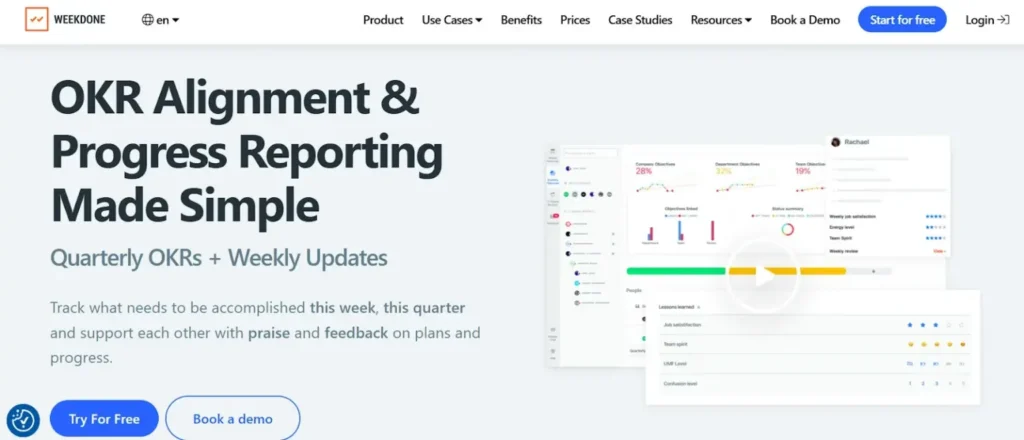
Designed for teams that prefer a simpler OKR approach, Weekdone provides goal tracking, weekly check-ins, and alignment views without the wider feature set of enterprise performance platforms.
Why choose this platform
- Ideal for mid-sized businesses looking for an easy-to-adopt OKR solution.
- Combines quarterly OKRs with structured weekly planning to help teams build consistent execution habits.
- Provides implementation guidance and OKR coaching resources to help teams establish effective goal-setting practices.
Core capabilities
- Company, team, and individual-level OKR tracking
- Weekly planning and automatic progress reports
- Built-in OKR coaching resources
- Third-party integrations for collaboration tools
Pricing Model:
- Free plan for up to 3 users
- Paid plans are based on team size, with pricing ranging from $3.75 to $9/user per month for teams of 4–500 people
- Customer pricing for 500+ users
Why businesses need OKR software today
Dedicated OKR software is important because goals that live outside a shared system quietly stop being goals. They become a document nobody revisits until the next planning cycle. The right business OKR software fixes that by making progress visible every week, not just every quarter.
Challenges of managing goals without dedicated software
Without a structured goal management software system, growing teams run into the same four problems on repeat:
Misaligned priorities
Teams create goals separately, causing individual objectives to lose alignment with company priorities.
For example, a marketing director may focus on generating more leads, while the sales manager prioritizes closing larger enterprise deals. Without shared OKRs, marketing celebrates lead volume while sales struggles with lead quality, creating friction instead of business growth.
Lack of visibility
Leadership cannot see real-time progress, so problems surface only after a deadline has already been missed.
Manual reporting
Status updates get compiled by hand from spreadsheets, Slack threads, and memory, which eats hours that should go toward actual execution.
Research from Asana’s U.S. Anatomy of Work Index found that American knowledge workers lose close to 6.5 hours a week, roughly 308 hours a year, to duplicate work and tasks considered a waste of time, much of it the kind of manual status-chasing dedicated OKR software eliminates.
In many growing companies, department managers spend hours collecting updates from spreadsheets, Slack conversations, and project tools before every leadership review. An OKR platform automatically brings this information together, giving leaders an up-to-date view without manual reporting.
Poor accountability
When nobody owns a specific key result, progress becomes everyone’s job and therefore nobody’s job.
That accountability gap shows up clearly in workforce data. Gallup’s most recent workplace research found that only 46% of U.S. employees say they clearly know what is expected of them at work, down from 56% in March 2020.
A shared OKR system can help reduce this challenge by making ownership, objectives, and success criteria visible across teams instead of relying on informal communication or manager interpretation.
How to choose the right OKR software for your business
The best OKR software for business is not necessarily the one with the longest feature list. It is the one your team will actually use every week. Evaluate candidates against these six criteria before you commit.
1. Right business fit
A ten-person startup and a 2,000-person enterprise need fundamentally different tools. Match the platform’s target company size to your own.
2. Ease of use
If setup feels complicated during a trial, adoption will stall after rollout. Run a real quarter’s worth of OKRs through the tool with an actual team before signing a contract.
3. Review integrations
OKR software that connects to Slack, Microsoft Teams, Jira, and your HRIS reduces the manual updates that discourage long-term adoption. Check the integration list against the tools your teams already use daily.
4. Compare reporting depth
Look for dashboards that surface at-risk goals automatically rather than requiring someone to build a report from scratch every week.
5. Evaluate support quality
Enterprise teams should evaluate onboarding, support responsiveness, and the availability of dedicated customer success assistance.
6. Growth plan
Prioritize platforms that support business growth without requiring a major system change as your team expands.
A tool’s long-term value depends less on its feature list and more on how well it fits your team’s current requirements and future growth plans.
How OKR software improves business performance
OKR software improves business performance by aligning goals, increasing visibility, automating progress tracking, and helping teams make faster decisions based on real-time insights. As a business performance software, it gives leaders a centralized view of strategy execution, accountability, and organizational progress.
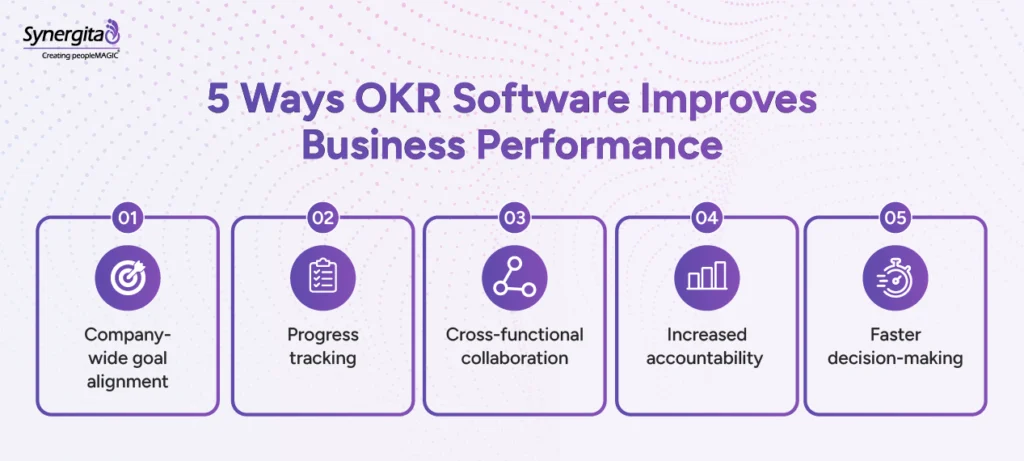
1. Company-wide goal alignment
Every team and individual goal links back to company priorities, keeping everyone aligned on what matters most.
For instance, if the company objective is to increase annual recurring revenue, Sales can track new customer acquisition, marketing can measure qualified pipeline growth, and customer success can monitor renewal rates. Every team’s progress contributes to the same business objective.
2. Progress tracking
Real-time dashboards replace end-of-quarter surprises with early warning signs, so at-risk goals get attention while there is still time to course-correct.
For instance, a customer success leader monitoring renewal targets can immediately see when product adoption declines in a key customer segment. Early visibility allows the team to launch targeted onboarding and support initiatives before renewal conversations begin.
3. Cross-functional collaboration
Team collaboration software features like shared dashboards and comment threads on key results, let departments see how their work depends on and affects each other.
4. Real-time reporting
Automated reports pull data directly from the platform, giving leaders faster visibility without relying on manually prepared updates.
Before quarterly business reviews, an operations director spends hours collecting updates from spreadsheets, emails, and project management tools. Automated reporting replaces this manual work with live dashboards, allowing leaders to focus on decisions.
5. Faster decision-making
With current data always visible, leaders can reallocate resources or adjust priorities mid-cycle instead of waiting for the next scheduled review.
Final takeaway
The right OKR software for businesses does more than display goals; it creates a system where strategy stays visible, ownership stays clear, and execution keeps moving. Without a connected goal system, companies lose time collecting updates, miss early warning signs, and allow priorities to drift across departments.
If you need an affordable platform with AI-assisted OKR creation, flexible goal alignment, real-time progress tracking, and workplace integrations, Synergita OKR is worth considering. Start your free trial today and build goals that deliver lasting results.
Start your free trial with Synergita and build a goal execution system that grows with your business.
Frequently asked questions
The best OKR software is the one that fits your business size, workflows, and long-term goals. Growing companies should look for affordability, ease of adoption, and strong integrations, while larger enterprises may need advanced governance and reporting instead of choosing the platform with the most features.
OKR tracking software improves business performance by keeping goals visible and progress measurable. Teams can monitor objectives in real time instead of relying on spreadsheets or manual status updates. Leaders identify risks early, adjust priorities faster, and keep departments aligned throughout the quarter. This reduces reporting effort while improving execution.
Small businesses can benefit from OKR software just as much as larger organizations. A centralized platform helps growing teams align priorities before disconnected processes become difficult to manage. Everyone works toward shared objectives with clear ownership and measurable outcomes. As the business expands, the same framework scales without replacing existing goal-setting practices.
The right OKR software should be easy to adopt, integrate with existing tools, and support future growth. Compare platforms based on usability, reporting, AI assistance, collaboration features, and integrations with systems like Slack, Microsoft Teams, Jira, and HR software. Running a pilot with a real team also helps identify adoption challenges before rollout. Long-term usability matters more than an extensive feature list.
Most businesses can implement OKR software within a few days to several weeks. The timeline depends on company size, system integrations, and rollout planning. Synergita OKR tool offers faster adoption and can be implemented within a few hours.
Modern OKR software connects with the tools employees already use every day. Integrations with Jira, Slack, Microsoft Teams, HR systems, and other workplace applications reduce manual updates and improve visibility. Teams can monitor progress without switching between multiple platforms. Connected systems also improve reporting accuracy.