
When your performance measurement system is missing key components, you make every decision based on incomplete data. That is how the wrong people get promoted and the right ones leave. You may not realize it until it’s too late. Are you missing any of these key components?
| TL;DR: The 30-Second TakeawayThe Problem: Most organizations track activity, hours logged, tasks completed, and meetings attended, not outcomes. The Shift: Performance measurement needs to move from annual reviews to continuous, data-driven feedback tied directly to business goals. The Fix: Build a system around all key components below. Miss one and the whole thing breaks down at the decision-making stage. Keep reading to: Get the 13 critical components of measurement used by high-growth teams, and see how each component connects to real ROI, not just HR compliance. |
Running performance reviews and actually measuring performance are two different things. Most teams are doing the first and think they are doing the second. The result is wrong promotion decisions, higher attrition, and performance conversations that do not provide clarity or direction.
So what makes a performance measurement system reliable? What should be included in that?
In this guide, we will explain what is performance measurement, explore 13 key components of the performance measurement system, and share a performance measurement checklist to measure performance correctly.
| Table of Contents 1. What Is Performance Measurement? 2. What Are the Key Components of Successful Performance Measurement 3. Performance Measurement Checklist: Run This Before Your Next Review Cycle 4. Final Takeaway 5. Frequently Asked Questions |
What Is Performance Measurement?
Performance measurement is a structured method for collecting, analyzing, and acting on data about how well people, teams, and processes are achieving defined goals. It’s not a form you fill out once a year. It’s an ongoing feedback system.
Most businesses fail to measure performance correctly for three reasons:
• Metrics are tracking effort, not results.
• Data collection happens too late to act on.
• Managers interpret the same metrics differently, so calibration collapses.
What Are the Key Components of Successful Performance Measurement
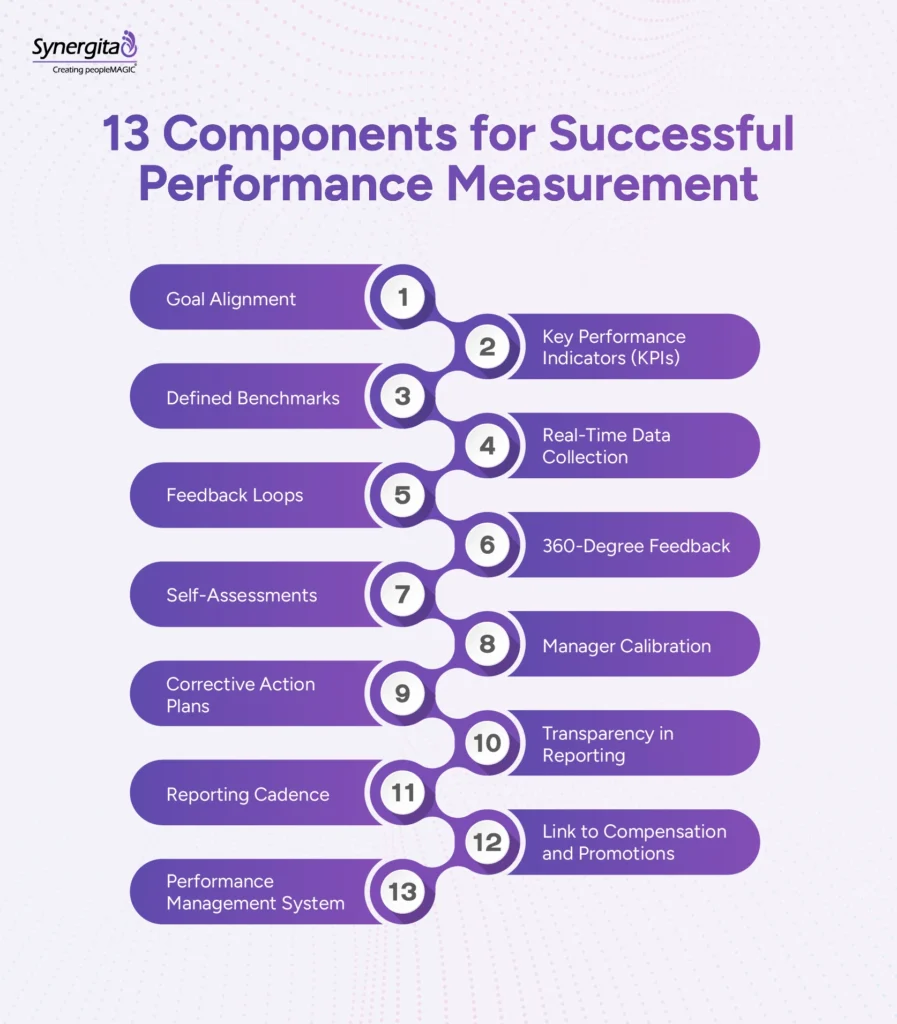
These proven elements create a successful system, which turns data into decisions and drives real business growth.
1. Goal Alignment
Every performance metric must track a business objective. If it doesn’t, you are measuring activity, not performance. When goals aren’t aligned, teams can hit 100% of their targets but the company will miss the numbers.
Here is how to ensure that company goals align with employees’ efforts.
- Connect individual KPIs to team priorities.
- Connect team priorities to company OKRs.
- Review alignment every month, not just at the start of the year.
2. Key Performance Indicators (KPIs)
KPIs are the specific, quantifiable metrics used to evaluate whether goals are being met. A good KPI is:
• Related to a specific outcome (not a task)
• Measurable with existing data
• Reviewed at short intervals
For example:
- Strong performance measures: customer retention rate, time to close, defect rate, and revenue per employee.
- Weak metrics: number of emails sent, hours worked, meetings attended.
3. Defined Benchmarks
A metric without a benchmark is just a number and does not tell if there has been improvement or not. Benchmarks tell you whether a number is good, bad, or acceptable. These come from three sources:
• Historical performance: how did this team perform last quarter?
• Industry standards: what are comparable organizations achieving?
• Internal targets: what does leadership need this number to be?
4. Real-Time Data Collection
In many organizations, annual performance reviews are a snapshot of the performance of the last 1-2 months of the year. The data that matters happened in January, and nobody wrote it down.
Effective performance measurement requires continuous data collection: check-in notes, goal progress updates, feedback logs, and system-generated metrics pulled automatically from the tools teams already use. Here is how to measure performance in real-time:
- Use performance management software and integrate it with HRIS platforms and other systems to pull data without manual entry.
- Check-ins every two weeks capture more useful information than one annual review.
5. Feedback Loops
According to a Gallup report, employees who receive regular feedback are 3.6x more likely to say they are motivated to do outstanding work. This is not a soft metric; it directly affects output.
Yet in most organizations, feedback only moves in one direction and arrives too late to act on. A feedback loop can help managers convert performance data into action. There are two types of feedback:
• Manager-to-employee: structured, documented, tied to specific evidence.
• Employee-to-manager (upward feedback): What is blocking this person from performing?
6. 360-Degree Feedback
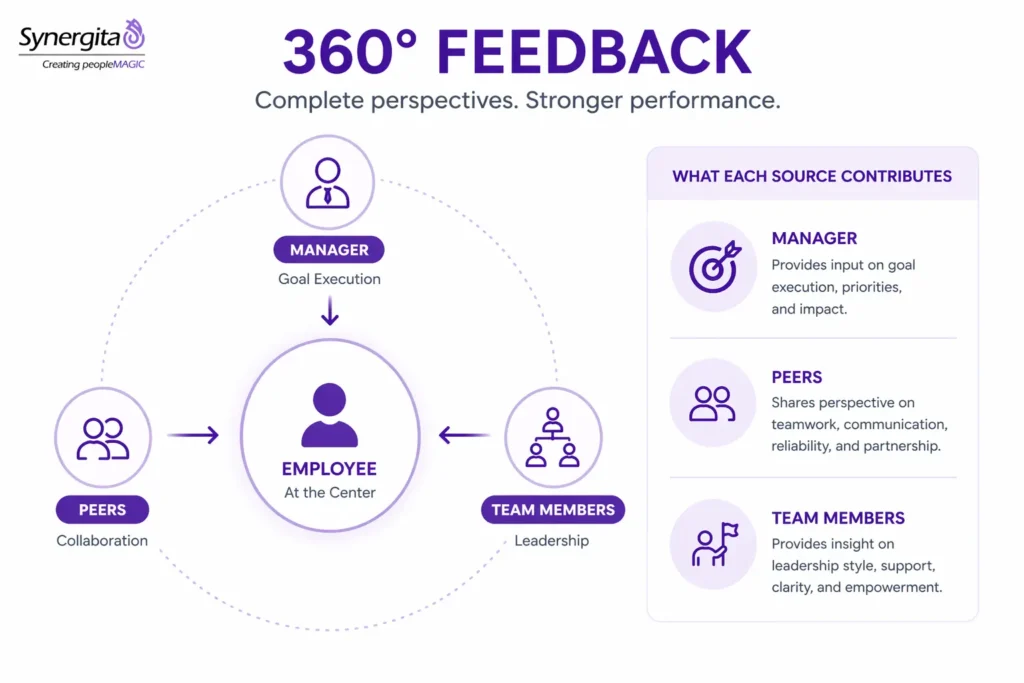
Single-source performance data has blind spots. A manager sees one dimension of an employee’s performance. Peers see another. Direct reports see another.
360-degree feedback captures all three angles and provides a complete picture. The key is structure: every reviewer uses the same competency framework, so feedback is comparable and not just a collection of opinions.
• Peer feedback: collaboration, reliability, communication.
• Manager feedback: goal execution, strategic contribution.
• Team member feedback: leadership, clarity, support.
7. Self-Assessments
When employees assess their own performance before a review, two things happen: the review conversation becomes more productive, and accountability becomes internal rather than top-down.
Self-assessments also surface blind spots that managers miss. An employee might rate themselves low on a skill that the manager assumed was fine. That gap is valuable data.
- Use structured self-assessment forms aligned with the same KPIs that managers evaluate.
- Review self-assessments before finalizing manager ratings, not after.
Suggested Read: Benefits of Self-Assessment in Performance Appraisal
8. Manager Calibration
Without calibration, performance ratings are not comparable across teams. One manager’s ‘meets expectations’ is another manager’s ‘exceeds expectations.’
Calibration sessions bring managers together to compare ratings before they’re finalized. It removes bias and creates consistency across the organization.
• Run calibration sessions quarterly for high-growth teams.
• Use evidence from continuous feedback, not recall from the last two weeks.
9. Corrective Action Plans
Corrective Action Plans (CAPs) are a critical part of performance measurement. These are not punishments, but structured development documents that specify: what the gap is, what support will be provided, what improvements are expected, and by when.
Moreover, the way CAPs are introduced is also important. Here are a few things you should consider:
• When a performance gap is identified, a CAP should be initiated through an open conversation
• CAPs should be co-created with the employee, not handed down.
10. Transparency in Reporting
If employees don’t know how they are being measured, they can’t improve. If managers don’t share performance data with their teams, it creates anxiety among the employees. That’s why transparency in performance measurement is essential but that doesn’t mean sharing everyone’s ratings with each other. It means every employee knows their goals, their metrics, and how they are performing in real time. Here’s how to ensure transparency.
• Give employees dashboard access to their own performance data.
• Share team-level trends with managers, not just individual scores.
11. Reporting Cadence
Performance data reported once a year is useless for decision-making. The reporting cadence should match the speed at which the business moves.
A simple way to structure this across the year:
• Weekly: individual goal progress updates.
• Monthly: team performance dashboards reviewed by managers.
• Quarterly: formal evaluation cycles with documentation.
• Annually: compensation and promotion decisions tied to cumulative data.
12. Linking Performance to Compensation and Promotions
Performance measurement only changes behavior when employees believe it affects decisions that are important to them. If reviews happen regularly but nothing changes, employees won’t engage.
According to Mercer’s 2024 Global Talent Trends report, fair pay ranked as the second most important reason employees stay with an employer, right after job security. Fair pay starts with documented, consistent performance data.
13. Performance Management System (Software)
Measuring employee performance manually becomes almost impossible when your organization grows. At 50 employees, spreadsheets begin to miss data. When it grows to 200 or more, the entire process becomes a mess and finding useful data becomes a challenge.
Performance management software solves this by automating data collection, standardizing review processes, identifying trends, and giving leadership performance data across the organization. When selecting a performance management tool, look for tools that offer:
- Continuous feedback collection
- 360-degree review modules
- Real-time reporting dashboards
- Integration with Microsoft Teams, Jira, Slack and HRIS tools
Performance Measurement Checklist: Run This Before Your Next Review Cycle
If you answer no or not sure to more than four of these, your system has a gap that will surface as a legal or retention issue within 12 months.
| ☐ | Every employee has at least one KPI tied to a team-level business objective. |
| ☐ | Performance data is collected continuously, not recalled at review time. |
| ☐ | Managers use a shared competency framework rather than personal judgment. |
| ☐ | 360-degree feedback is included in every formal review cycle. |
| ☐ | Self-assessments are collected before manager ratings are finalized. |
| ☐ | A calibration session is held before ratings are communicated. |
| ☐ | Corrective action plans are triggered within two weeks of a performance gap. |
| ☐ | Employees have real-time access to their own performance data. |
| ☐ | Compensation and promotion decisions are documented and tied to performance ratings. |
| ☐ | Review processes are identical across all seniority levels, including senior management. |
| ☐ | Your performance management software integrates with your HRIS and productivity tools. |
| ☐ | Review cadence is at least quarterly, not annual. |
| ☐ | HR has an audit trail for every performance decision made in the last 12 months. |

Final Takeaway
Performance measurement problems grow silently until top performers walk out or promotions backfire. The reason is that the data required to make right performance decisions was not captured correctly.
The 13 components in this guide helps in building a robust performance measurement system. Synergita’s performance management system provides everything you need to measure performance including 360-degree feedback, goal alignment, and AI-powered insights. Start a free trial today
Frequently Asked Questions
The key components of a performance measurement system include but are not limited to goal alignment, KPIs, benchmarks, real-time data collection, feedback loops, 360-degree feedback, self-assessments, corrective action plans, compensation linkage, and performance management software.
Performance measurement helps you track what happened against expectations while performance management helps you decide what to do with that data.
Performance data should be collected continuously, reviewed every quarter, and used for annual compensation decisions.
Missing components mean decisions are made based on incomplete data. The result is wrong people get promoted, top performers leave, and leadership cannot find what is happening.
Businesses need performance management software for multiple reasons:
Align goals across the organization
Track feedback continuously
Moves beyond annual reviews
Reduces bias in evaluations