
A strategy may appear clear in the boardroom but become fragmented as it moves across regions, departments, and management levels. Different priorities, reporting systems, time zones, and market conditions can leave teams working toward goals that do not fully support the company’s wider direction. According to a recent report, 90% of companies do not achieve their goals.
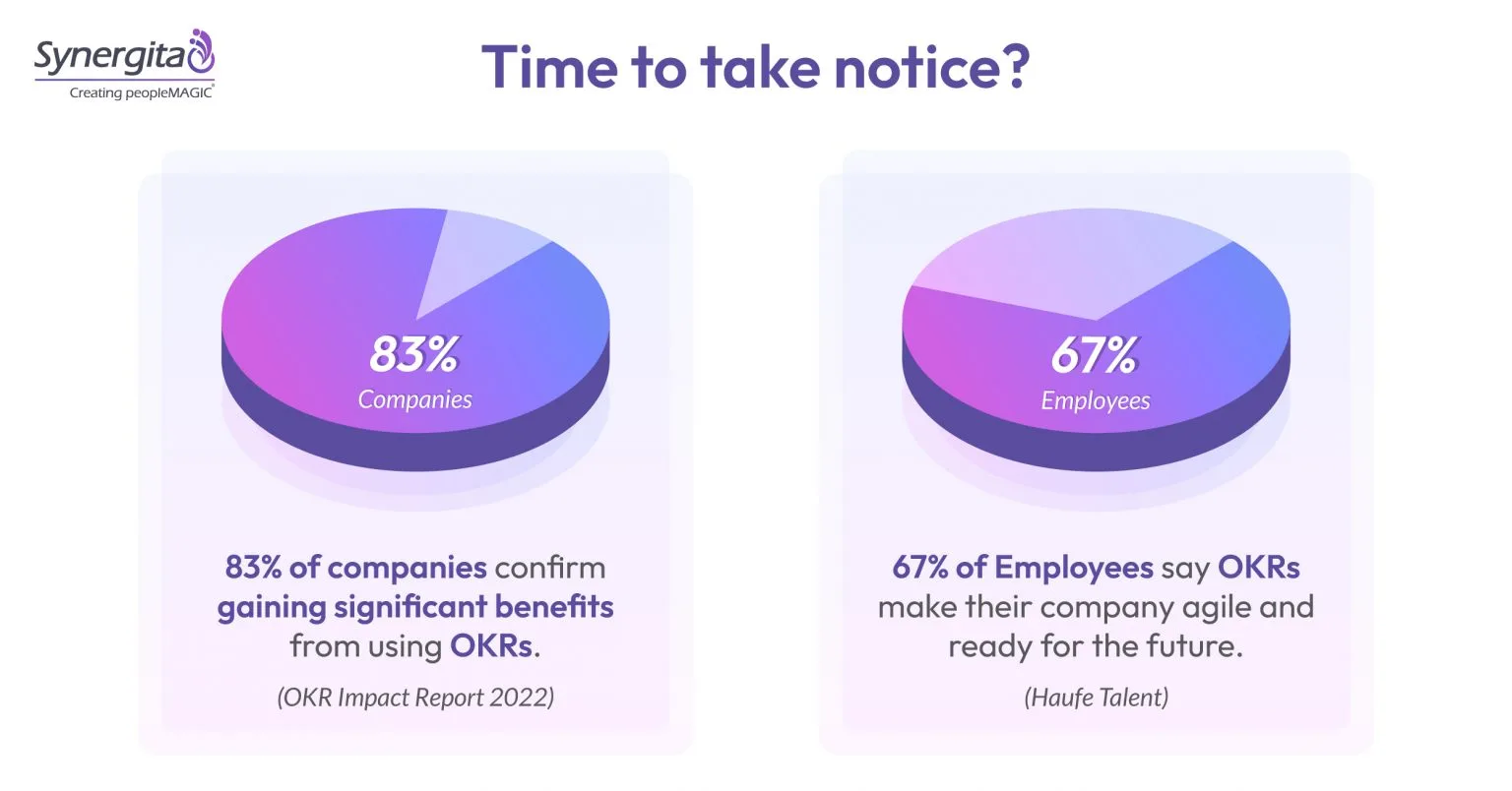
That’s why most global companies are adopting OKRs. 83% of organizations report better performance and outcomes after adopting OKRs.
This article explains why global companies use OKRs, the benefits they gain, the mistakes that impact OKR adoption, and how the OKR framework can support consistent execution across locations.
| TL;DR: Global companies adopt OKRs to connect strategy with measurable outcomes across regions, departments, and teams. Successful adoption requires clear priorities, regional flexibility, accountable owners, regular check-ins, and a shared system that gives leaders an accurate view of progress. |
| Table of Contents 1. Why are OKRs important 2. Why are OKRs useful for global organizations 3. Five benefits of OKRs for global companies 4. How global companies can implement OKRs across regions 5. Common OKR adoption mistakes to avoid 6. How technology supports OKR adoption 7. How Synergita helps global teams manage OKRs 8. Summing up 9. Frequently asked questions |
Why are OKRs important?
The clearest explanation of why OKR is important is that it connects strategic priorities with measurable results. CEOs often face the challenge of growing a company while maintaining clarity and focus. Before examining their value, it helps to answer a basic question: what are OKRs and how do they work?
The answer is clear: OKRs enable leaders to set clear, impactful goals (objectives) and track progress through specific, measurable outcomes (key results). They offer a structured approach that ensures everyone is working toward the same vision.
By transforming ambitious goals into actionable steps, OKRs foster a culture of transparency, accountability, and engagement. This drives innovation and addresses common leadership pain points.
In a world where agility is paramount, OKRs are important to help CEOs maintain focus, adapt swiftly to changes, and lead their organizations toward sustainable success. Whether leaders manage a global corporation or a growing enterprise, OKRs provide a structured way to turn priorities into measurable outcomes.
Disorganized work environments can harm team collaboration and productivity. OKR software provides the visibility teams need to coordinate work, track progress, and stay aligned on shared goals.
Why are OKRs useful for global organizations
An organization becomes an OKR company when it connects regional goals with a limited number of shared business priorities. Global organizations need consistency without removing local decision-making.
A company-wide strategy may apply to every region, but its execution can vary based on customer expectations, regulations, market maturity, and available resources.
Understanding what is an OKR in business starts with separating an intended outcome from the work required to achieve it.
OKRs provide a common structure for managing these differences. Leadership can define a limited number of company priorities, while business units and regional teams create supporting OKRs based on their responsibilities.
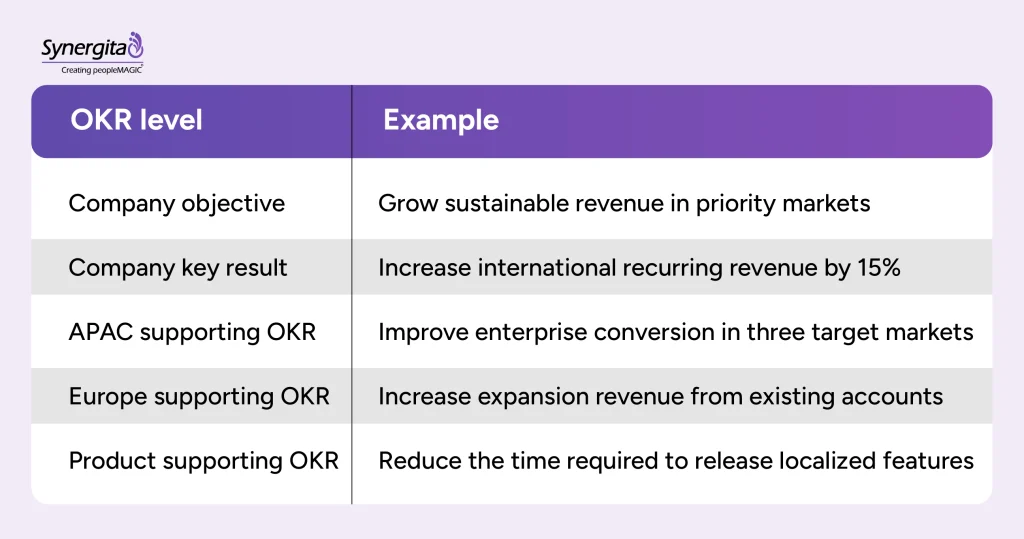
For example, a company may set an objective to increase revenue from international markets. Its European team could focus on customer expansion, while its Asia-Pacific team could prioritize new customer acquisition. The approaches differ, but both support the same company objective.
Five benefits of OKRs for global companies
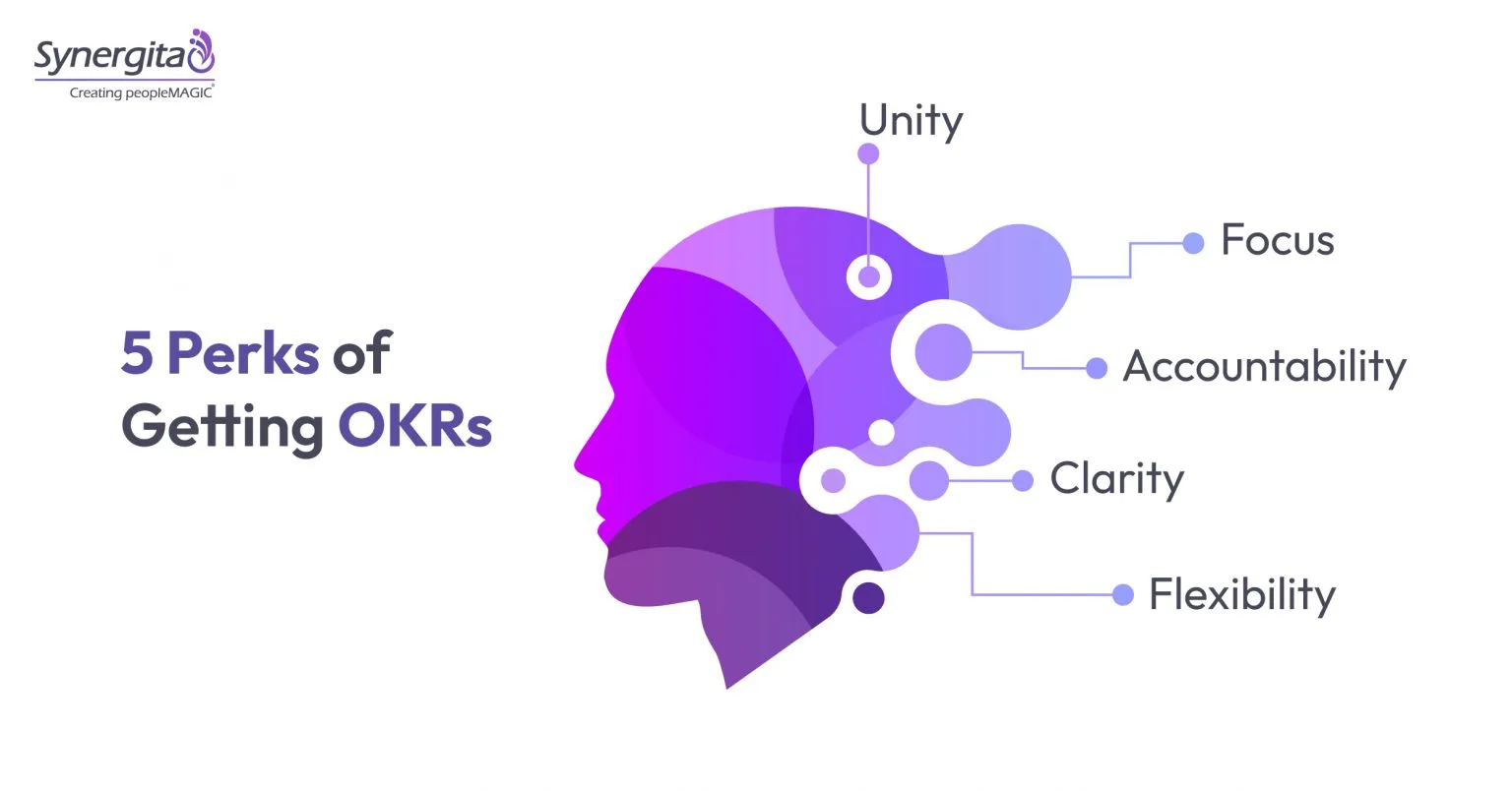
Here are a few benefits of OKRs that make a difference:
1. Aligning goals across diverse teams
Many global companies that use OKRs connect company-wide priorities with regional and departmental goals. OKRs create a shared structure that works across geographical and departmental boundaries. By setting company-wide objectives with measurable key results, everyone understands the bigger picture and how their role contributes to overall success.
To understand which companies use OKRs successfully, it helps to examine how global organizations apply the framework.
For instance, Unilever adopted OKRs inspired by tech giants to define and communicate its top-level goals. With more than 400 brands operating across 190 countries, Unilever must align priorities across a large and distributed organization. This approach forces leaders to set clear priorities and helps teams see how their work connects to the company’s strategic objectives. Leaders at Unilever establish company-level OKRs that connect with regional and team-specific targets.
For example, if the goal is to boost market share, it translates into specific targets for regional teams, ensuring everyone aligns with and contributes to the company’s overarching goals.
2. Enhancing transparency and accountability
OKRs improve transparency by making objectives, key results, progress, and ownership visible across the organization. Employees can see how their goals connect with team priorities and wider business outcomes.
This clarity is important because Gallup found that only 46% U.S. employees clearly knew what was expected of them at work at the end of 2024. By defining measurable results and assigning clear owners, OKRs help teams understand their responsibilities, report progress consistently, and address delays earlier.
Adobe and Spotify use goal-setting systems to give employees greater ownership of their work. Transparent goals allow employees to take ownership of their work and come up with solutions.
3. Focus and efficiency
Employees can lose valuable time when priorities are unclear, and work is spread across meetings, emails, and disconnected requests. According to the Microsoft’s 2025 Work Trend Index, 53% of leaders said productivity needed to improve, while 80% of employees and executives reported lacking the time or energy to meet rising expectations. OKRs help address this gap by defining a limited number of priorities and showing how each team contributes to them. With clear objectives and measurable key results, teams can direct their time toward meaningful outcomes, deprioritize unrelated work, and make faster decisions.
4. Empowering teams to innovate
OKRs can include ambitious stretch goals, sometimes called “moonshots.” This approach encourages teams to think creatively and pursue bold, innovative solutions that can lead to significant breakthroughs. By challenging employees to reach beyond their comfort zones, OKRs foster a culture where innovation is not just encouraged but expected. This mindset shifts the focus from merely completing tasks to achieving transformative results.
Take Intel, for instance. During the early adoption of OKRs under Andy Grove, the company set moonshot goals that were pivotal in its transition from memory chips to microprocessors. This shift not only saved the company but also positioned Intel as a leader in the semiconductor industry. By regularly reviewing and adjusting goals, companies can stay aligned with market trends and evolving customer needs.
5. Measuring success and driving growth
This ability to measure progress consistently explains why OKR is important for companies operating across multiple regions. It allows organizations to monitor progress and make data-driven decisions. This alignment helps in accelerate growth by ensuring that all parts of the organization are working towards common goals, thereby enhancing overall efficiency and effectiveness.
Examples of which companies use OKRs include IBM, Intel, Adobe, Spotify, and Unilever.
IBM uses OKRs to manage performance and scale its operations across global teams. By setting clear objectives related to innovation, customer satisfaction, and operational efficiency, IBM ensures that its vast workforce is aligned toward achieving strategic goals.
When leaders explain what is an OKR, they should use examples based on measurable company outcomes.
How global companies can implement OKRs across regions
Employees must first understand what OKRs are, how progress is measured, and who owns each result. Effective OKR adoption requires a defined process. Introducing the terminology without changing how priorities are set and reviewed will produce limited value.
Global companies can follow these steps:
- Define three to five company-level objectives.
- Connect every objective to measurable business outcomes.
- Assign one accountable owner to each objective and key result.
- Allow regional teams to create relevant supporting OKRs.
- Record dependencies between departments and locations.
- Conduct brief monthly progress reviews.
- Review and reset OKRs at the end of each cycle.
The relationship between company and regional goals may look like this:
Leadership should also explain how OKRs will be used. Employees need to know who can create or modify goals, how progress will be calculated, when reviews will happen, and whether OKRs are connected to performance evaluations.
An OKR pilot program can make the rollout easier. Start with one business unit or cross-functional team, review what worked, and refine the process before expanding it across the organization.
Common OKR adoption mistakes to avoid
Leadership involvement is one of the strongest factors influencing successful OKR adoption. The results achieved by companies that use OKRs depend on the quality of implementation. The framework cannot correct unclear strategy or inconsistent leadership on its own.
The most successful companies using OKR systems establish clear ownership and conduct frequent progress reviews.
Common mistakes include:
- Creating too many objectives during one cycle
- Writing tasks instead of measurable key results
- Cascading goals without involving the teams responsible for them
- Giving every region identical targets despite different market conditions
- Reviewing progress only at the end of the quarter
- Changing goals without recording the reason
- Using OKR scores as the sole basis for employee compensation
- Expecting software to replace regular management conversations
Another mistake is treating every key result as a stretch target. Some goals require ambitious experimentation, while others involve firm commitments related to customers, revenue, security, or compliance. Leaders should clarify which type of target they are setting.
The best companies using OKRs treat the framework as a management discipline. Leaders maintain focus, teams report progress honestly, and reviews lead to decisions rather than status updates.
How technology supports OKR adoption
For companies using OKRs across several regions, a shared platform keeps goals, owners, and progress visible. Spreadsheets may be sufficient for a small team, but they become difficult to maintain when goals span multiple regions, departments, and reporting levels.
An OKR platform creates a shared source of information. Employees can view current objectives, update key results, identify owners, and understand how their goals connect with company priorities.
Useful capabilities include:
- A hierarchy showing company, team, and individual OKRs
- Dashboards with current progress and at-risk goals
- Automated reminders and check-ins
- Approval workflows and access controls
- Integrations with workplace and project management tools
- Reports for leadership and quarterly reviews
Technology also reduces the administrative work involved in collecting updates. Leaders spend less time combining reports and more time examining why goals are ahead, delayed, or blocked.
For global organizations, selecting an OKR platform that supports alignment, progress tracking, collaboration, and governance can make adoption easier to manage.
How Synergita helps global teams manage OKRs
Synergita gives distributed organizations one place to create, align, track, and review OKRs. Company objectives can be connected with departmental, team, and individual goals, helping employees see how their responsibilities support the wider strategy.
The hierarchy tree gives leaders an organization-wide view of goal alignment and progress. Live dashboards highlight objectives that need attention, while automated reminders and check-ins encourage teams to provide consistent updates throughout the cycle.
Synergita also supports organizations through:
- AI-powered OKR creation and practical goal suggestions.
- Real-time progress tracking.
- Custom dashboards and detailed reports.
- Cascading OKRs from company-level objectives to departmental, team, and individual goals.
- Integrations with Jira, Slack, Microsoft Teams, HRIS platforms, and other workplace tools.
- Plans designed for small teams, growing companies, and large enterprises.
These capabilities are valuable for companies using OKR frameworks across several locations. Leaders gain shared visibility without relying on separate regional spreadsheets, while teams retain clear ownership of their goals.
Summing Up!
As organizations expand into new markets, managing goals through disconnected documents and annual planning cycles becomes harder to sustain. OKR adoption provides the structure required to create that connection.
Company leaders define the outcomes that matter, regional teams translate them into relevant goals, and regular reviews keep progress visible. This approach gives teams room to respond to local conditions without losing sight of the company’s wider direction.
Synergita helps global teams turn company priorities into visible, measurable OKRs and track progress from one shared platform. Start aligning your teams with Synergita’s OKR. Explore Synergita free for 14 days.
Frequently Asked Questions
OKRs (Objectives and Key Results) are a goal-setting framework organizations use to set specific goals and track them. Objectives define what you want to achieve, while key results provide measurable indicators to determine whether the objective has been achieved. OKRs help employees understand their goals and how their work contributes to the organization’s overall success.
Global companies adopt OKRs to align regions, departments, and employees around shared business outcomes. The framework provides common priorities while allowing local teams to choose the most relevant way to achieve them.
OKRs are important because it connects company priorities with measurable team outcomes. It helps employees focus on shared goals, understand their responsibilities, track progress, and address delays before the goal cycle ends.
Google, Intel, Adobe, Unilever, and several other global organizations have used OKRs within parts or all of their operations. Their implementation methods differ according to their organizational structure, culture, and strategic requirements.
OKR adoption often fails when organizations create too many goals, write task-based key results, assign unclear ownership, or neglect regular reviews. Adoption also suffers when leaders introduce the framework without explaining how decisions, updates, and progress measurement will work.
Synergita helps organizations create aligned OKRs, connect goals through a hierarchy tree, track progress on live dashboards, and conduct regular check-ins. Its integrations also allow teams to connect OKRs with the workplace tools they already use.
Teams should update progress regularly and conduct structured reviews at least once a month. A complete review should take place at the end of each OKR cycle to score results, record lessons, and set the next priorities.
Yes. Regional teams can create different OKRs as long as those goals support agreed company-level outcomes. This approach preserves strategic alignment while accounting for local customers, regulations, resources, and market maturity.