
A product manager pulls up the quarterly OKR report and finds three key results with no updates in six weeks. Nobody flagged it. Nobody caught it until now.
This kind of gap can emerge as teams grow. Managers spend time drafting objectives, fixing weak key results, linking goals, reviewing updates, and preparing reports. Meanwhile, the goals can get less attention.
The problem is that too much time goes into managing the OKR process. Asana found that knowledge workers spend 58% of their day on “work about work” and estimated that better processes could save 4.9 hours per week.
Traditional OKR software tracks goals but leaves gaps like the one above to be caught manually. AI OKR software can significantly reduce that risk by flagging stalled goals early, on top of speeding up how OKRs get created and tracked.
Here are six differences you should understand before choosing between the two.
| TL;DR Compare AI vs traditional OKR software using 6 practical differences that matter when scaling teams. Identify whether your organization is ready to move from traditional to AI OKR software. Evaluate AI OKR tools with a checklist that helps you choose the right platform. Make the best decision based on your team’s planning, alignment, and growth needs. |
| Table of Contents 1. AI OKR software vs traditional OKR software: a quick comparison 2. What are the key differences between AI vs traditional OKR software 3. AI OKR software vs traditional OKR software: feature comparison for growing teams 4. How to decide between AI and traditional OKR software for your organization 5. What to look for when selecting the best AI OKR software 6. Final takeaway 7. Frequently asked questions |
AI OKR software vs traditional OKR software: a quick comparison
AI and traditional OKR software differ mainly in how much support they provide beyond basic goal tracking. Traditional platforms focus on creating, organizing, and tracking goals, while AI-powered platforms can assist with planning, goal quality, progress analysis, alignment, and reporting. Here is a quick comparison.
| Capability | Traditional OKR software | AI OKR software | Business Impact |
| OKR planning | Created manually | AI-assisted drafts | Shortens the time needed to turn business priorities into draft OKRs |
| Goal quality | Depends on manager review | Clearer goal suggestions | Reduces vague OKRs before approval |
| Manager coaching | Relies on manager judgment | AI-assisted prompts | Gives managers guidance in creating and reviewing goals |
| Progress intelligence | Tracks reported updates | Risk detection | Helps managers identify underperforming goals quickly |
| Cross-team alignment | Goals linked manually | Relationship mapping | Makes it easier to identify dependencies |
| Reporting | Managers interpret dashboards | AI-assisted summaries | Managers spend less time scanning updates and compiling reports |
What are the key differences between AI vs traditional OKR software
The key difference between AI and traditional OKR software is the level of intelligence added to the OKR process. Traditional software helps teams organize and track goals, while AI OKR software can assist with goal creation, risk detection, recommendations, manager support, and progress summaries.
Evaluate both across the full OKR cycle, from planning and goal creation to reviews and reporting.
1. Manual creation vs. AI-assisted drafting
With traditional OKR software, managers still have to formulate objectives and key results themselves. AI-assisted OKR planning can generate a structured first draft from a business objective, giving managers something concrete to review and refine.
This means AI creates the starting point; managers make the final decision.
2. Manager-dependent vs. AI-assisted consistency
A poorly written objective can go unnoticed when managers have to review OKRs manually. The difference comes during review, when AI-assisted recommendations can flag unclear wording or key results that are difficult to measure.
Goal clarity remains a challenge: Gallup found that only 46% of U.S. employees clearly know what is expected of them at work, highlighting the need for clearer and more consistent goal-setting.
AI OKR software can evaluate goals against criteria such as measurability, clarity, ownership, and deadlines, then recommend improvements before approval.
3. Manual linking vs. AI-assisted mapping
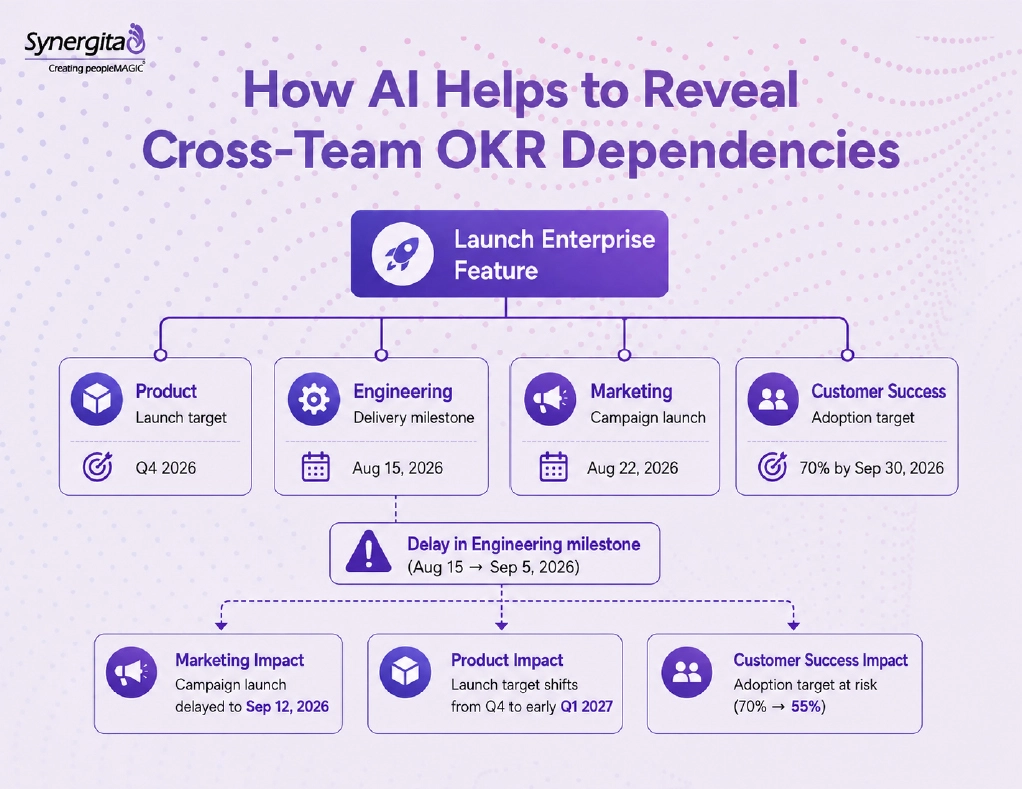
Cross-functional dependencies become difficult to track as more teams contribute to the same business priority. AI can help identify relationships between goals that managers may need to review.
This difference becomes critical as organizations add departments and shared initiatives.
For instance, a SaaS company launching an enterprise feature may have product, engineering, marketing, and customer success OKRs tied to the same initiative. If engineering misses a milestone, it can delay marketing campaigns and customer adoption targets across teams.
4. Reactive tracking vs. proactive insights
Traditional tools show teams what has been reported. AI-assisted tools can go a step further by analyzing updates to identify underperforming key results, new risks, and areas requiring manager attention.
For example, a sales organization has a quarterly objective linked to pipeline growth. Several regional teams report progress, but one region repeatedly misses its weekly targets. Instead of waiting until the quarterly review to notice the pattern, an AI-assisted system can help bring the potential issue to the manager’s attention earlier.
5. Static data vs. AI-generated summaries
Preparing a leadership update can require managers to review dozens of goal updates and identify the few that deserve discussion. AI-assisted summaries can organize that information and identify potential issues quickly. This reduces the time managers spend interpreting reports and preparing updates.
For instance, an HR leader preparing a monthly leadership review has to examine goal updates from six departments. Instead of manually summarizing every update, an AI-assisted system can help organize the information around progress, potential issues, and areas requiring attention.
6. Training-dependent vs. guided adoption
Traditional platforms may require managers to learn both the software and the organization’s OKR methodology. AI-assisted platforms can provide contextual guidance while users create, review, and update goals.
AI OKR software vs traditional OKR software: feature comparison for growing teams
AI OKR software improves goal creation, identifies risks early, strengthens alignment across teams, and supports better decision-making. Traditional OKR software mainly tracks goals, leaving managers to review progress, identify issues, and improve OKRs manually.
The table below compares AI OKR software and traditional OKR software across the capabilities that matter most to growing teams. If you’re evaluating AI OKR tools, this comparison highlights where AI delivers the biggest advantages.
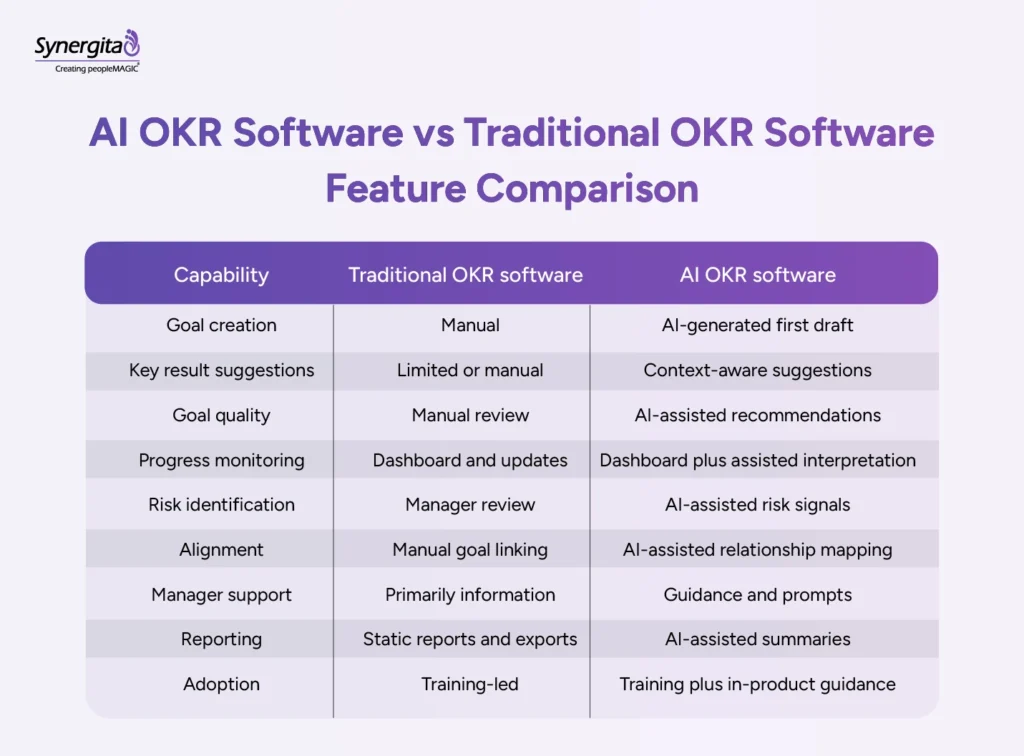
Traditional OKR software handles the core workflow, while many planning and interpretation tasks still depend on managers.
For a small organization with experienced managers and straightforward goals, that may be acceptable.
For a growing organization with multiple departments, new managers, and increasing cross-functional dependencies, the amount of manual work can become harder to maintain.
Suggested Reading: Learn how simplifying processes improves organization-wide adoption in our guide to Modern OKR Management Practices.
How to decide between AI and traditional OKR software for your organization
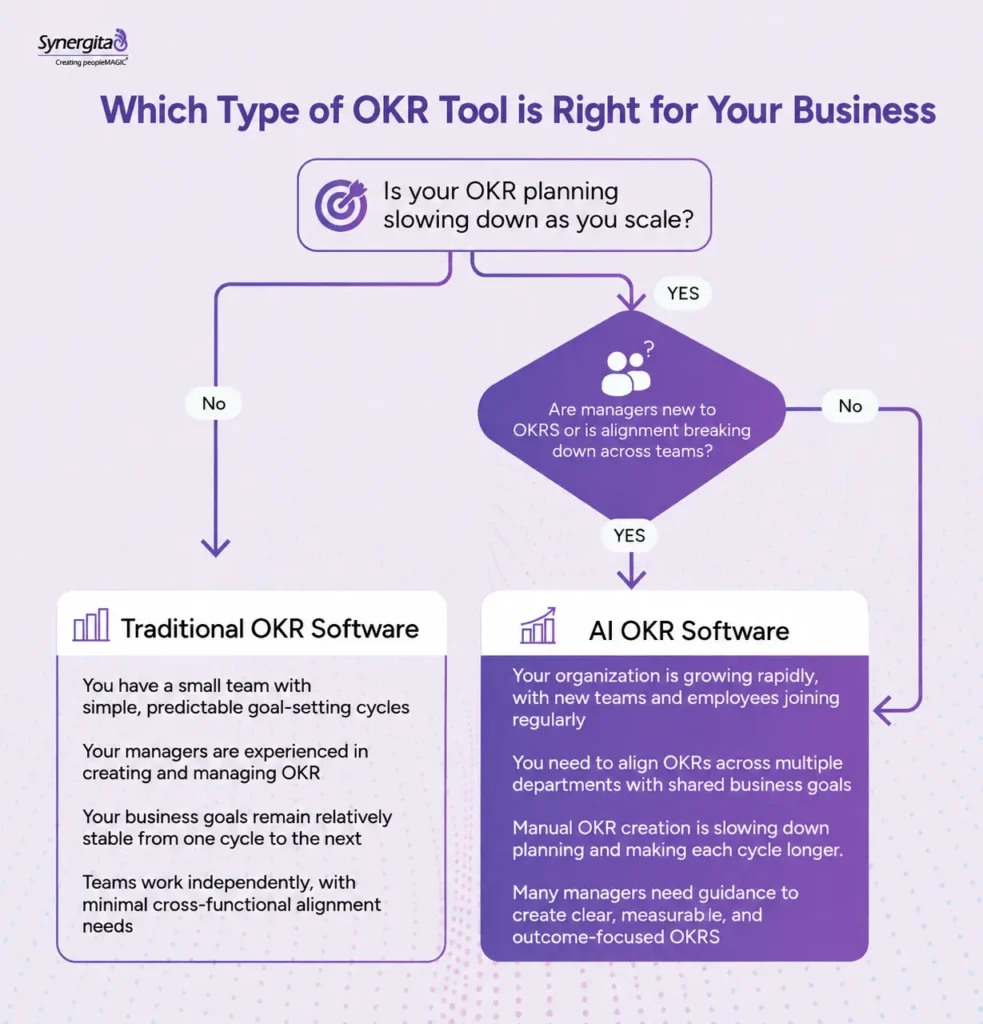
The best choice depends on your organization’s growth, planning complexity, and how much time managers spend creating and maintaining OKRs. Use the checklist below to identify which approach is the better fit.
Traditional OKR software is best suited for
- You have a small team with simple, predictable goal-setting cycles.
- Your managers are experienced in creating and managing OKRs without additional guidance.
- Your business goals remain relatively stable from one planning cycle to the next.
- Teams work independently, with minimal cross-functional coordination or alignment challenges.
AI OKR software is best suited for
- Your organization is growing rapidly, with new teams and employees joining regularly.
- You need to align OKRs across multiple departments with shared business goals.
- Manual OKR creation is slowing down planning and making each cycle more time-consuming.
- Many managers need guidance to create clear, measurable, and outcome-focused OKRs.
- Your growing business has outgrown spreadsheets and manual goal-tracking processes.
A useful test is to look at the last OKR cycle.
Ask how much time managers spent creating goals, how many goals required rewriting, how often HR had to intervene, how quickly stalled goals were identified, and how much work went into preparing progress reports.
What to look for when selecting the best AI OKR software
Before investing in AI goal management software, look beyond AI-powered features and evaluate how well the platform supports your goal-setting process. Asking the right questions will help you identify solutions that improve planning, maintain quality, and keep managers in control.
☐ Does it generate a complete OKR, or only suggest wording?
☐ Can it improve OKRs someone has already written, not just create new ones?
☐ Does it recommend key results that are actually measurable?
☐ Does it explain why it made a specific suggestion?
☐ Does it learn from your organization’s past goals and priorities?
☐ Does it still require human approval before a goal goes live?
The right goal management software should help managers create better goals, improve alignment, and support smarter decision-making without replacing human judgment. If a platform can confidently answer most of these questions, it can support your organization as it grows.
Final takeaway
When comparing AI vs traditional OKR software, AI-assisted OKR software becomes more useful as planning, goal reviews, reporting, and cross-team coordination create more manual work. Traditional OKR software can suit smaller teams with experienced managers, simple goals, and limited dependencies.
Synergita’s AI-powered OKR software can generate structured OKRs from a simple prompt, while managers review and edit them before finalizing.
Testing the workflow with a real business priority can help teams determine whether AI assistance reduces planning effort and supports a more consistent OKR process.
Start your free trial to see how AI can improve planning before your next OKR cycle begins.
Frequently asked questions
AI OKR software adds assistance to planning, goal creation, progress review, and reporting, while traditional OKR software mainly provides the structure for managing goals. Traditional platforms let teams create objectives, define key results, track updates, and review progress.
AI does not replace managers during OKR planning; it assists them while they remain responsible for the final goals. An AI OKR tool can create an initial objective and suggest key results based on the business context provided. Managers still review, edit, and approve the OKRs before they become part of the planning cycle.
AI-assisted OKR planning can help small businesses create consistent goals with less manual preparation. Smaller teams may not have dedicated HR or OKR specialists available to review every objective and key result.
The best AI OKR software should improve the quality and management of goals throughout the OKR cycle. Useful capabilities include AI-assisted OKR creation, measurable key result suggestions, goal-quality recommendations, progress insights, alignment support, and reporting assistance.
AI can help managers review and improve existing OKRs as well as create new ones. Teams often begin with goals that contain vague objectives, activity-based key results, or measurements that do not clearly show progress.
AI goal management software can make the OKR workflow easier to follow by assisting employees as they create and manage goals. Managers can receive guidance during goal creation instead of relying entirely on separate training sessions or HR intervention.
An organization should consider AI OKR software when manual planning, review, and reporting create significant administrative work. Warning signs include long planning cycles, inconsistent goal quality, frequent HR intervention, increasing cross-functional dependencies, and difficulty identifying goals that need attention.
Evaluate AI OKR software by testing how well it improves the complete OKR workflow and how much control it gives managers. Check whether the platform can create complete OKRs, suggest measurable key results, improve existing goals, support alignment, and simplify reporting.