
43% of organizations now use AI in HR tasks, up from 26% just one year ago. That number is not a trend report headline. It is what your peers are already doing.
HR leaders are already using AI to screen candidates, identify skill gaps, analyze workforce data, and support performance conversations. But AI is only one part of the picture. Skills intelligence, people analytics, and hybrid work technologies are changing how organizations recruit, develop, and retain employees.
With HR technology evolving rapidly, the challenge is identifying the trends that will deliver value to the business rather than chasing every new technology.
In this guide, we explore the top trends in human resource management for 2026, helping HR leaders evaluate the technologies that will improve hiring speed, employee development, performance, and workforce planning.
| TL;DR HR technology connects hiring, performance, learning, and employee development, giving HR teams a more complete view of their workforce AI adoption is expanding across recruitment, performance management, workforce planning, and employee development, making it a core part of HR operations. Predictive analytics and skills intelligence help HR teams make more informed decisions about hiring, retention, and workforce planning. Organizations that connect workforce data across HR functions can make faster and more informed workforce decisions. |
| Table of Contents 1. What is HR technology and why it is important for human resource management 2. What are the top trends in human resource management in 2026 3. How current HR technology trends are changing the role of HR leaders 4. Best practices for implementing technology for human resources management 5. Final takeaway 6. Frequently asked questions |
What is HR technology and why it is important for human resource management
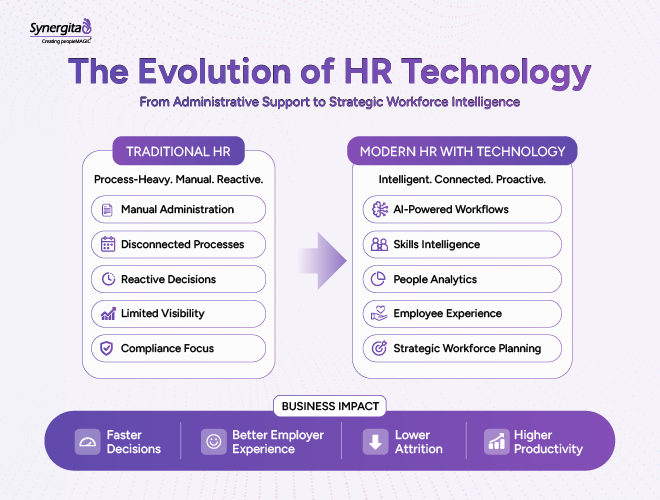
HR technology refers to the tools, platforms, and applications, spanning software, hardware, and mobile solutions, that streamline HR functions. Technology in HR management enables organizations to automate routine processes, improve decision-making, and create a better employee experience through connected digital systems.
Today, it also supports remote and hybrid work, AI-driven decision-making, and workforce analytics. This growth is being driven by employees who expect smooth digital experiences at work.
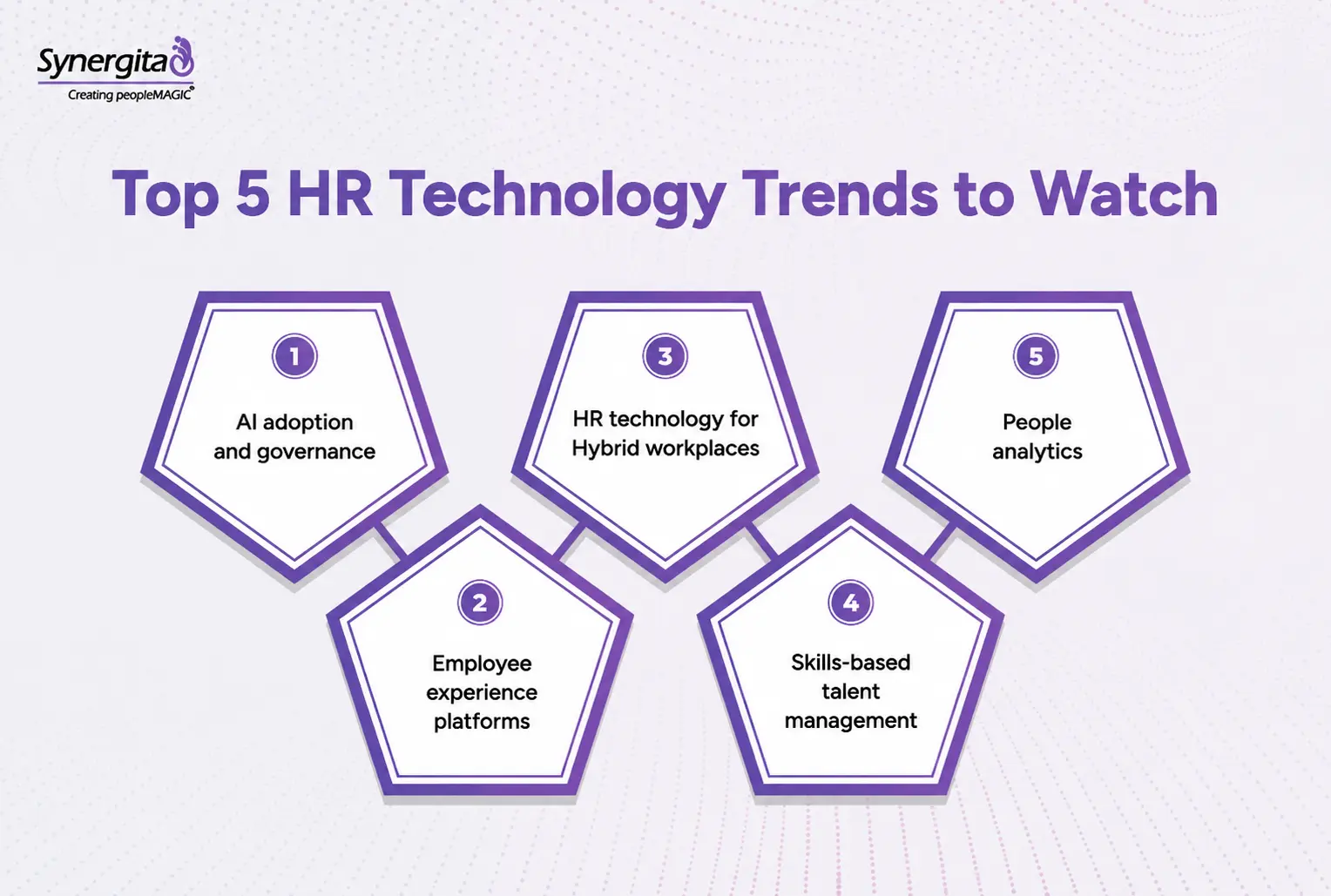
What are the top trends in human resource management in 2026
HR technology connects hiring, performance, learning, and workforce planning into a single platform, giving HR leaders a more complete view of their workforce.
Businesses that use outdated HR applications will find it difficult to generate reliable AI insights because the data remains scattered across systems.
1. AI adoption and governance
Among all current human resource trends, AI adoption is having the greatest impact on recruitment, performance management, and workforce planning.
Employees are increasingly using AI tools in their daily work, commonly ahead of formal policies, while concerns about job displacement remain high. HR leaders must navigate both realities simultaneously.
AI is becoming part of everyday HR operations rather than a standalone productivity tool. For many organizations, the challenge is ensuring AI tools have access to reliable data and operate within governance policies. In 2026, companies are focusing on governing AI use, redesigning workflows, and helping employees work effectively with AI.
Steps to adapt AI in 2026:
- Audit current AI usage: Identify where employees are already using AI tools, formally or informally, and evaluate risks, gaps, and opportunities
- Upskill and reskill continuously: Launch learning programs on AI literacy, prompt engineering, and human-AI collaboration skills.
- Redesign roles and processes: Reframe job descriptions to emphasize uniquely human skills, creativity, critical thinking, empathy, while integrating AI for repetitive tasks
- Create AI governance and guardrails: Develop ethical guidelines, data privacy standards, and usage policies that balance innovation with trust and compliance.
2. Employee experience platforms
A strong employee experience (EX) improves retention, productivity, and organizational culture. According to Gallup’s State of the Global Workplace report, companies with highly engaged employees achieve 23% higher profitability, making employee experience an important factor to business performance.
Modern HR technology helps organizations improve every stage of the employee journey, making experiences more consistent and personalized while strengthening employee retention.
Annual engagement surveys provide a snapshot of employee sentiment, but they do not explain why engagement changes over time. Employee experience platforms support continuous feedback, recognition, and analytics so HR teams can identify trends before they affect productivity or retention.
Suggested Reading: HR’s Guide to Employee Retention
3. HR technology for hybrid workplaces
As hybrid work becomes the norm, HR technology plays a critical role in keeping employees connected, aligned, and productive, regardless of where they work.
Hybrid work remains one of the most significant human resource industry trends because it requires organizations to rethink collaboration, communication, and employee engagement.
Hybrid work technology has expanded beyond video meetings and messaging platforms. Modern HR systems integrate attendance, workspace management, communication, and employee services to give managers better visibility into distributed teams.
Trends that support successful hybrid work
- Unified employee platforms: Bringing communication, HR services, scheduling, and employee information into one platform creates a more consistent experience for distributed teams.
- Employee engagement tools: Pulse surveys, recognition platforms, and feedback tools help HR monitor engagement and maintain stronger connections with remote employees.
- Hybrid workforce management: HR technology helps organizations coordinate attendance, leave, scheduling, and flexible work policies and gives managers better visibility across distributed teams.
4. Skills-based talent management
Recent HR trends emphasize employee skills and capabilities over job titles and years of experience. Modern skills intelligence platforms help companies identify existing capabilities, uncover skill gaps, and connect employees with personalized learning programs.
This improves both hiring and retention. LinkedIn’s Workplace Learning Report found that 94% of employees say they would stay longer at a company that invests in their learning and development.
Steps to build skills-based talent management:
- Skills intelligence: Use AI to identify current workforce skills, uncover gaps, and support workforce planning.
- Internal talent marketplaces: Create systems where employees can be matched to projects, mentoring, and gigs that align with their skills
- Continuous development: Offer microlearning, continuous feedback, and role-specific training tailored to in-demand skills
- Performance alignment: Integrate skills data into performance reviews, promotions, and succession planning
Aligning performance evaluations with role-specific skills helps companies make better development and promotion decisions. For example, Canara Robeco Mutual Fund replaced its one-size-fits-all template with role-based performance templates in Synergita performance management system, allowing sales and non-sales teams to run separate appraisal workflows suited to how each actually works.
5. People analytics
Predictive people analytics shifts HR from reporting past workforce outcomes to anticipating future workforce needs. It uses performance and engagement to forecast attrition, identify skill shortages, measure learning effectiveness, and support more confident workforce planning decisions.
Performance management software simplifies people analytics and brings performance, engagement, and development data into one place. This gives decision-makers better context for workforce planning and development instead of relying on individual observations.
Common applications of people analytics
- Sentiment analysis: Use AI-powered surveys and collaboration tools to monitor employee engagement and workplace well-being.
- Attrition prediction: Identify employees who may be at risk of leaving using engagement data before turnover increases.
- DEI reporting: Monitor hiring, promotion, and pay data to identify potential equity gaps.
- Productivity analysis: Use workflow data to identify collaboration gaps, resource constraints, and operational bottlenecks.
How current HR technology trends are changing the role of HR leaders
By automating routine tasks such as scheduling, compliance management, and payroll processing, HR technology enables leaders to focus on strategic priorities such as workforce planning, employee engagement, and organizational growth. It increases expectations for HR professionals to develop stronger technology and data skills.
Three areas where the change is most visible:
1. Workforce planning
HR leaders can use predictive tools to model headcount needs, spot skill gaps before they become problems, and plan for attrition before it disrupts teams. This kind of forward-looking planning was difficult to do consistently without technology.
For example, Vedanta standardized its performance management using Synergita, giving HR leaders access to performance data that helped better workforce planning and performance reviews.
2. Boardroom influence
When HR can show data on engagement, retention costs, and productivity, leadership takes those insights seriously. Technology makes it possible to link people’s decisions to business outcomes, changing how HR is perceived internally.
3. Risk management
As organizations adopt AI tools for hiring and performance management, HR leaders have to think carefully about bias, privacy, and regulatory compliance. Managing that complexity is now part of the job description.
Best practices for implementing technology for human resources management
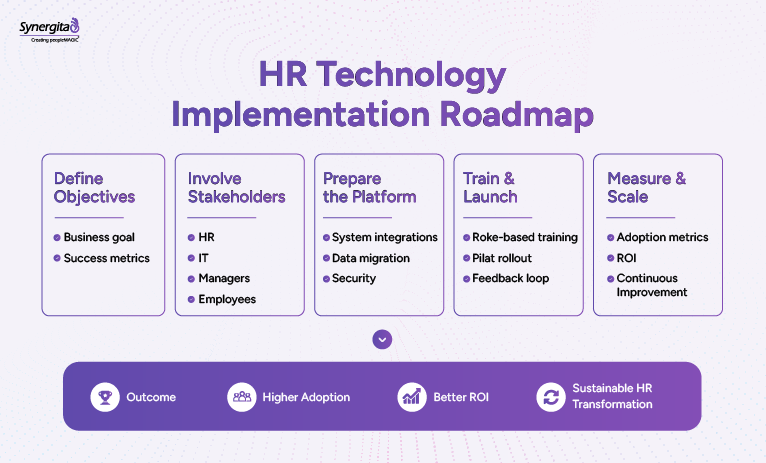
The success of HR technology depends as much on implementation as it does on the software itself. These best practices help address the common challenges that often prevent successful adoption.
1. Define clear objectives
Before adopting any HR technology, identify the specific problem you are solving, whether it is improving recruitment speed, reducing attrition, or streamlining payroll. Clear objectives make it possible to measure ROI and keep the implementation focused.
2. Involve stakeholders early
Engage HR teams, managers, IT departments, and employees in the decision-making process. Their input helps identify real pain points, ensures the solution fits actual workflows, and increases buy-in before the rollout begins.
3. Provide comprehensive training
Even the best technology fails without proper adoption. Conduct hands-on training sessions, create role-specific user guides, and offer ongoing support so employees and managers can use the tools without friction.
4. Prioritize integration
Select HR technology that integrates seamlessly with existing payroll, learning management, and performance management systems.
Integrated HR technology improves reporting, reduces manual work, and provides a single source of data. Learn how integrated HR technology helps organizations streamline HR operations and improve decision-making.
5. Start small and scale gradually
Pilot new technology in one department or function before rolling it out company-wide. Collect feedback, refine the process, and make adjustments before the stakes get higher.
Final takeaway
HR technology has become a core part of how organizations hire, develop, manage, and retain their workforce. Organizations that use insights from data in hiring, performance, learning, and employee development can respond faster to changing business needs than those that rely on outdated HR tools.
Companies adopting the latest HR technology trends need a platform that provides goal management, performance reviews, skills intelligence, continuous feedback, and people analytics in one place.
Synergita helps HR teams do exactly that, enabling better workforce decisions through an integrated performance management platform. Book a demo to see how it works.
Frequently asked questions
The new trends in human resource management include AI adaptation, people analytics, skills-based talent management, employee experience platforms, and hybrid work technology. These HR trends help organizations improve workforce planning, employee engagement, and business performance.
HR technology is software and digital tools that automate human resource functions such as recruitment, payroll, performance management, learning, employee engagement, and workforce analytics. Modern human resource technology improves efficiency and supports data-driven HR decision-making.
AI is used in HR to automate candidate screening, schedule interviews, personalize employee learning, predict attrition risks, analyze performance data, and improve talent management. AI enables faster, more accurate, and data-driven HR decisions.
AI in HR can introduce bias, raise data privacy concerns, and lack human judgment in sensitive situations. Organizations should combine AI with human oversight to ensure fair, ethical, and compliant HR practices.
HR technology helps organizations automate routine tasks, improve employee experience, support hybrid work, and make data-driven workforce decisions. It also enables HR leaders to align people’s strategies with business goals more effectively.