
Accountability problems usually don’t appear suddenly. They build quietly through missed follow-ups, unclear ownership, and delayed action, and by the time teams notice, the impact is already affecting results.
TL;DR — The 30-Second Takeaway
The Problem: Employees are disengaged at work, and a lack of accountability is one of the top reasons. When no one takes ownership of results, progress slows down.
The Reality: Accountability in the workplace is about meeting expectations, setting measurable goals, taking ownership, and ensuring consistent follow-through.
The Fix: The OKR framework helps organizations create accountability through transparent goals, measurable progress tracking, regular reviews, and continuous feedback.
| Table of Contents 1. Why Accountability is Important for Business Performance 2. How Employees, Managers, and Leaders Practice Accountability 3. How the OKR Framework Improves Accountability at Work 4. Best Practices for Setting and Using OKRs Effectively 5. How to Create an Accountability Culture in the Workplace 6. How OKR Platforms Increase Accountability 7. Final Takeaway 8. Frequently Asked Questions |
A recent report shows that only 29% of employees strongly agree that their performance is managed in a way that motivates them to do outstanding work. When expectations, ownership, and follow-through are not clear, it impacts the accountability.
So, what does accountability at work actually mean?
It means people take ownership of their work, follow through on commitments, and understand how their efforts support larger business goals.
When accountability becomes part of how a team operates, you don’t need to tell people what to do. They understand expectations, track progress consistently, and raise concerns early when something goes off track.
Why Accountability is Important for Business Performance
Accountability improves business performance by helping teams meet deadlines, take ownership, reduce confusion, improve productivity, and keep everyone aligned toward shared business goals.
Poor accountability affects much more than individual productivity.
Over time, it creates execution gaps that impact team performance, customer experience, deliver timelines and business growth. When accountability is weak:
- Deadlines are missed without clear explanations
- Managers spend time chasing updates
- Cross-functional collaboration slows down
- High performers burn out covering for others
- Small execution issues become large operational risks
This is why creating accountability in the workplace is a must, as execution quality, employee engagement, and organizational performance depend on it.
Gallup research shows employees held accountable by their manager are 2.5 times more likely to be engaged at work. When accountability is handled properly, it boosts engagement and productivity.
How Employees, Managers, and Leaders Practice Accountability
Accountability works differently at each level of an organization. Here’s how accountability looks across different roles and responsibilities.
1. Employees
For employees, accountability means owning your work from start to finish, not just completing tasks, but communicating early when something is at risk.
- Update OKR progress without waiting to be asked.
- Flag blockers before they become delays.
- Take responsibility for outcomes, not just effort.
- Follow through on commitments made in team check-ins.
2. Managers
Managers set the standard for accountability on their teams. When a manager avoids difficult conversations or ignores missed deadlines, the team starts treating that behavior as normal.
- Set clear, measurable expectations at the start of every cycle.
- Run consistent OKR check-ins (weekly or bi-weekly), not just at quarter-end.
- Address execution gaps early, not in the annual review.
- Recognize follow-through publicly, so accountability becomes the norm.
3. Leaders
Leadership accountability sets the tone for the entire organization. When leaders own their OKRs openly, including misses, it gives everyone else permission to do the same.
- Make company-wide OKRs visible to everyone in the organization
- Show transparency by openly sharing both successes and challenges during all-hands meetings
- Include accountability in regular performance discussions, not just in company culture presentations
- Use OKR software to keep leadership goals visible alongside employee goals
When accountability is practiced at all three levels, it becomes the way the organization naturally operates.
How the OKR Framework Improves Accountability at Work
The Objectives and Key Results (OKR) framework is one of the most effective tools for building accountability into day-to-day work. Here is how OKR improves accountability.
1. Clear Ownership: OKRs define who is responsible for each outcome, reducing confusion around priorities and accountability.
2. Measurable Outcomes: Key Results turn broad goals into measurable outcomes, so teams have a clear idea of the success metrics.
3. Progress Tracking: Regular check-ins and OKR tracking ensure timely execution that helps teams stay aligned throughout the cycle.
4. Early Identification of Blockers: Managers can quickly spot delays, performance gaps, or resource issues before they affect business goals.
5. Alignment with Business Priorities: OKRs connect day-to-day work with larger company objectives, helping teams focus on the most important outcomes.
Suggested Reading: Top OKR Tracking Techniques for Managers
Best Practices for Setting and Using OKRs Effectively
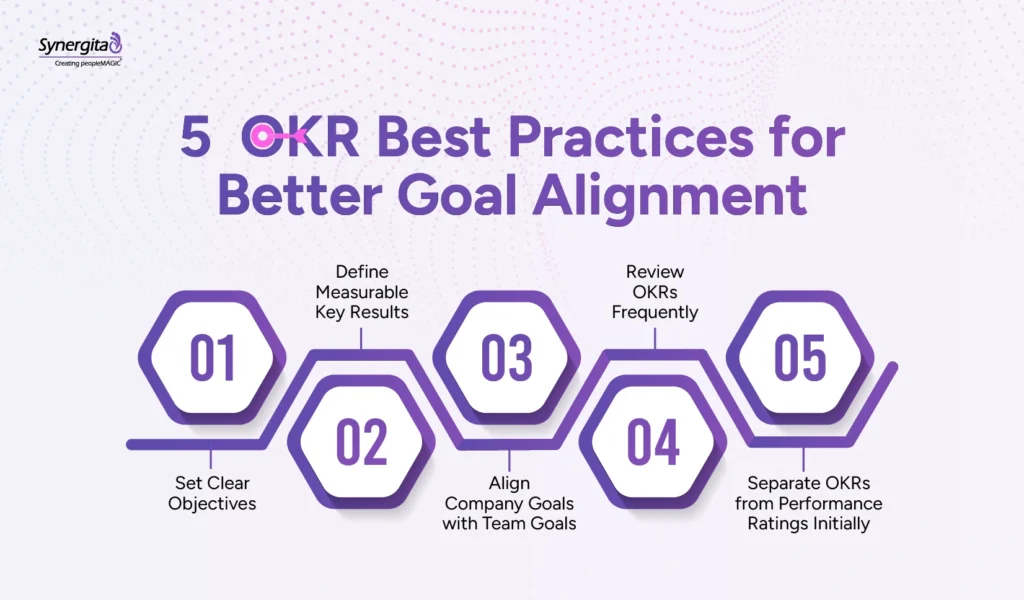
Strong OKRs improve accountability culture by giving teams clear direction and measurable outcomes. Here are the key OKR best practices businesses can follow.
1. Set Clear Objectives
Improving customer satisfaction is too broad. For example, “Become the top-rated product in our category by Q4” gives teams a clear target to work toward.
2. Define Measurable Key Results
If you can’t measure it with numbers, it’s a task, not a Key Result. Good examples include “Increase NPS from 32 to 50” or “Reduce response time from 4 hours to 1 hour”.
3. Align Company Goals with Team Goals
Company OKRs define the direction. Team and individual OKRs support those goals. When everything aligns, people clearly understand how their work contributes to business success.
4. Review OKRs Frequently
OKRs reviewed only at quarter-end are just performance reviews with extra steps. Review OKRs weekly or bi-weekly to spot issues before they grow bigger.
5. Separate OKRs from Performance Ratings
If people think missing an OKR will affect their review, they’ll start setting safe and easy goals. OKRs should be ambitious, which means some will be missed, and that’s fine.
How to Create Accountability Culture in the Workplace
Creating accountability in the workplace requires more than just assigning tasks. Your teams need clear expectations, progress tracking, and regular follow-through to stay aligned and responsible for outcomes. Here are some important tips to build accountability across teams:
- Set measurable expectations so employees understand what they are responsible for.
- Review progress consistently through regular check-ins, OKR reviews, and status updates.
- Encourage transparent communication so teams raise blockers, risks, and delays early.
- Address blockers quickly by helping teams resolve dependencies, resource gaps, or execution challenges.
- Make goals visible across teams to improve alignment, ownership, and collaboration across departments.
- Use OKR platforms for continuous tracking to create real-time visibility into progress and execution risks.
How OKR Platforms Increase Accountability
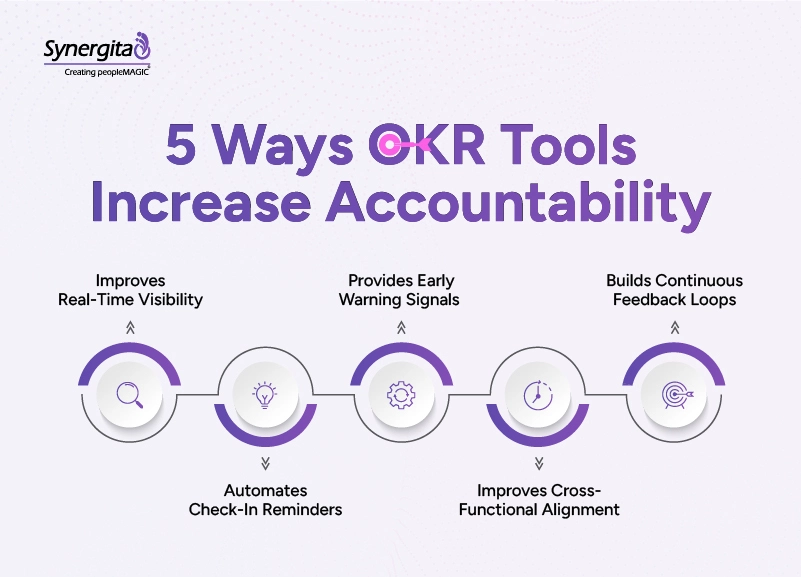
OKR tools help in creating accountability across the organization. Here’s how they improve it.
1. Real-time Visibility
Everyone, from employees to leadership teams, can clearly see what’s progressing and what’s falling behind.
2. Automated Check-in Reminders
Instead of managers constantly following up, the platform reminds team members to update their progress.
3. Early Warning Signals
When a key result remains off track for weeks, managers can spot it early and take action quickly.
4. Cross-functional Alignment
OKR platforms connect team goals to company goals, helping people understand the impact of their work.
5. Feedback Loops
OKR platforms allow managers to provide continuous feedback instead of quarterly reviews to ensure accountability as part of everyday work.
Modern OKR platforms like Synergita help organizations maintain accountability by helping them to set AI-powered OKRs, structured tracking, and continuous feedback.
Suggested Reading: 10 Key Benefits of Using OKRs Software
Final Takeaway
Accountability in workplace culture is one of the strongest predictors of execution quality and long-term business performance. But accountability does not happen automatically.
Without clear goals, measurable progress tracking, and consistent visibility, even high-performing teams can lose alignment over time. The OKR framework makes accountability practical.
Try Synergita OKR to improve visibility, strengthen accountability culture, and help teams stay focused on measurable business outcomes.
Frequently Asked Questions
Accountability in the workplace means employees, managers, and leaders take ownership of their responsibilities, follow through on commitments, and accept responsibility for outcomes.
For employees, accountability means meeting deadlines, communicating proactively, taking ownership of work, and accepting responsibility for results.
Taking accountability means acknowledging mistakes, communicating openly, and actively solving problems instead of avoiding responsibility.
OKR platforms improve accountability by creating visibility into goals, progress, ownership, and execution risks through real-time tracking and continuous feedback.
Good accountability goal Examples include:
Reduce customer churn from 8% to 4%
Improve project delivery timelines by 30%
Resolve 95% of customer tickets within 24 hours
Managers use OKRs to define expectations, track measurable progress, identify blockers early, and improve team alignment.
Accountability of managers refers to their responsibility for leading teams, ensuring tasks are completed on time, providing clear expectations, and taking ownership of their team’s success or failure.
Accountability of employees means taking responsibility for their assigned tasks, ensuring their work contributes to the team’s goals, and being proactive in communicating challenges and updates.